Description
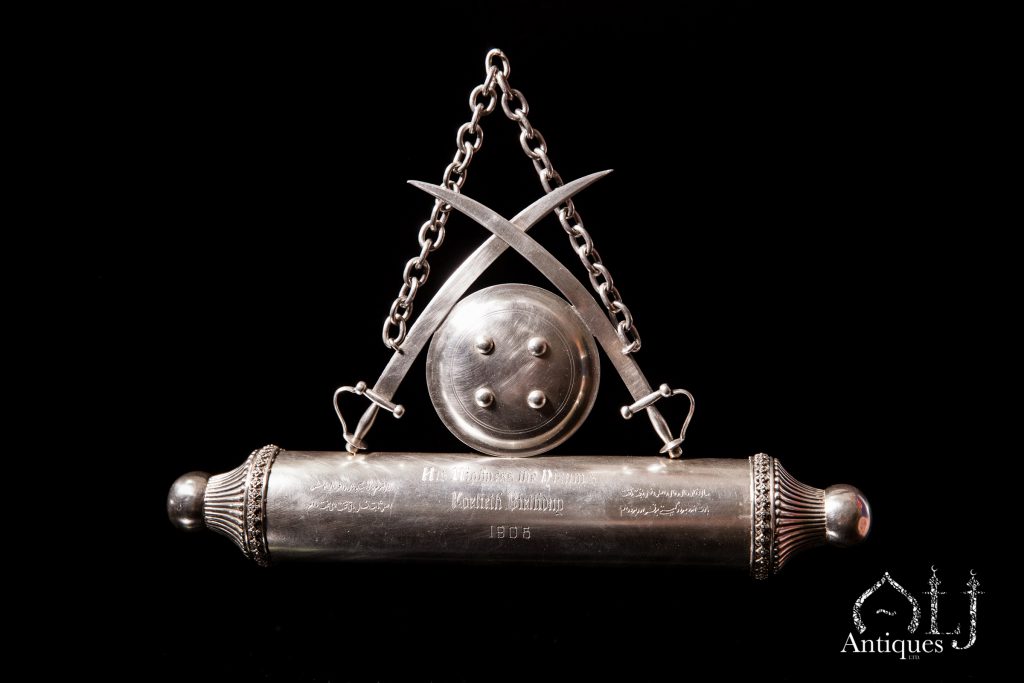
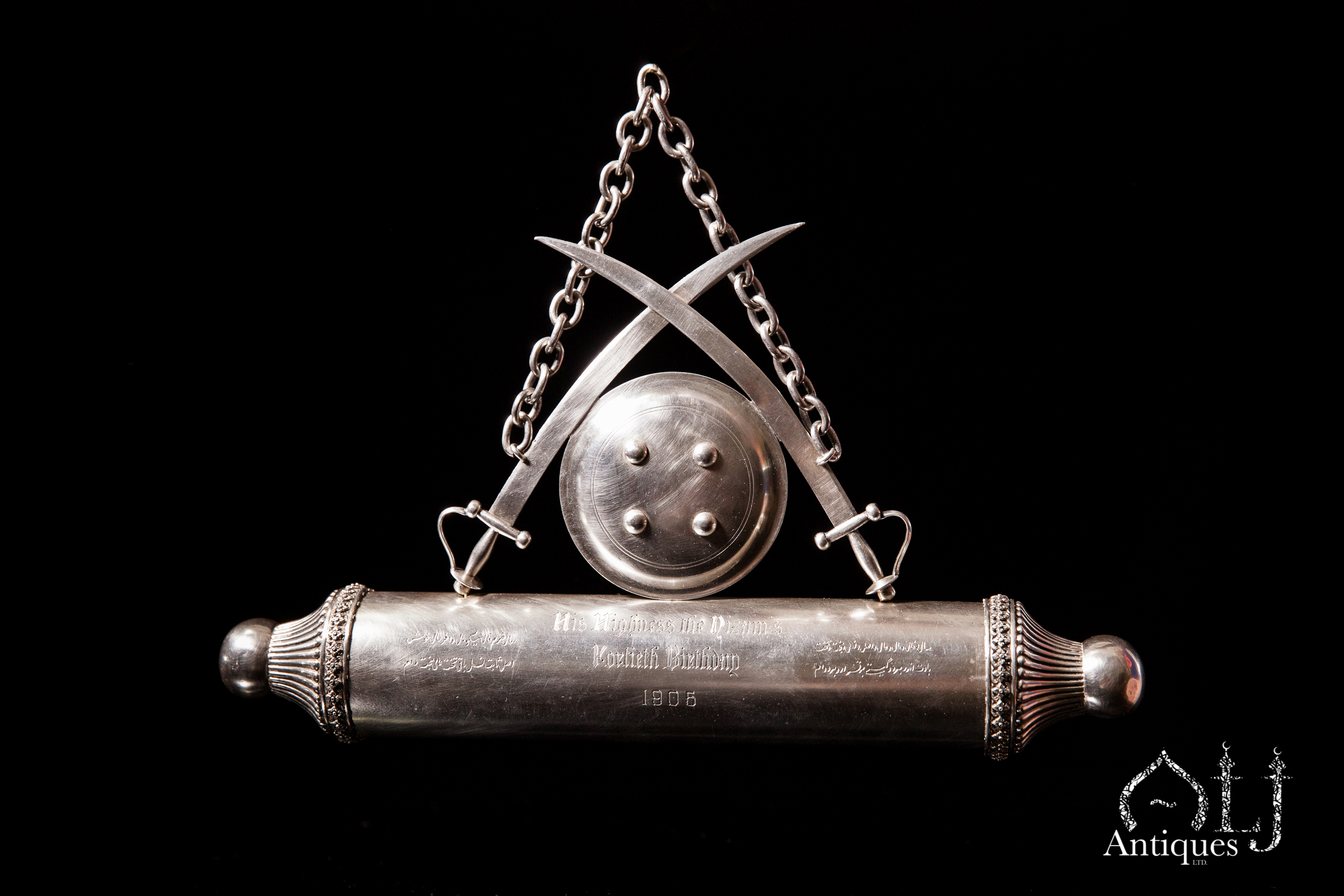
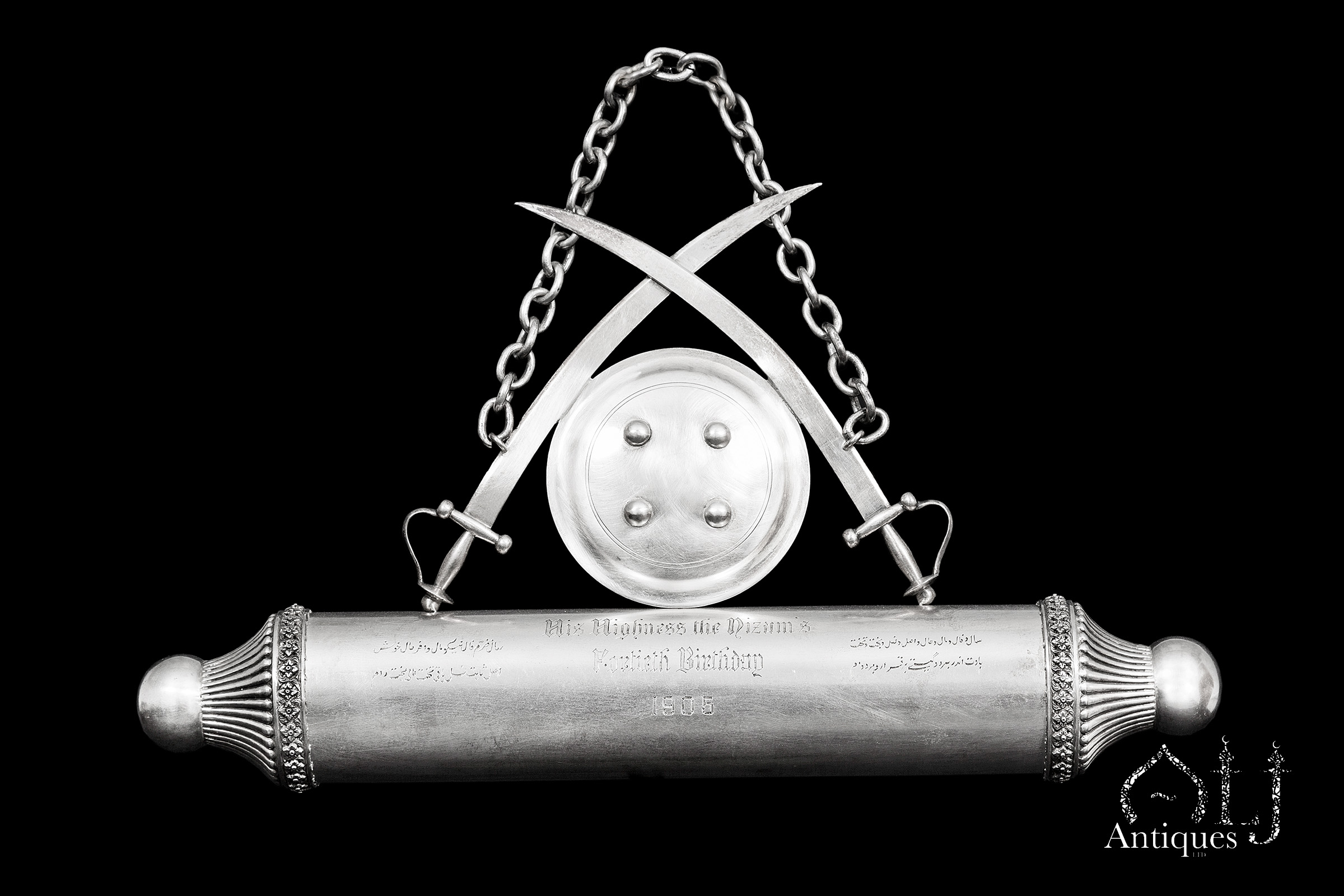
An important and historically significant Indian silver royal presentation scroll container, made for His Highness Mir Mahboob Ali Khan Siddiqi, Asaf Jah VI (1866–1911), the Sixth Nizam of Hyderabad, and dated 1905.
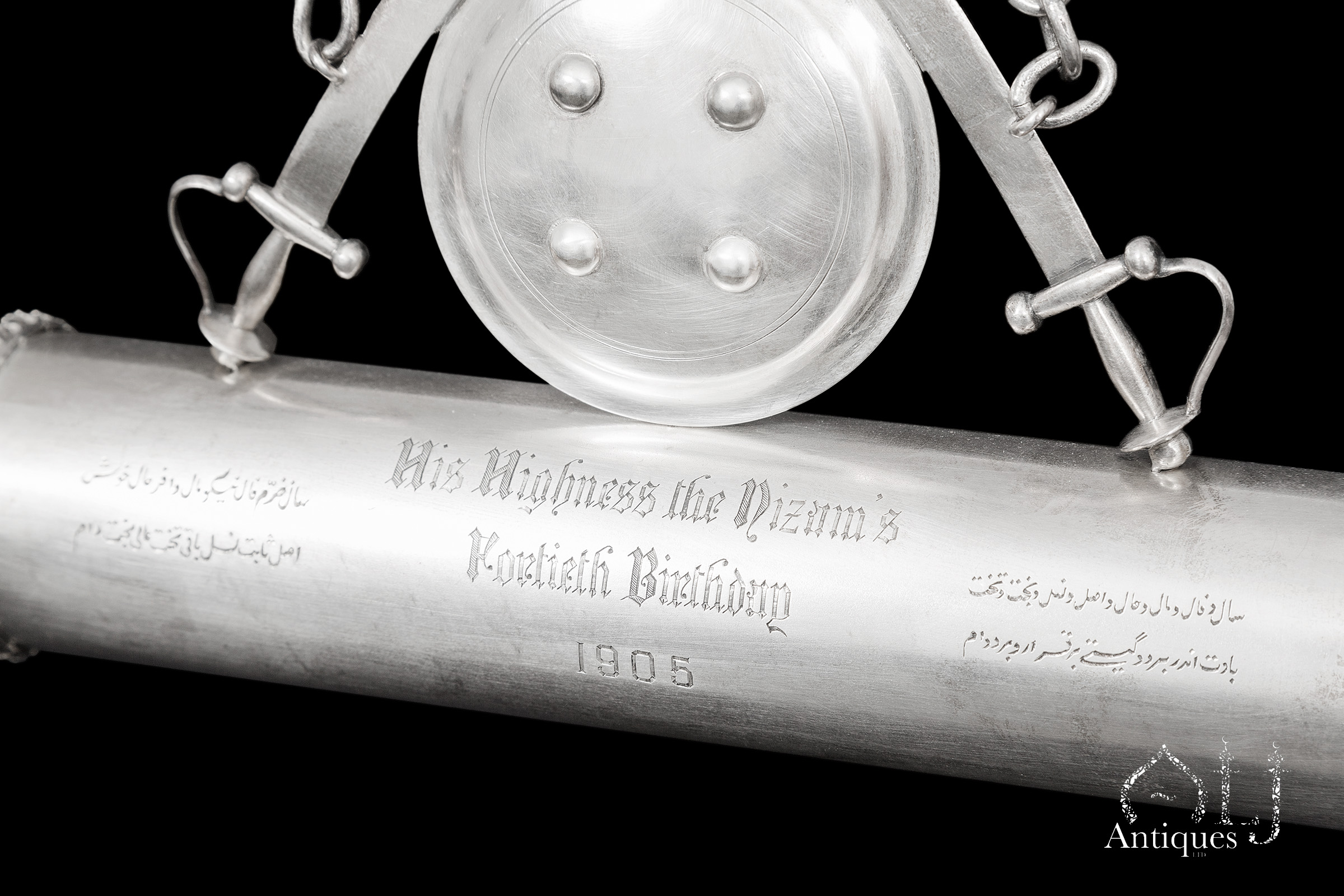
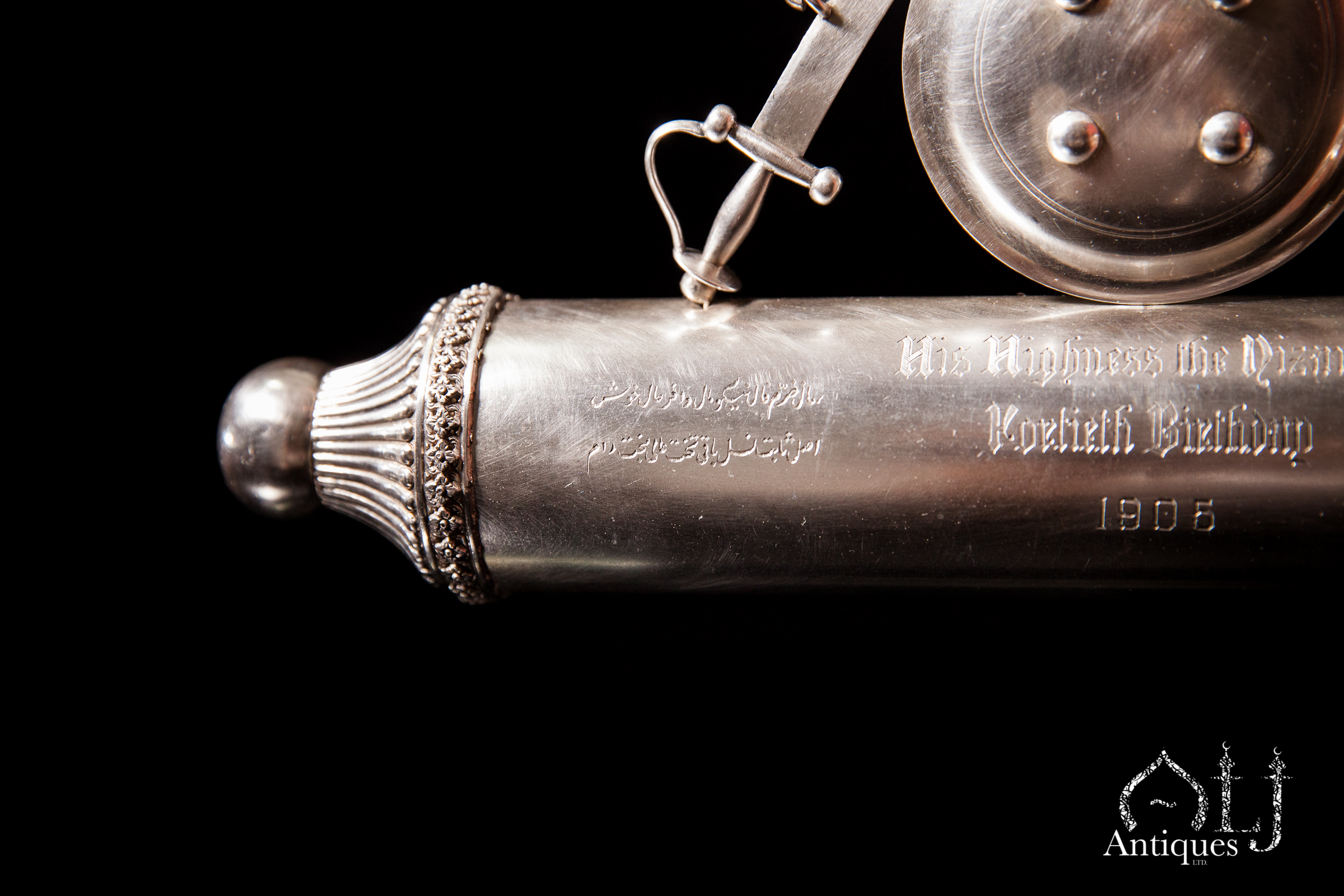
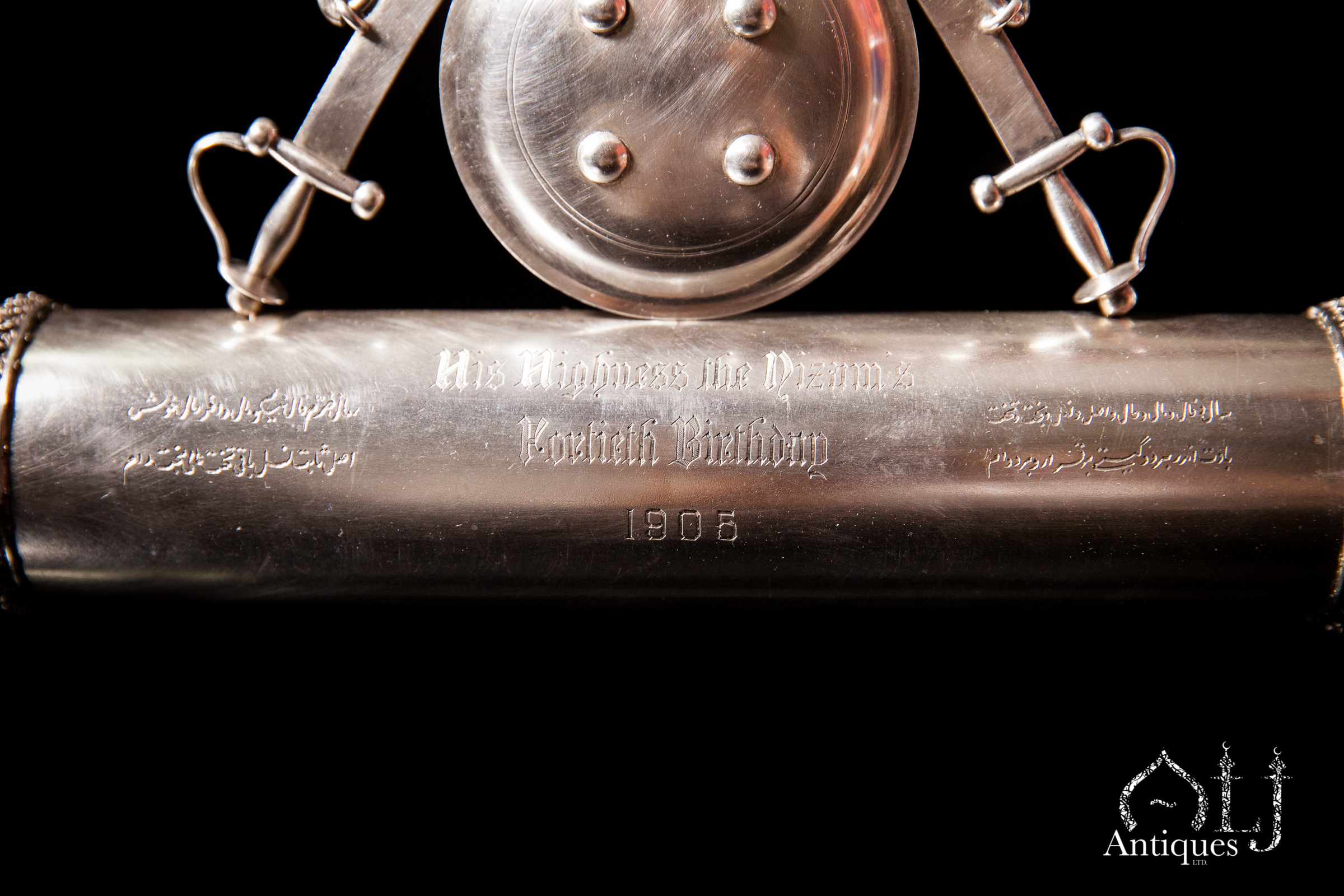
The identity of the intended recipient is established by the prominent English presentation inscription engraved upon the cylindrical silver body:
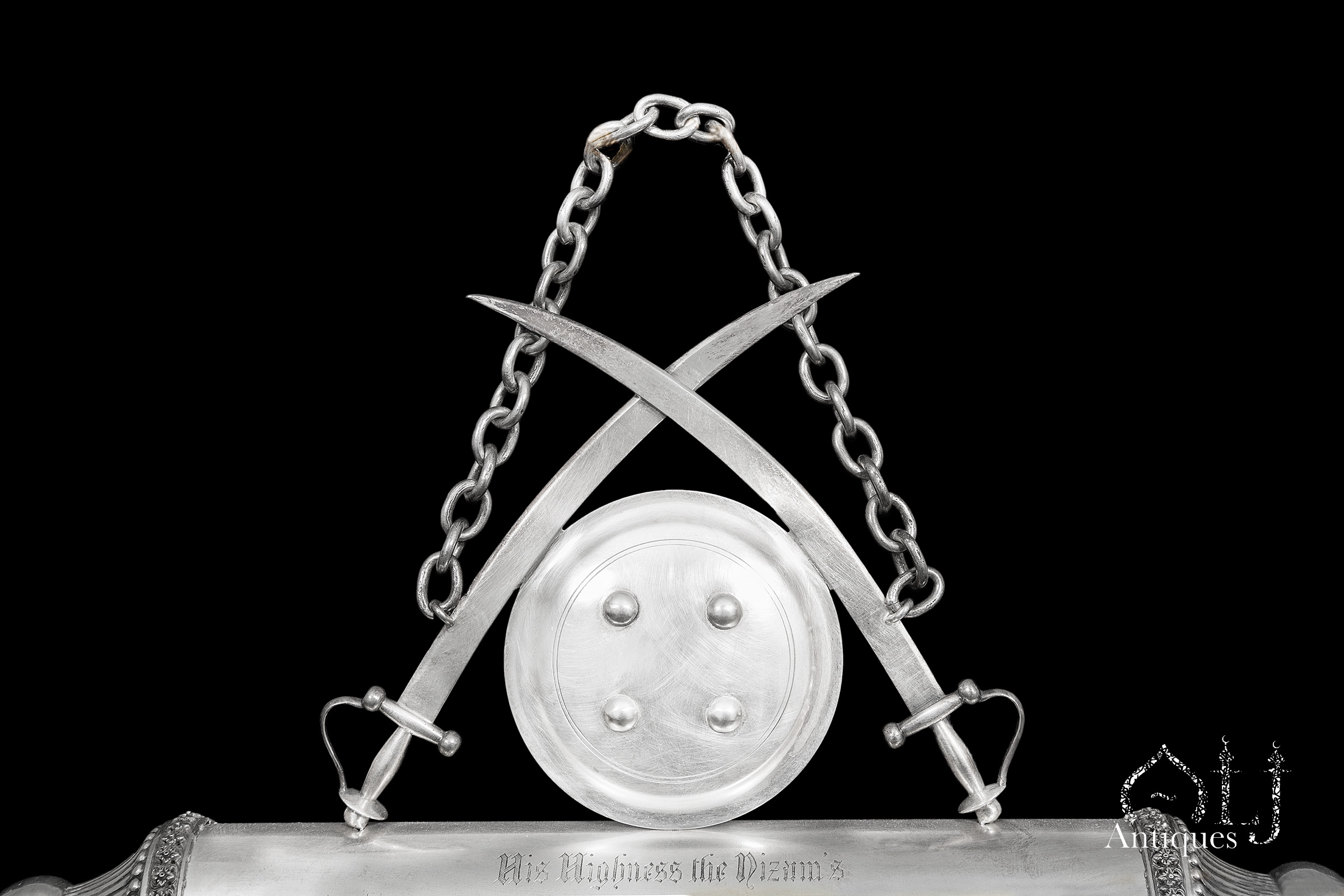
“His Highness The Nizam’s
Fortieth Birthday
1905”
At the date engraved upon the object, the reigning sovereign of Hyderabad was Mir Mahboob Ali Khan, Asaf Jah VI, who succeeded to the throne in 1869 and ruled until his death in 1911.
The Asaf Jahi Nizams of Hyderabad presided over one of the largest, wealthiest and most prestigious princely states of the Indian subcontinent. The Hyderabad court was renowned for the extraordinary richness of its treasury and for its patronage of jewellery, precious stones, gold and silver objects, arms, textiles and the decorative arts.
The present object should therefore be understood within this exceptionally wealthy and sophisticated environment of royal patronage, ceremony and gift-giving.
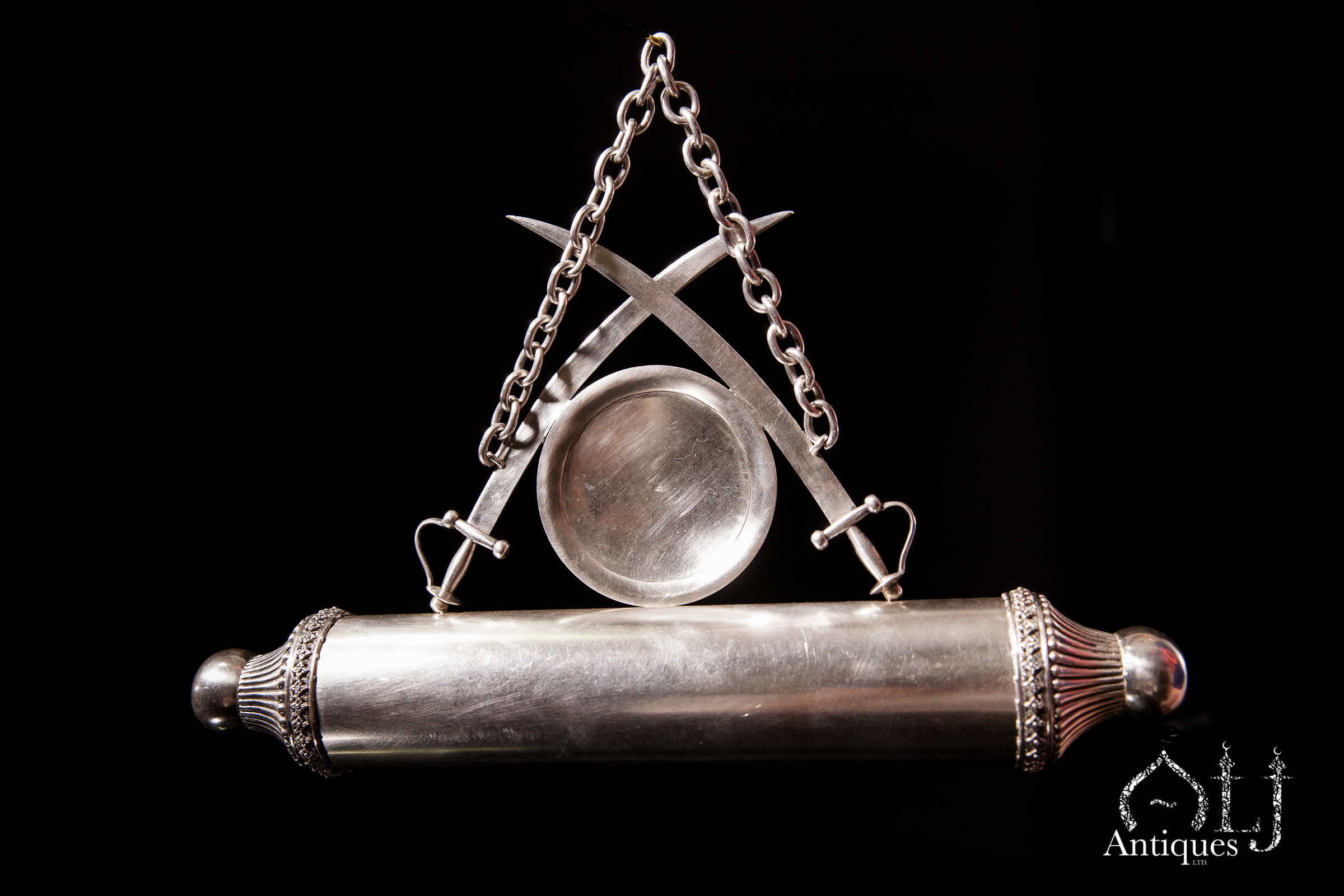
The container is of elongated cylindrical form, suspended from a substantial silver chain. Its principal body is comparatively restrained in decoration, allowing particular prominence to be given to the engraved inscriptions and the richly worked terminal sections.
Applied above the cylinder is a striking martial device comprising two crossed curved swords or talwars and a circular shield with four raised bosses. The combination of crossed swords and shield is particularly appropriate to a princely presentation, evoking martial strength, authority and sovereignty.
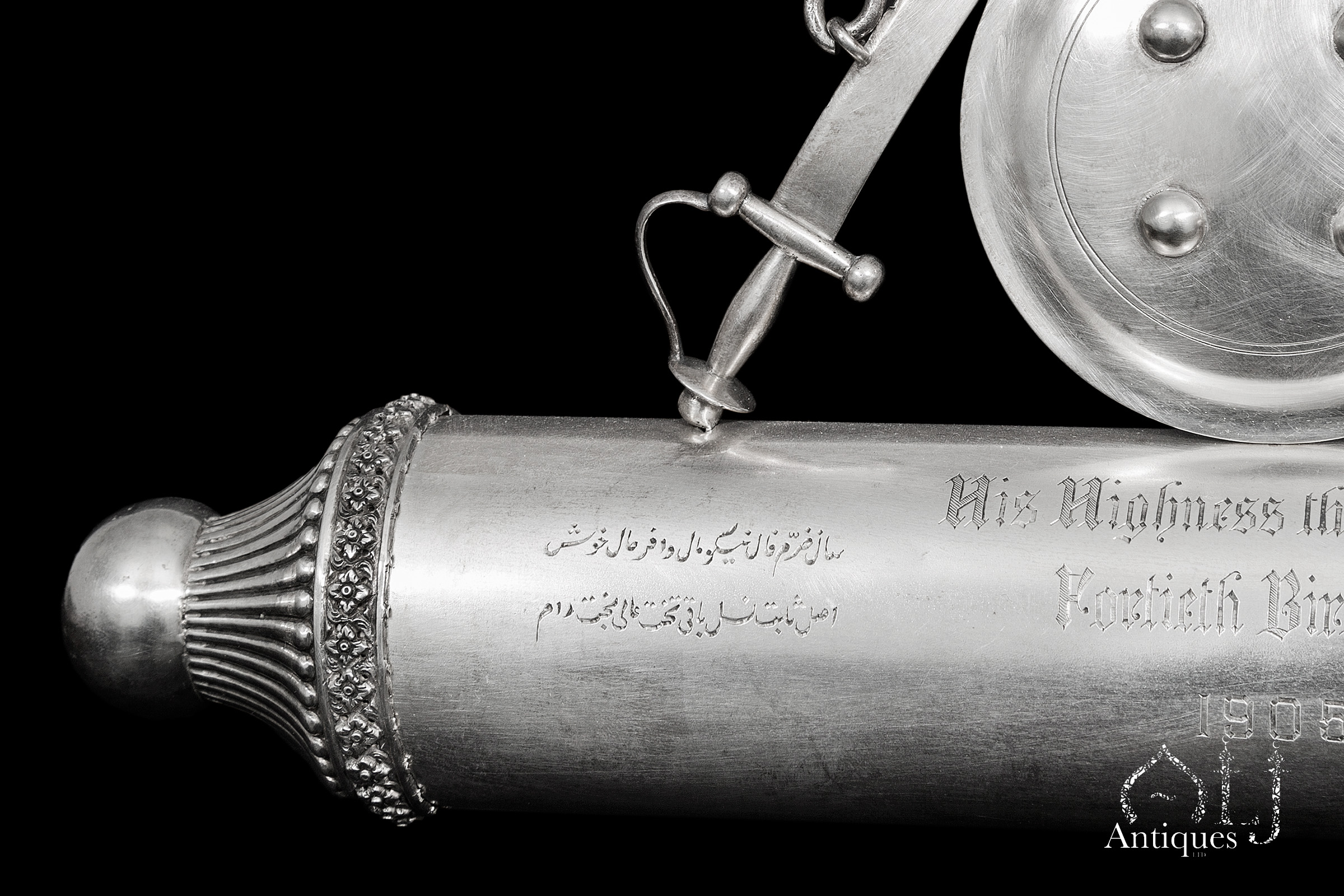
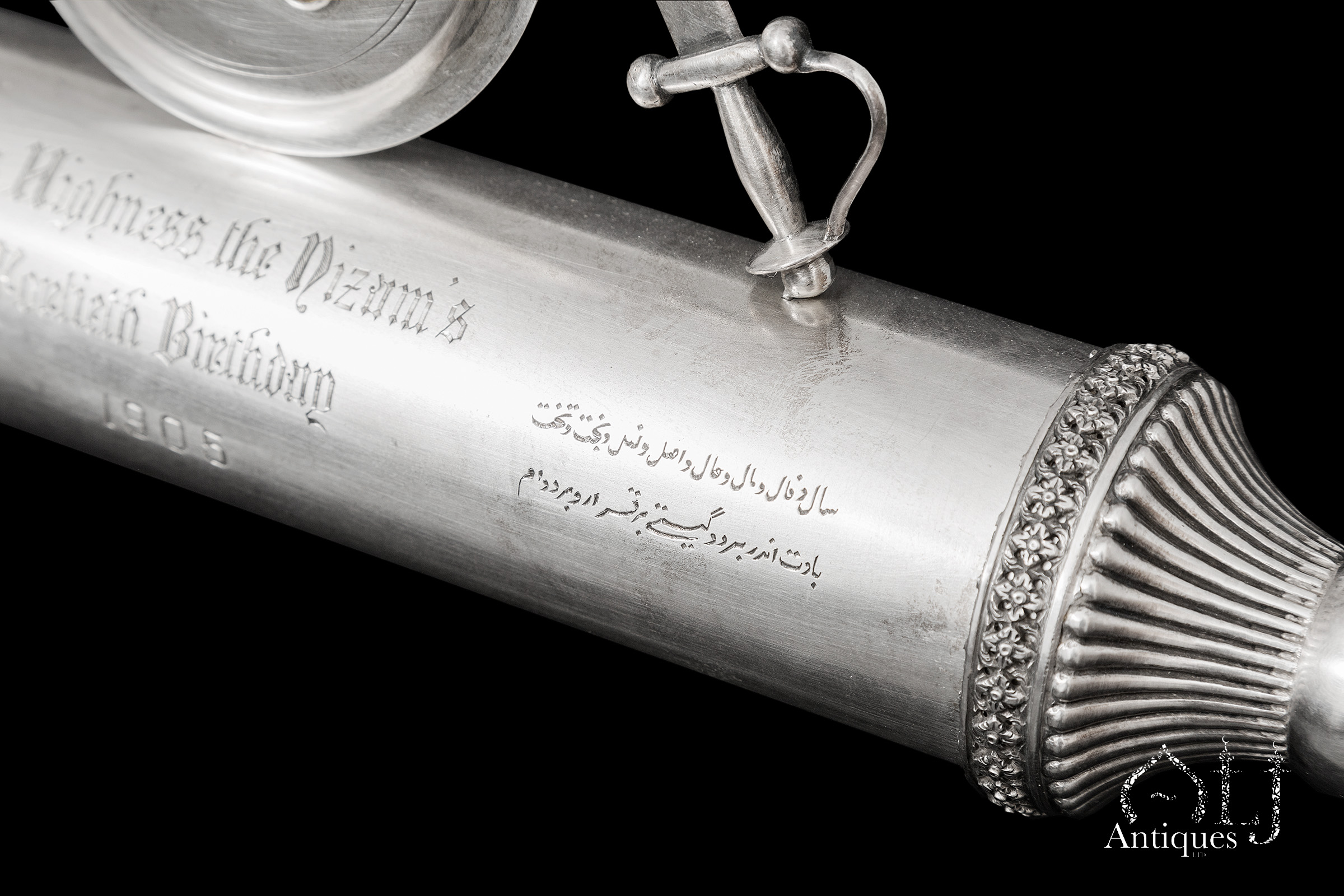
Both ends of the container are considerably more elaborate. Narrow floral borders lead to deeply worked repoussé terminal sections, each terminating in a rounded finial. The radiating ornament has the distinctive appearance of stylised lotus petals.
The repoussé technique, floral borders and pronounced lotiform character of these terminals invite comparison with the precious-metal traditions of South India, particularly those associated with Thanjavur (Tanjore).
It is therefore possible that, although the container was commissioned for presentation at the Hyderabad court, its silverwork was executed by a South Indian silversmith, perhaps a Hindu craftsman trained in or influenced by the Thanjavur tradition.
The Persian Poetic Inscription
Of particular importance are the four lines of poetry engraved upon the cylindrical body.
Although the inscription might initially be described as Urdu because of the Perso-Arabic script and its Hyderabad context, the language of the poem itself is Persian.
The four lines are not independent or unrelated blessings. Read in their proper sequence, beginning from the right-hand side of the scroll and proceeding from right to left, they form a connected Persian royal benediction.
The inscription on the present object reads:
سال و فال و مال و حال و اصل و نسل و تخت و بخت
بادت اندر شهریاری برقرار و بر دوام
سال خرم، فال نیکو، مال وافر، حال خوش
اصل ثابت، نسل باقی، تخت عالی، بخت دام
Transliteration
Sāl o fāl o māl o hāl o asl o nasl o takht o bakht
Bādat andar shahriyārī bar-qarār o bar-davām
Sāl khurram, fāl-e nīkū, māl-e vāfir, hāl-e khush
Asl sābit, nasl bāqī, takht-e ʿālī, bakht dām
English Translation
“May your year, fortune, wealth, well-being, lineage, descendants, throne and destiny remain established and enduring throughout your sovereignty;
may your year be joyful, your omen auspicious, your wealth abundant and your condition happy; may your lineage remain firmly established, your descendants endure, your throne remain exalted and your good fortune continue.”
The choice of this particular benediction for a presentation to the Nizam was highly appropriate and almost certainly deliberate. Its carefully balanced sequence invokes the principal blessings associated with successful kingship: a prosperous year, favourable fortune, abundant wealth, personal well-being, continuity of lineage, enduring descendants, an exalted throne and lasting sovereignty.
The inscription therefore performs a considerably greater function than simple ornament. It is effectively a literary prayer for the Nizam himself, his descendants, the continuation of the Asaf Jahi dynasty and the permanence and prosperity of his throne.
The Literary Source and its Connection with Hafez
The inscription is of particular literary interest because it derives from a celebrated Persian royal benediction traditionally included in the Dīvān of Hafez of Shiraz, amongst the Qiṭʿāt, as Qiṭʿa no. 21.
It is important, however, to distinguish between the inscription as actually engraved upon the present object and the standard published literary text. The wording above records the object itself, including the readings برقرار — bar-qarār and, in the final phrase, بخت دام — bakht dām.
The standard published version traditionally attributed to Hafez concludes instead with بخت رام — bakht rām. The present object’s variant should not be silently “corrected” to conform to the literary edition; it is part of the historical inscription and should therefore be preserved in the catalogue transcription.
The authorship of the original poem is itself not entirely straightforward. A closely related form of the same royal benediction occurs in the poetry of the earlier Persian court poet Amir Muʿizzi, whose Qaṣīda no. 311 contains the closely corresponding sequence of blessings concerning wealth, well-being, year, fortune, lineage, descendants, throne and destiny.
The safest scholarly description is therefore:
“The inscription derives from a celebrated Persian royal benediction traditionally included in the Dīvān of Hafez of Shiraz as Qiṭʿa no. 21, with a closely related form also transmitted in the poetry of the earlier Persian court poet Amir Muʿizzi. The wording engraved upon the present object contains minor variants from the standard published text.”
The literary choice is especially meaningful in the context of Hyderabad. Persian had occupied an important position within the literary, administrative and courtly culture of the Deccan for centuries. The juxtaposition on the present object of a classical Persian royal benediction with the English presentation inscription “His Highness The Nizam’s Fortieth Birthday 1905” provides a particularly evocative expression of the cosmopolitan character of the Hyderabad court at the beginning of the twentieth century.
Taken together, the explicitly dated royal dedication, classical Persian poetry, crossed talwars and shield, lotus-derived repoussé decoration and precious silver construction make the present scroll container an important surviving document of Asaf Jahi court culture, royal patronage and ceremonial gift-giving in early twentieth-century Hyderabad.