
Description
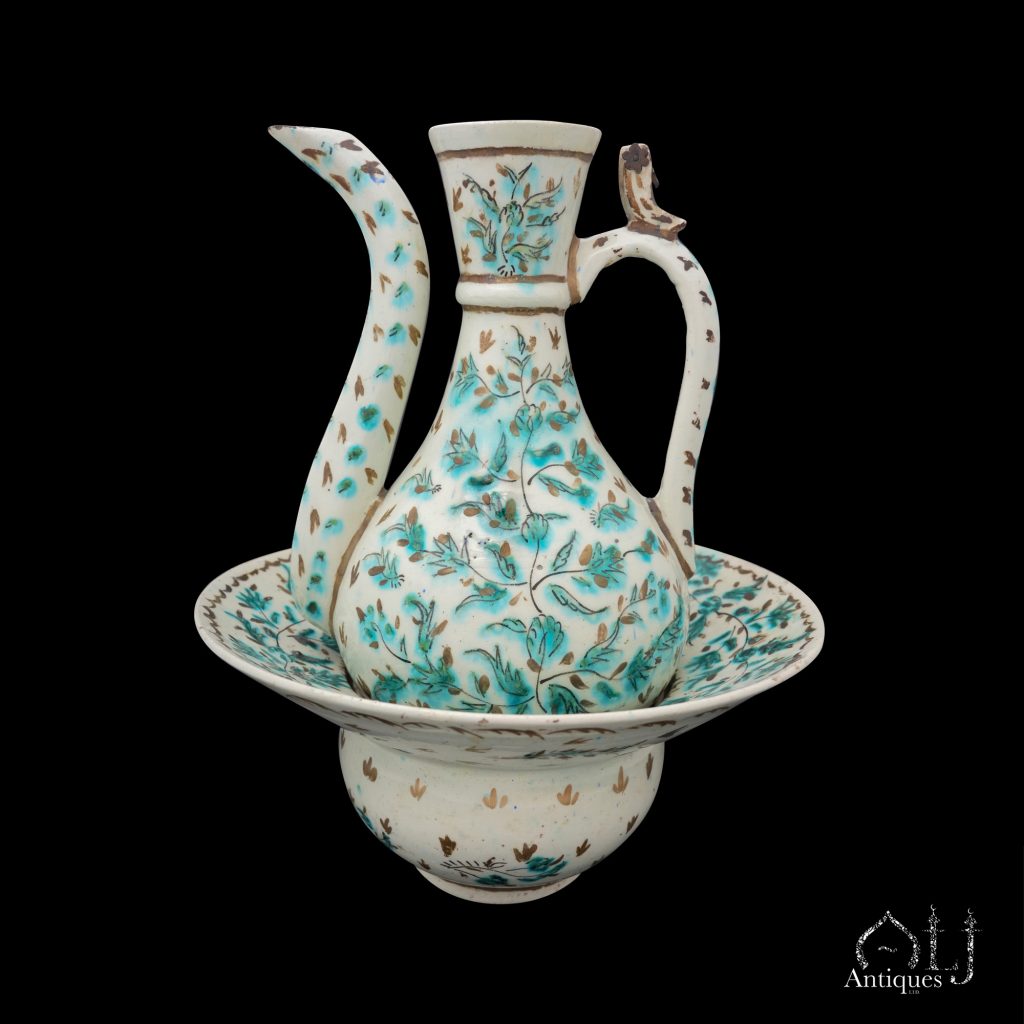
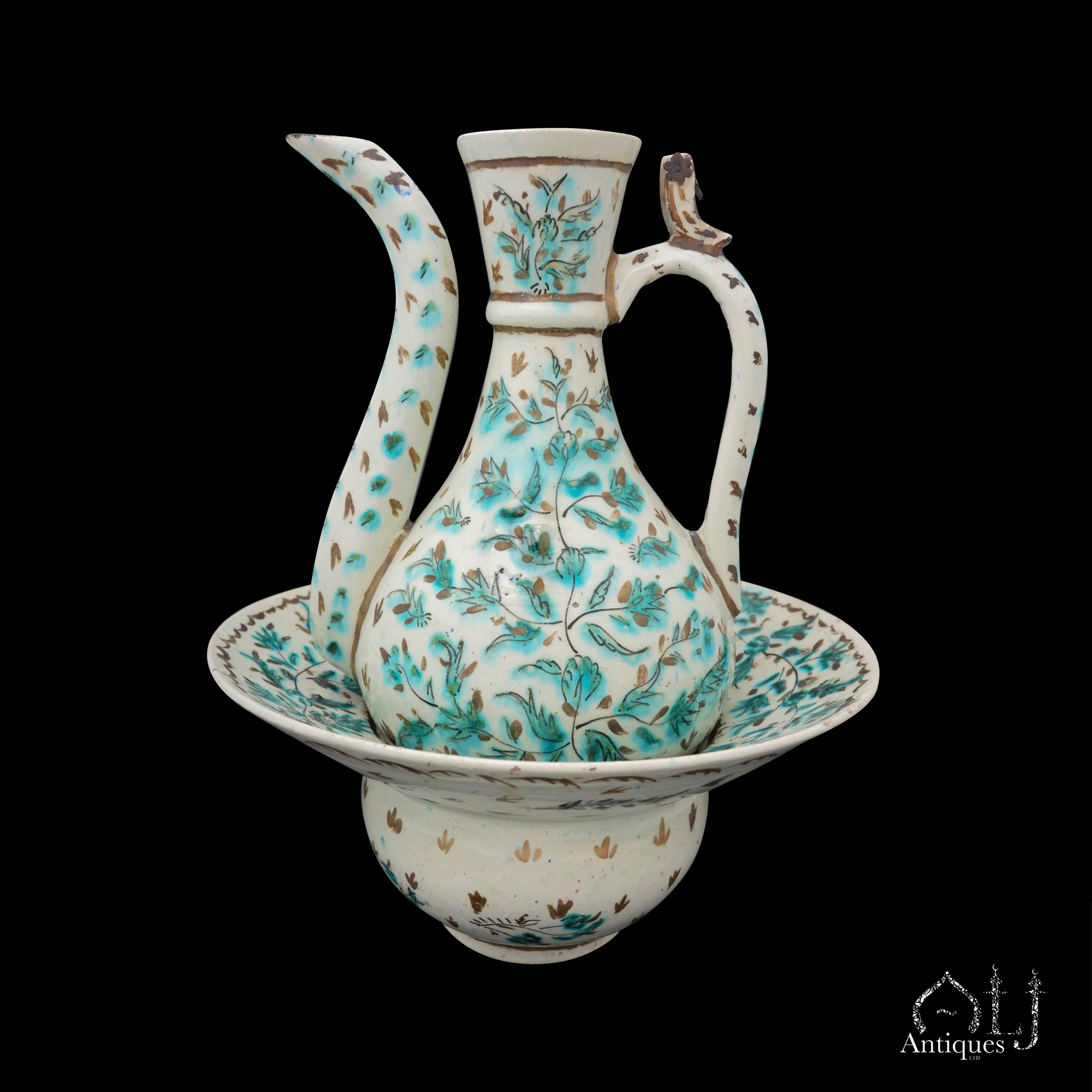
This exceptional and remarkably rare Ottoman Kütahya pottery hand-washing set (İbrik ve Leğen), produced by the Armenian potters of Kütahya during the second half of the eighteenth century, is a rare and important surviving example of Ottoman domestic ceramic art. Complete eighteenth-century Kütahya ewer and basin sets are considerably rarer than their nineteenth-century counterparts and seldom survive together, making the present example an especially significant and highly desirable collector’s piece.
The set comprises a beautifully proportioned pear-shaped ewer (İbrik) with a tall cylindrical neck, elegant loop handle terminating in a graceful scroll, a long tapering spout strengthened by an openwork triangular support, and a spreading circular foot. Characteristic of Ottoman ewers, the spout rises almost to the same height as the neck opening, creating the balanced and elegant silhouette that became one of the defining features of Ottoman ibriks from the seventeenth century onwards. This refined form clearly derives from contemporary Ottoman examples produced in brass, copper, silver and gilt-copper (tombak), demonstrating how the potters of Kütahya successfully translated prestigious Ottoman metal forms into ceramic.
The accompanying Leğen is of broad circular form with a deep central well raised upon a high footring, perfectly designed to receive the ewer when not in use. The form closely corresponds with earlier surviving Kütahya basins preserved in museum collections and published literature, many of which have unfortunately lost their accompanying ewers through time or Vise versa. The survival of the present basin together with its original matching ewer is therefore particularly significant, preserving the complete functionality and visual integrity of the traditional Ottoman İbrik ve Leğen as originally intended.
The present set belongs to the Ottoman tradition of the İbrik ve Leğen, the ceremonial ewer and basin used for pouring water over the hands before and after meals, for personal washing, and for performing ablutions (abdest / wudu) in preparation for the Islamic prayers. Throughout the Ottoman Empire these elegant services formed an essential part of both domestic hospitality and religious life. Unlike many Persian washing services, which generally comprise a three-piece arrangement consisting of an ewer, a pierced strainer and a basin, Ottoman examples are characteristically conceived as a two-piece service, with the ewer resting directly within the basin. This practical arrangement became a hallmark of Ottoman domestic life and was faithfully adopted by the potters of Kütahya in ceramic.
The decoration is entirely floral and vegetal, painted beneath a clear glaze upon a creamy white fritware body in the characteristic palette of eighteenth-century Kütahya pottery. Freely painted scrolling branches, leafy stems, stylised floral sprays and delicate ornamental motifs are rendered in turquoise, cobalt blue, emerald green, manganese-black outlines and restrained iron-red accents. Rather than striving for courtly refinement, the decoration possesses the lively, spontaneous and charming character that distinguishes much of the finest Armenian Kütahya pottery. Its expressive brushwork and slightly naïve interpretation give the set warmth, individuality and considerable decorative appeal.
Particularly attractive are the surviving traces of overglaze gilding, now softly faded and naturally mellowed through age and use. These subtle gilded highlights originally enriched the floral decoration and demonstrate that this was intended to be a more luxurious domestic object. The restrained palette, expressive brushwork and informal vegetal ornament closely relate to contemporary Kütahya rosewater sprinklers (gülâbdan), pilgrim flasks (matara), coffee cups, ceramic Easter eggs and ecclesiastical wares produced by the Armenian potters of Kütahya for both domestic and religious use throughout the Ottoman Empire.
The elegant proportions of the ewer, particularly its long tapering spout rising almost level with the neck, together with the broad basin designed to receive it, exemplify the refined silhouette that distinguishes Ottoman İbrik ve Leğen services from many of their contemporaries and reflects the enduring influence of Ottoman court metalwork on Kütahya ceramic production. This successful translation of prestigious metal forms into ceramic demonstrates the remarkable artistic versatility of the Armenian potters of Kütahya and their ability to adapt courtly Ottoman designs into beautifully decorated domestic wares.
Today, complete eighteenth-century Kütahya İbrik ve Leğen sets are exceptionally rare. While individual ewers or basins occasionally survive, matching sets retaining both original components are encountered far less frequently. Combining elegant Ottoman form, charming vegetal decoration, surviving traces of overglaze gilding and strong parallels in museum collections and the principal scholarly literature, the present set represents an increasingly scarce and highly desirable survival of eighteenth-century Ottoman ceramic art.