Description
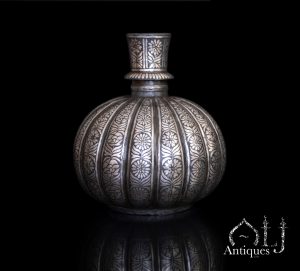
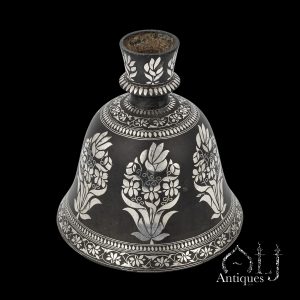
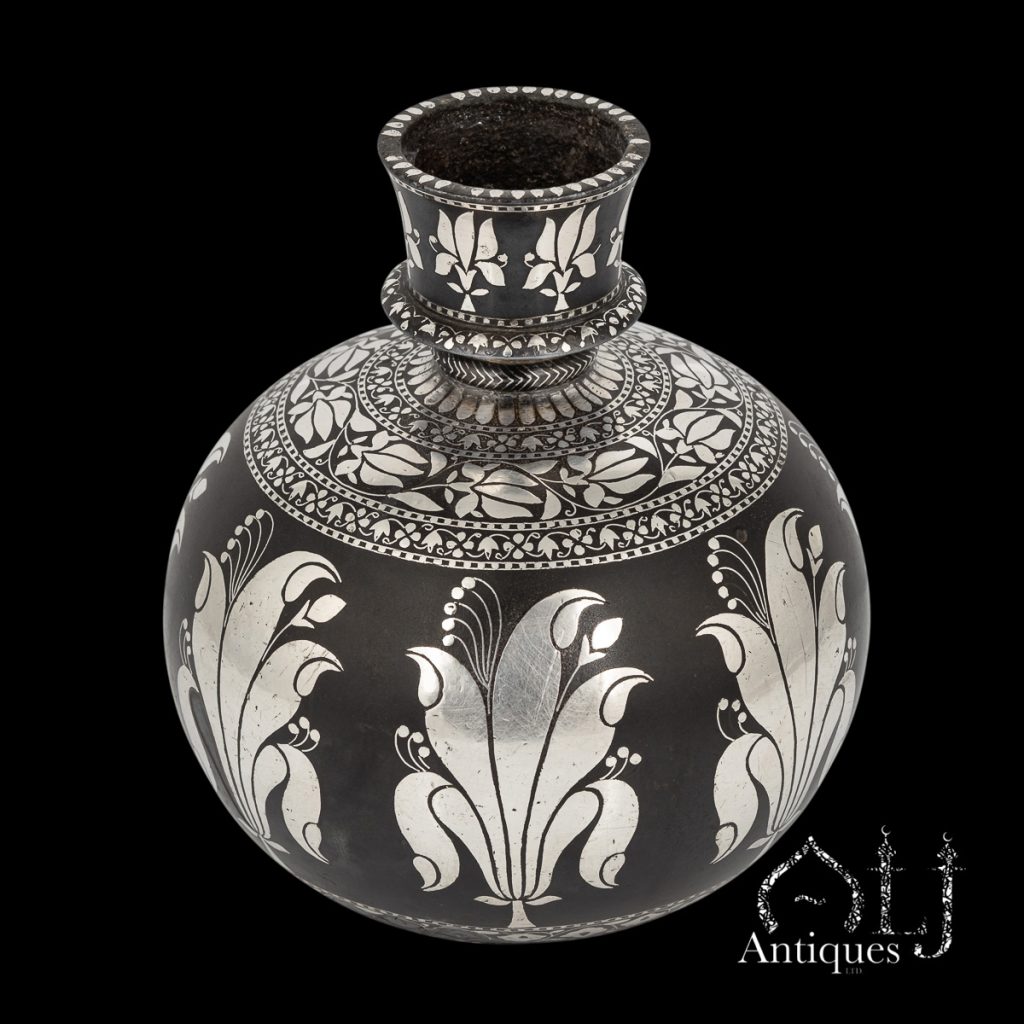
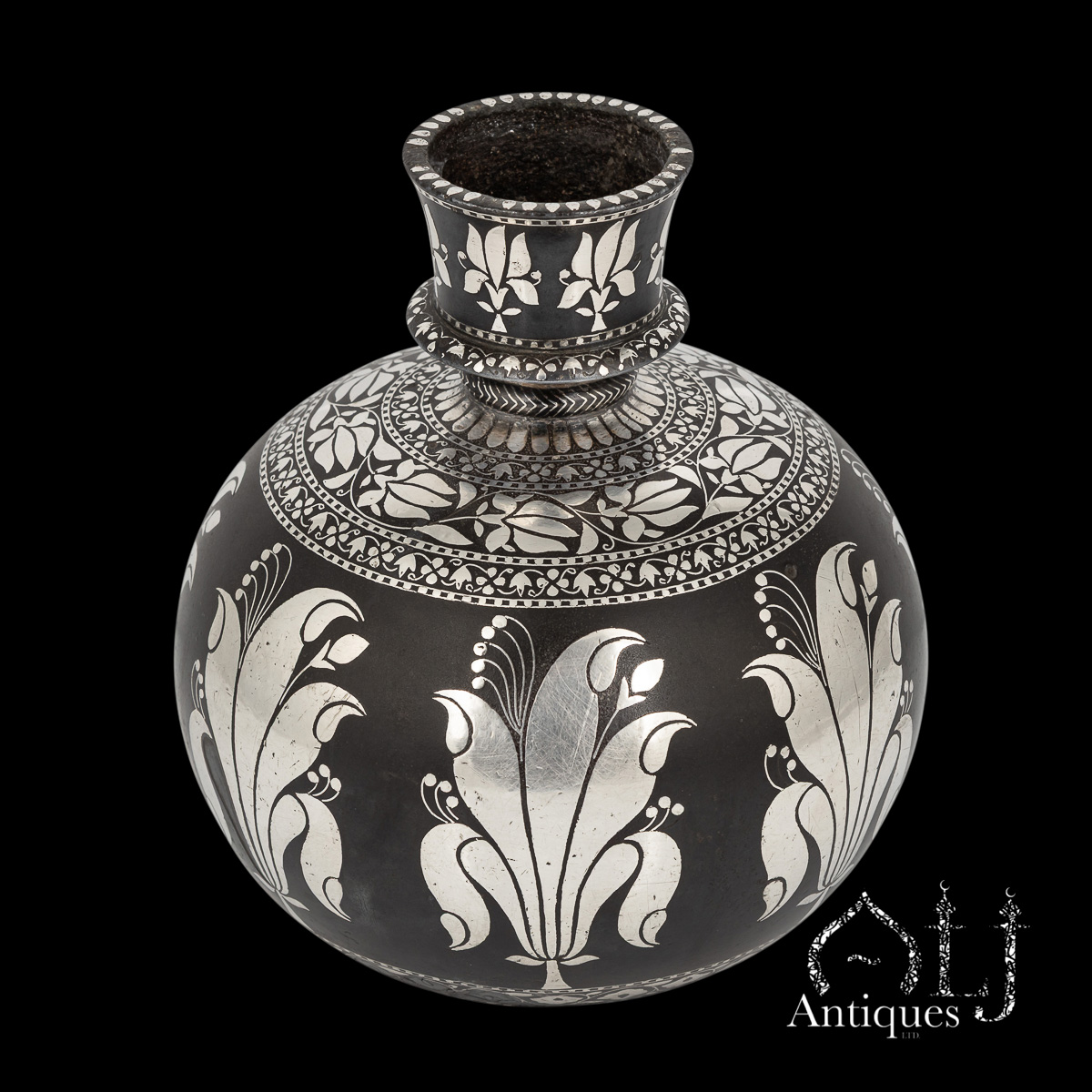
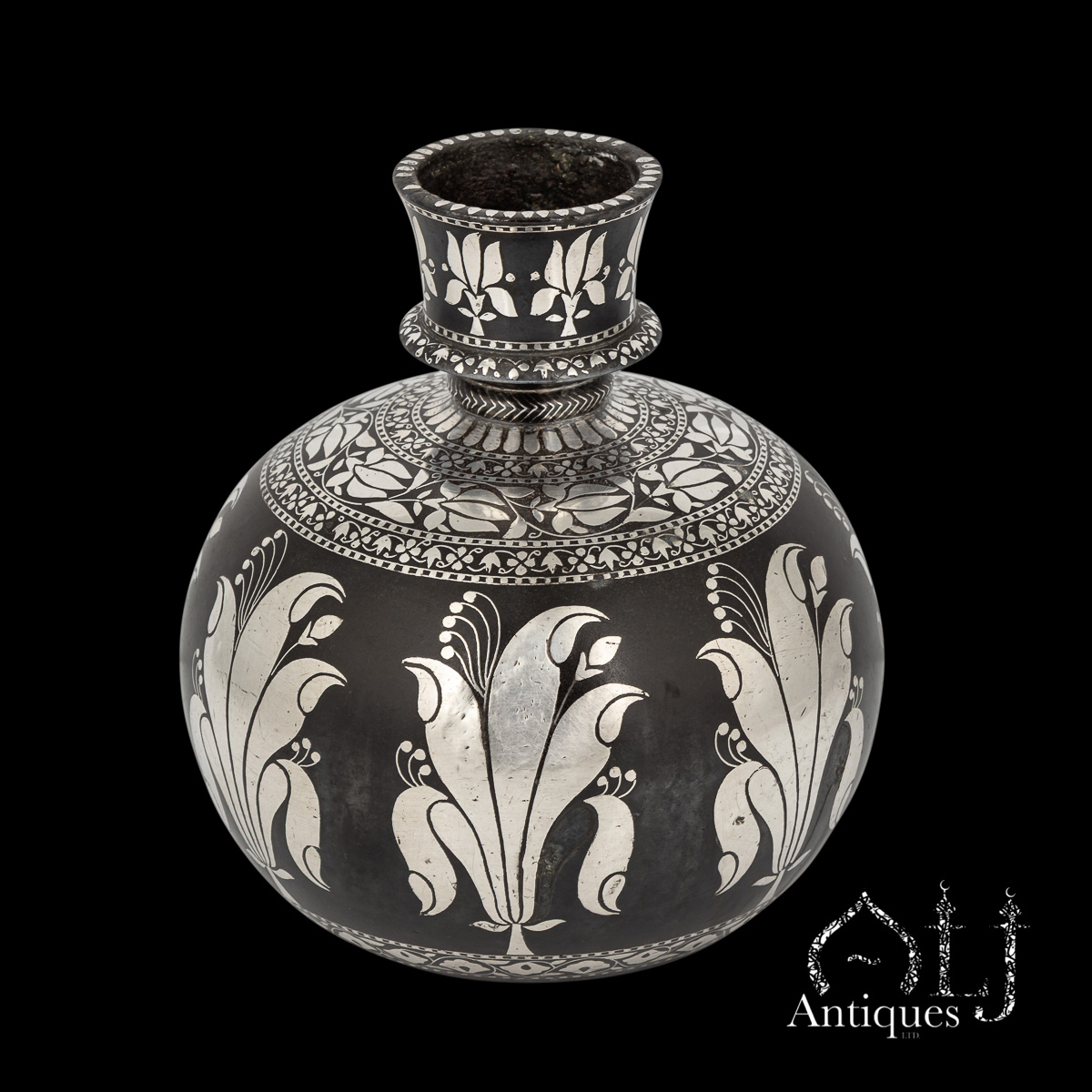
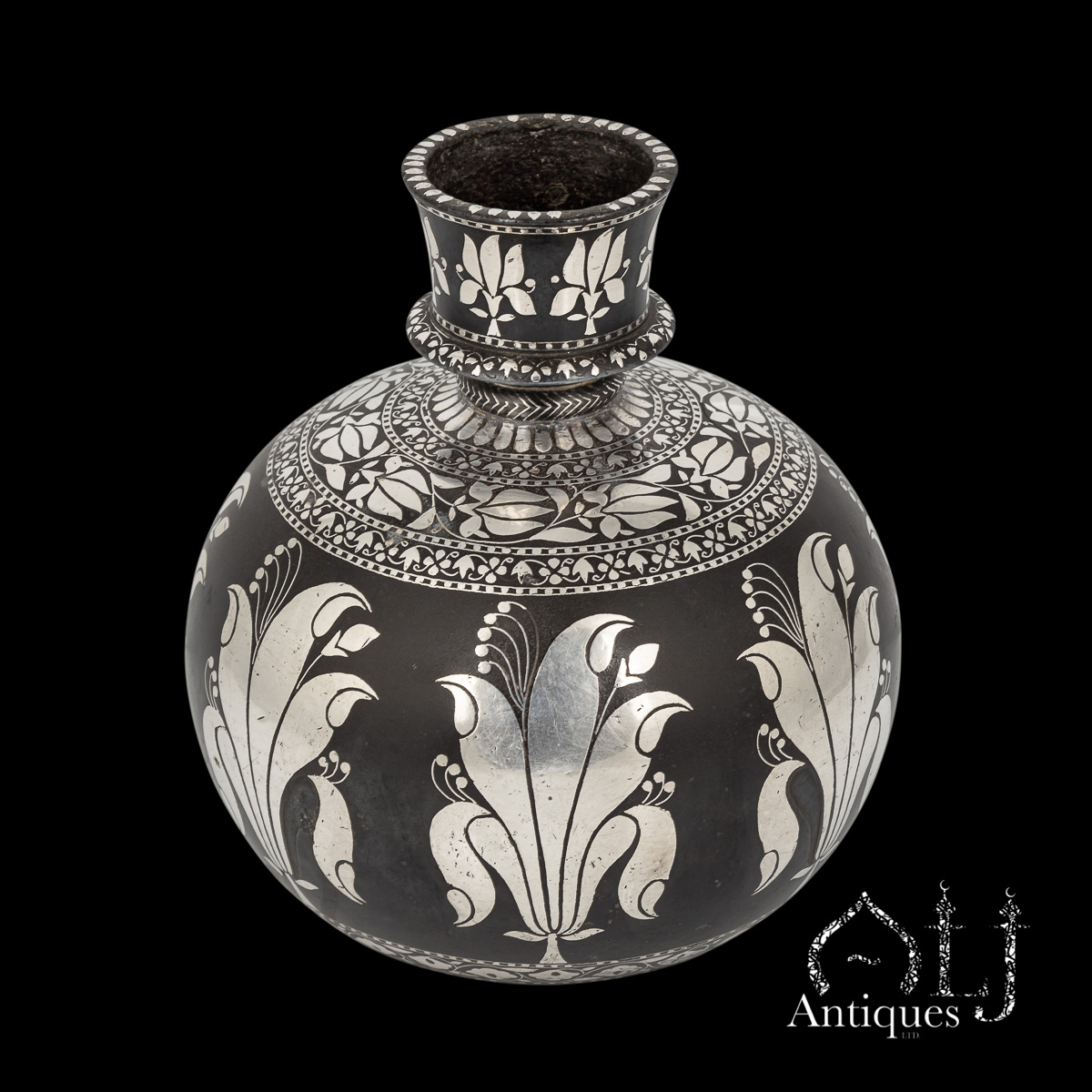
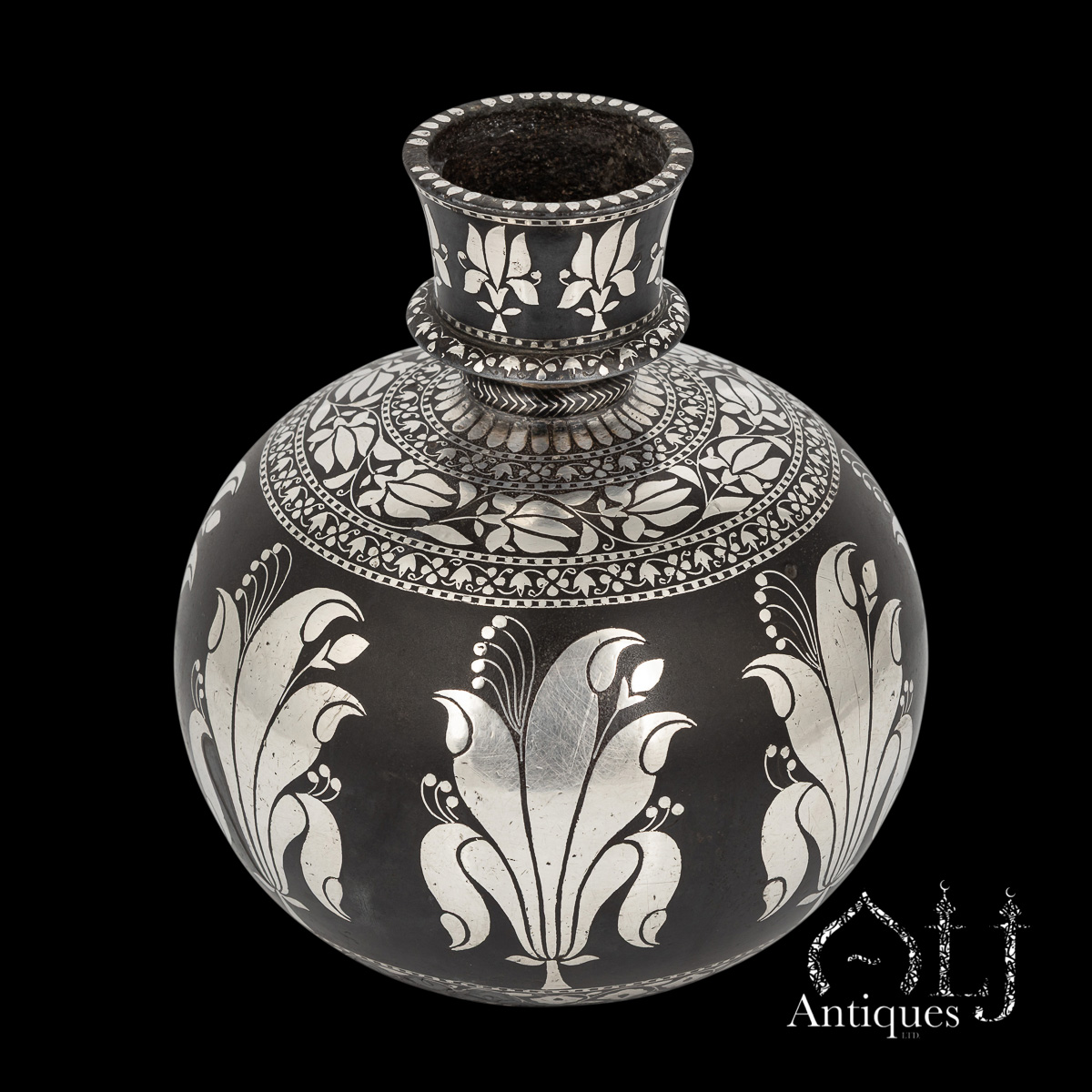
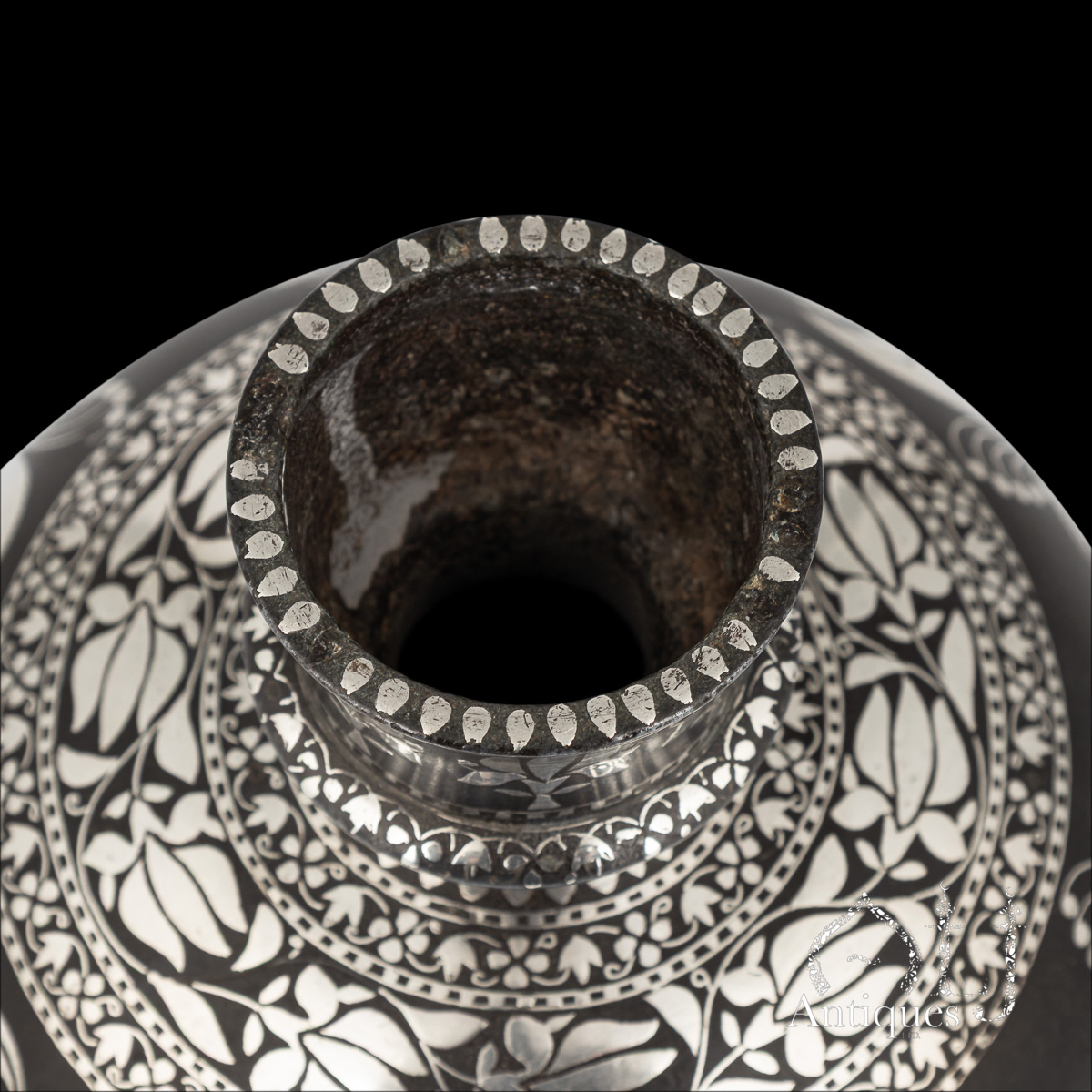
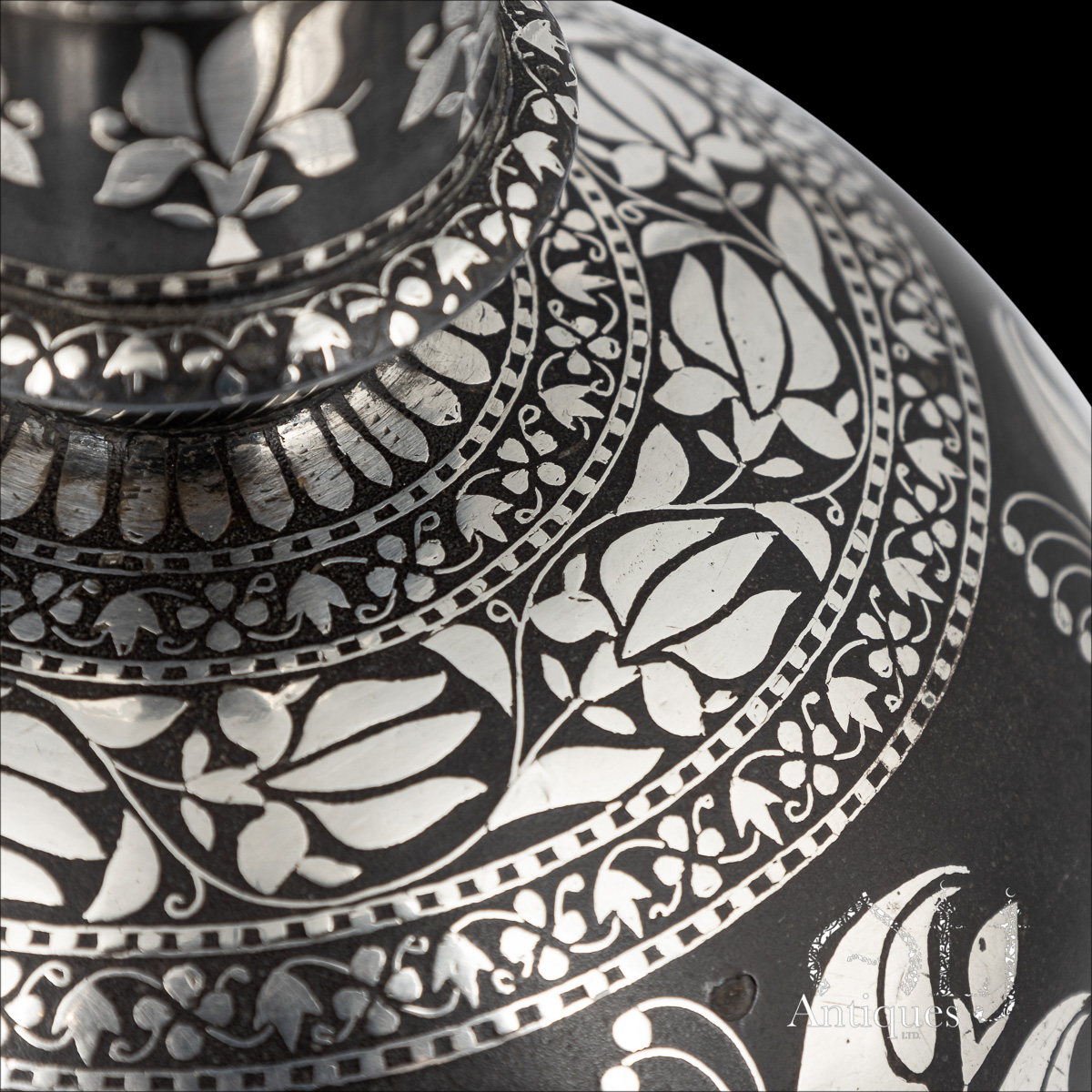
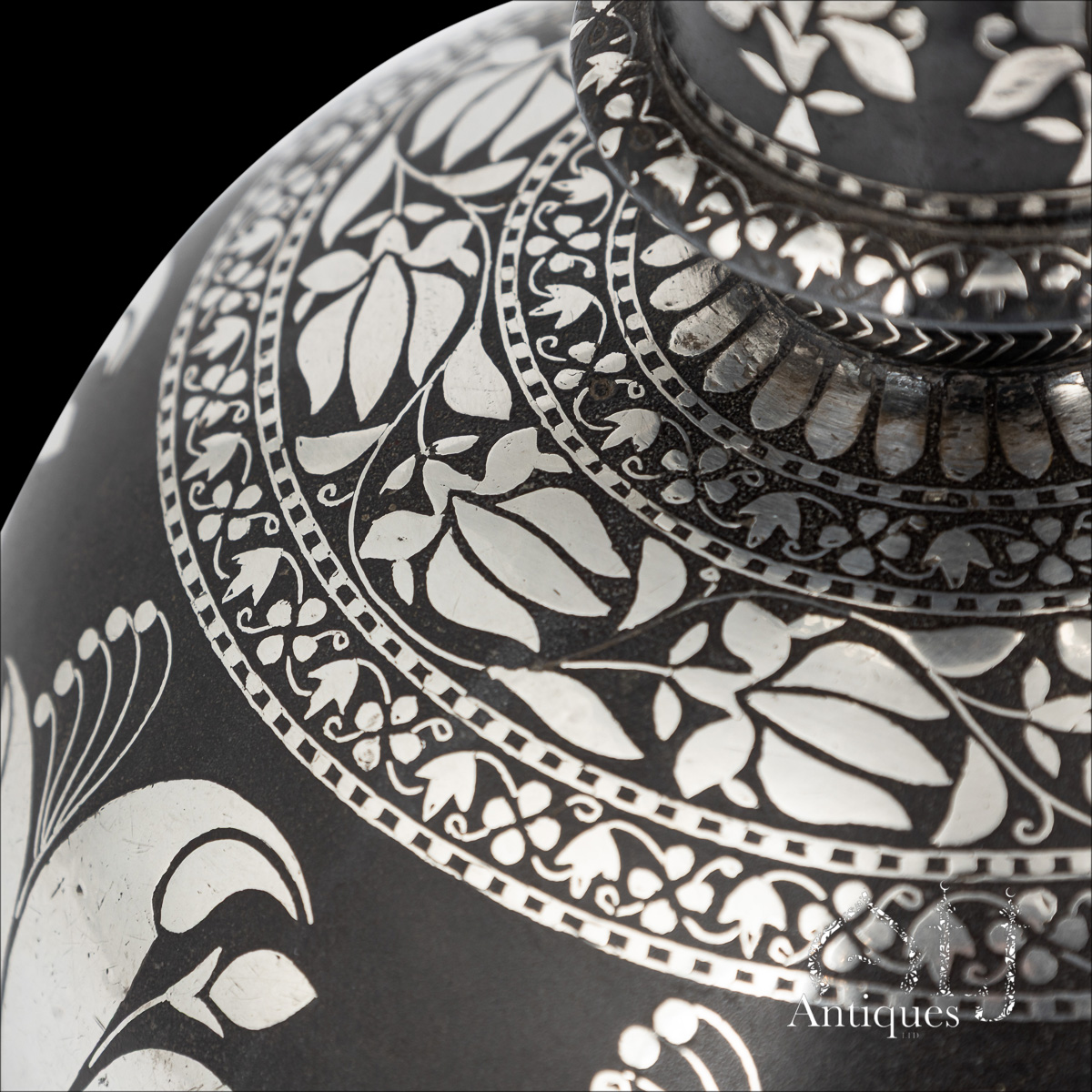
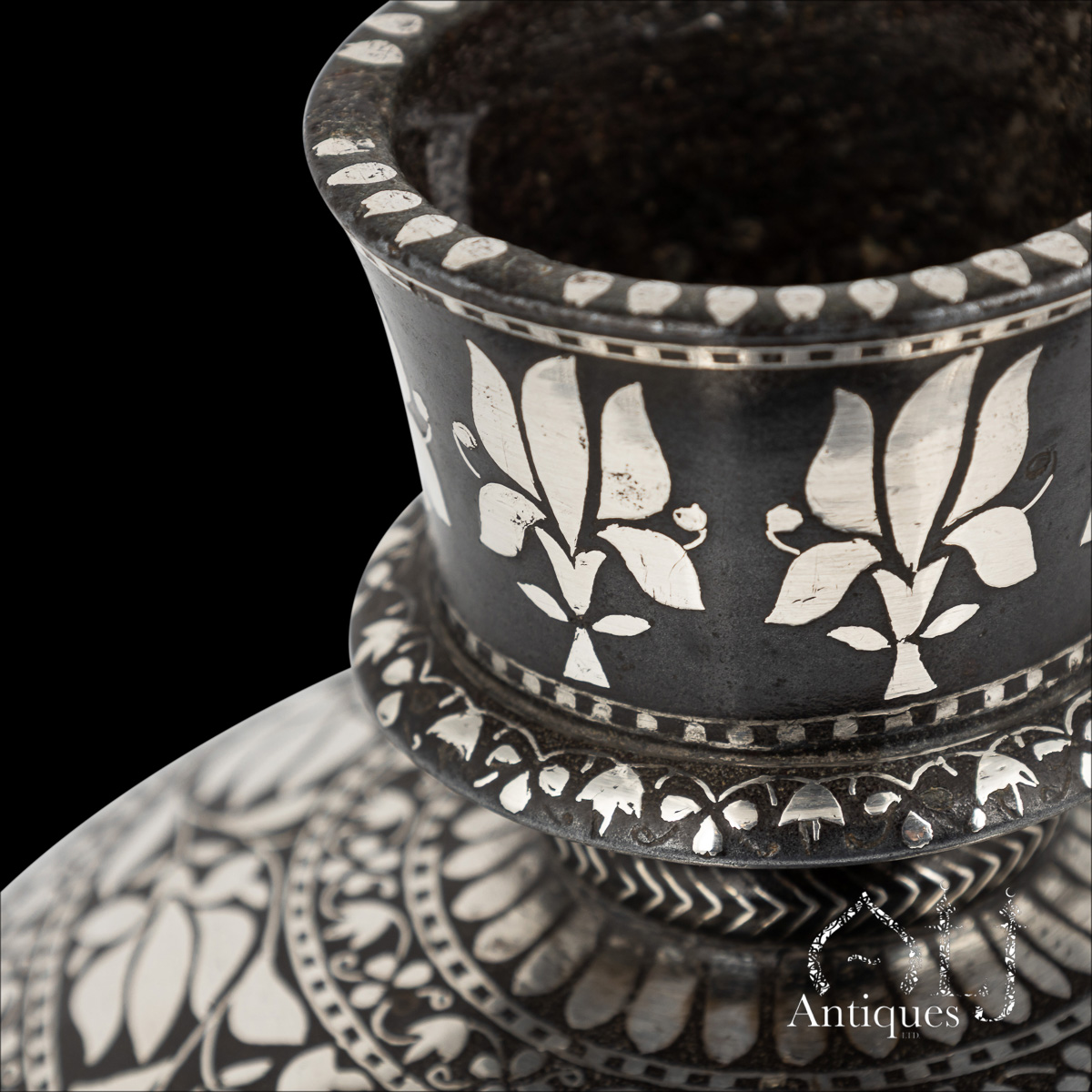
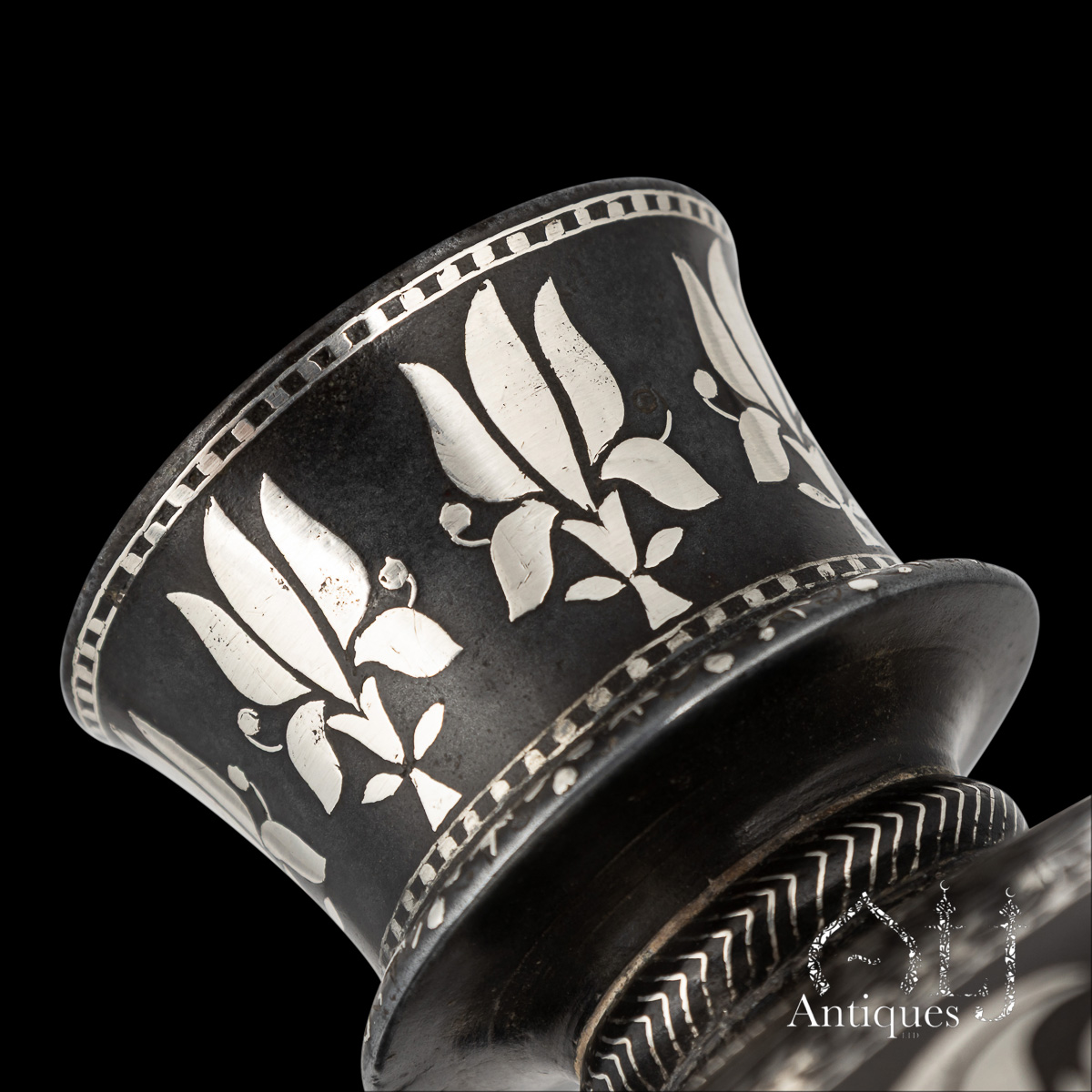
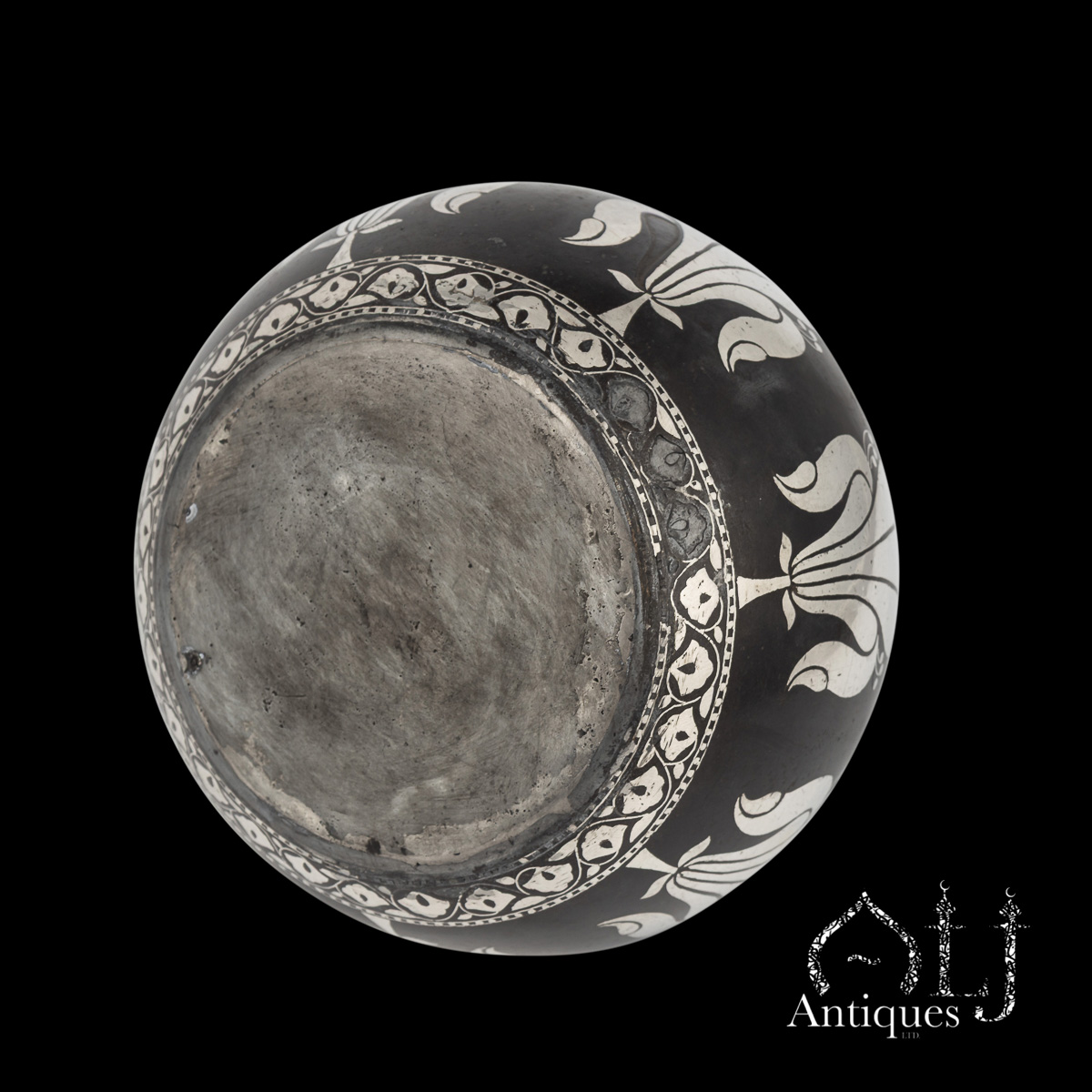
This elegant huqqa (hookah) base, characterised by a globular body, a ringed shaft, and a flared cylindrical neck with an everted rim, is crafted from the characteristic blackened zinc alloy of Bidar (bidri) and richly inlaid with silver using both tarkāshi (wire inlay) and tehnīshān (sheet inlay) techniques. The surface is articulated with a rhythmic programme of Mughal-inspired floral motifs in highly stylised form.
In particular, the largest frieze on the body features repeated monumental silhouettes of the palash or dhak flower, also known as the “Flame of the Forest” (Butea monosperma), a vibrant orange-red flower with upward-curved petals from a deciduous tree common in the Deccan Plateau, especially in its dry woodlands and grasslands. This species is deeply charged with symbolic value in North and Central India, where its vividly coloured inflorescences are associated with purification, springtime renewal, Shivaratri rites, and, in Hindu textual sources such as the Yajurveda, where it is used by priests in sacrificial rituals. The shape of the flower employed here also bears some resemblance to that of the Indian Dutchman’s pipe flower, a species of Aristolochia.
The shoulders present alternating ornamental registers containing scrolling tendrils, stylised lotus petals, and floral sprays, repeated around the lower base as well. The entire composition embodies a well-balanced synthesis of the refined Mughal–Deccani aesthetic favoured in Bidri metalwork from the late 17th to the mid-18th century (Marika Sardar, in Maryam Ekhtiar, Priscilla P. Soucek, Sheila R. Canby, and Navina Haidar, eds., Masterpieces from the Department of Islamic Art in The Metropolitan Museum of Art, 2011, pp. 385–86, cat. nos. 273 and 274).
In terms of form and decorative style, an almost identical specimen to the present example can be admired in the collection of the Jagdish and Kamla Mittal Museum of Indian Art (a Bidri globular huqqa base inlaid with brass and silver), published in Mark Zebrowski, Gold, Silver & Bronze from Mughal India, 1997, p. 233, cat. no. 386. It has been dated to the 17th century, when brass inlays in Bidri wares appear to have been more recurrent and in vogue, compared to the following century, when monochromatic inlays were preferred (see ibid., p. 233, cat. no. 383; and J. M. Rogers, The Arts of Islam: Masterpieces from the Khalili Collection, 2010, p. 296, cat. no. 352).
The form is undeniably derivative of early 17th-century Mughal huqqa bases, typically executed in metal and glass; however, the even spacing of the negative black ground is affiliated with late 17th- or early 18th-century models, such as the globular huqqa bases with wave-pattern medallions and those with brass- and silver-inlaid cypress trees and marigolds, both in the Victoria and Albert Museum, London (inv. nos. 1402-1903 and IS.2539-1883), published in Susan Stronge, Bidri Ware: Inlaid Metalwork from India, 1985, pp. 45 and 49.
Further comparison may be drawn with the brass-inlaid huqqa base in The Metropolitan Museum of Art (inv. no. 1984.221), which shares the same spherical shape, the multi-banded friezes on the shoulders, and the even spacing of the floral motifs on the main body. In the present example, the stylised rendering of the palash blossoms—elongated, flame-like, and arranged in symmetrical paired groupings—echoes the drooping iris blossoms of the MET specimen. Similar floral motifs decorate not only the metal and glass surfaces of huqqa bases but also, as Marika Sardar points out, the large cotton fields of kalamkari tent panels and wall hangings used to dress the walls of Deccani courts, testifying to the universality of botanical motifs across all artistic categories of Mughal India, especially in the former Deccani Sultanate territories (Marika Sardar, in Navina Najat Haidar and Marika Sardar, Sultans of Deccan India 1500–1700: Opulence and Fantasy, 2015, pp. 269–270).
Please see the Chinese Kangxi porcelain globular-shaped huqqa base, produced for the Indian market and decorated with palash (dhak) flower motifs, circa 1661–1722 AD.
Acknowledgment
The above text and literature were produced with the valued collaboration of Ms. B. C. (with thanks).