
Description
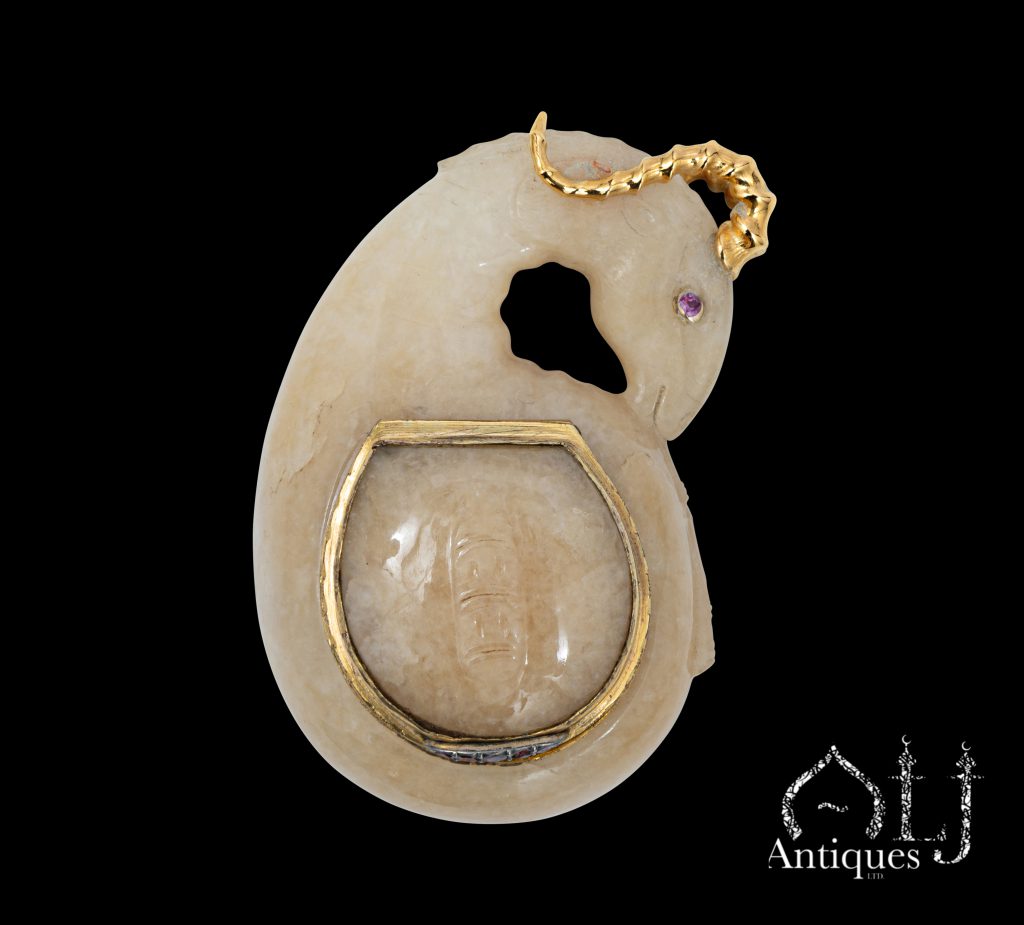
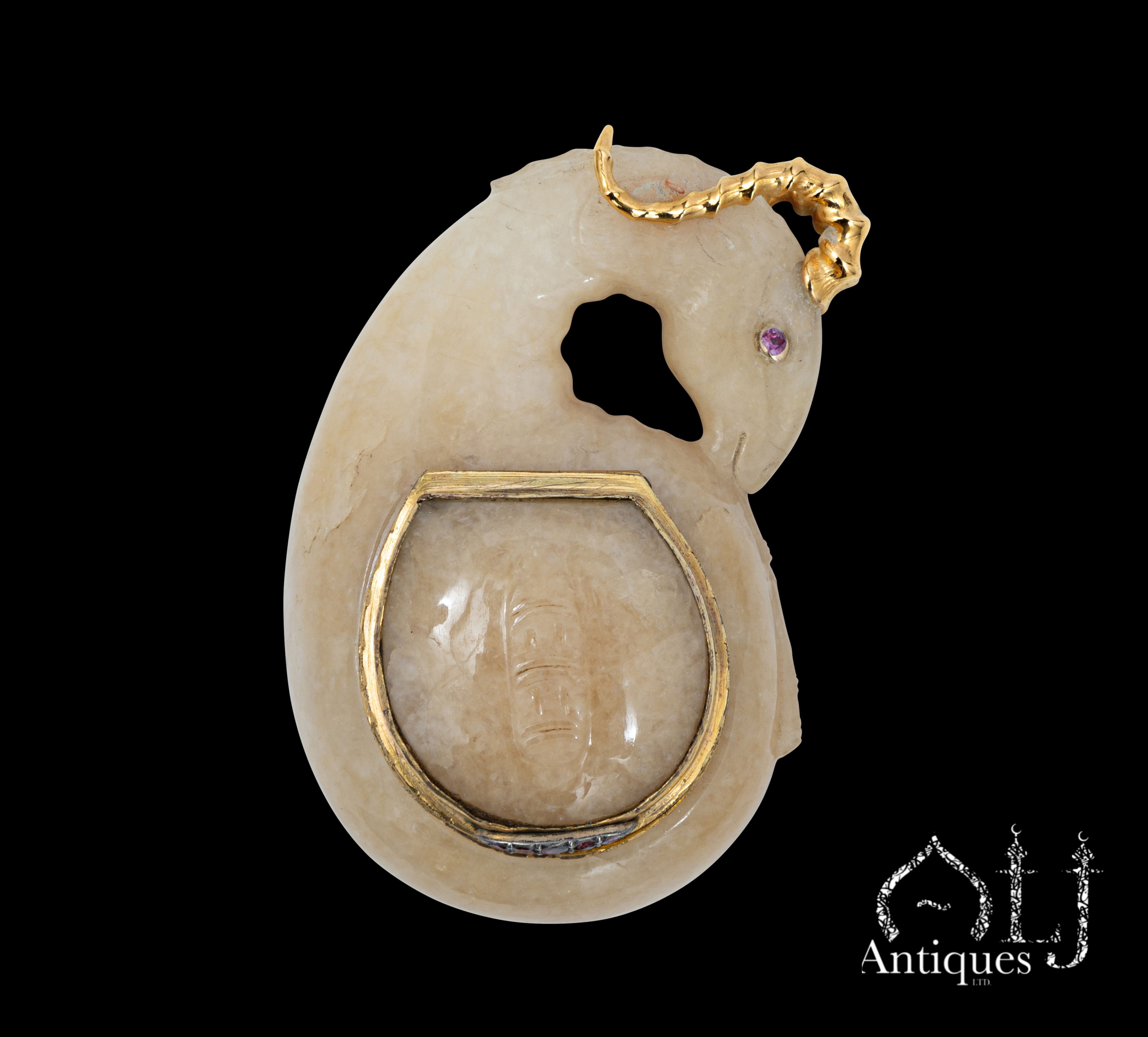
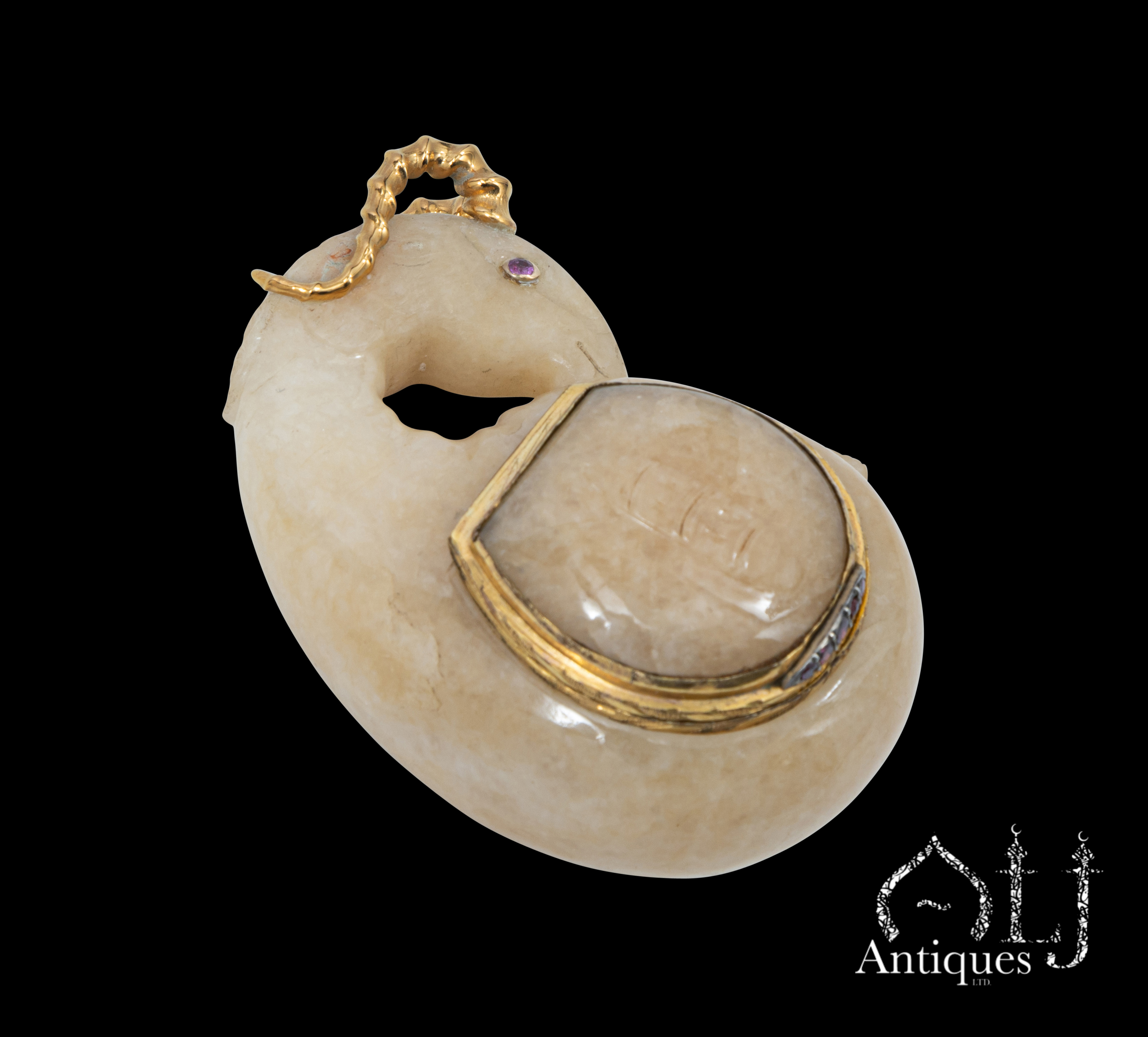
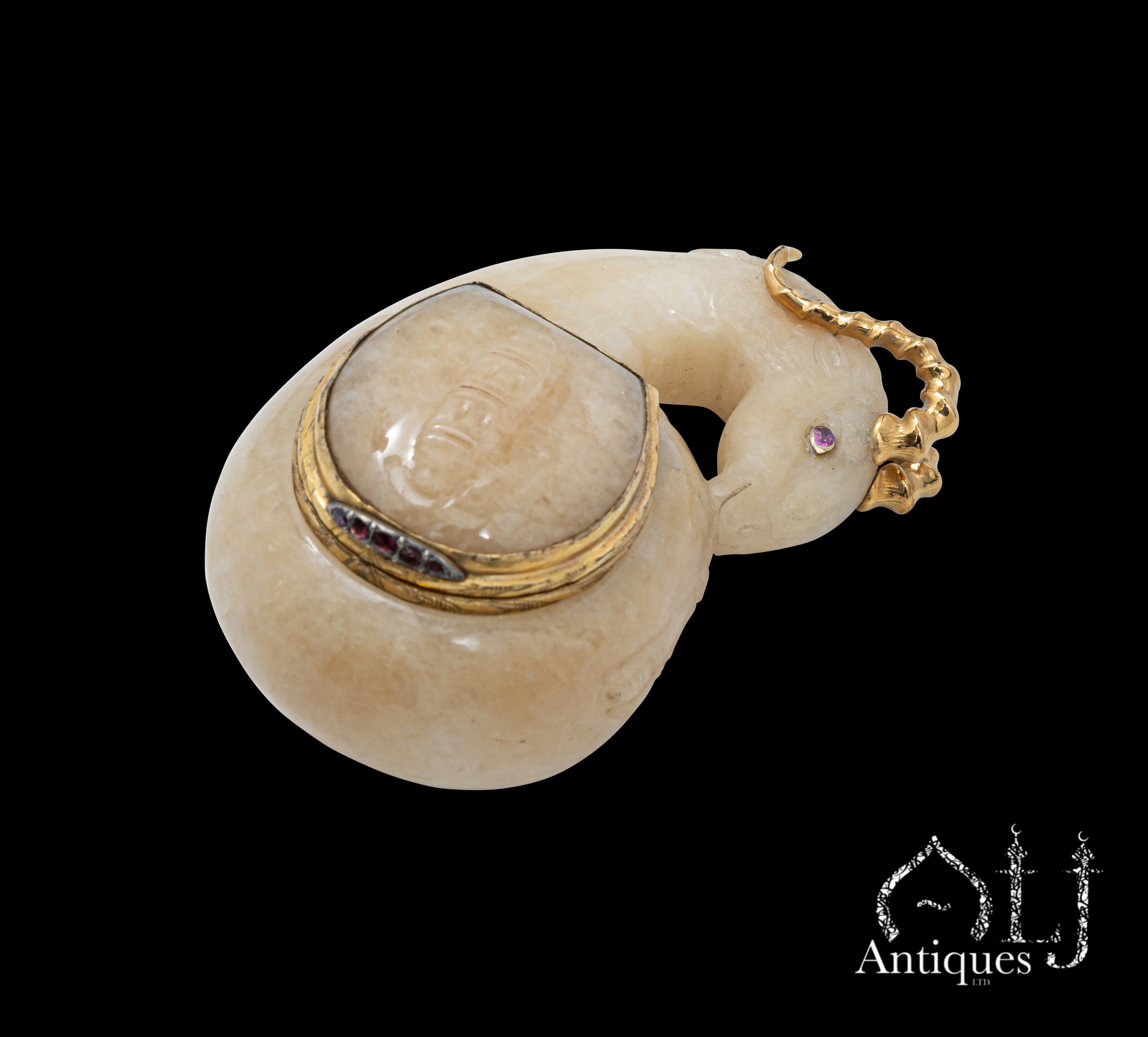
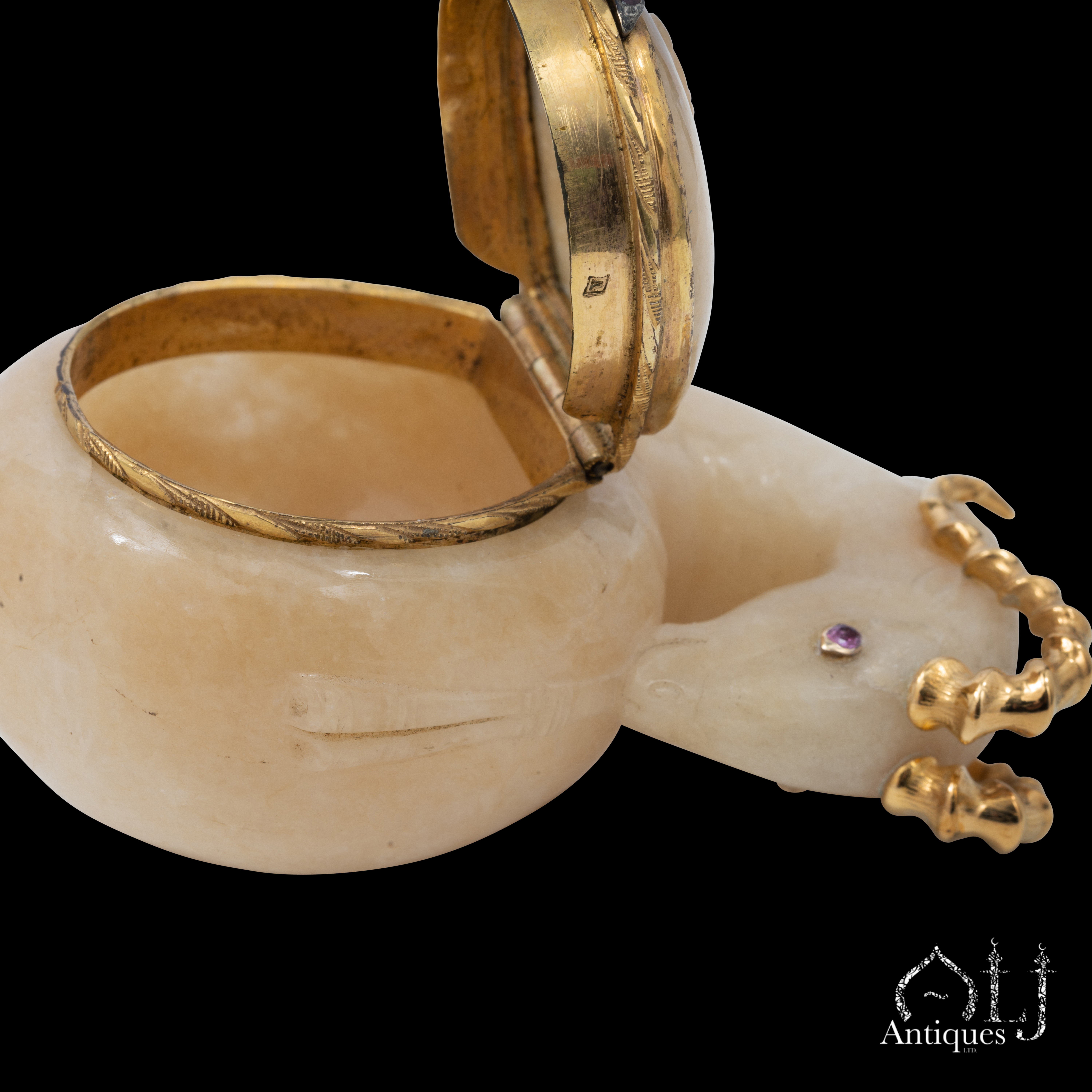
This rare gourd-shaped object is carved from translucent, clear honey-toned chalcedony. The snuff box takes the elegant form of a ruby-set ram’s head with curling gold horns and a hollow interior fitted with a lid mounted in Austrian gold and encrusted with purple sapphires. The ram’s head—its incised mane and expressive features—is carved with remarkable subtlety. The eyes are set with small ruby cabochons in chased gold collets; the curling gold horns are later additions, replacing the original horns now lost or deliberately being removed; and the convex lid, carved from matching chalcedony, bears a central intaglio-style seal motif composed of alternating pairs of lines and dots.
The decorative choice of the ram is far from accidental, reflecting the enduring Mughal taste for animal-headed vessels and establishing a direct visual link to the celebrated white nephrite jade wine cup of the Mughal Emperor Shah Jahan, now in the Victoria and Albert Museum, London (museum no. IS.12-1962).
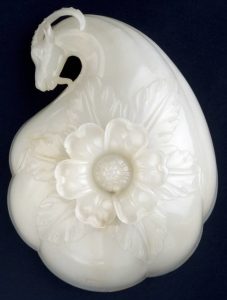
From the 17th century onward, Mughal India developed a distinguished tradition of hardstone carving, with its most renowned lapidary workshops located in Agra and Delhi. Under Shah Jahan’s patronage, zoomorphic vessels and dagger hilts not only defined the canons of imperial production but also provided artistic ideals that continued to inspire later generations of craftsmen across northern India.
The Al Thani Collection features a remarkable group of 17th- and 18th-century animal-headed hardstone vessels, many of which—despite chronological differences—offer compelling visual comparisons to the present snuff box. Favoured animals include members of the Bovidae family, such as rams, ibexes, wild goats, and gazelles. For instance, a white jade wine cup similar to the Shah Jahan cup in the V&A features a wild goat head with gold-set ruby eyes and finely carved rounded horns (Treasures of the Mughals and the Maharajas: The Al Thani Collection, Palazzo Ducale, Venice, exhibition catalogue, 9 September 2017–3 January 2018, p. 108, cat. no. 59). A jade crutch handle and a pesh kabz steel dagger hilt present, respectively, a pair of ibexes and a gazelle (ibid., p. 118, cat. nos. 67 and 68), demonstrating an acute appreciation for faunistic detail. An 18th-century encrusted jade powder horn depicting the face of a goat with rounded ears and grazing teeth (ibid., p. 126, cat. no. 74) further expands this animal repertoire.
Such creations fascinated not only Mughal emperors but also Qing dynasty rulers in China, who soon began commissioning similar works in their own imperial lapidary workshops. Many examples were produced in the Muslim regions bordering China, including Kashgar and Xinjiang, as well as along Silk Road trading posts. An illustrative example is a wine cup with ram’s head published in Teng Shu-P’ing’s exhibition catalogue Exquisite Beauty: Islamic Jades, National Palace Museum, Taipei, 2007, p. 198, pl. 246.
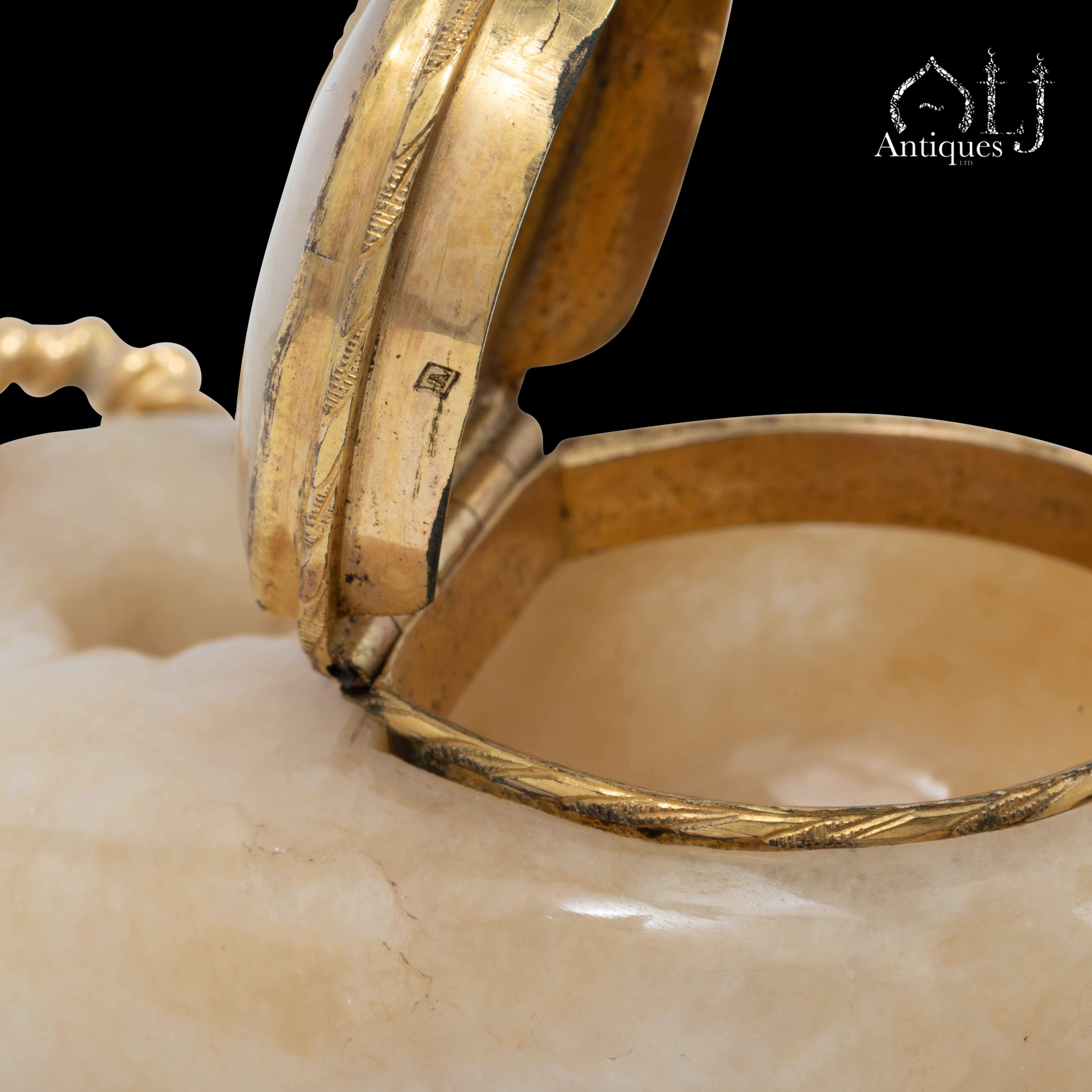
In the present snuff box, the finely chased gold frame bears an Austrian gold mark dating to circa 1800. It is fitted with delicate Western hinges and mounted with a calibrated row of purple sapphires set in silver. This element represents a sophisticated cross-cultural embellishment, reflecting the artistic exchange between Mughal India and European goldsmithing traditions during the late 18th and early 19th centuries. European collectors developed a strong taste for Indian lapidary works and often commissioned trusted jewellers to mount exotic hardstones in precious metals, either acquired during travel or purchased on the antique market. This practice is well documented in museum collections and in 19th-century export luxury objects. The present work stands at the intersection of imperial Mughal hardstone carving and European jewellery techniques, offering an eloquent testament to the global mobility of luxury goods and the enduring fascination with Mughal design long after the Empire’s decline.
On 16 October 2025, Sotheby’s New York offered for sale A Park Avenue Treasury: The Alan and Simone Hartman Collection, Part II. In that sale, lot 458 comprised an identical snuff box, described as a jewelled gold-mounted hard-stone snuff box and attributed to Germany, circa 1760. This attribution may be explained either by the possibility that the item was unmarked, or by the presence of concealed Austrian gold marks, as clearly visible on the present example, which may be hidden beneath the hinged gold frame. In comparable cases, such marks can be obscured when lids are glued to the stone, preventing close examination.
Acknowledgment
The above text and literature were produced with the valued collaboration of Ms. B. C. (with thanks).