
Description
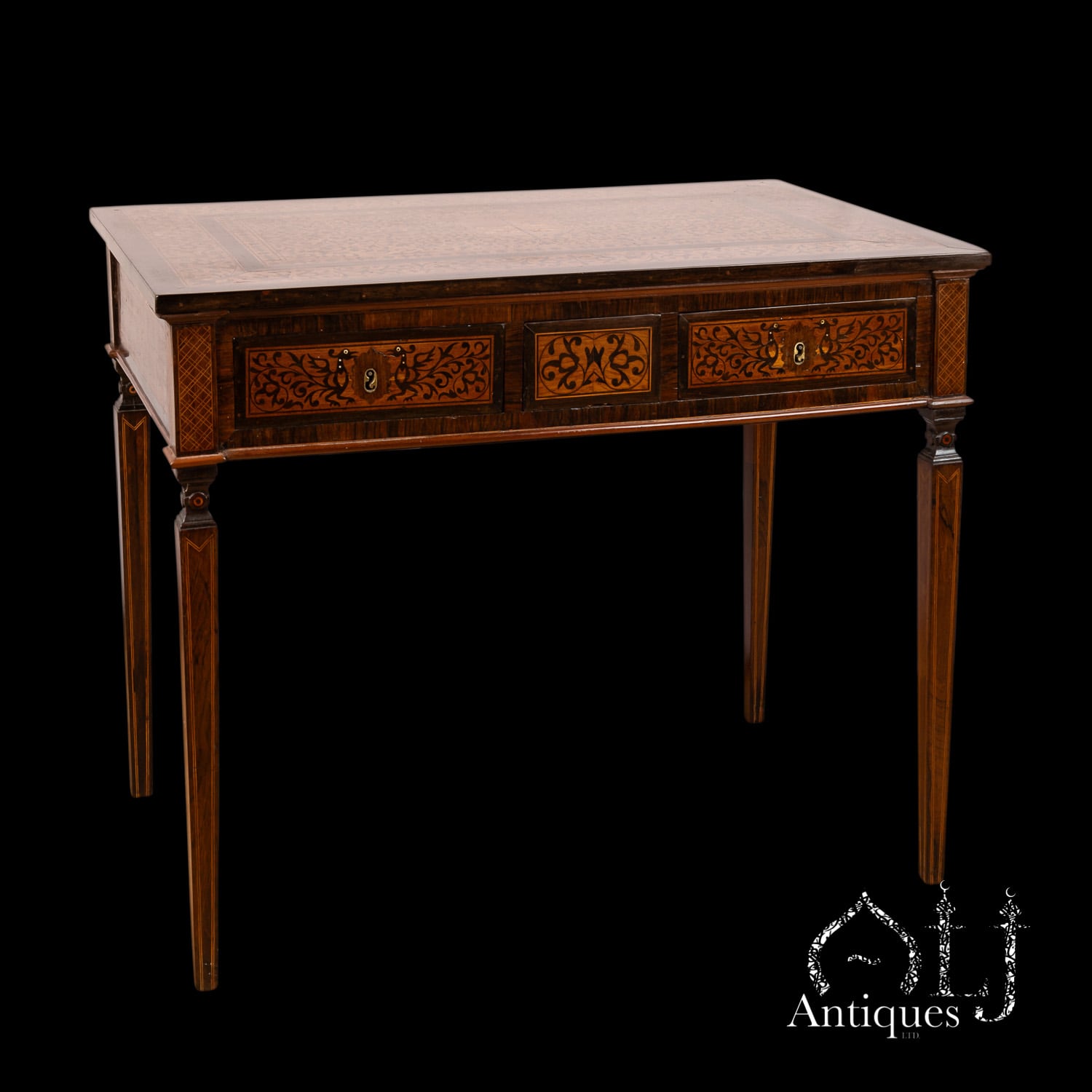
This exceptional and finely executed Indo-Portuguese writing table, produced in Western India during the seventeenth century and almost certainly made for a European, probably Portuguese, patron.
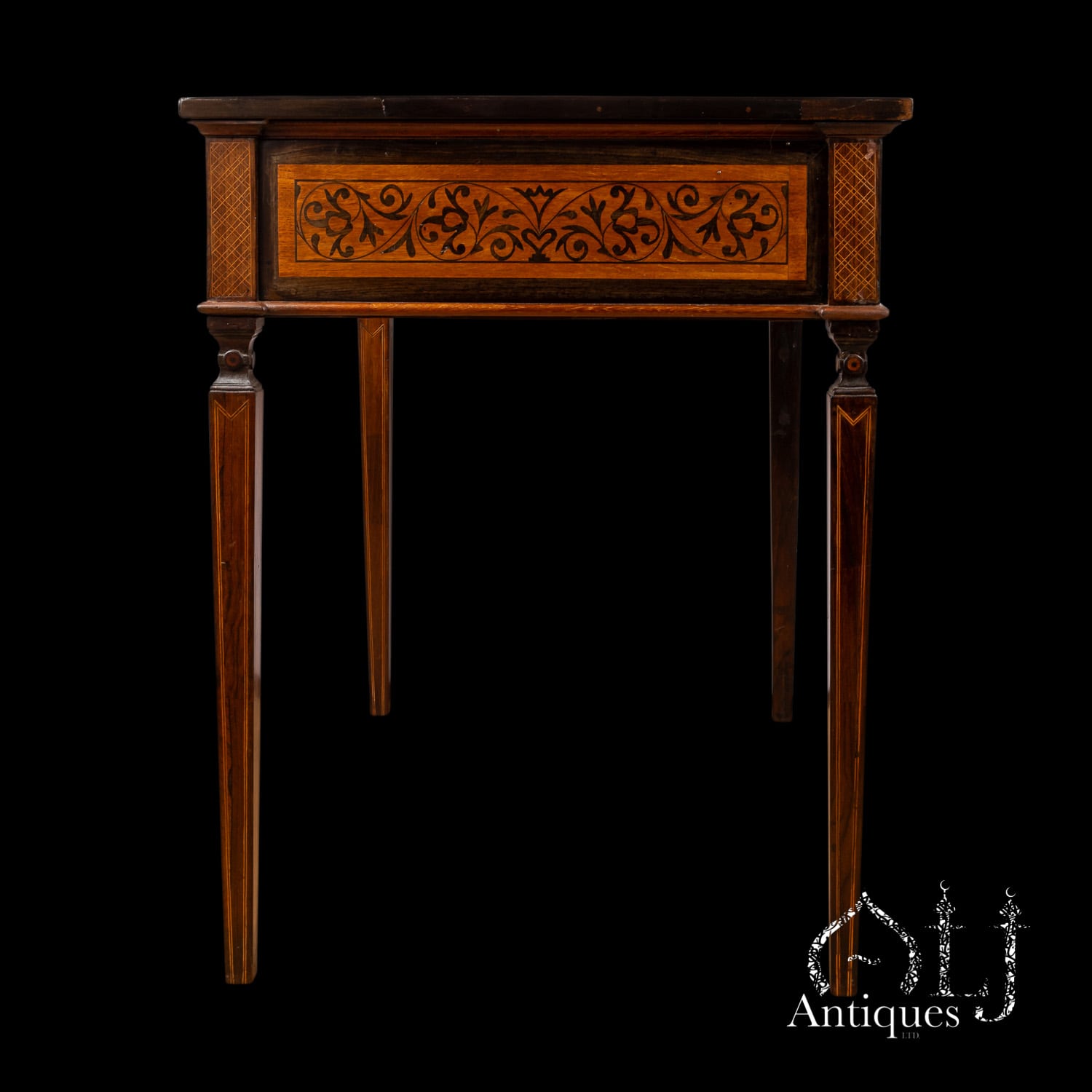
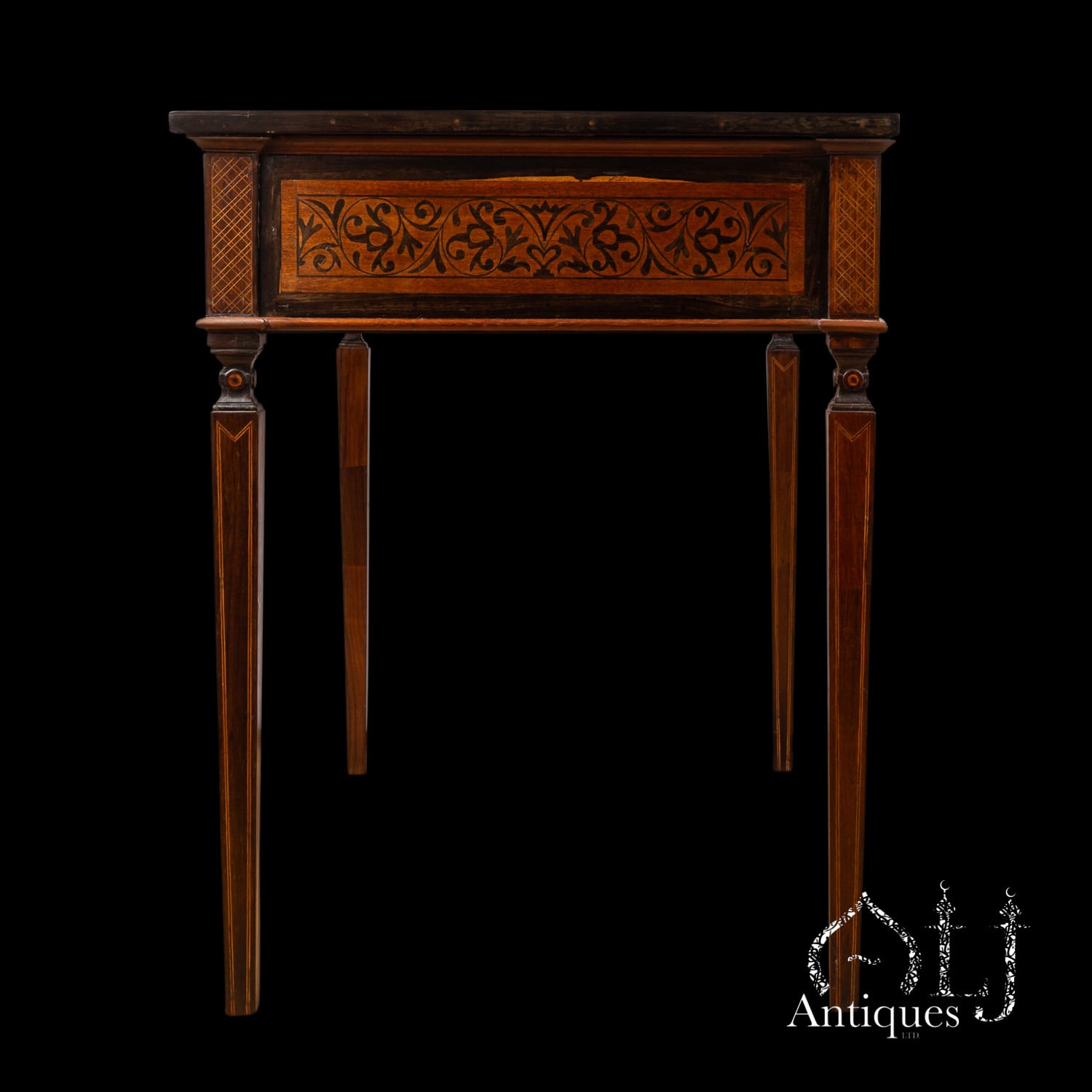
Of rectangular architectural form, the table is constructed principally of hardwood, probably teak, and richly decorated with contrasting dark-wood marquetry and small details in ivory or bone. The restrained European-derived form is transformed by an exceptionally elaborate Indian decorative scheme covering the tabletop, drawer fronts and principal architectural elements.
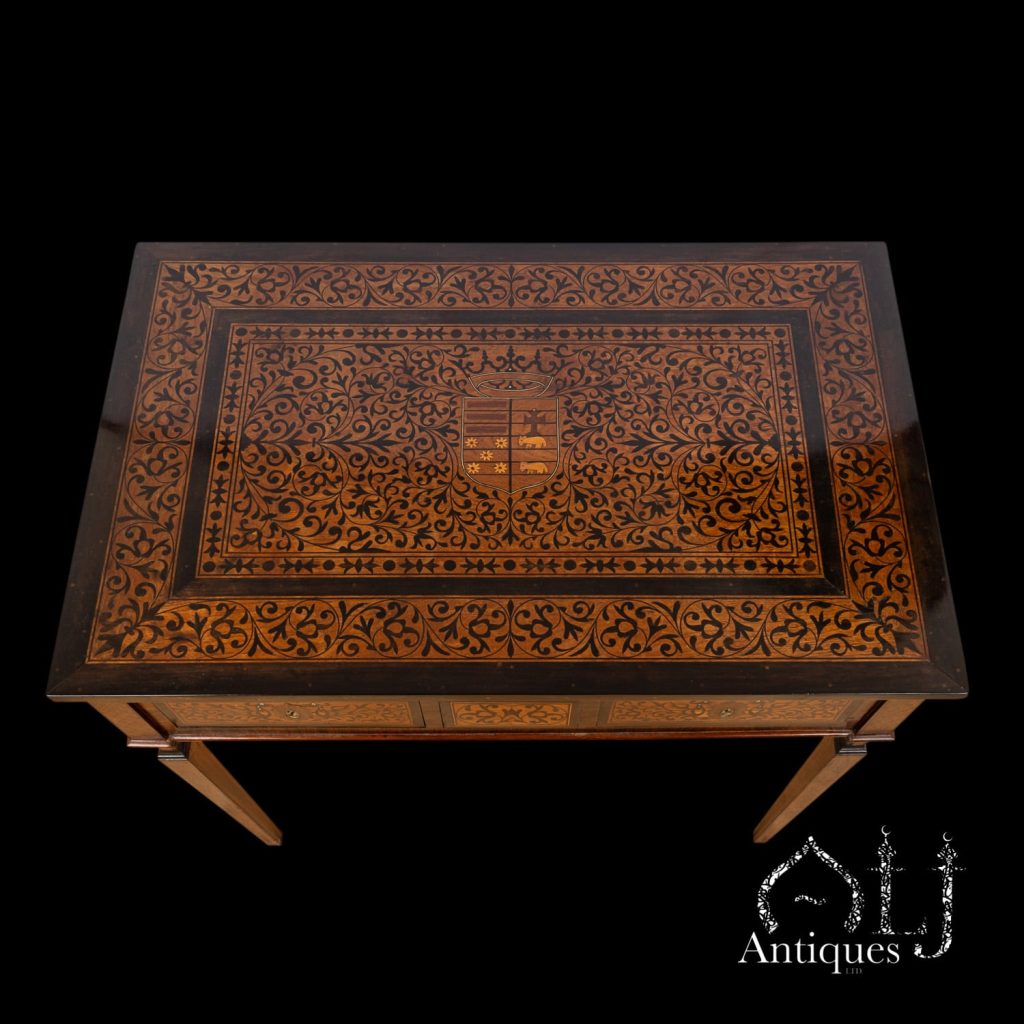
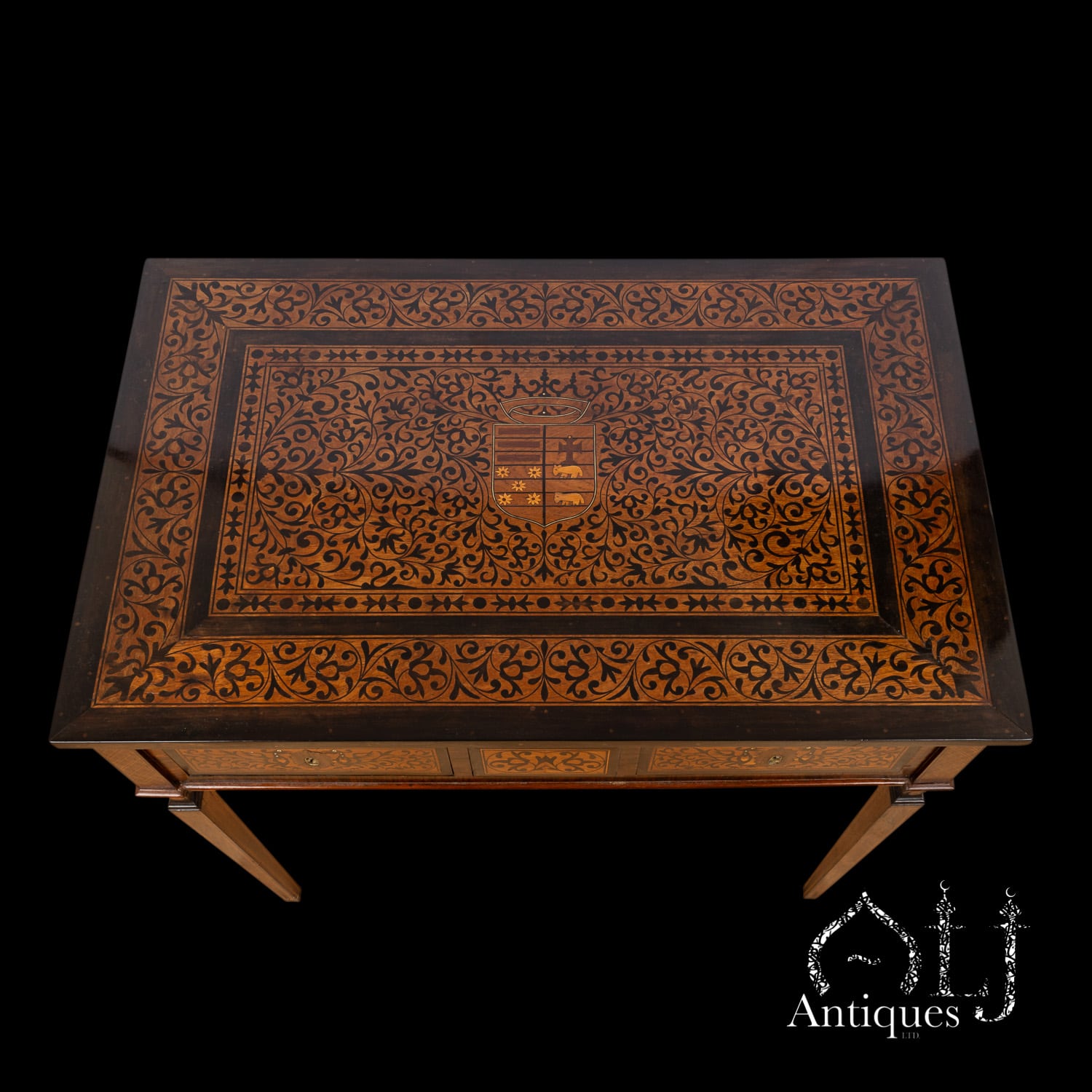
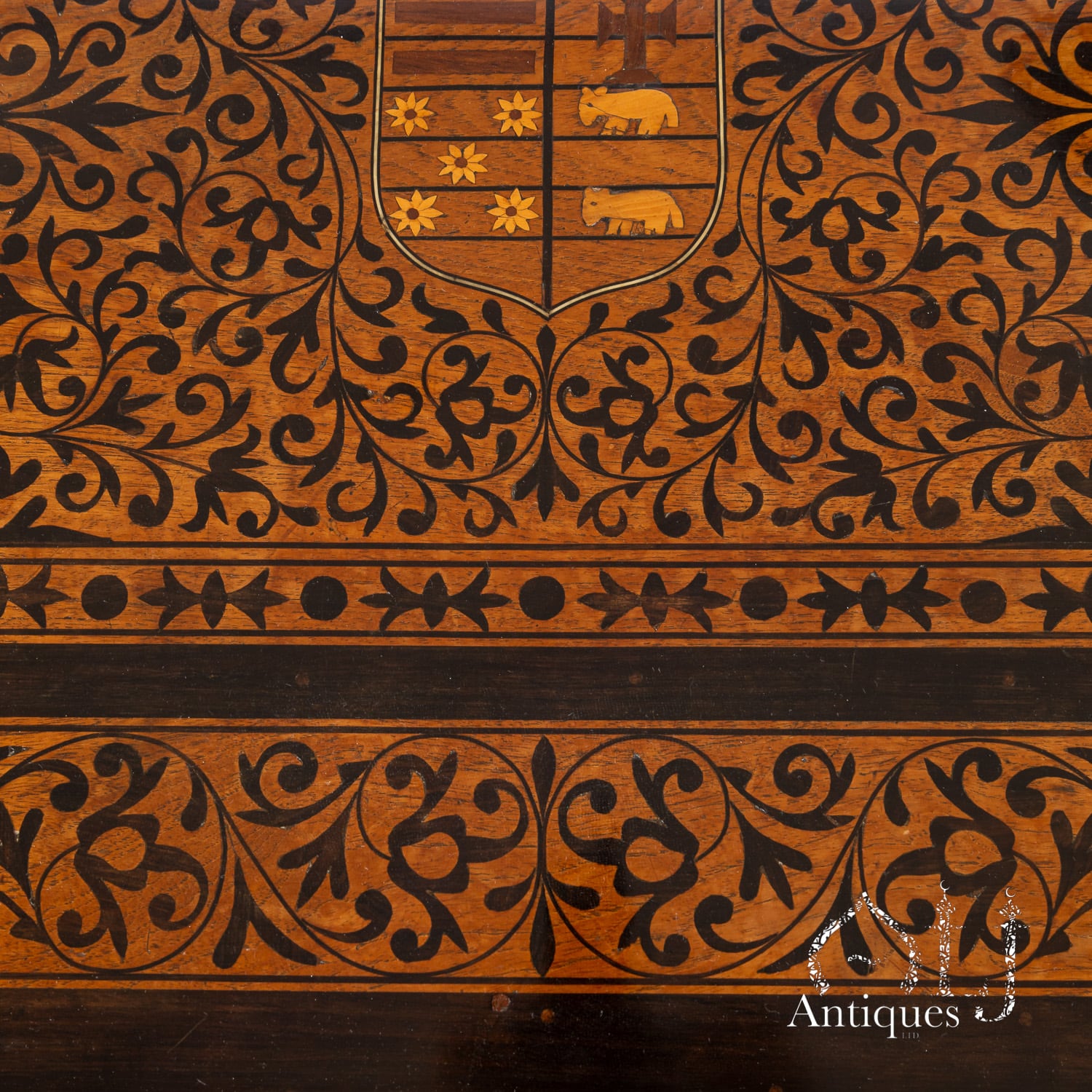
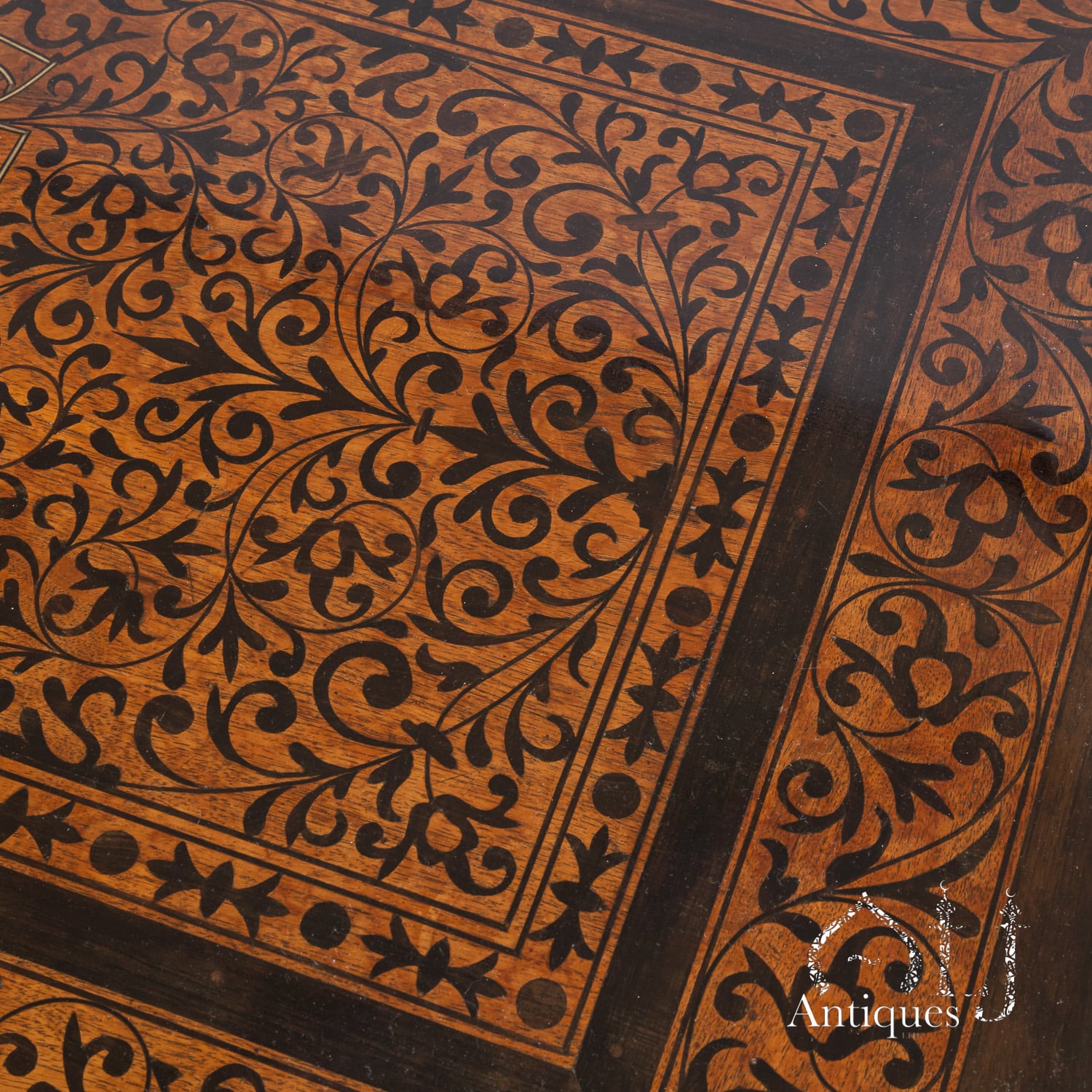
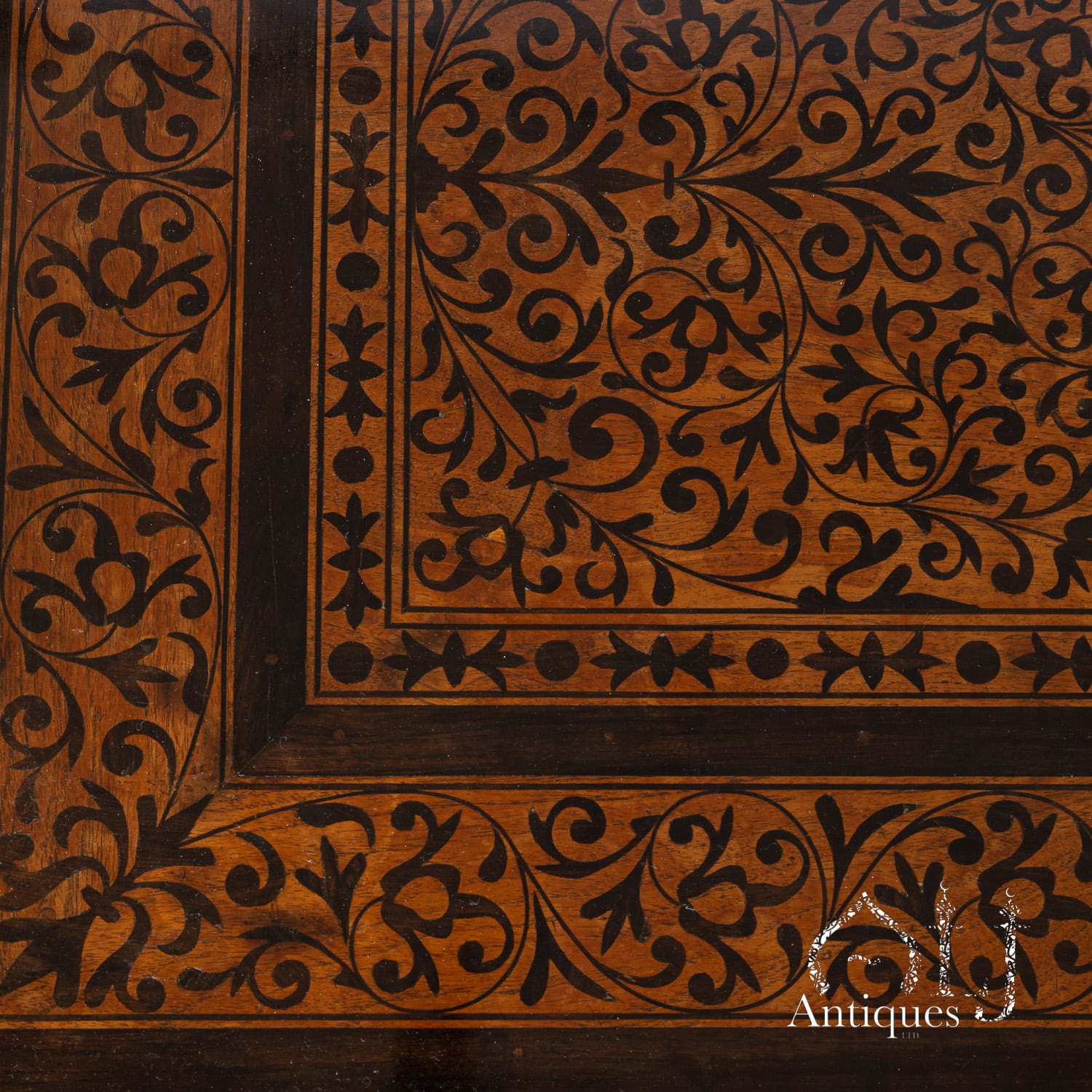
The rectangular top forms the visual focus of the table. Its decoration is organised into a succession of concentric borders surrounding a densely ornamented central field. The broad outer border is filled with continuous scrolling foliage and arabesques, while narrower registers of alternating stellar or floral devices and circular motifs frame the inner composition. Within these borders, vigorous dark scrolling tendrils, leaves and stylised floral forms spread symmetrically across the warm-coloured wooden ground.
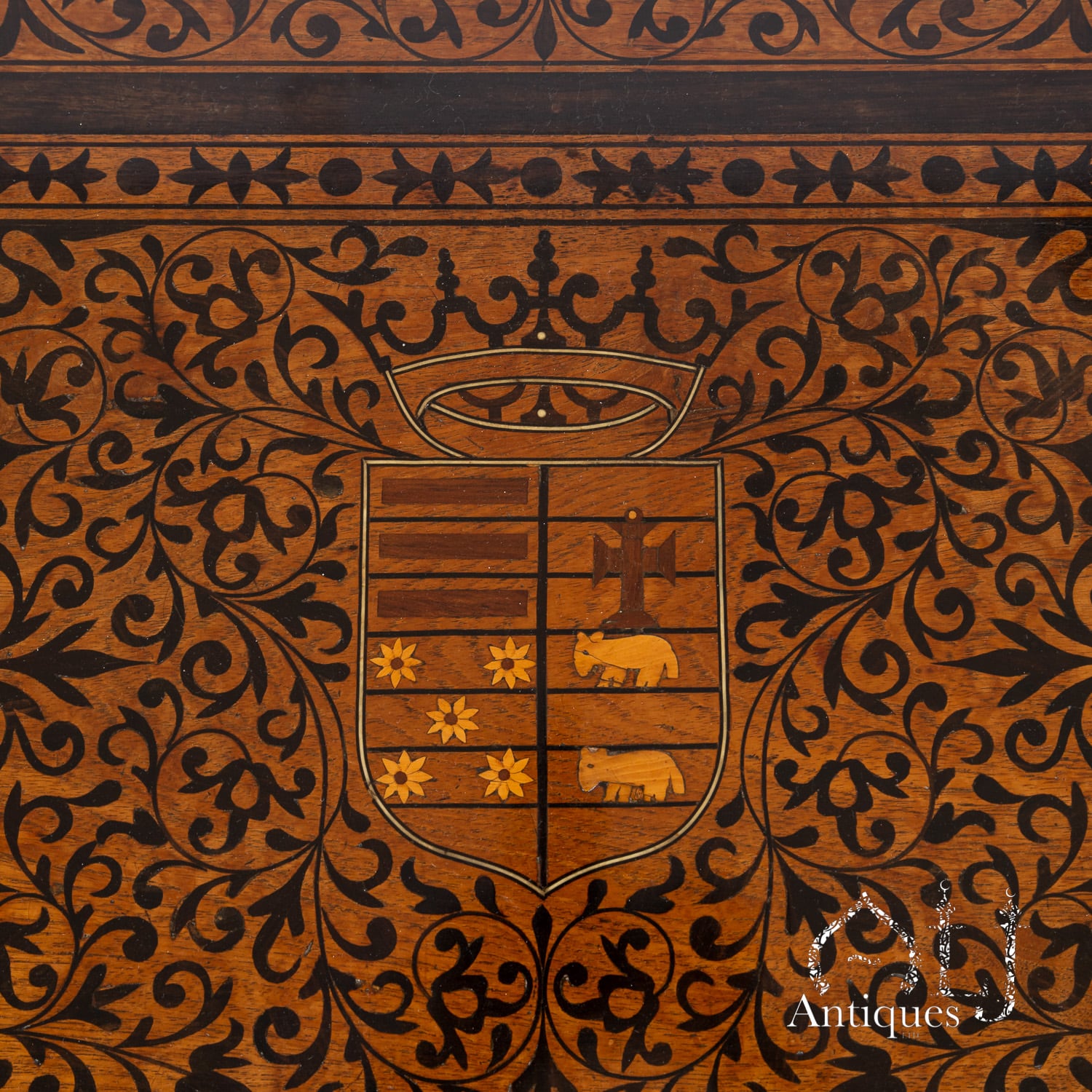
At the centre is the table’s most distinctive feature: a crowned composite European armorial shield, carefully incorporated into the surrounding Indian vegetal decoration. The shield is divided into several fields containing different heraldic charges, including horizontal bars, stellar or floral devices and other emblematic forms, and is surmounted by an open crown or coronet.
The prominent position of these arms strongly suggests that the table was commissioned for, or associated with, a particular European patron or family. European heraldic devices are known on luxury furniture manufactured in India for Portuguese and other European patrons, and their incorporation within an otherwise thoroughly Indian decorative vocabulary is characteristic of the cross-cultural artistic environment in which Indo-Portuguese furniture developed. The precise arms represented here have not yet been securely identified, and they are therefore deliberately left unattributed pending further heraldic research.
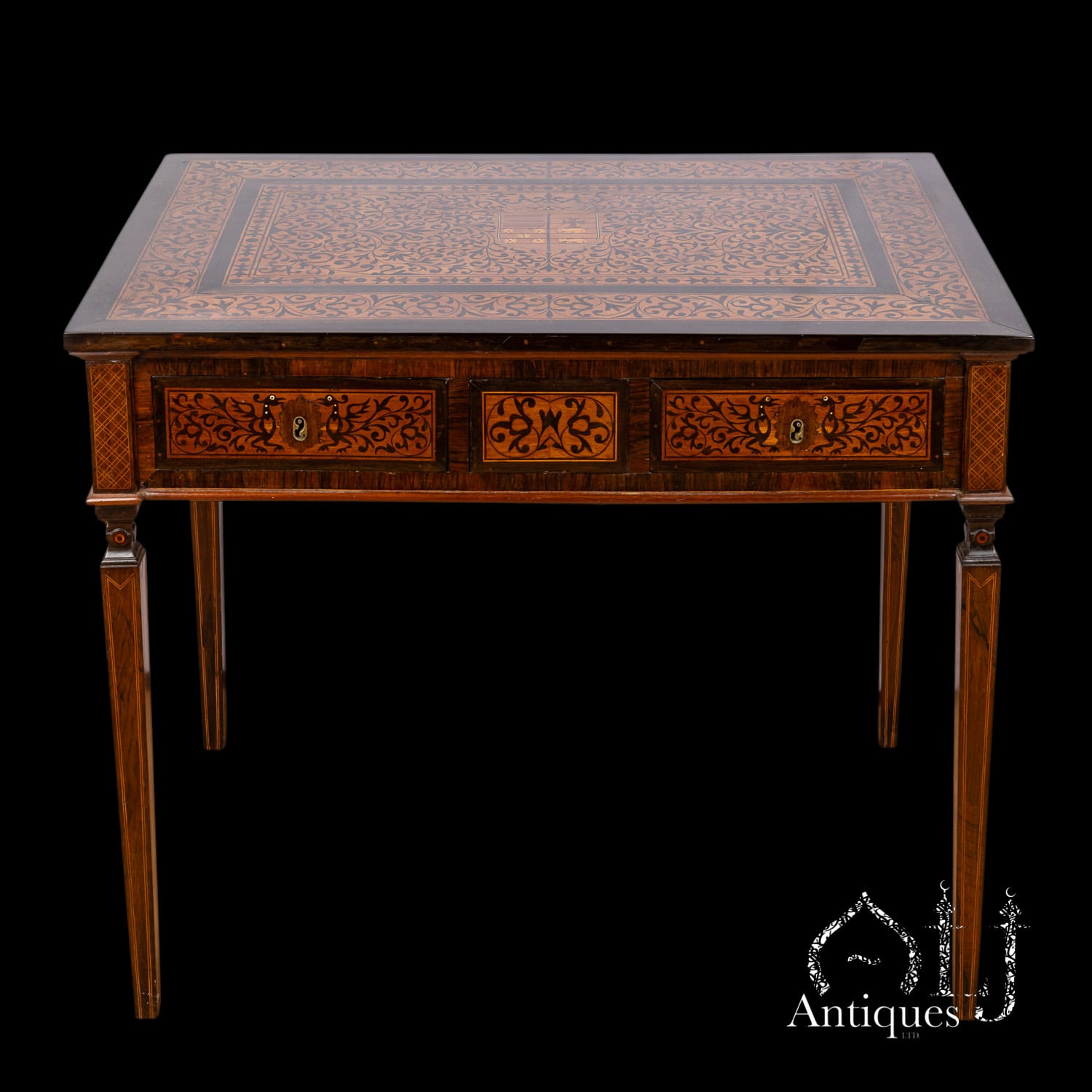
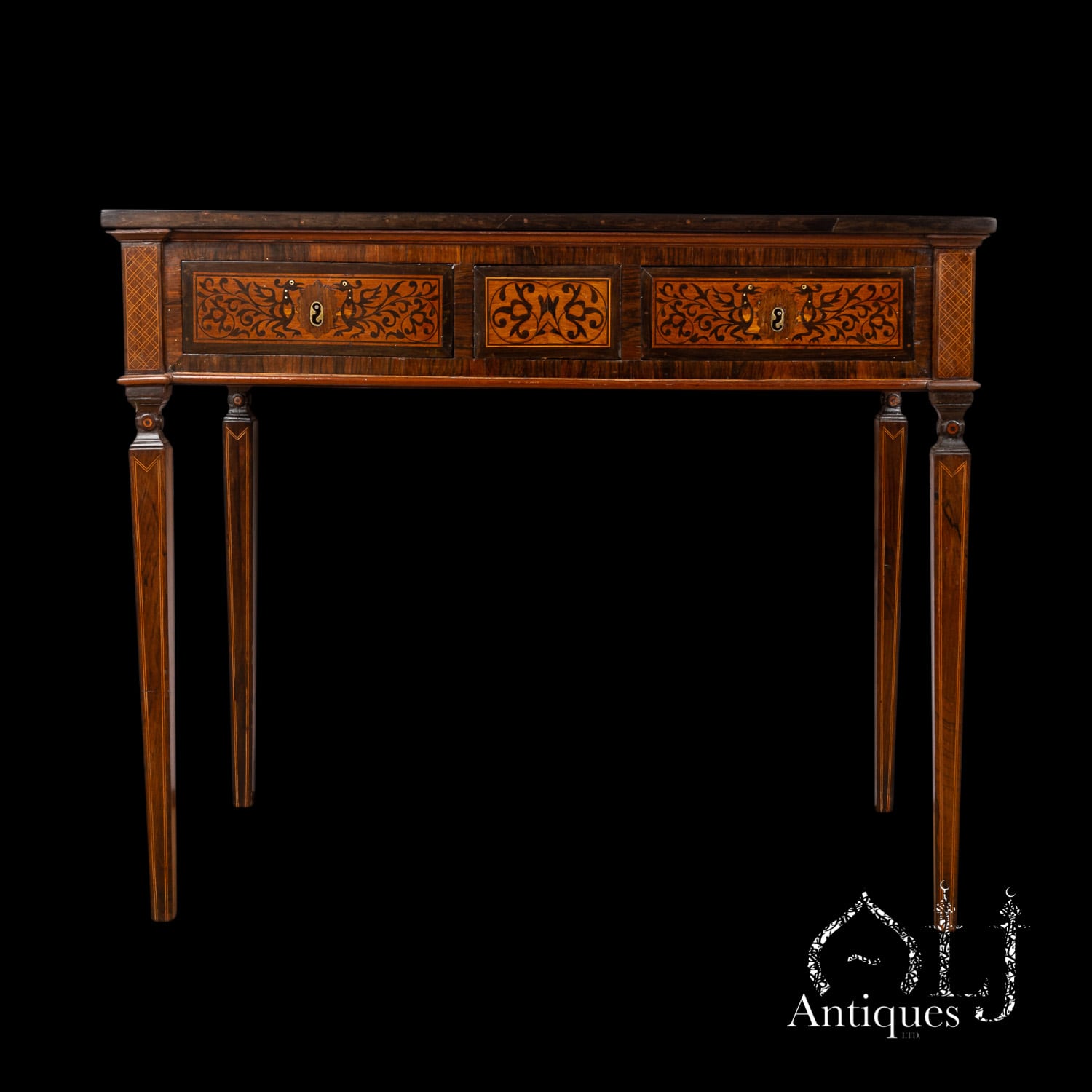
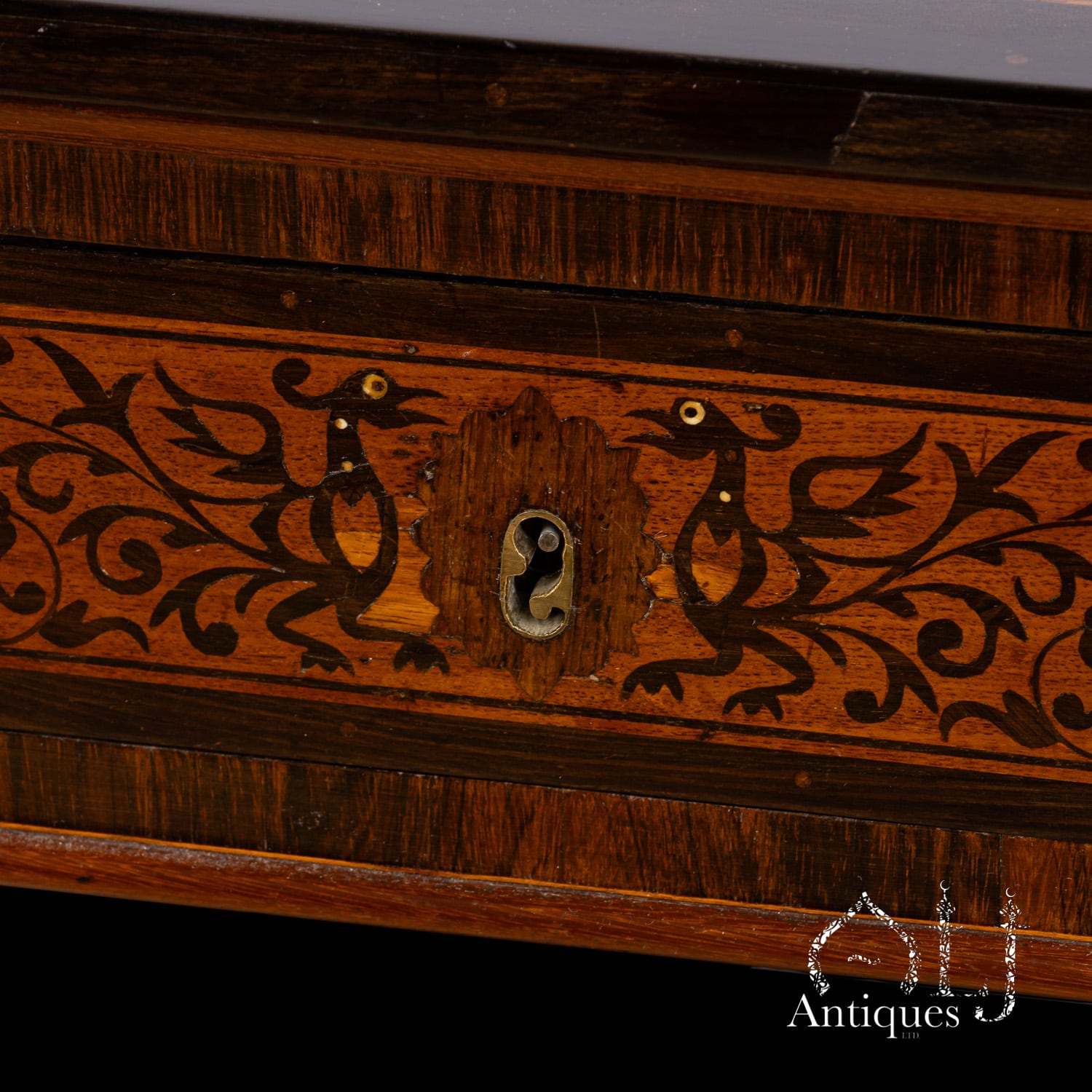
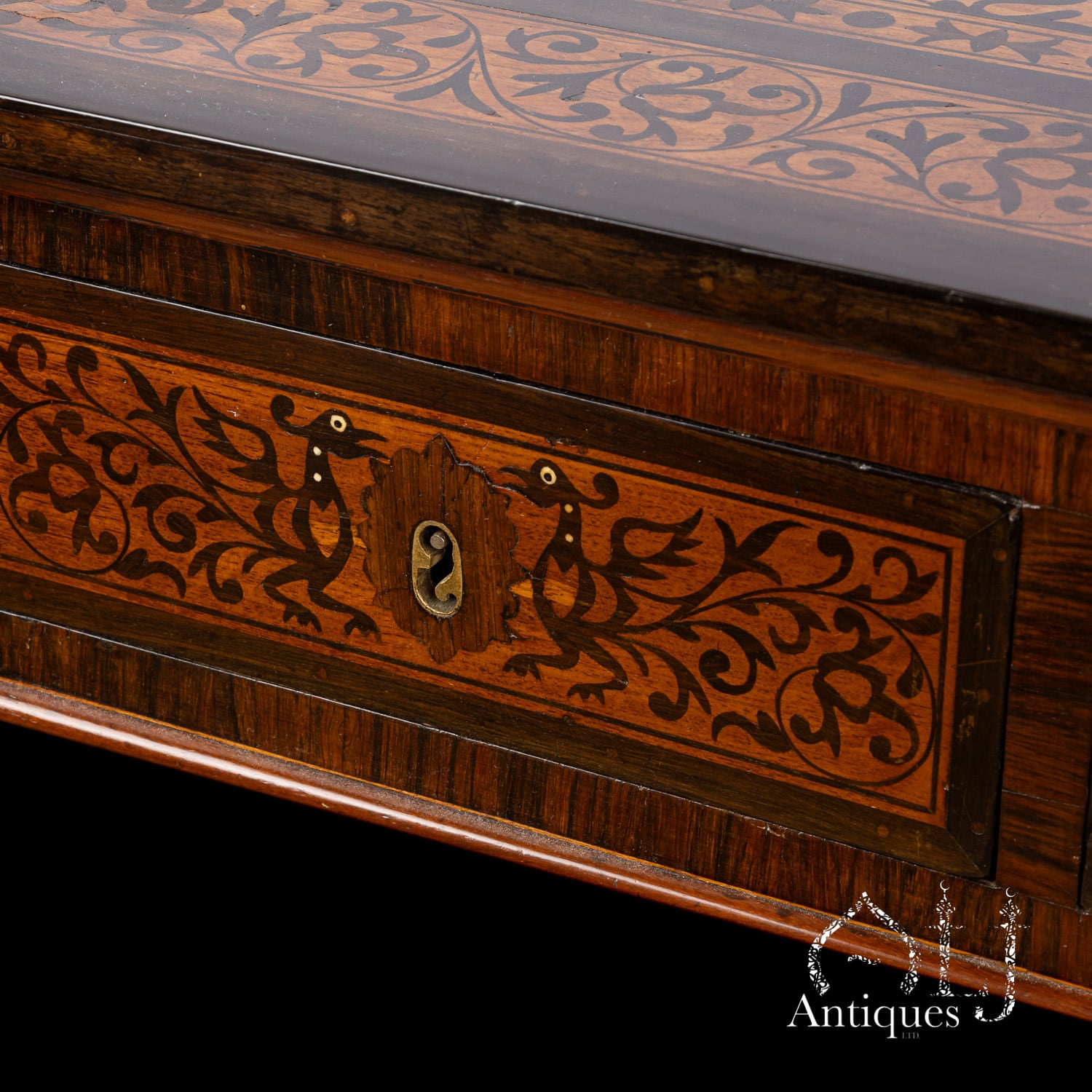
The front contains an unusual arrangement of three drawers, comprising two larger lockable drawers flanking a much smaller central drawer. The two larger drawers have no conventional projecting handles or pulls; instead, the keys are inserted into the locks and used to pull the drawers forward.
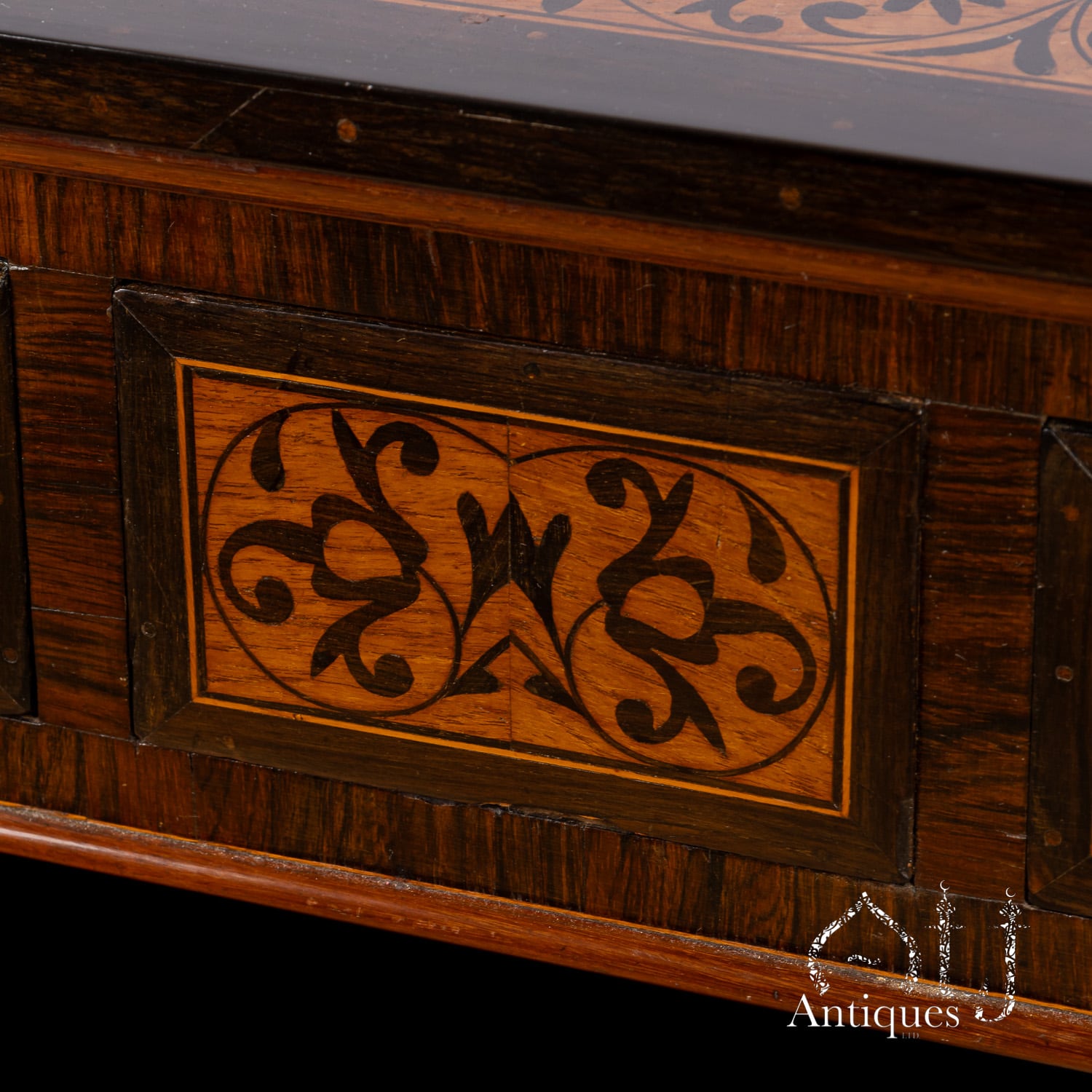
The smaller central drawer is particularly interesting. It cannot be opened directly from the front and is accessible only after one of the larger flanking drawers has first been withdrawn, allowing the smaller drawer to be released from within. Its discreet arrangement suggests that it may have been intended as a concealed or secret compartment, suitable for keeping small personal objects, documents, coins or other valuables.
The fronts of the two larger drawers are richly ornamented with scrolling foliage incorporating pairs of confronted stylised or mythical birds. Related fantastic birds occur throughout seventeenth-century Indo-Portuguese and Western Indian furniture. They have variously been interpreted in the literature as Jatayu-type sacred vultures from Hindu mythology or as simurghs and related Indo-Persian mythical birds. Given the stylised character of the present examples, it is preferable not to impose a definitive identification, but their presence provides another important link with the established decorative vocabulary of Indo-Portuguese furniture.
The smaller central drawer is likewise decorated with a symmetrical foliate composition, maintaining the visual continuity of the richly ornamented façade.
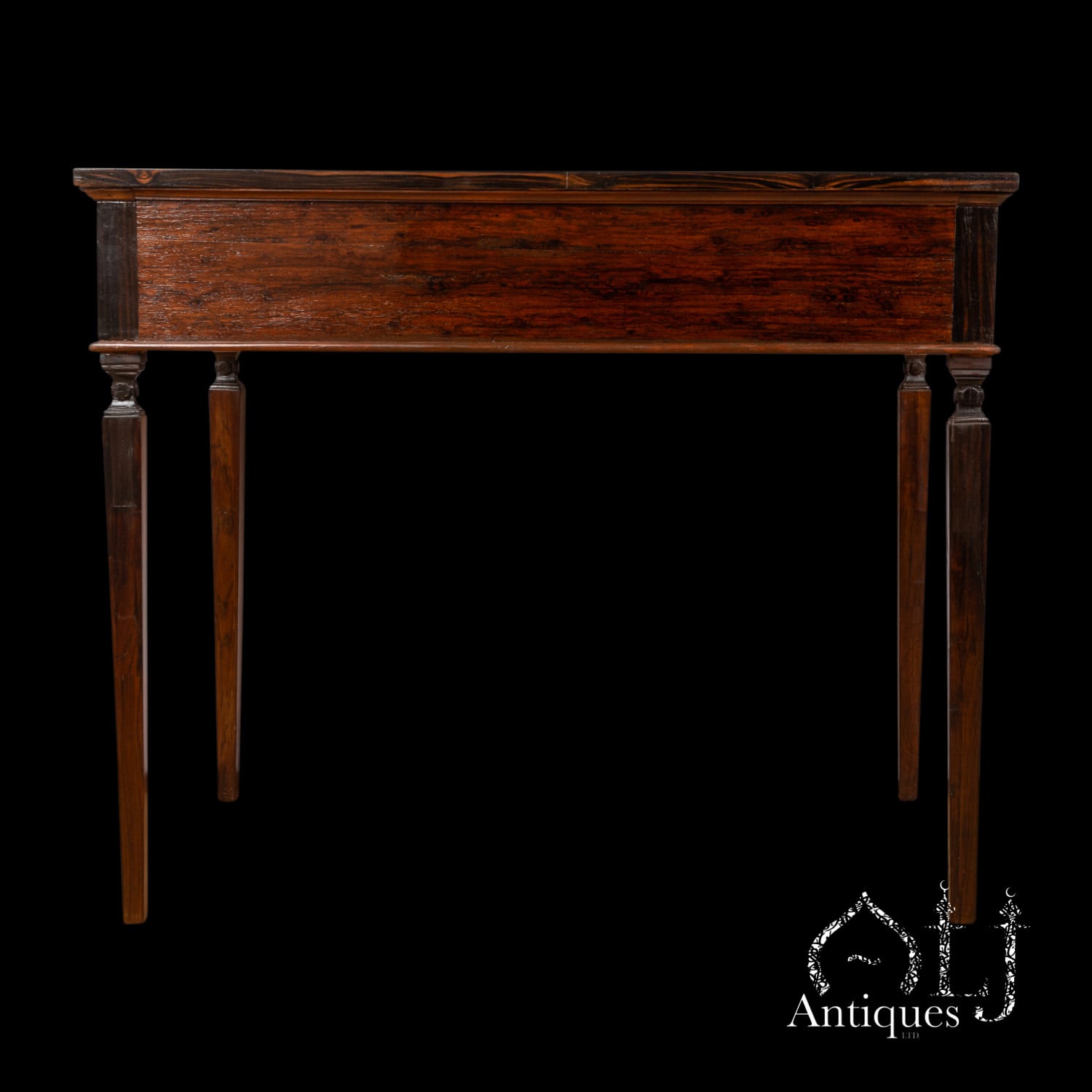
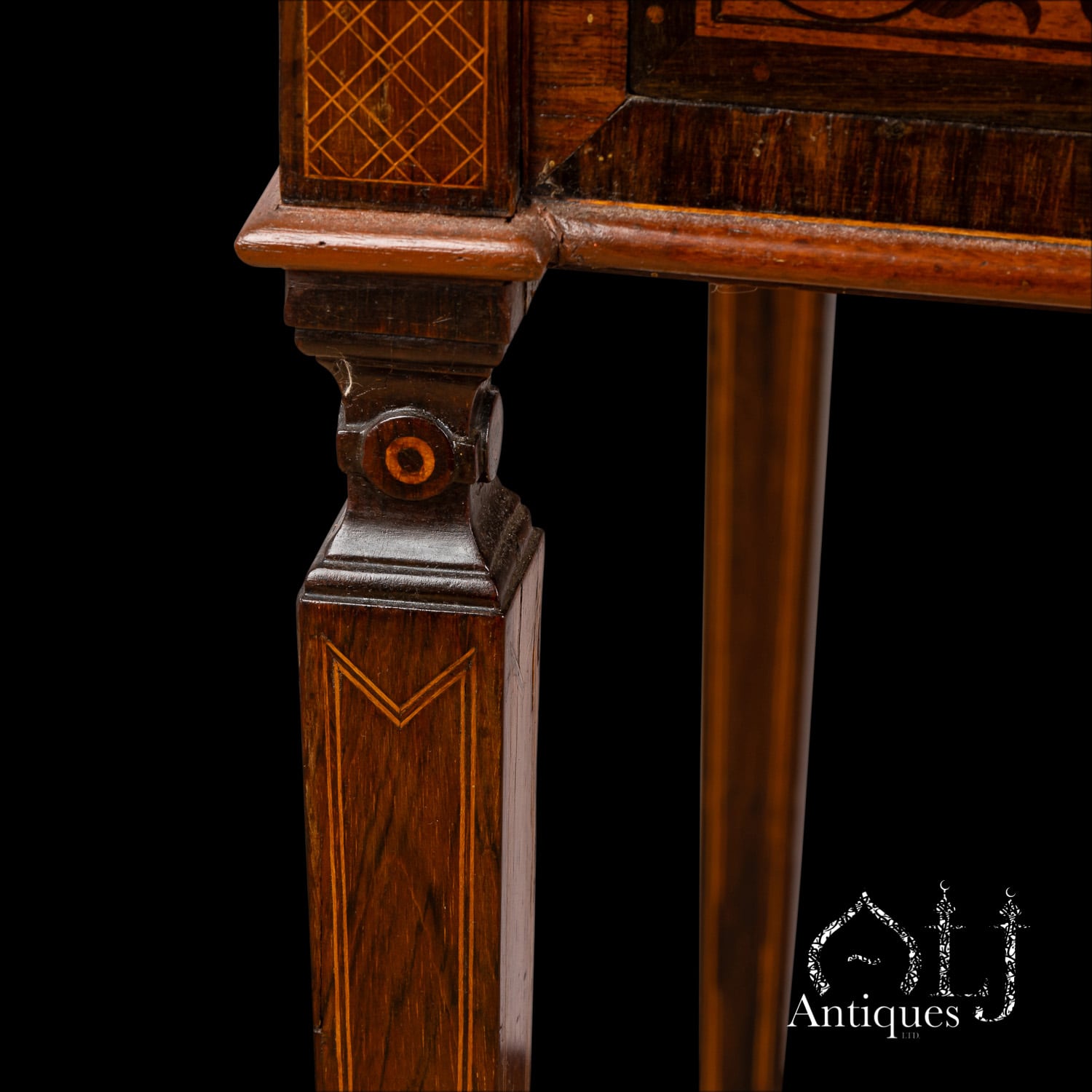
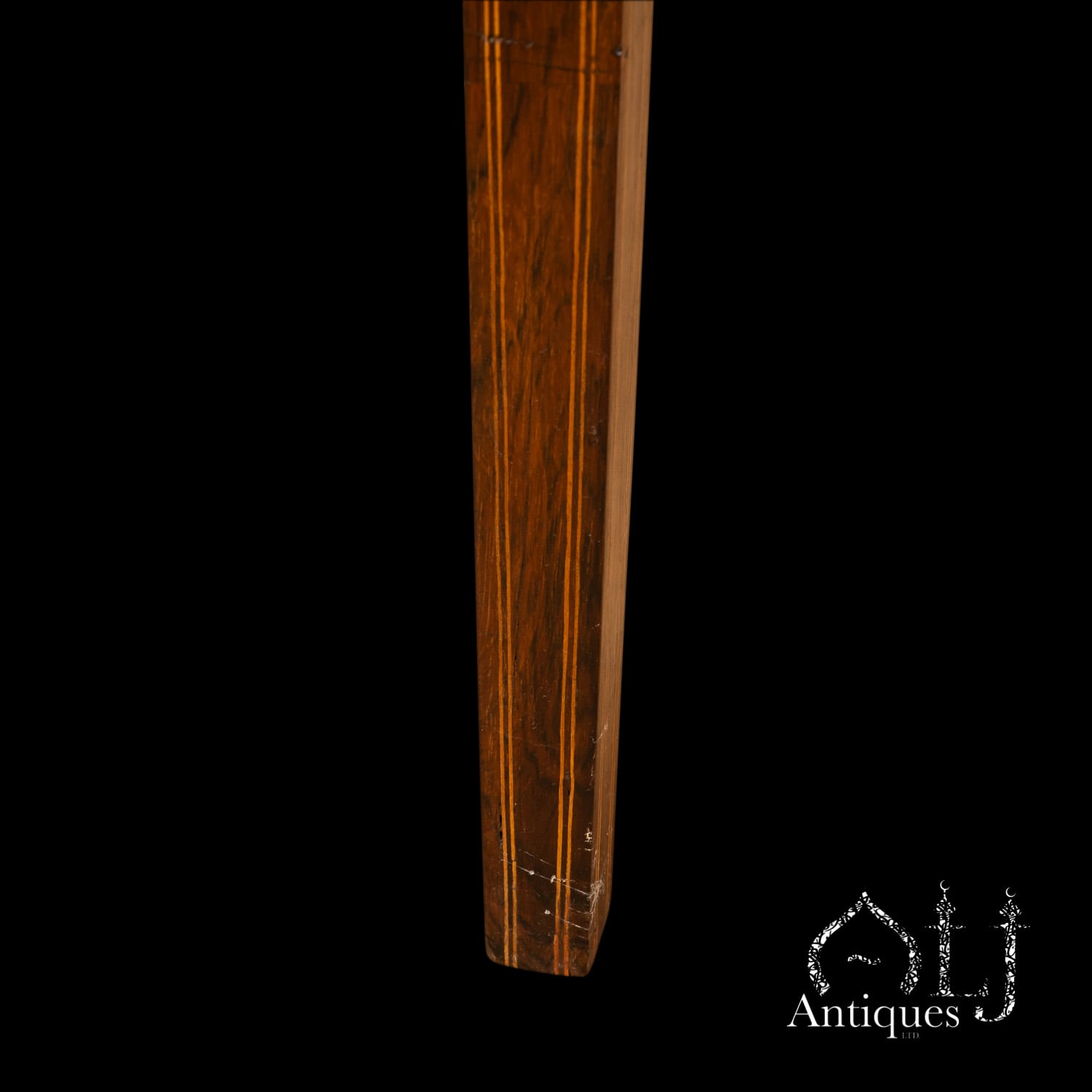
The table is supported on four slender, square-section tapering legs, considerably more restrained than the tabletop and drawer fronts, but nevertheless enriched with contrasting linear and geometric decoration and small circular inlaid details. This balance between the relatively architectural form of the table and the extraordinary density of its surface ornament is characteristic of the finest furniture produced for European patrons in India during the seventeenth century.
The attribution deserves some qualification. Closely related tables and cabinets have traditionally been associated with Goa, the principal Portuguese centre in India and an important centre for the production, commissioning and circulation of luxury furniture. However, modern scholarship has increasingly recognised the importance of Gujarat and Sindh in the manufacture of sophisticated inlaid furniture intended for European patrons.
Contemporary European accounts record the manufacture of desks, writing cases, cabinets and related luxury furniture decorated with contrasting woods and ivory at Thatta in Sindh and Surat in Gujarat. These documentary references have become fundamental to the modern reassessment of a substantial group of furniture previously classified more broadly as Indo-Portuguese or Goan.
The present table therefore occupies an especially interesting position within this wider tradition. Its European-derived writing-table form and prominent crowned armorial device point directly towards European patronage, while its dense vegetal marquetry, mythical birds and sophisticated manipulation of contrasting woods belong unmistakably to the artistic vocabulary of the Indian subcontinent.
In the absence of documentary evidence connecting, it with a specific workshop, Western India, probably Gujarat or Goa, provides the most appropriately cautious attribution.
The quality and extent of its decoration, its unusual three-drawer arrangement with concealed central compartment, and above all the survival of a prominent and potentially identifiable crowned coat of arms distinguish the table from more conventional surviving examples of Indo-Portuguese writing furniture.
Registration of an Item with Percentage of Ivory Submission Reference
CXLDAT93