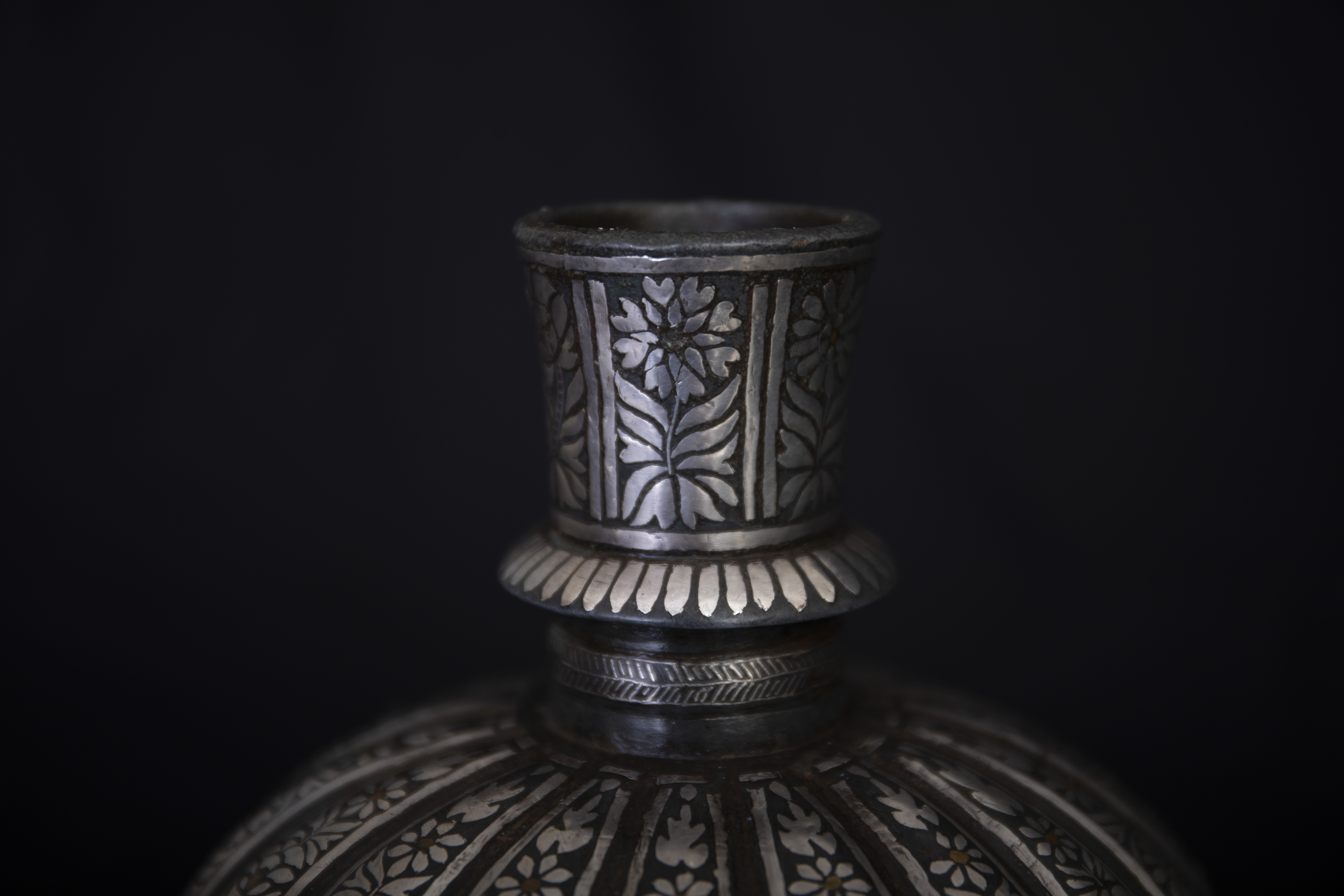
A Fine Bidri Silver- and Brass-Inlaid Globular Huqqa or Hookah Base Bidar, Deccan, Central India, early 18th century

Identification Number: 657
Available

Description

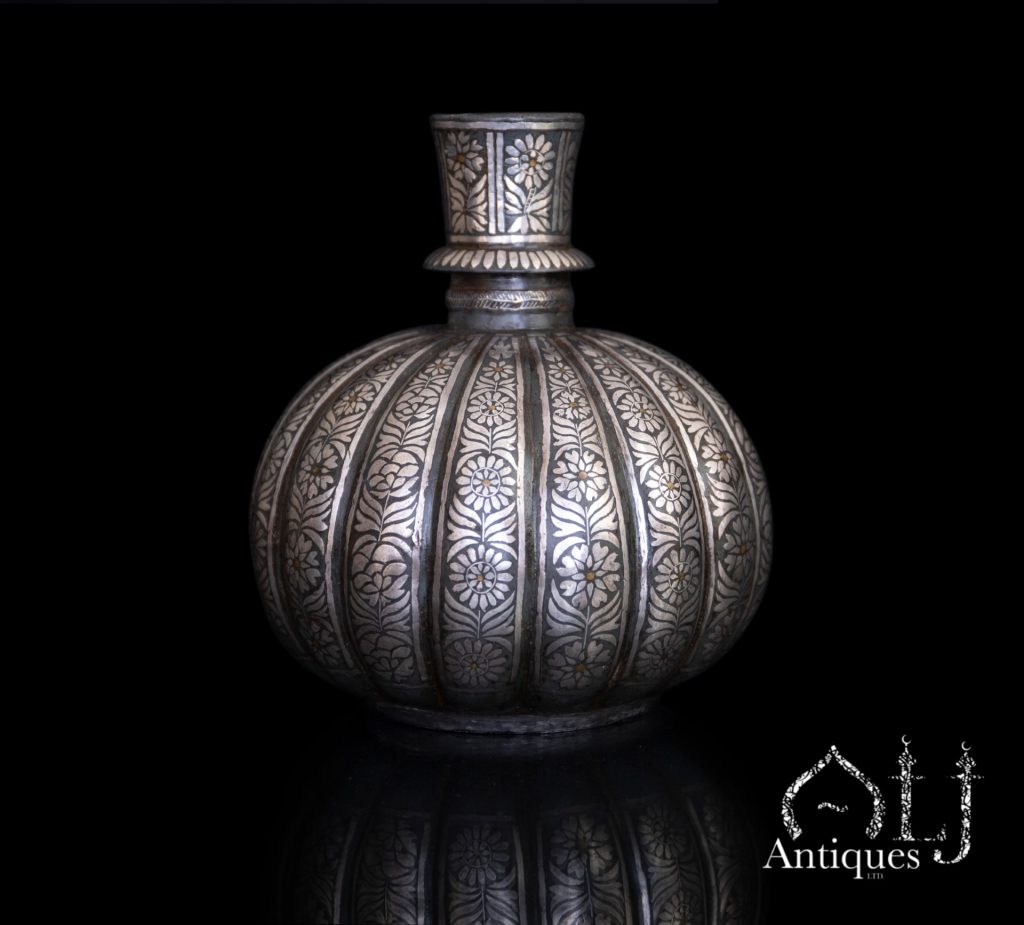
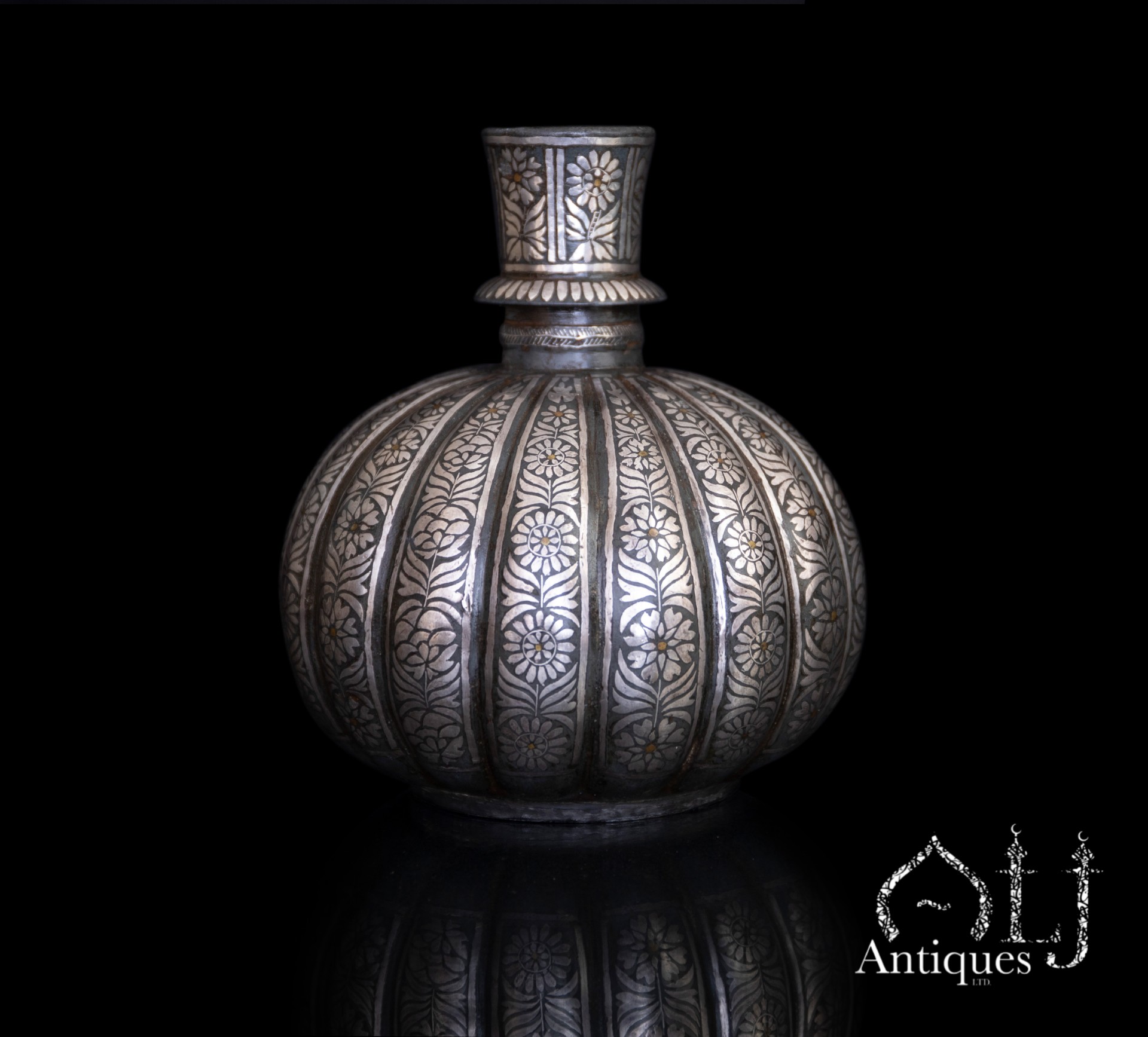
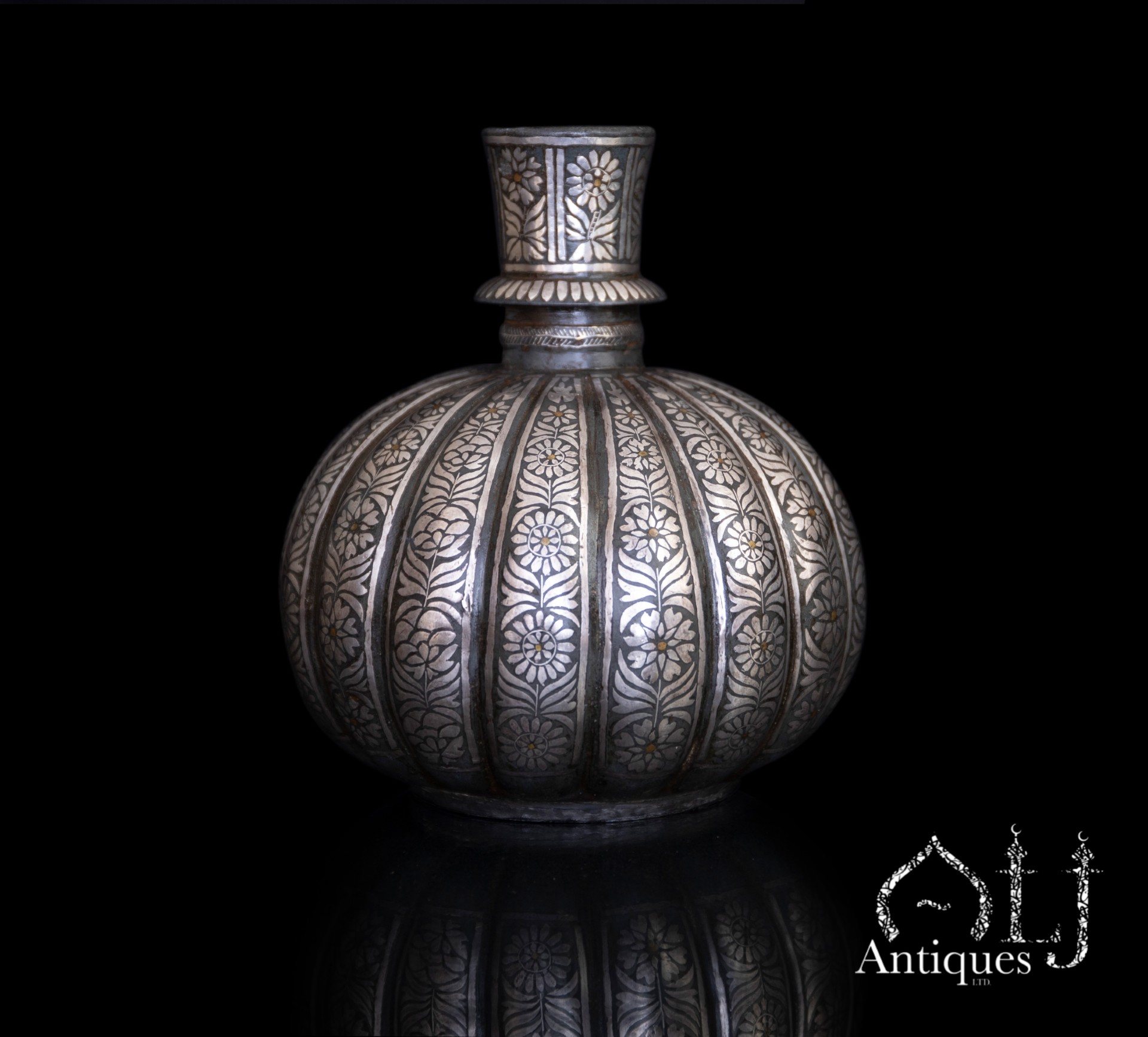
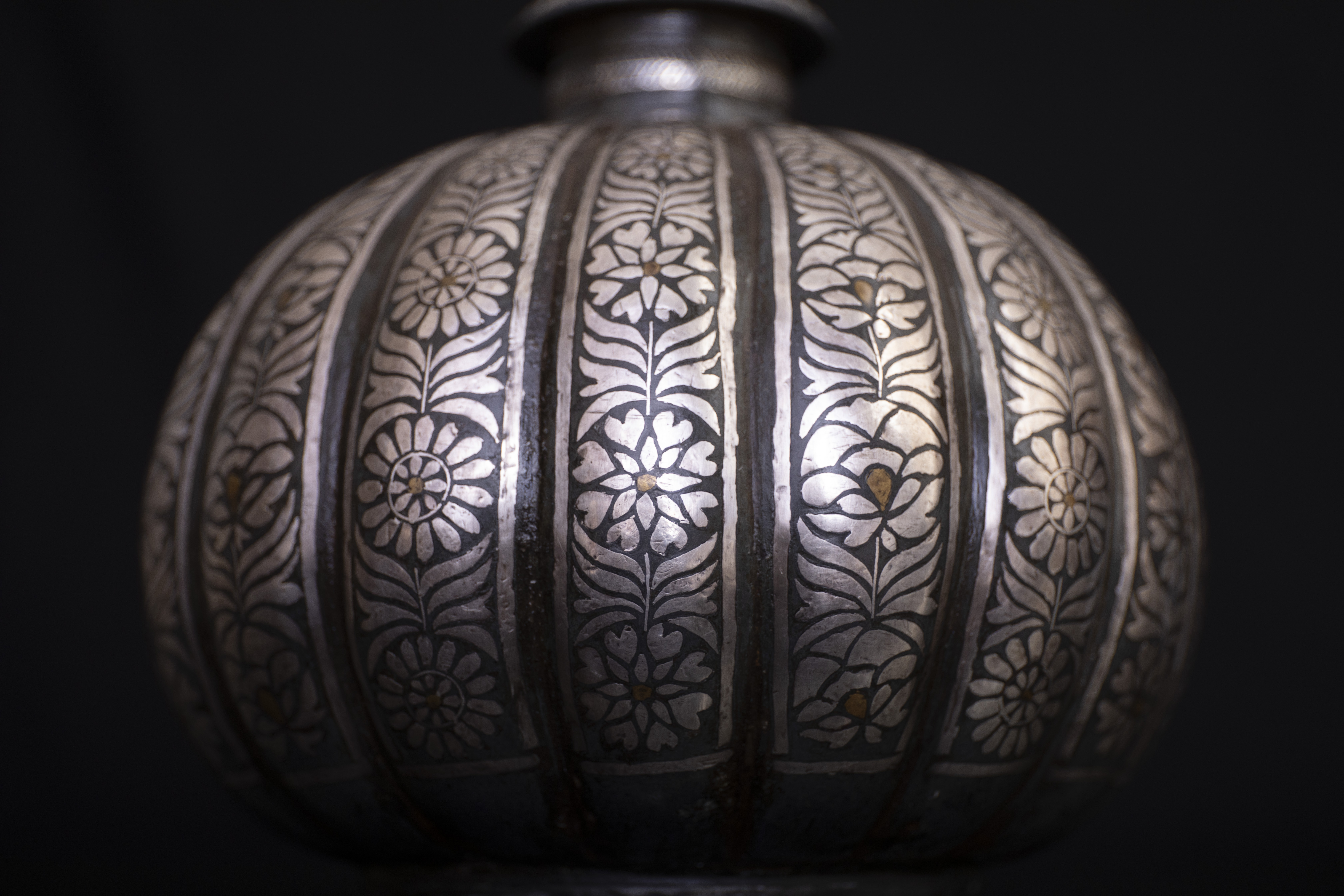
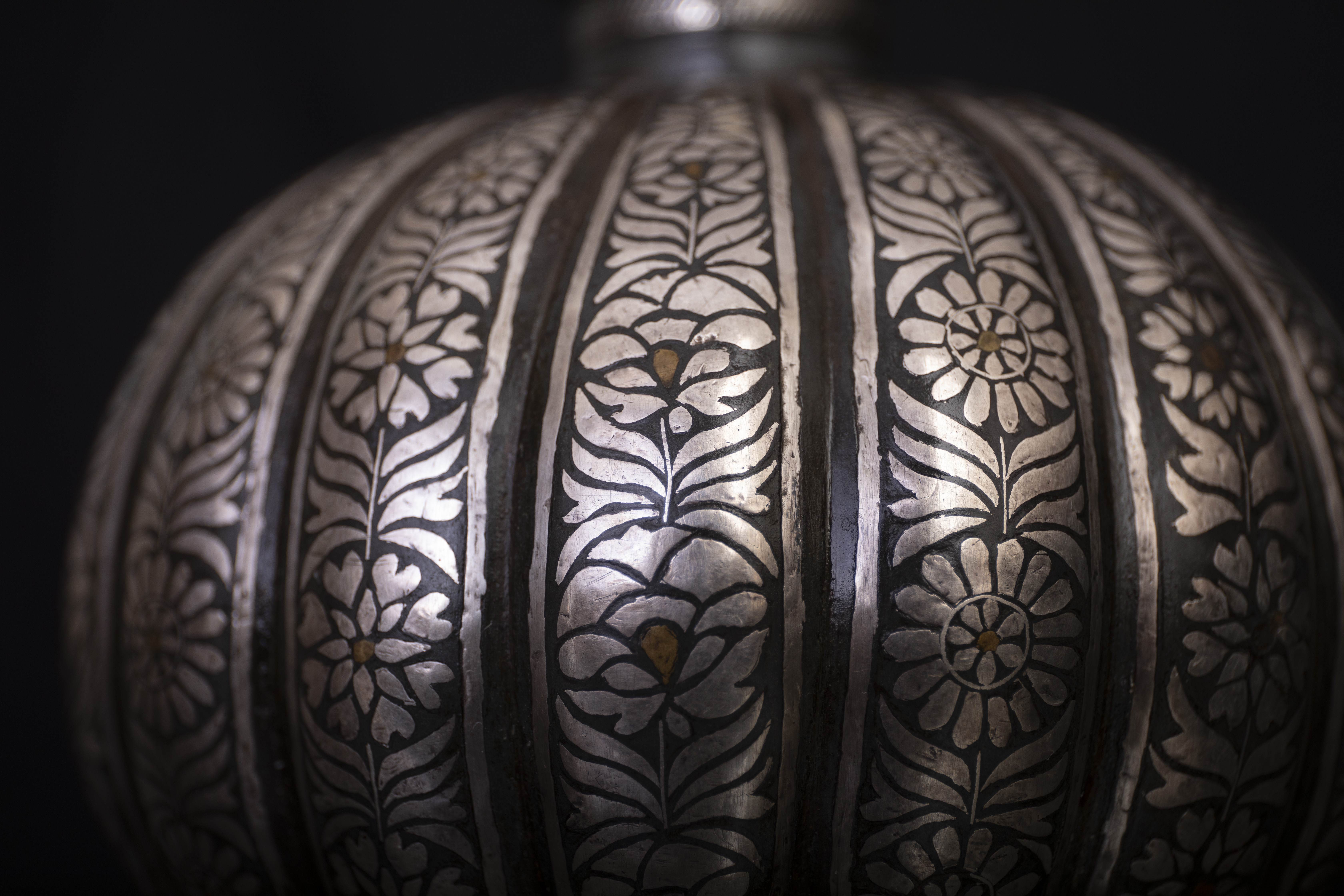
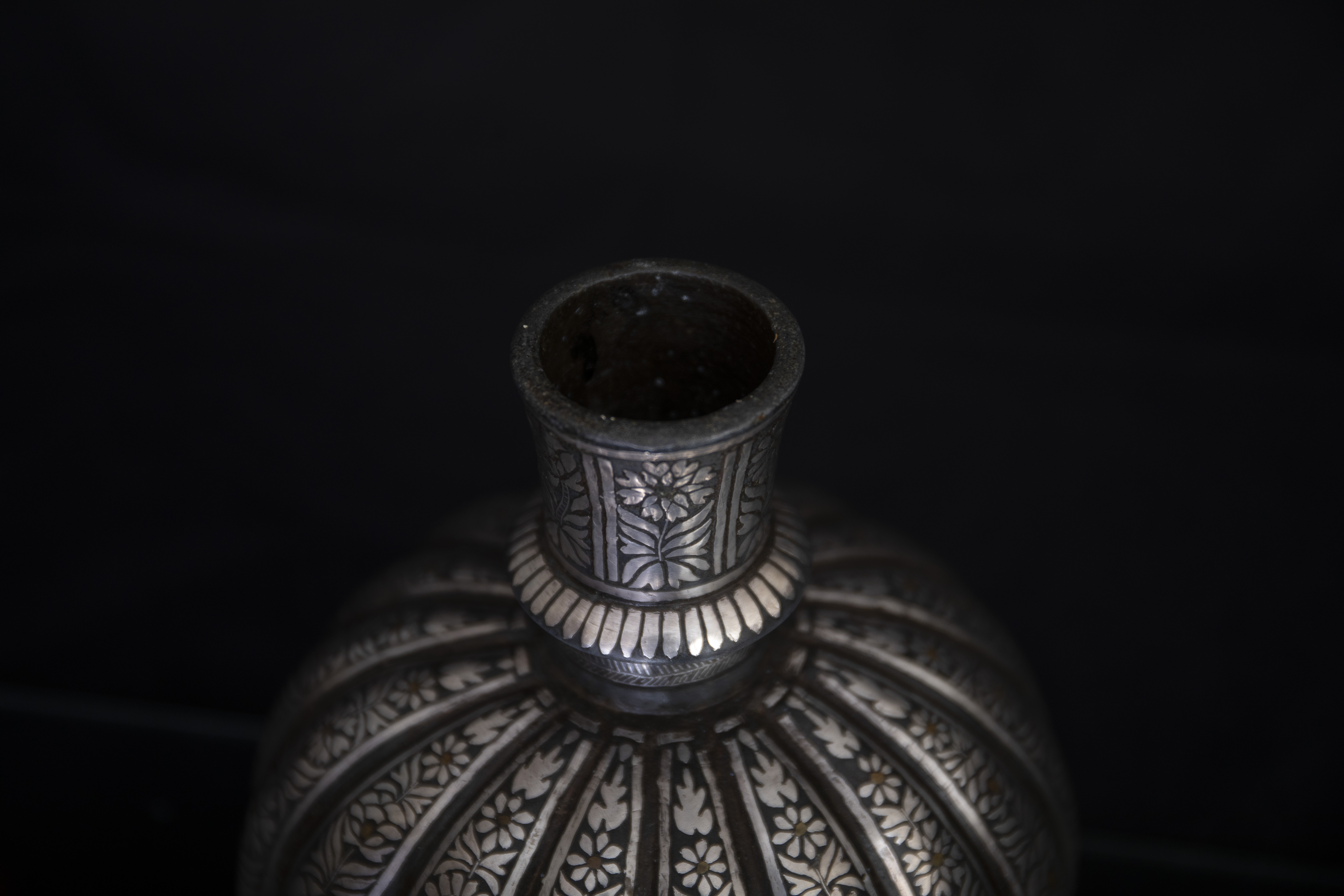
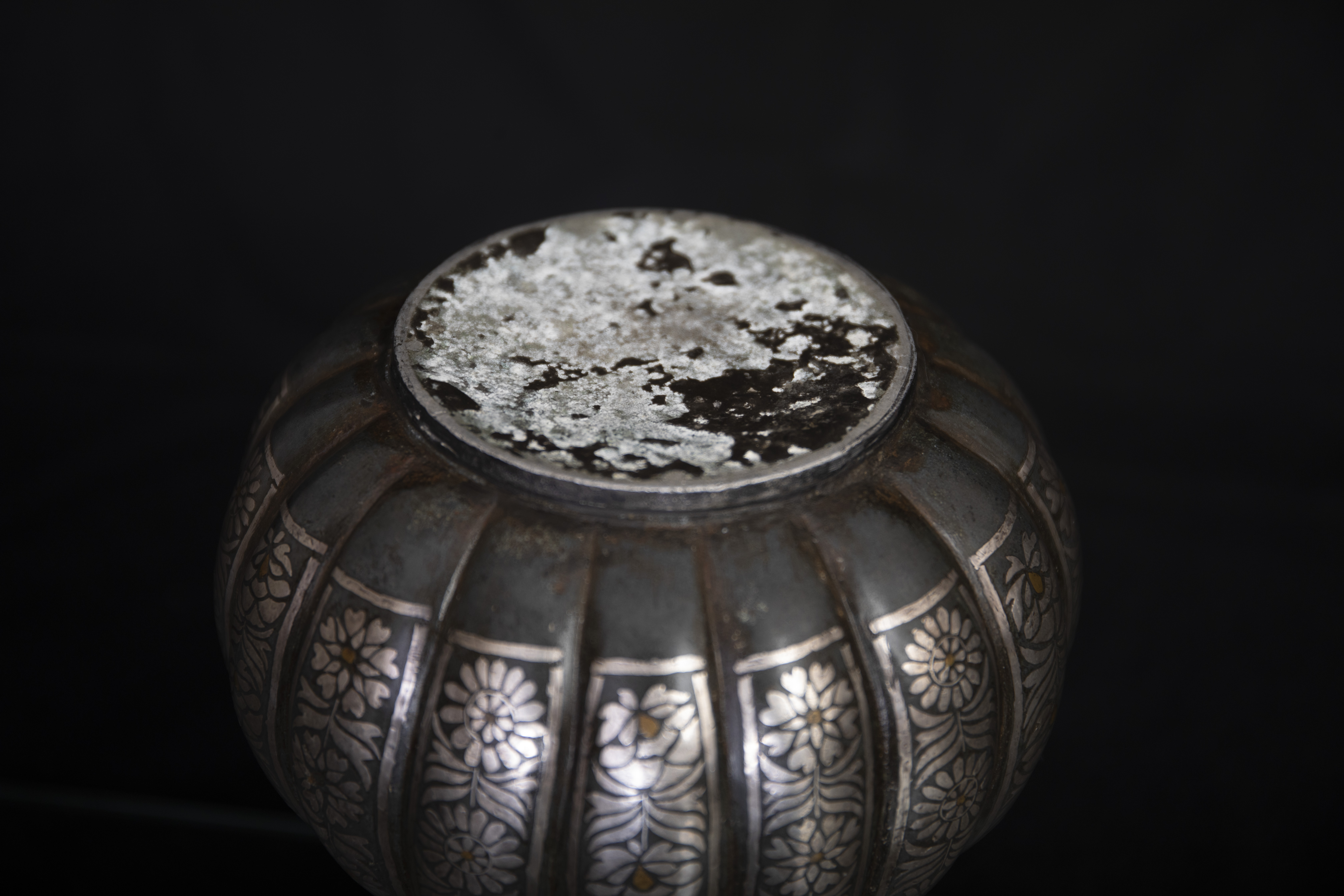
This elegant huqqa base, characterised by a lobed globular body, a ringed shaft, and a flared cylindrical neck with a gently everted rim, is crafted from the characteristic blackened zinc alloy of Bidar (bidri) and richly polychrome-inlaid with silver and brass. Its convex surface is enriched with alternating vertical ornamental panels arranged in harmonious rhythmic bands of flowering marigolds, poppies, radiating daisies, and rosettes. The collar is further embellished with serrated leaves, while the shaft and neck present cusped lotus petals, a chevron band, and rectangular panels infilled with individual blossoms, visually connecting this register to the main body.

The overall design demonstrates a sophisticated interplay of two-tone metals that accentuates the sculptural lobed and convex form of the huqqa base, creating a sense of swelling luminosity against the deep matte-black ground produced through the traditional Bidri oxidation process.

The botanical decoration of this specimen is particularly noteworthy for its emphasis on flowering poppies, stylised daisies, and marigolds—typical flowers of the Indian Subcontinent—often incorporated on Bidri wares for their rhythmic, almost textile-like repeating patterns. The ornamental variety, together with the fine silver and brass inlay catching the light with remarkable clarity, produces a shimmering pictorial effect, suggesting that this base was produced by highly skilled craftsmen accustomed to high-end commissions from royal and aristocratic circles.

This huqqa’s characteristic lobed globular silhouette recalls Mughal and Deccani prototypes of the late 17th and first half of the 18th centuries. Its rib-like, swelling form and vertical ornamental articulation draw close parallels with a huqqa base formerly in the collection of William Tayler, an official of the East India Company from 1829 to 1859, now in the Victoria and Albert Museum, London (inv. no. 856-1874), published in Susan Stronge, Bidri Ware: Inlaid Metalwork from India, 1985, pp. 46–47, cat. no. 9.

Another close comparable is the globular huqqa base with lobed lotus collar in the collection of the Jagdish and Kamla Mittal Museum of Indian Art, Hyderabad (attributed to mid-18th-century Bidar; see Jagdish Mittal, Bidri Ware and Damascene Work in Jagdish & Kamla Mittal Museum of Indian Art, 2011, pp. 106–107, cat. no. 28), both displaying the same refined Deccani preference for deeply scalloped sectioning and meticulously balanced vegetal ornament distributed across the fluted registers.

The Louvre Museum also preserves a related huqqa base (inv. no. MAO 719), formerly part of the Ariane Faye Collection, recently exhibited at the Hôtel Département des Expositions du Var, Jardins et Palais d’Orient, Draguignan (14 December 2024 – 6 April 2025). Lastly, another relevant parallel may be drawn with the brass- and silver-inlaid huqqa base attributed to late-17th-century Bidar, published in Mark Zebrowski, Gold, Silver & Bronze from Mughal India, 1997, p. 234, cat. no. 390. Although that example is rendered unique by its combination of figural and botanical motifs in the vertical registers, its floral selection is remarkably close to that of the present example.


Acknowledgment

The above text and literature were produced with the valued collaboration of Ms. B. C. (with thanks).
Condition

Special note on the general condition of historic huqqa bases:
Due to their age and repeated use, the majority of historic huqqa bases would naturally have undergone specialised care and expert conservation at some stage in their lifespan.

As is typical with most old huqqa bases, the separately attached—or partially attached—underside section of the plain base is often partly damaged, cracked, or occasionally lost, perhaps due to the use of hot water inside the vessel or stress caused by movement. Specialists in the field consider such features indicators of authenticity and age.

In the present example, the underside base appears to have been replaced with another at some point in its history. Overall, the upper and main body of the huqqa is in excellent condition. Very minor superficial scratches are present, consistent with age and use. There is no clear evidence of losses to the original silver inlay; gentle rubbing, wear, and oxidation are visible on the rim and base. Importantly, there is no evidence of major breaks or structural damage, and the main huqqa body remains intact and stable.

Provence

The EU Art Market

References

References

Jagdish Mittal, Bidri Ware and Damascene Work in Jagdish & Kamla Mittal Museum of Indian Art, 2011.

Mark Zebrowski, Gold, Silver & Bronze from Mughal India, 1997.

Susan Stronge, Bidri Ware: Inlaid Metalwork from India, 1985.

A comparable example was sold at Sotheby’s, London, Islamic and Indian Art, 24–25 April 1991, lot 694. Although Sotheby’s dated that lot to the 19th century, its form and decoration closely correspond to late 17th–early 18th-century Deccani prototypes (see Susan Stronge, cat. no. 9). It is likely that the tray or salver that originally accompanied this huqqa base has been lost or separated over time, a common occurrence with historical sets of this nature. This piece stands in line with comparable examples in the V&A Museum, the Jagdish and Kamla Mittal Museum, and the Louvre, all representing the finest tradition of early 18th-century Bidri metalwork.

Related Antiques

  • Rare Indian Silver and Nielloed Hookah Base with Beakers and Trays (Thali), Possibly Hyderabad or Golconda, Deccan Sultanates, circa 1780–1800

  • Japanese Art for the Islamic Market, A Very Unusual Cloisonné-Enamel Huqqa Base And Top, Japan 19 Century

    Sold
  • A Silver Gilt And Enamelled Water-Pipe Base (Huqqa),The Nawab Of Awadh, Uttar Pradesh, Lucknow, North India, Circa 1775.

    Sold
  • Bidriware, A Magnificent Zinc Alloy Inlaid With Silver & Brass Bidri Ware Presentation Tray (Thali), Bidar, Deccan, Central-India, Circa 17th Century.

    Sold
  • A Bidri Silver-Inlaid Bell-Shaped Huqqa Base with Mughal-Style Floral Bouquets, Bidar, Deccan, Central India, circa 1740s–1760s

  • Lucknow Enamelled Gulabdan, A Rare Silver Parcel-Gilt And Enamelled Rosewater Sprinkler, The Container In The Form Of A Mango Fruit, The Nawab of Awadh, Uttar Pradesh, Lucknow, North India, Circa 18th Century.

  • Bidriware, A Rare Zinc Alloy Inlaid With Silver Mango-Shaped Portable Hookah Bidri Ware, Bidar, Deccan, Central-India, Circa 18th Century.

    Sold
  • A Small Portable Gilt & Enamelled Silver Water-Pipe (Huqqah) Base, Upper Pradesh, Lucknow-India, 18th. Century.

    Sold