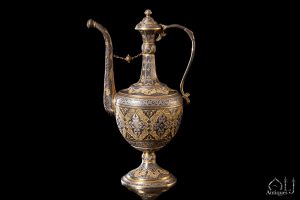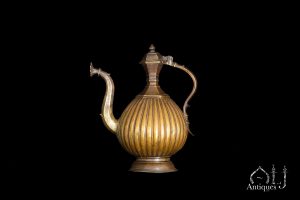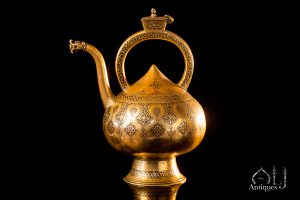
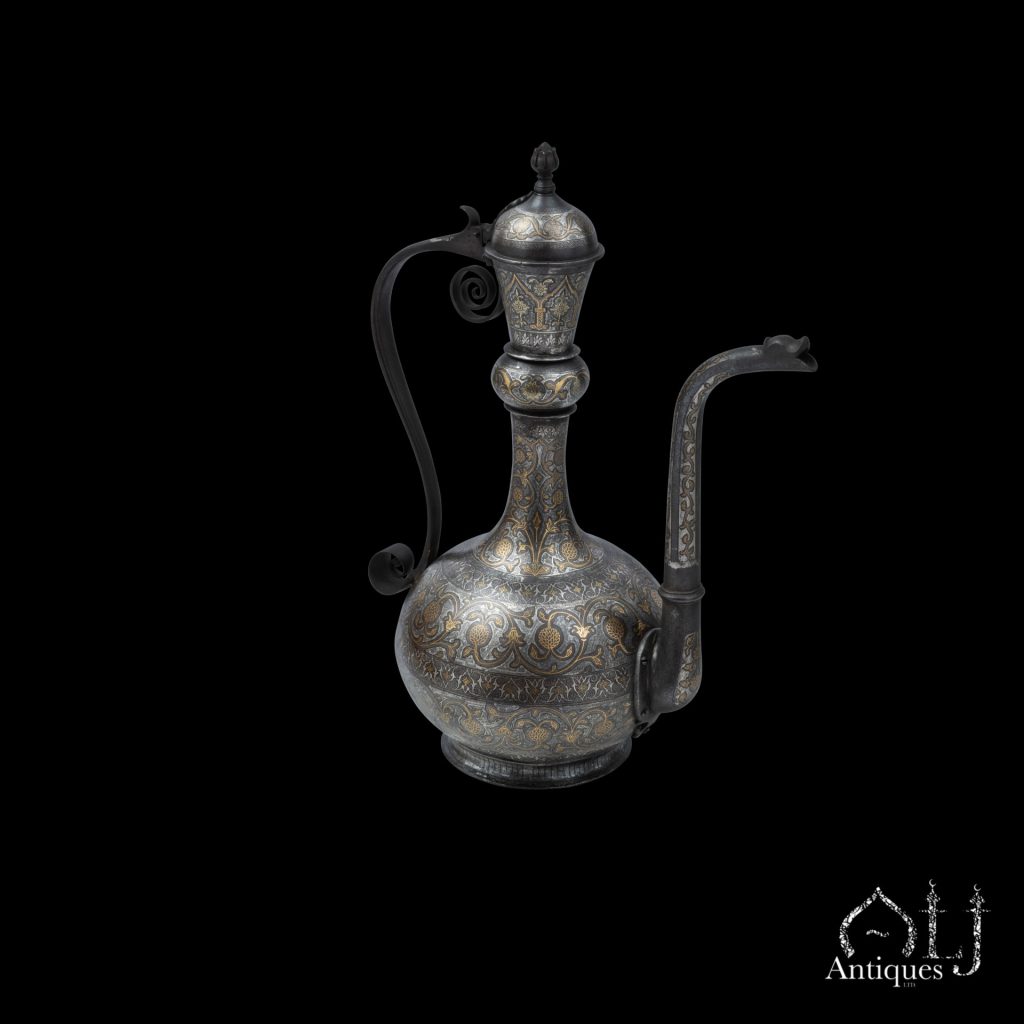
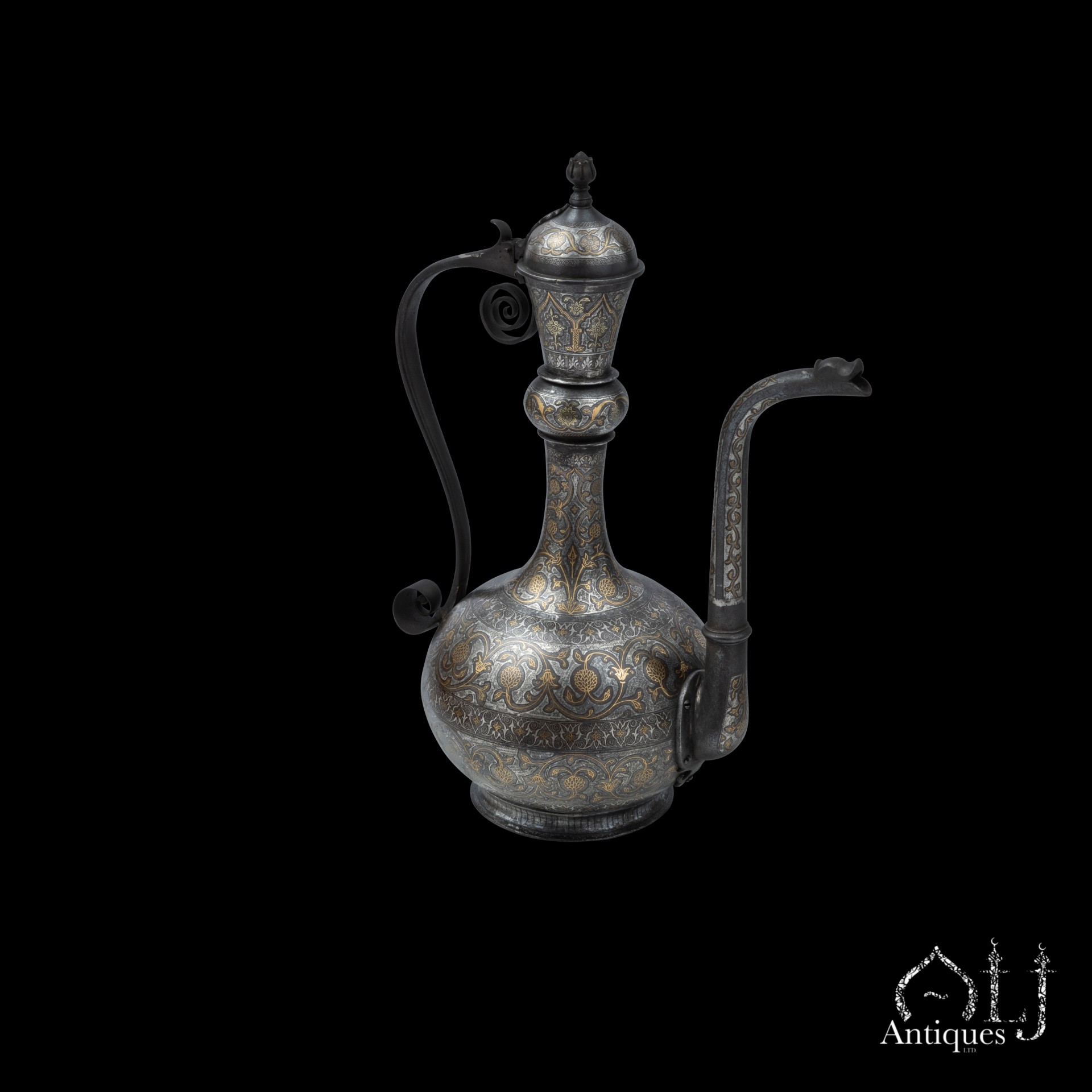
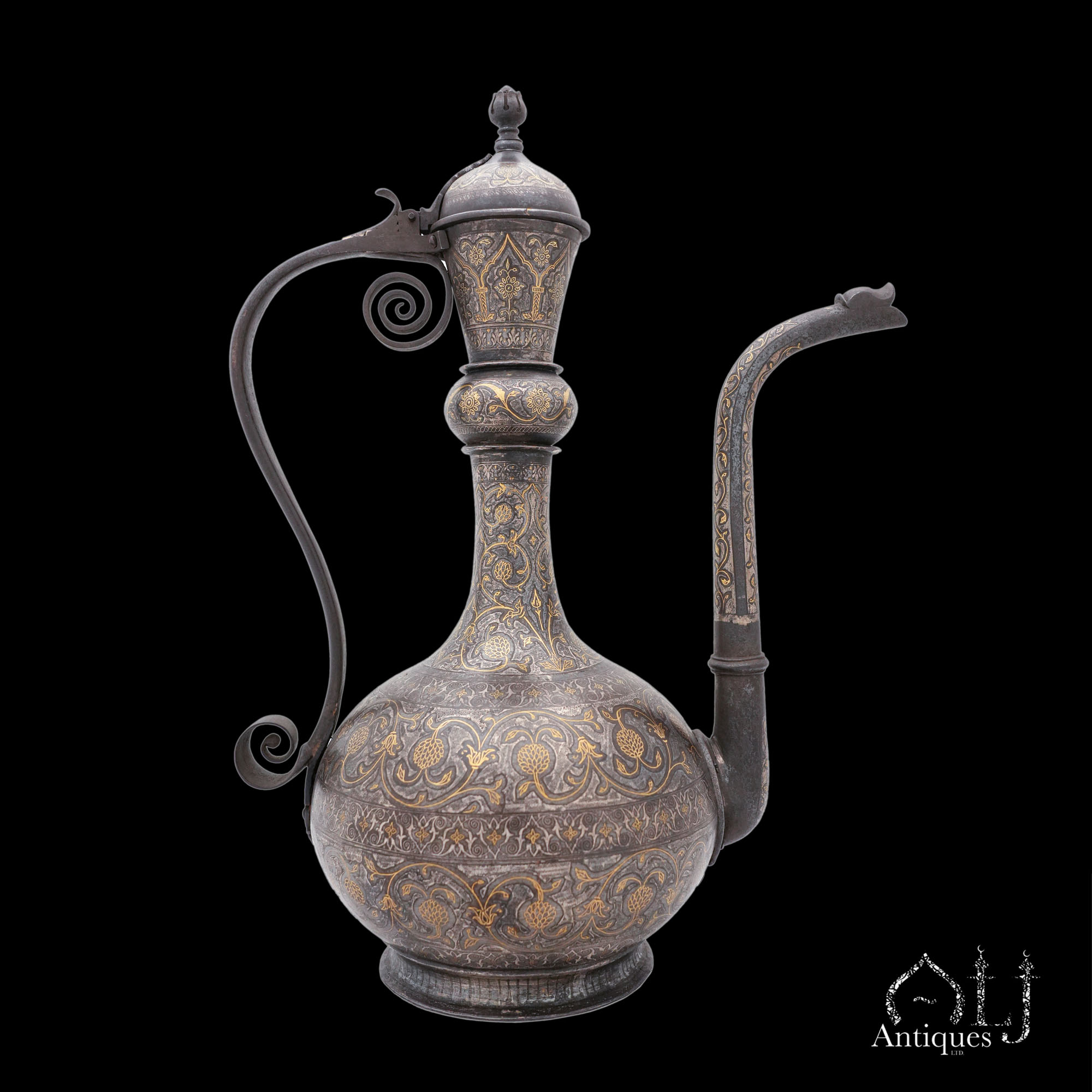
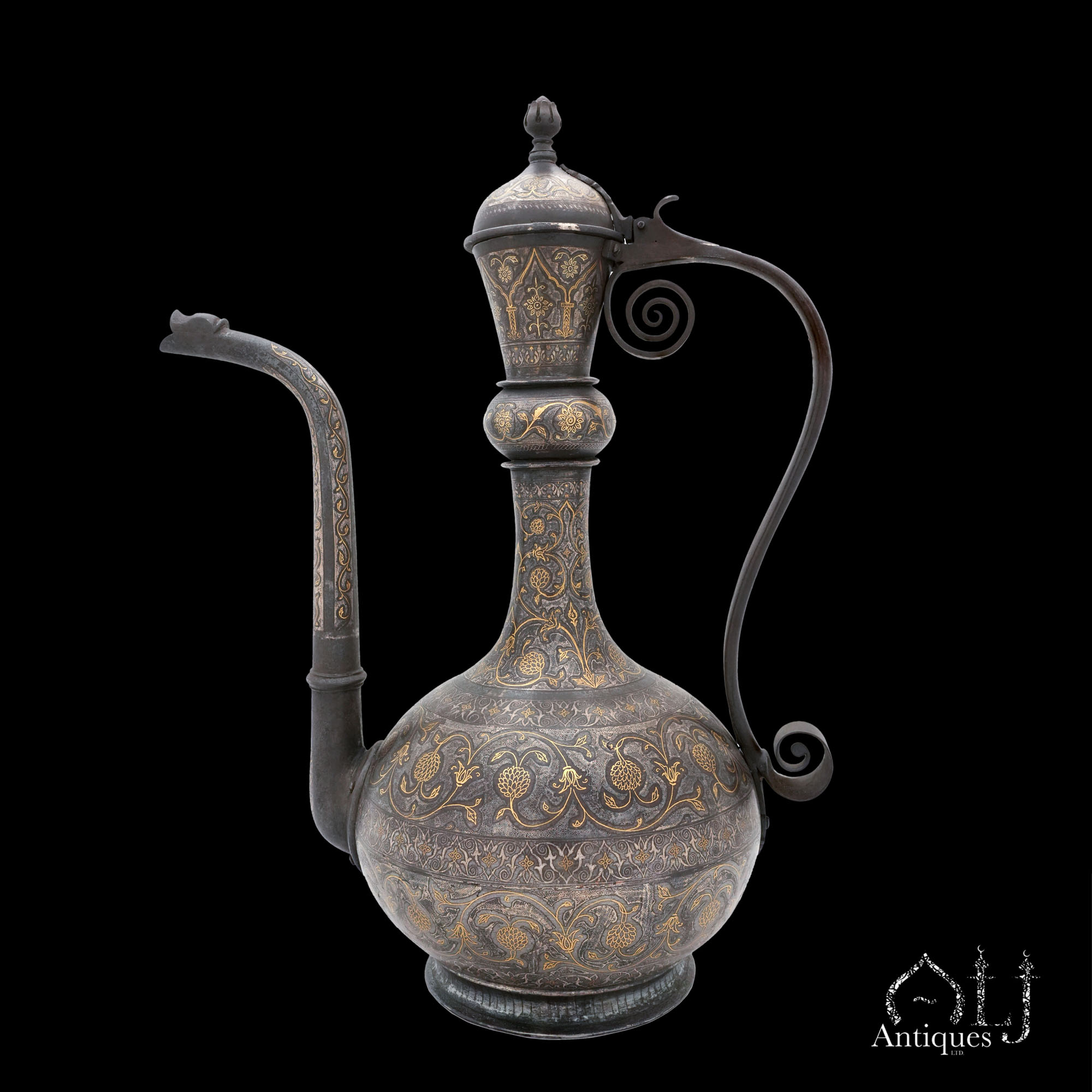
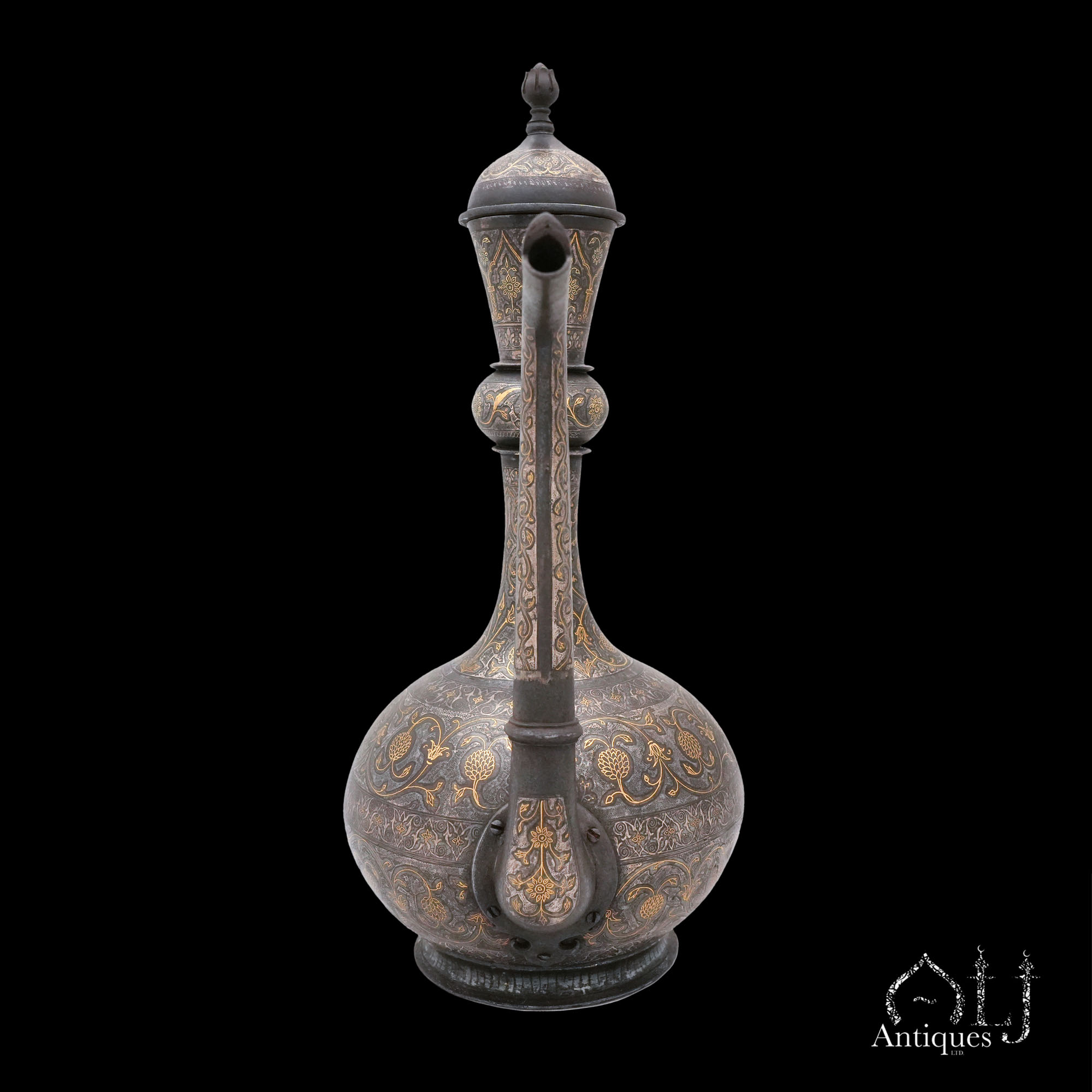
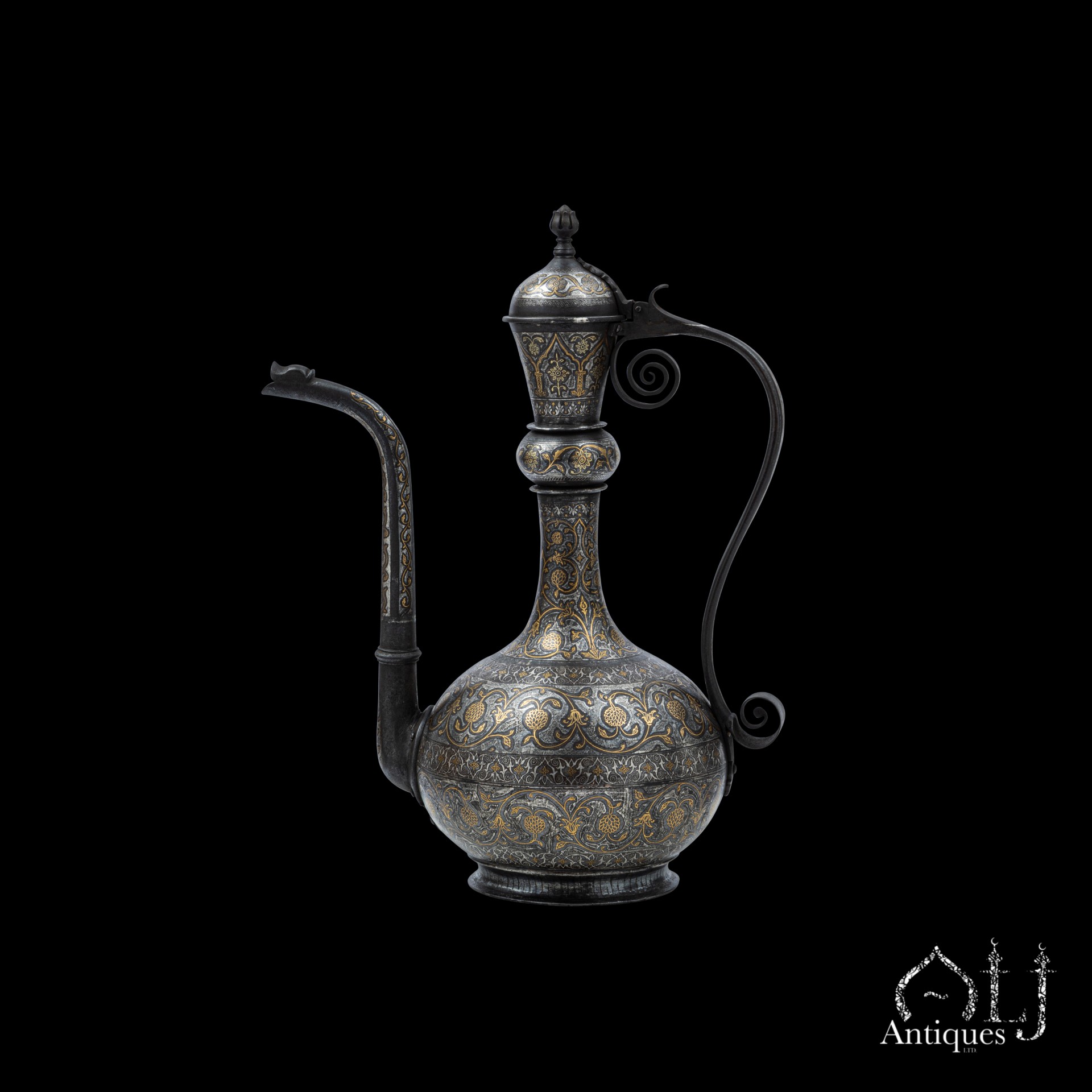
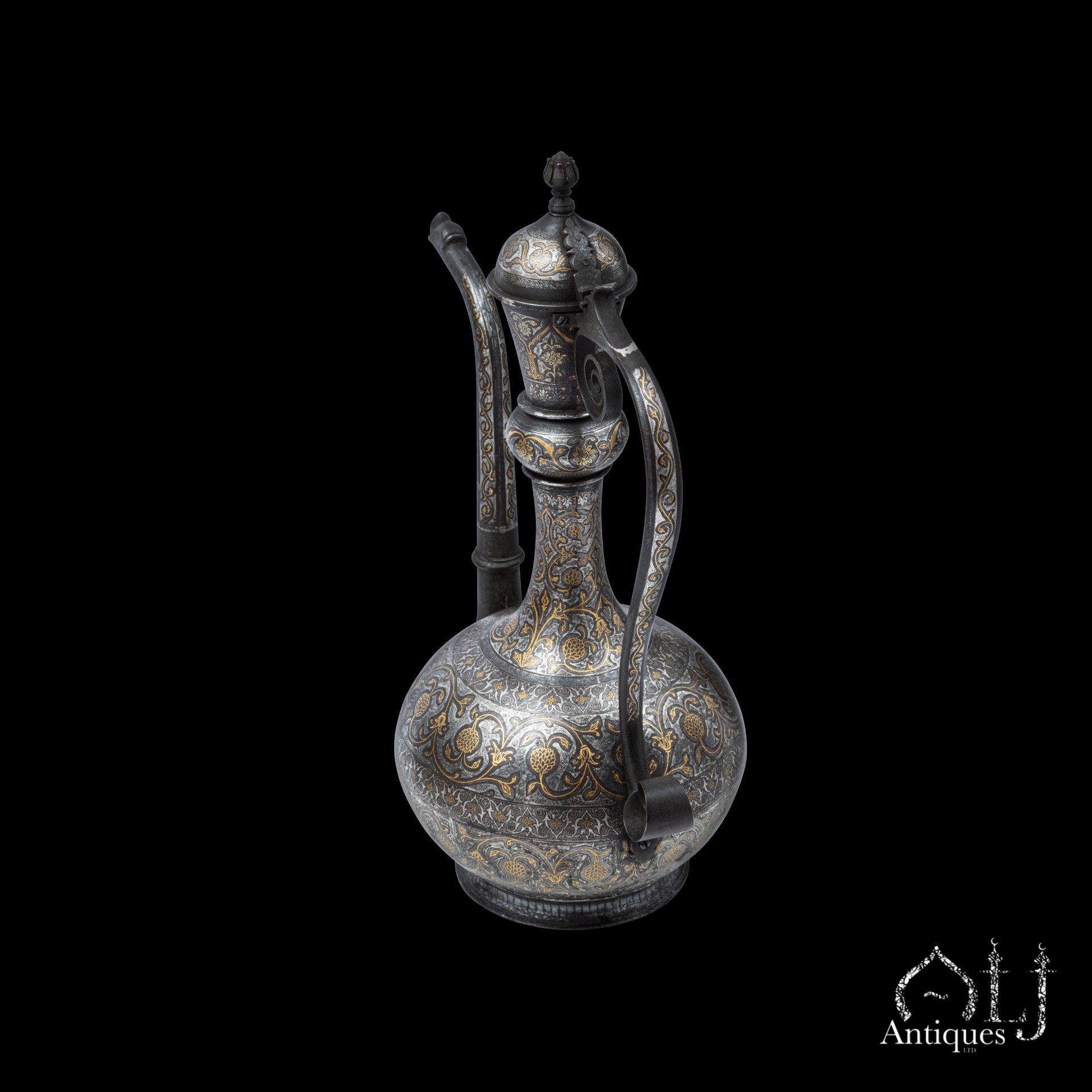
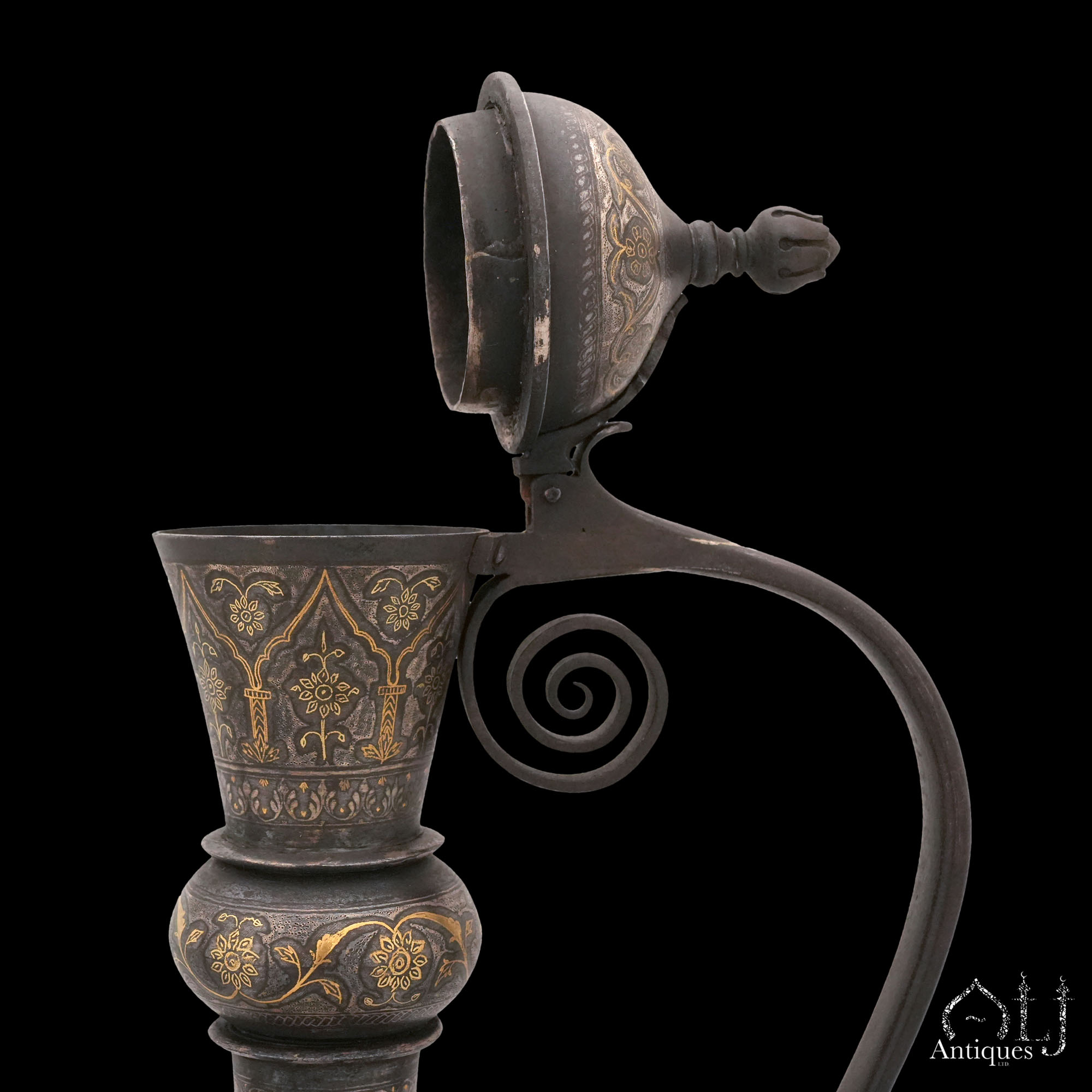
A Fine Gold & Silver Damascened (Koftgari) Steel Ewer, Punjab (Lahore), present-day Pakistan, circa 1881–1882 AD. Attributed to workshops associated with the Mayo School of Industrial Art.

Identification Number: 653
Available

Description

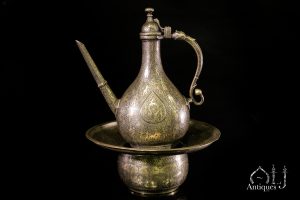
This finely crafted gold and silver damascened (Koftgari) steel ewer is of large piriform (pear-shaped) form, resting on a ring-shaped, slightly flared base, which has been entirely plated with a continuous band of rectangular silver-plated panels. The body rises elegantly to a tall, waisted neck, accentuated by a central moulded ring, and is surmounted by a hinged conical lid topped with a lotus-flower knop finial.

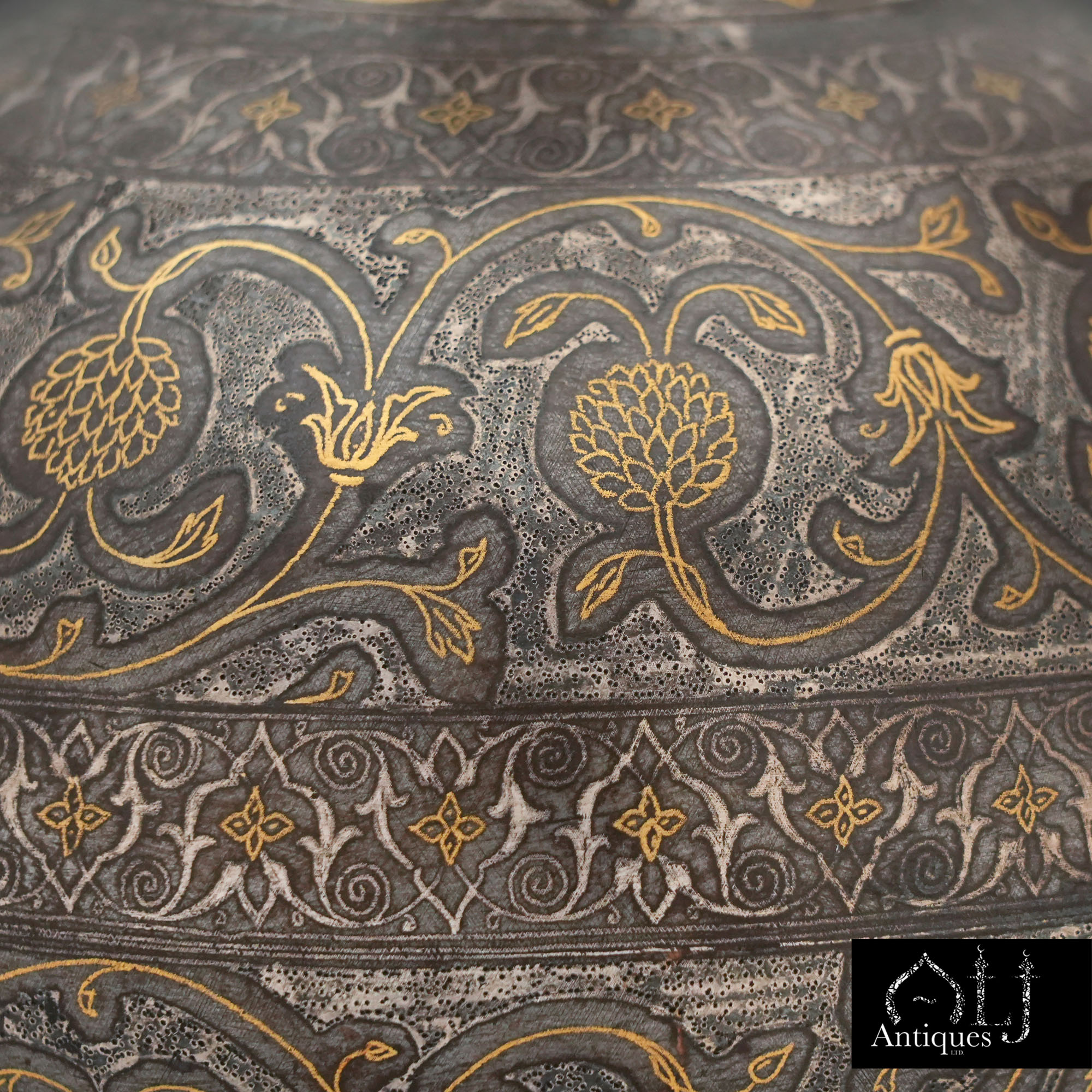
The ewer has a curved spout ending in a stylised dragon head and an S-shaped handle terminating in a stylised makara-like head with a spiral-coiled steel terminal. The surface is richly decorated with gold and silver Koftgari overlay, including scrolling vines, rosettes, cusped foliage, and interlocking palmettes.

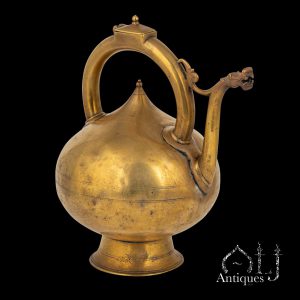
The tall, elegant shape of this ewer has a long history, having been employed in earlier Deccani and Mughal metalwork traditions of the 16th and 17th centuries. This late 19th-century example represents a revival of that prestigious form, making it both a nod to historical artistry and a reflection of late 19th-century craftsmanship.
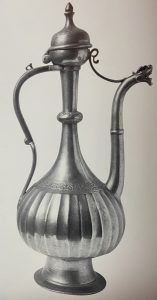
Lot 191, illustrated p. 148, 16th. century Mughal Dynasty Brass Ewer, from North India, Mark Zebrowski, Gold, Silver & Bronze from Mughal India, 1977.

While lavishly decorated, the ornamentation remains non-figural and non-inscriptional, allowing this type of ewer to appeal across different cultural and religious communities in India. Its elegant yet neutral design made it suitable for Muslim, Hindu, and Sikh patrons alike, reflecting a refined aesthetic that transcended sectarian boundaries. This cross-cultural appeal is supported by comparisons to related Koftgari steel objects from Punjab, including a gold-overlaid casket currently on display at the Victoria and Albert Museum in London.

Historical and Artistic Context

This ewer represents a late 19th-century revival of traditional Indian metalwork forms, produced in the Punjab region, specifically Lahore, and associated with the Mayo School of Industrial Art. Under the guidance of figures like John Lockwood Kipling, the Mayo School played a key role in preserving and promoting high-quality decorative arts in late 19th-century British India.
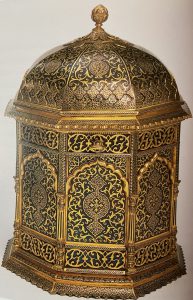
Lot 97, illustrated p. 88 (gold-overlaid steel casket with comparable lotus finial; currently on view at the Victoria and Albert Museum, London). The Arts of the Sikh Kingdoms, Susan Stronge, Victoria and Albert Museum Publications, 1999.
Dimensions

Height: 38 cm
Width (handle to dragon-head spout): 31 cm
Width of globular body: 20 cm
Diameter of base: 11.5 cm

Condition

Generally, in very good condition, Metal tarnishing, with minor wear consistent with age and use.
The spout is secured with five screws, with one screw at the top and two at each side of the handle.
The lotus-flower finial is intact.

Provence

The European Art Market.

References

The Arts of the Sikh Kingdoms, Susan Stronge, Victoria and Albert Museum Publications, 1999
– See lot 97, illustrated p. 88 (gold-overlaid steel casket with comparable lotus finial; currently on view at the Victoria and Albert Museum, London).
John Lockwood Kipling: Arts & Crafts in the Punjab and London,
Julius Bryant & Susan Weber, Yale University Press, 2017
– See illustrated koftgari steel caskets from Punjab (figs. 9.64–9.65).
Mark Zebrowski, Gold, Silver & Bronze from Mughal India, 1977
– For historical continuity of ewer forms and Indian metalwork traditions, pages, lots 189, 181 & 193 pp.147-149.

Related Antiques

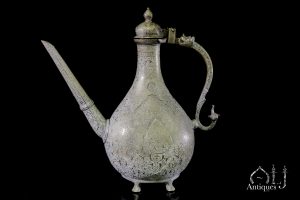
  • A Rare Safavid Engraved Bronze Ewer Inlaid With Black And Red Lac, Iran, Circa 17th Century.

    Sold
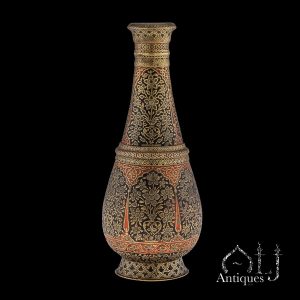
  • A Rare Mughal Brass Hookah Base (Shisha) with Lac and Metal Inlay North India, Lahore (Present-Day Pakistan), Circa 1700 AD

  • Deccani Brass Ewer (Aftaba), Circa 16th Century

    Deccani Ewer, India c. 16th. Century.

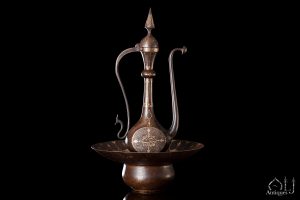
  • A Magnificent Early Qajar Dynasty Finely Engraved Brass Water Ewer Pitcher And Basin (Aftabeh), Attributed To The Persian Metal Master Baqir Hakkak, Probably Isfahan, Iran, Circa 1800-1850 AD.

    Sold
  • Zoroastrian Antiques, An Important (Parsi) Engraved Copper-Gilt Flattened Ewer With Half Moon (Crescent Shaped) Top Probably Used To Carry The Sacred Liquor (Haoma) Before The Sacred Fire At The Yasna Ritual, Bombay Or Zand Dynasty In Shiraz,India Or Iran

    Zoroastrian (Parsi) Art

  • A Rare Drop Shaped Brass Ewer or (Aftaba\Ibrik) with a Dragon’s Head Spout and a Crescent Shaped handle, Probably the Deccan Sultanates, Central-India, Circa 17th. Century. 

  • “Zand Dynasty Finely Engraved Miniature Brass Wine Ewer, Depicting Prophet Solomon, Jinn and the Shahnameh Scene of Rostam and Div-e Sepid, Shiraz, Iran, 18th Century”

  • A Superb Nielloed And Parcel Gilt Silver Ewer Designed By The Dagestani Master In The Making Of The Finest Nielloed Silverware, Mr R. Alikhanov, Kubachi-Dagestan, Probably The First Half Of the 20th Century.

    Sold
  • 18th-Century Mughal Cast Bronze Ewer (Aftaba)

  • A Finely Engraved Deccani Bronze Ewer (Aftaba), The Handle Terminals are Sculptured with A Tigre & typical Deccani Style Makara Heads, Probably the Deccan-Central India, Circa 1700.

  • A Very Fine Qajar Engraved, Gold and Silver Damascened Steel Ewer (Aftabah) and Basin or Lagan Set, Iran, 19th Century.

    Sold