Description
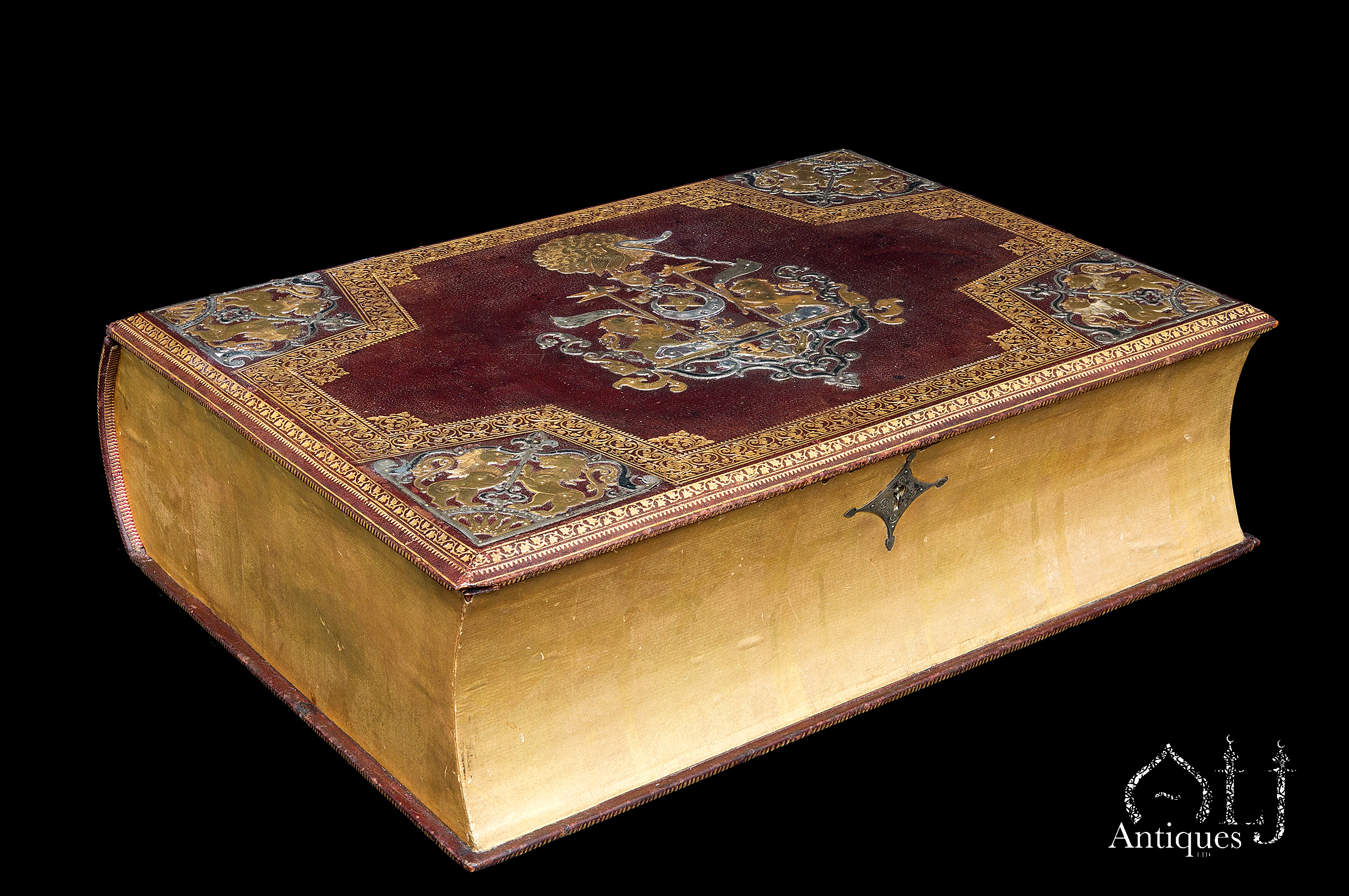
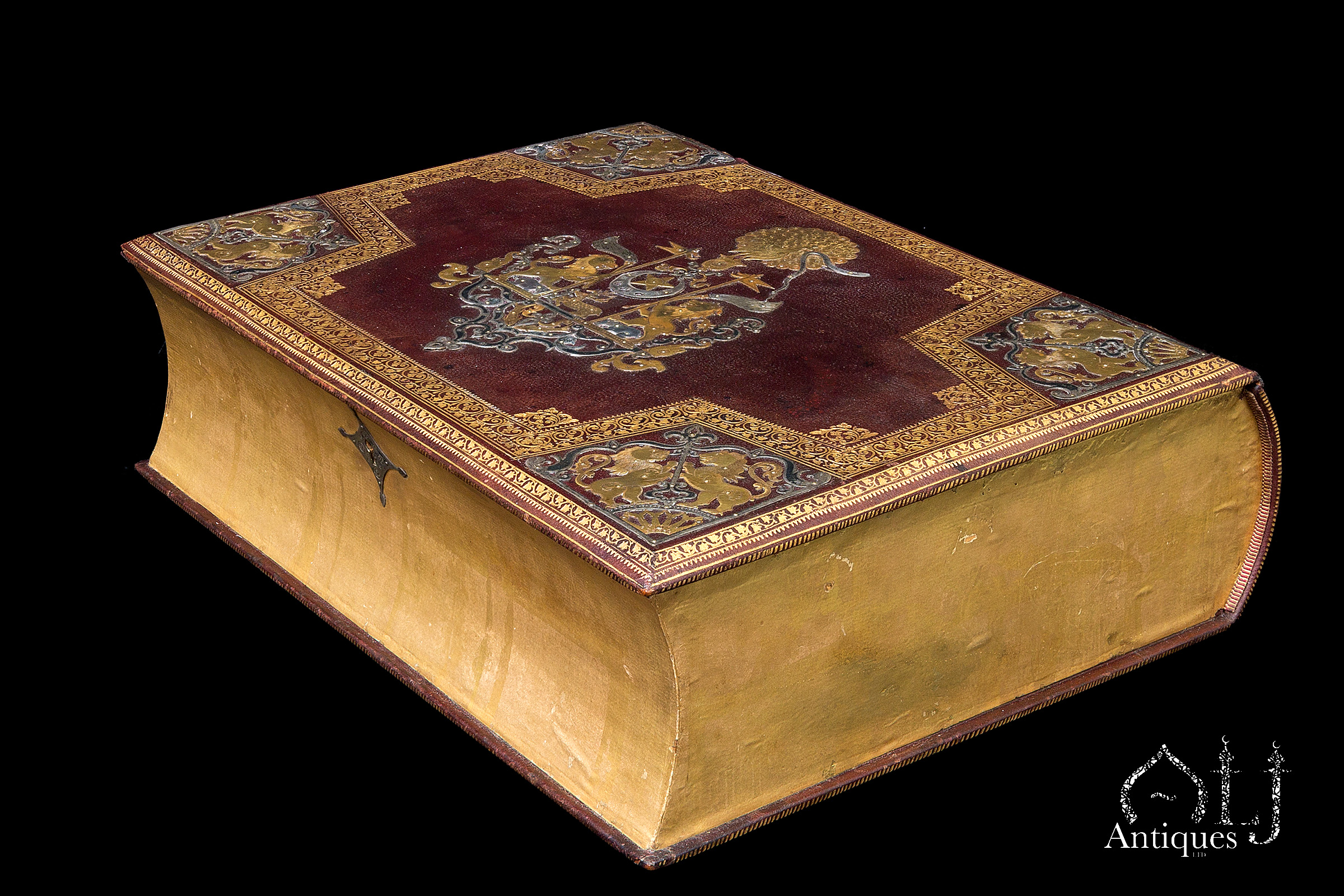
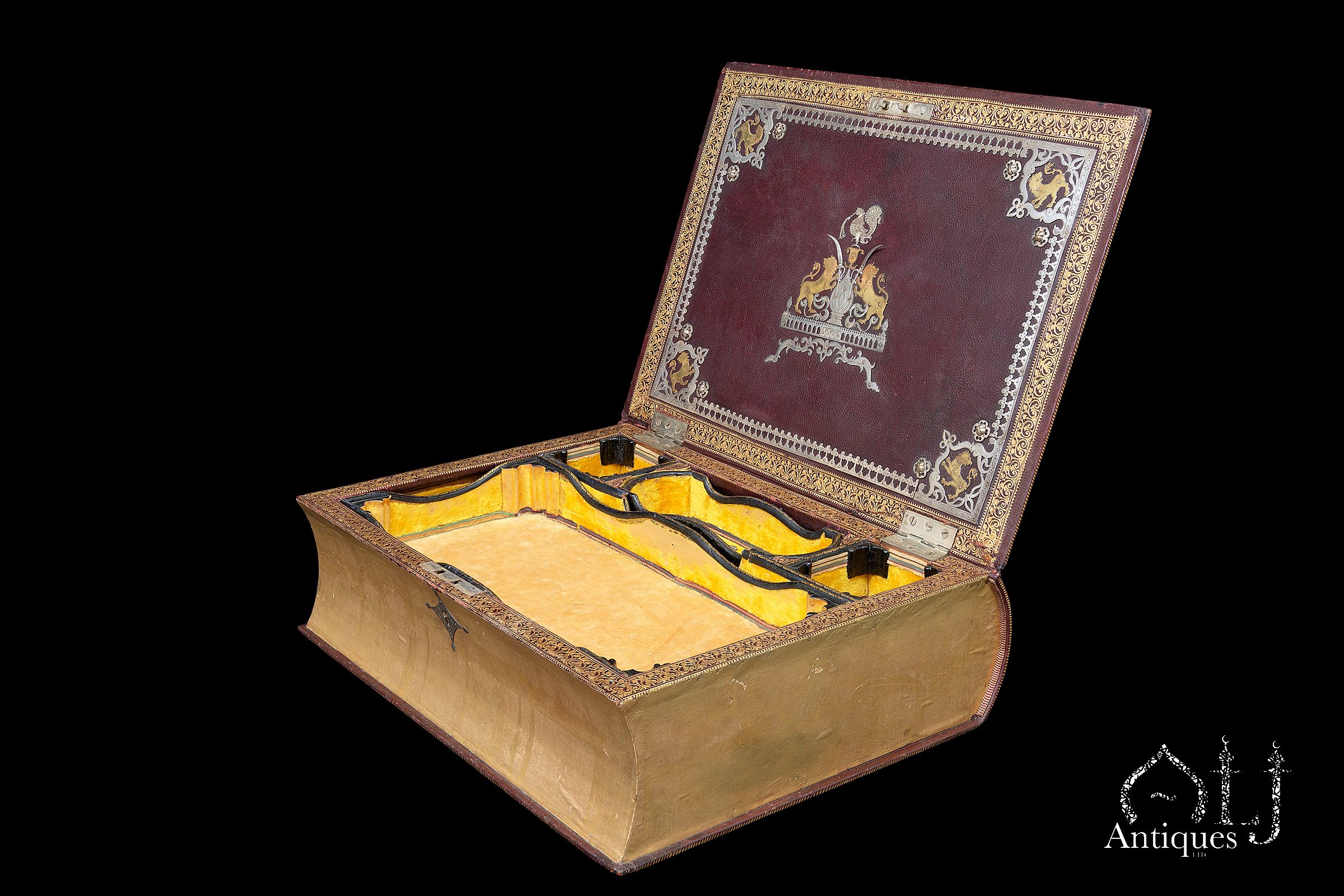
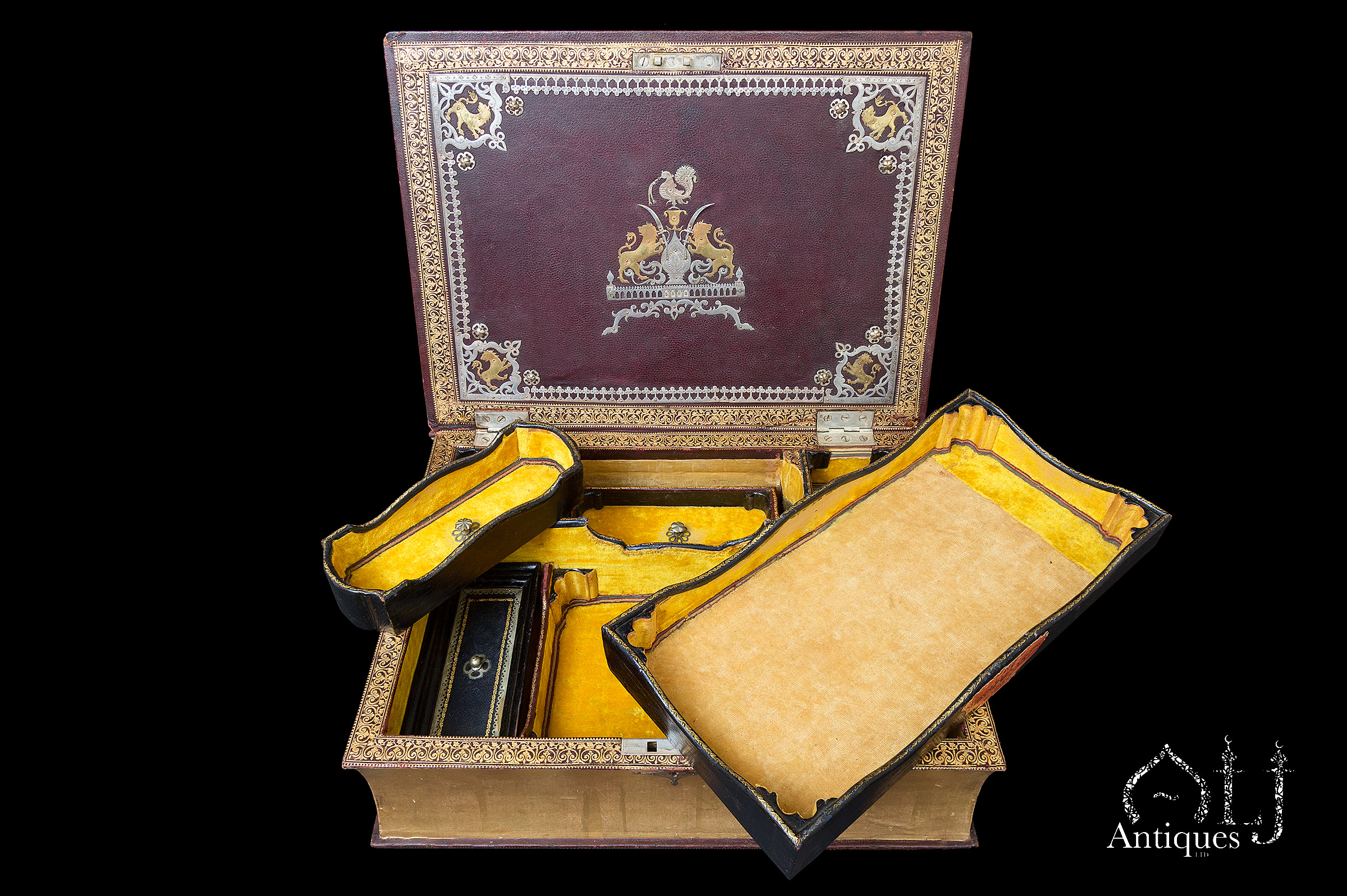
An exceptionally rare and highly sophisticated late nineteenth-century Hyderabad courtly casket, ingeniously constructed in the form of a monumental leather-bound book and extensively decorated with gilt tooling and extraordinarily elaborate applied gold and silver ornament.
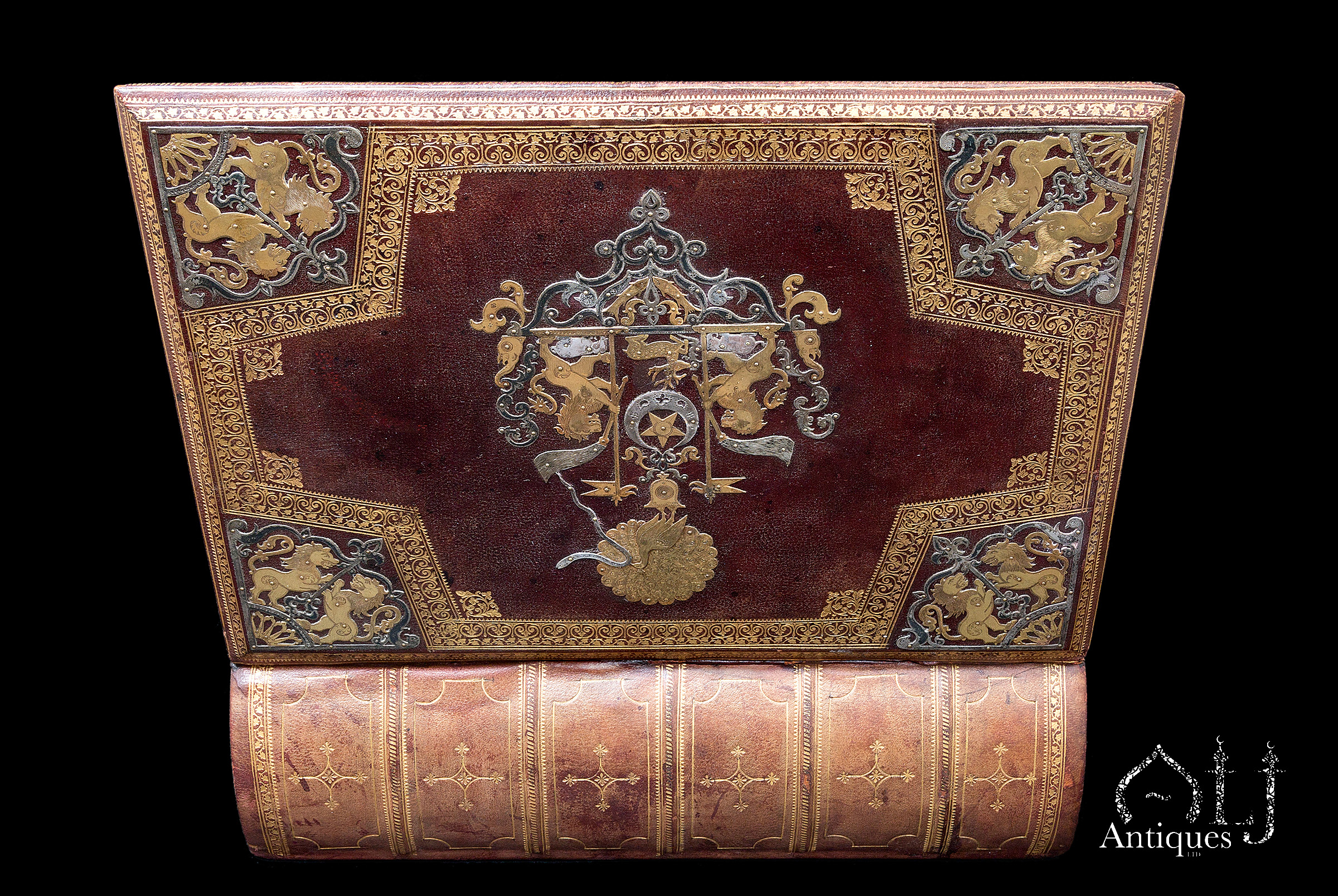
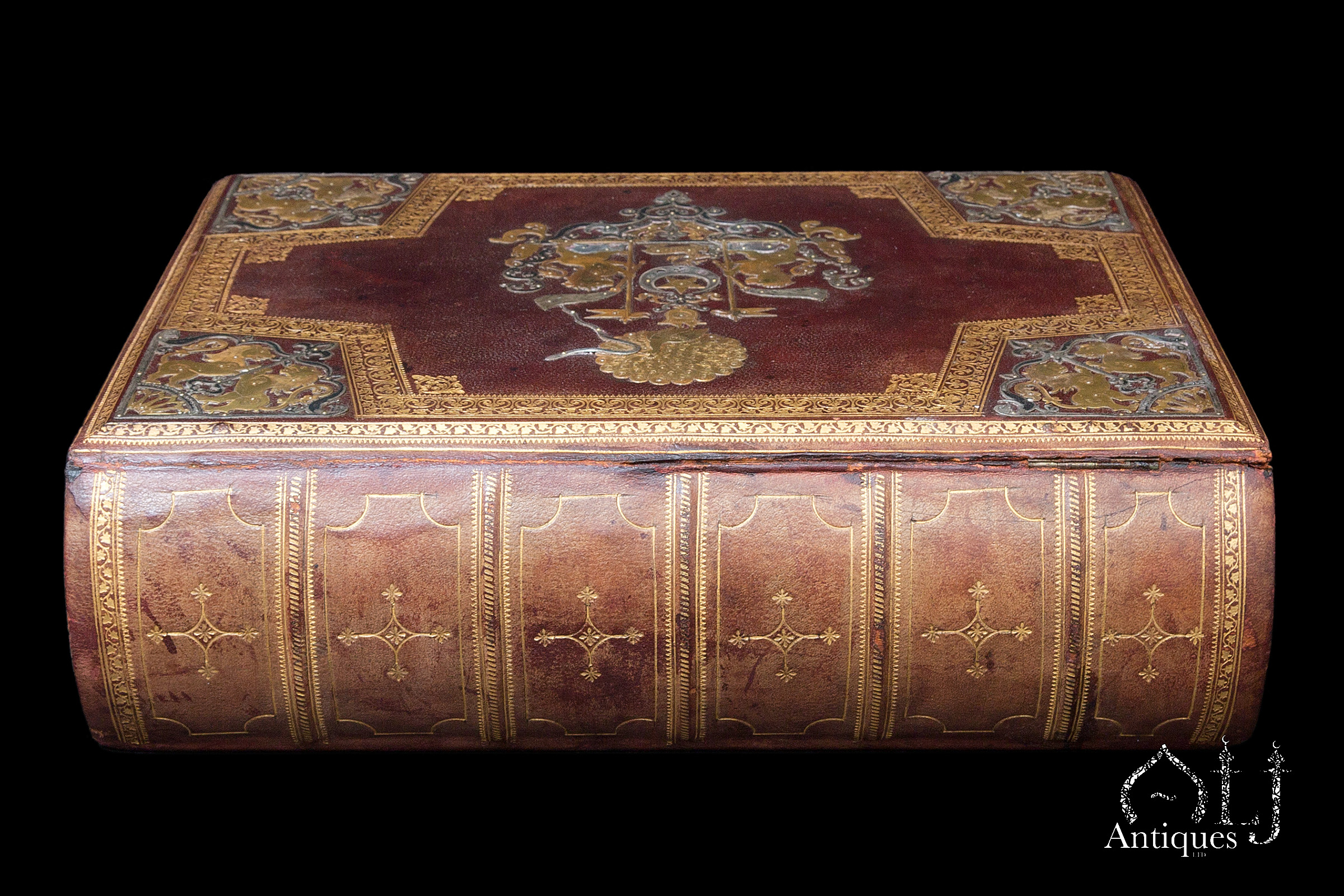
The casket is conceived so convincingly as an oversized luxury volume that, when closed, its true function is substantially disguised. One long side is formed as the rounded spine of a substantial bound book, covered in deep red-burgundy leather and divided into gilt-tooled compartments, while the remaining three sides imitate the exposed edges of the paper leaves.
Significantly, these apparent “pages” are not simply flat wooden surfaces painted gold. The underlying structure has been carefully shaped and modelled to reproduce the profile and mass of the closed leaves of a substantial manuscript or book and subsequently finished in a rich gold colour to imitate gilt paper edges. Together with the leather-covered rounded spine and extensive gilt tooling, this creates a remarkably convincing illusion of a monumental luxury volume.
The form is particularly appropriate to the intellectual and administrative culture of princely Hyderabad. The book could simultaneously signify knowledge, literacy, education, scholarship and cultivated status, while the deceptive construction offered an additional practical advantage: placed within a library, study, palace apartment or private cabinet, the object could outwardly appear to be a large volume while concealing documents and valuable possessions.
It should therefore probably be understood as a document, correspondence, writing and valuables casket, rather than assigning a single rigid function to its numerous fitted compartments. It could conceivably have accommodated private correspondence, documents, seals, writing materials, jewellery, money and other personal or confidential possessions.
The fitted interior
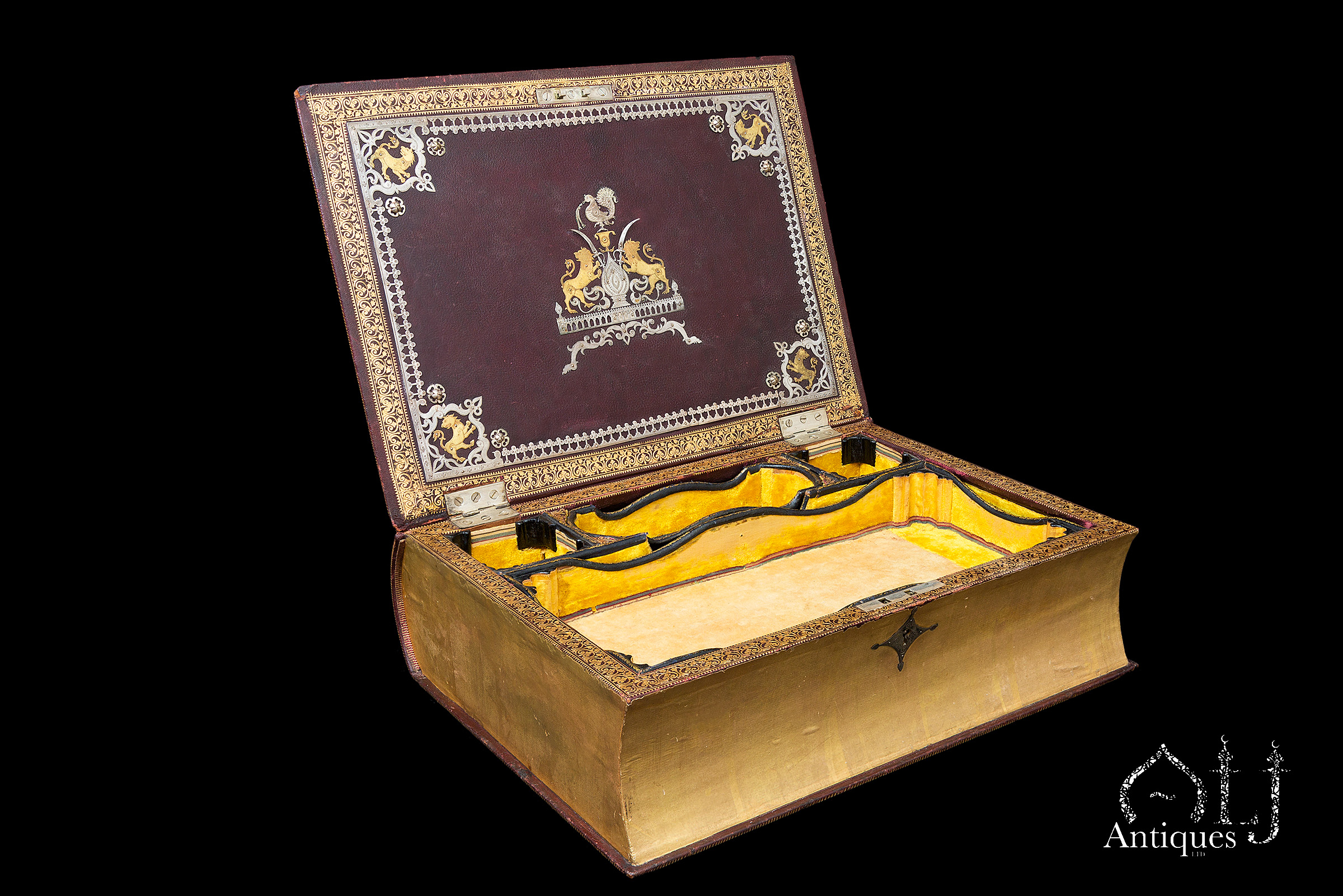
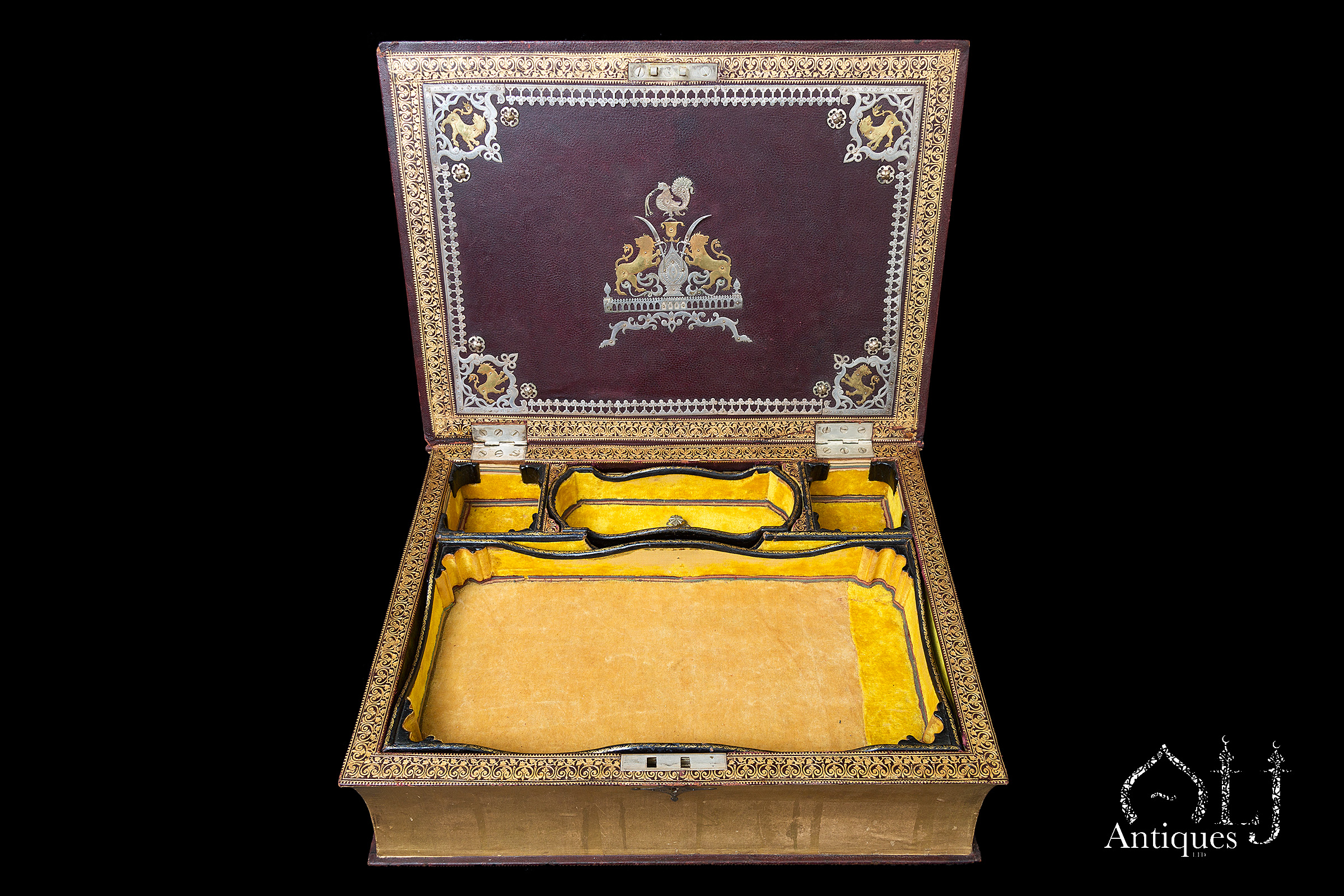
Opening the “book” reveals a striking contrast between its restrained burgundy exterior and its exceptionally elaborate fitted interior.
The interior is lined principally in brilliant yellow-gold velvet or silk-like textile and contains a sophisticated arrangement of fitted and removable elements, including a large central rectangular tray, a long shaped or ogival tray, a fitted rectangular sliding component, smaller shaped receptacles and narrow rectangular boxes fitted with small flower-form knobs.
The arrangement indicates that the casket was specifically commissioned for an owner requiring an organised repository for a variety of objects rather than being an ordinary storage box. Nevertheless, in the absence of the original contents, the precise purpose of each compartment should remain open to interpretation.
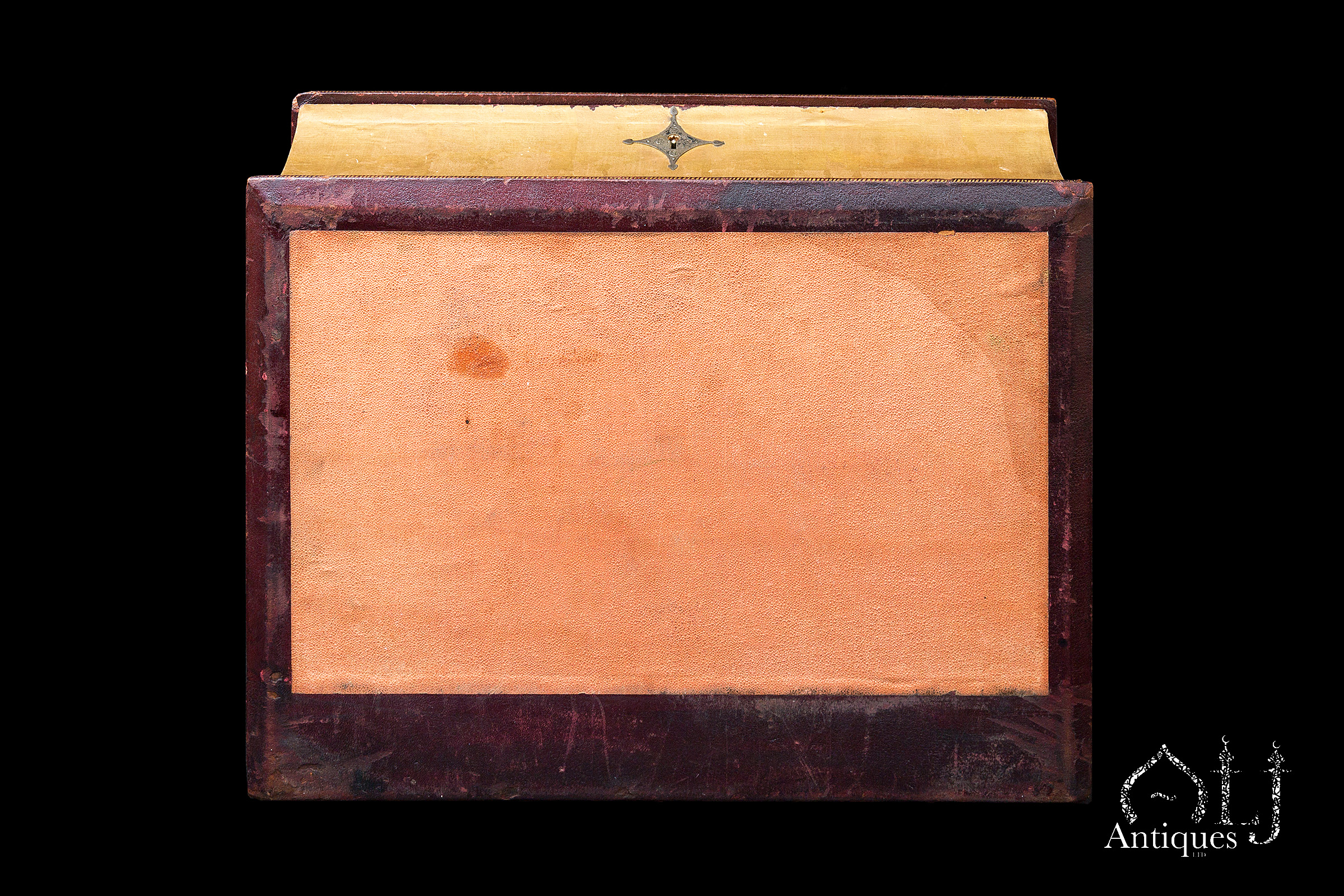
Silver hinges and a locking mechanism complete the construction.
The Inscription
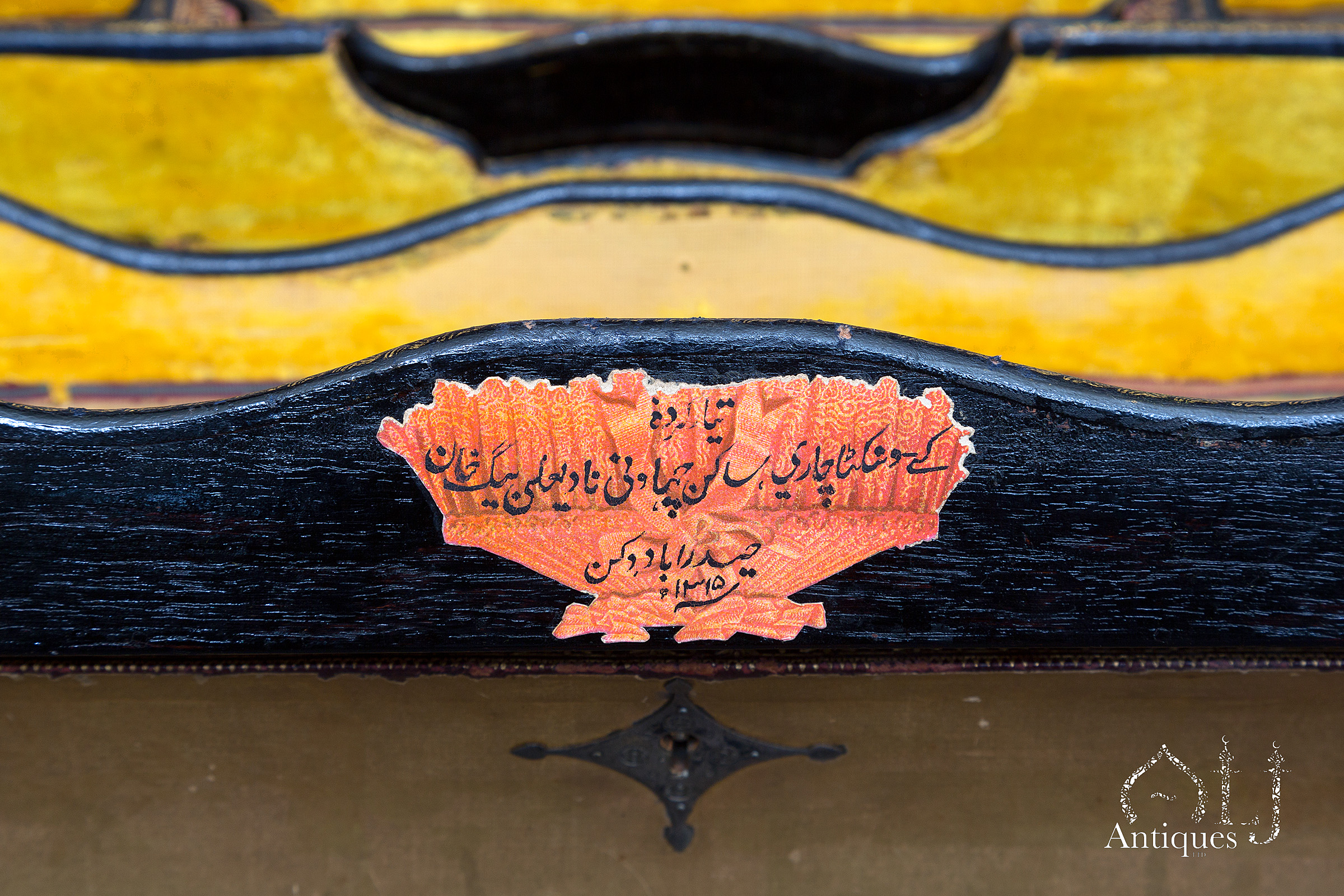
An especially important feature is the surviving red-orange paper label attached to one of the interior components. Written in a flowing Urdu/Persianate hand with Nastaliq and somewhat cursive or shikasta characteristics, it appears to read:
تیار کردہ کی وینکٹیا چاری، ساکن چھاؤنی، نادی علی بیگ خان، حیدرآباد دکن، سنہ ۱۳۱۵ ہجری
Tayyār kardah kī Venkatachari, sākin chhāonī, Nādī ʿAlī Beg Khān, Hyderabad Dakkan, sanah 1315 Hijrī.
The inscription is particularly valuable because it apparently records a maker or craftsman, an associated owner or patron, a place and a date.
The opening expression tayyār kardah means “made”, “prepared” or “manufactured”. Venkatachari (or Venkatayachari) is apparently a South Indian personal name and is the strongest candidate for the craftsman or workshop figure responsible for the casket. The expression sākin chhāonī can be understood as “resident of the Cantonment” or “residing in the Cantonment”.
The second name is written essentially continuously as:
نادیعلی بیگ خان
but is linguistically read:
نادی علی بیگ خان — Nādī ʿAlī Beg Khān.
The inscription concludes unequivocally with:
حیدرآباد دکن، سنہ ۱۳۱۵ ہجری
Hyderabad, Deccan, year 1315 Hijri, corresponding to 1897–98 AD.
Because the inscription is abbreviated and appears to represent practical vernacular workshop language rather than formal literary Persian or Urdu, the precise grammatical relationship between Venkatachari and Nādī ʿAlī Beg Khān should not be overstated. Its most plausible sense is:
“Made/prepared by Venkatachari, resident of the Cantonment, [for or associated with] Nādī ʿAlī Beg Khān, Hyderabad, Deccan, year 1315 Hijri.”
Venkatachari therefore appears most plausibly to be the maker or craftsman, while Nādī ʿAlī Beg Khān appears to be the patron, owner or person with whom the casket was associated.
Precious-Metal Decoration and Construction
Among the most extraordinary aspects of the casket is its elaborate precious-metal decoration.
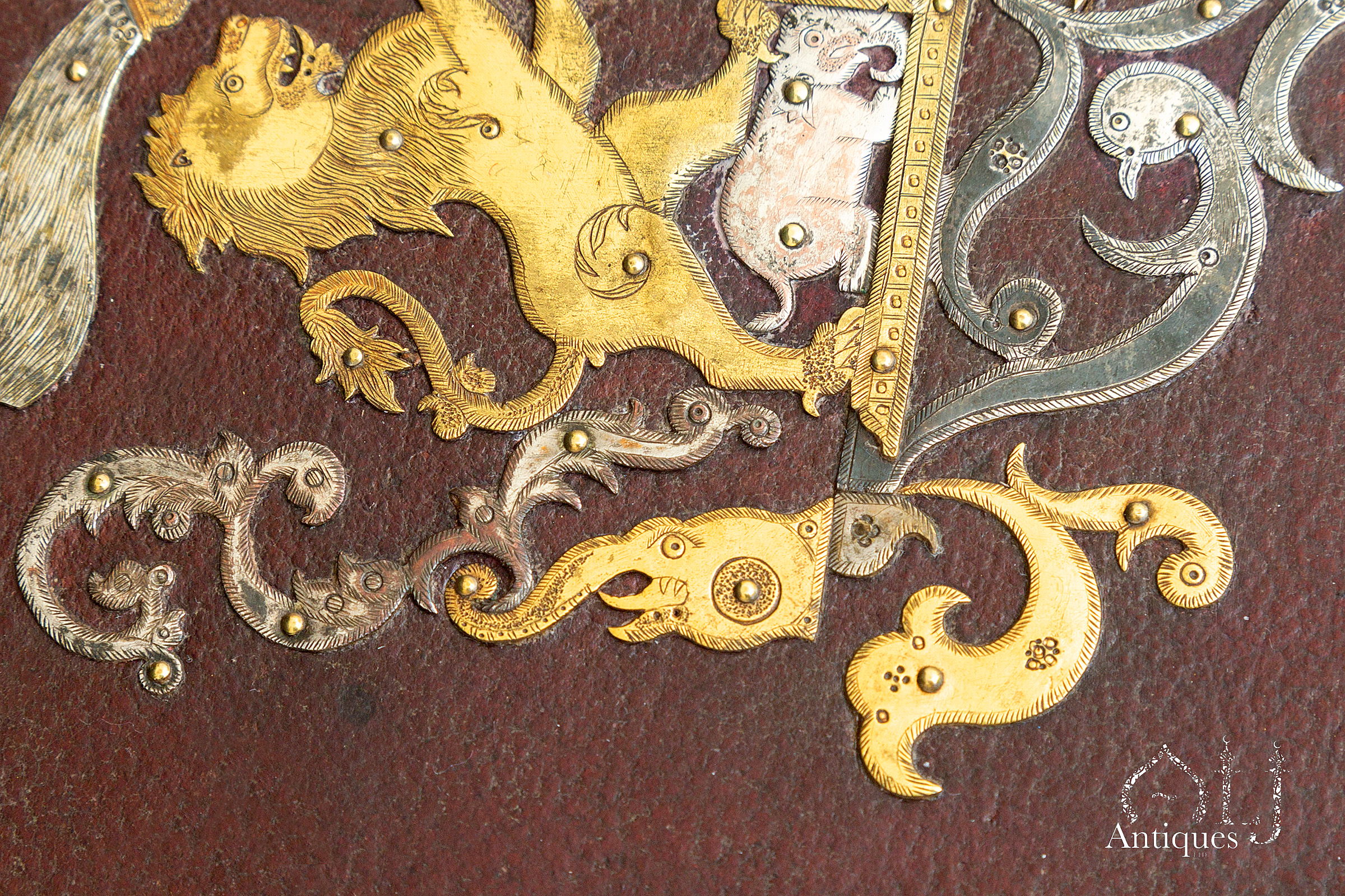
The ornament is not merely engraved into a continuous sheet of metal. Individual components have been separately fashioned, finely cut, engraved, chased or punched and mechanically applied to the leather, apparently using minute gold or silver pins corresponding to the metal being secured.
Close examination reveals an exceptional degree of workmanship: ring-and-dot punching, incised plumage, fur and feather patterns, pierced arabesques, minute floral details and the careful juxtaposition of gold and silver to distinguish individual animals, weapons, standards and architectural elements.
The decoration is organised around two different principal heraldic compositions—one on the exterior and another on the interior face of the lid. They clearly belong to the same artistic and symbolic vocabulary but are not duplicates of one another. This distinction is important.
Exterior Heraldic Achievement
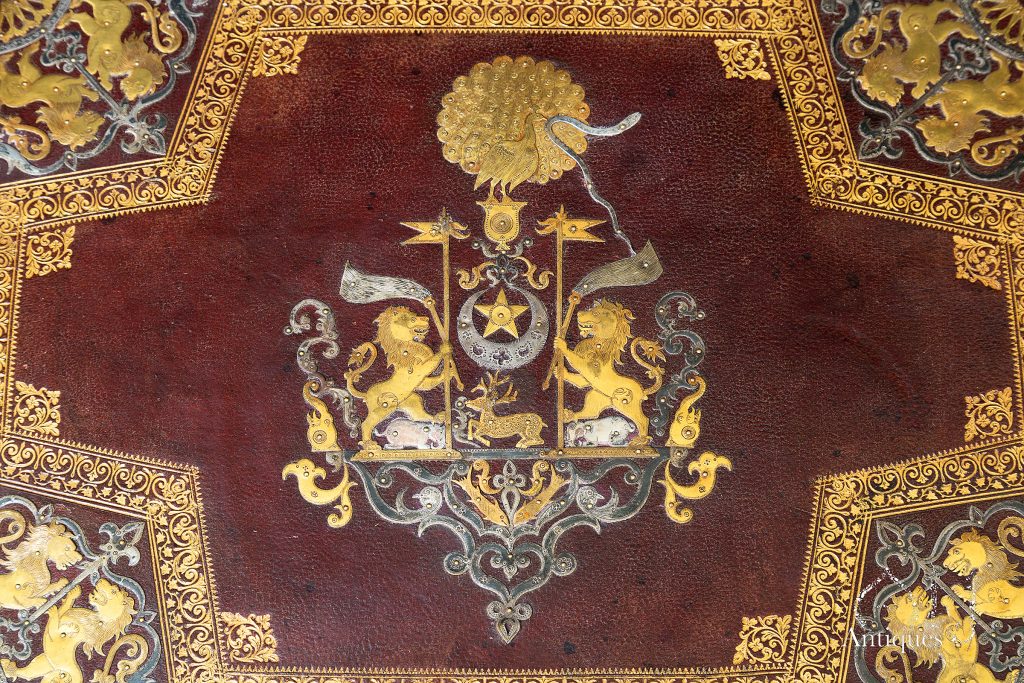
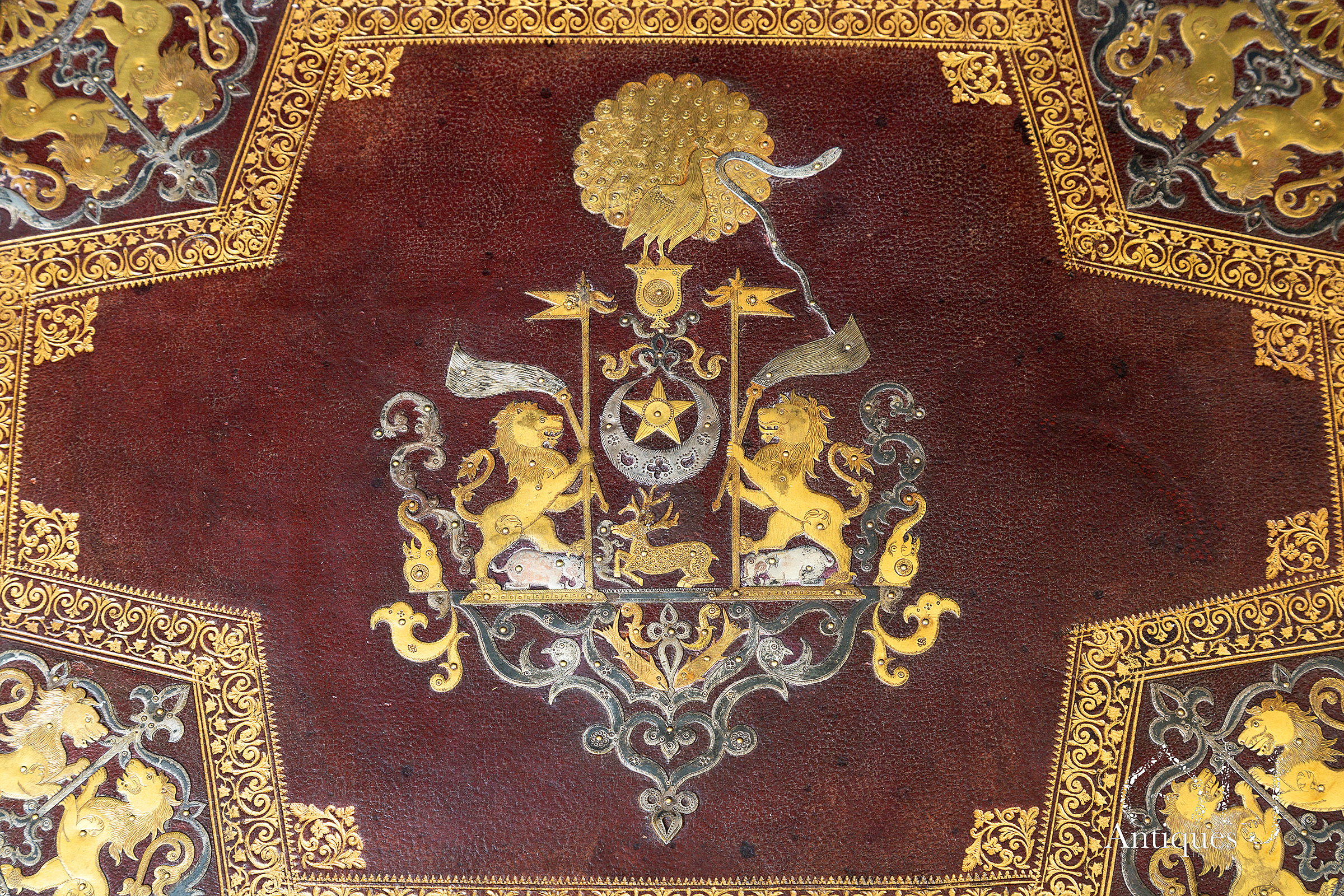
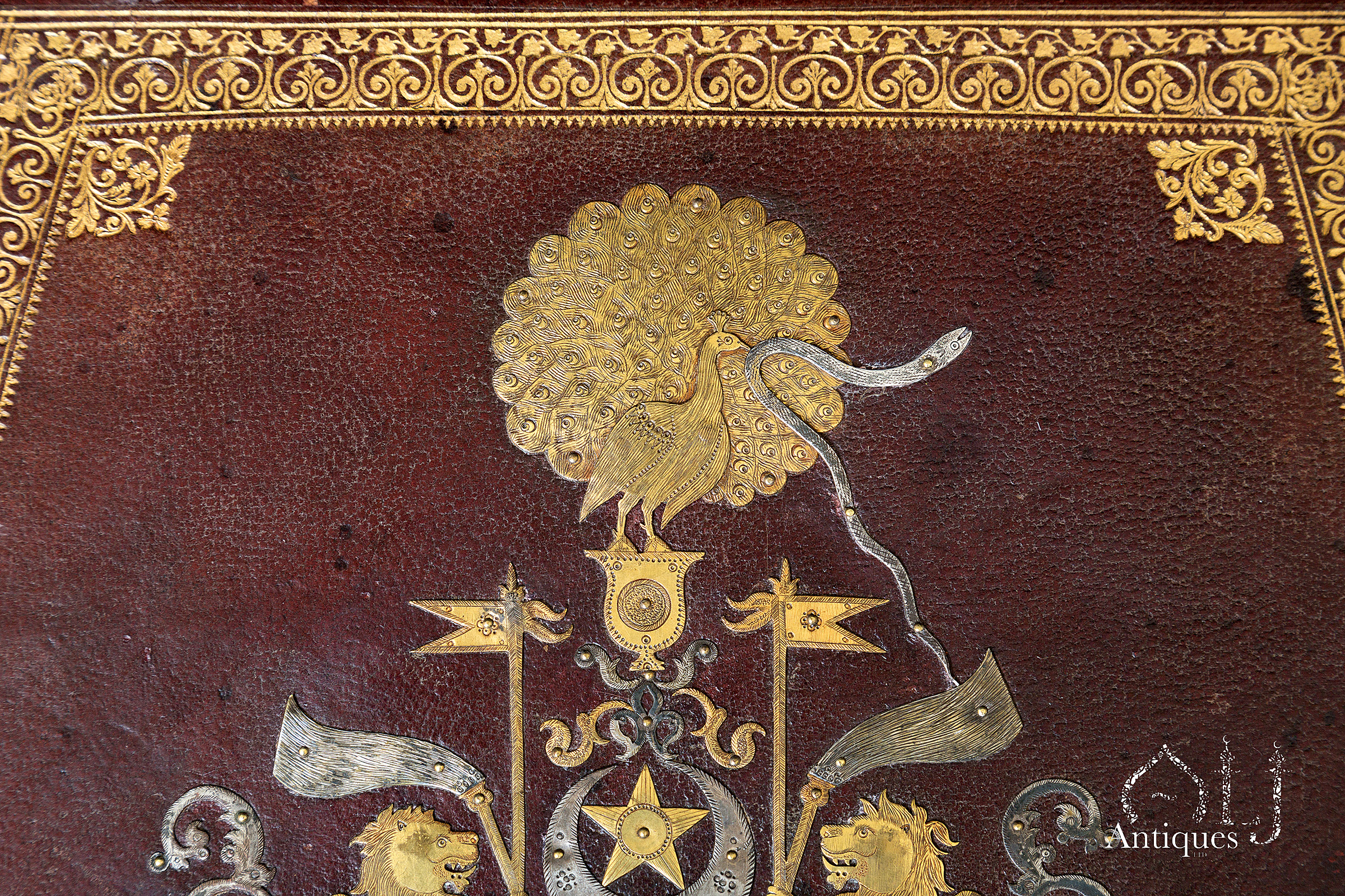
The exterior is dominated by an extraordinarily complex, vertically organised gold-and-silver heraldic achievement.
At its summit is a gold peacock with its tail fully displayed, standing upon a gold urn or vase and holding a long silver serpent in its beak. Immediately beneath the urn is a small gold-and-silver foliate flourish.
Two tall gold standards rise on either side, terminating in swallow-tailed pennants.
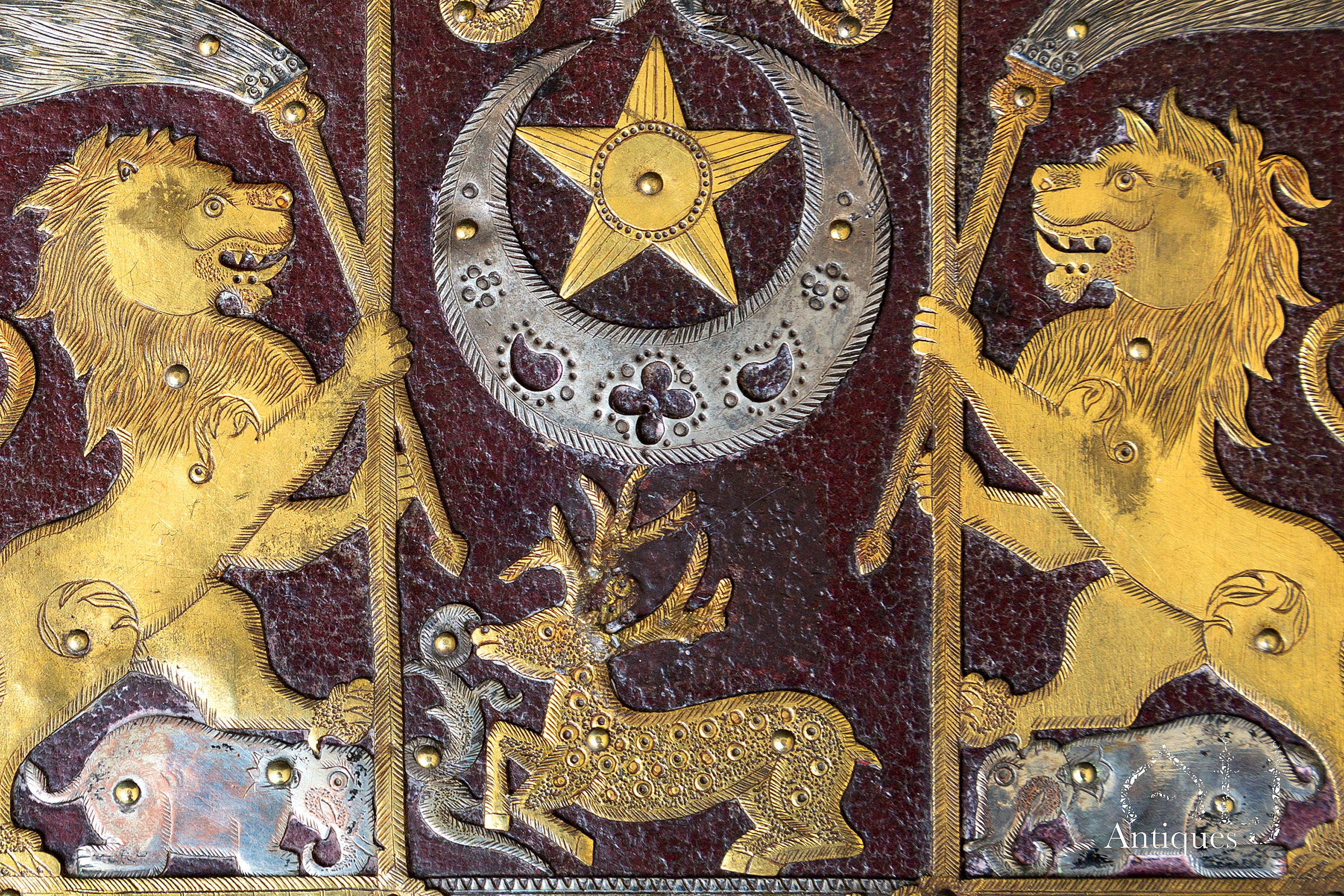
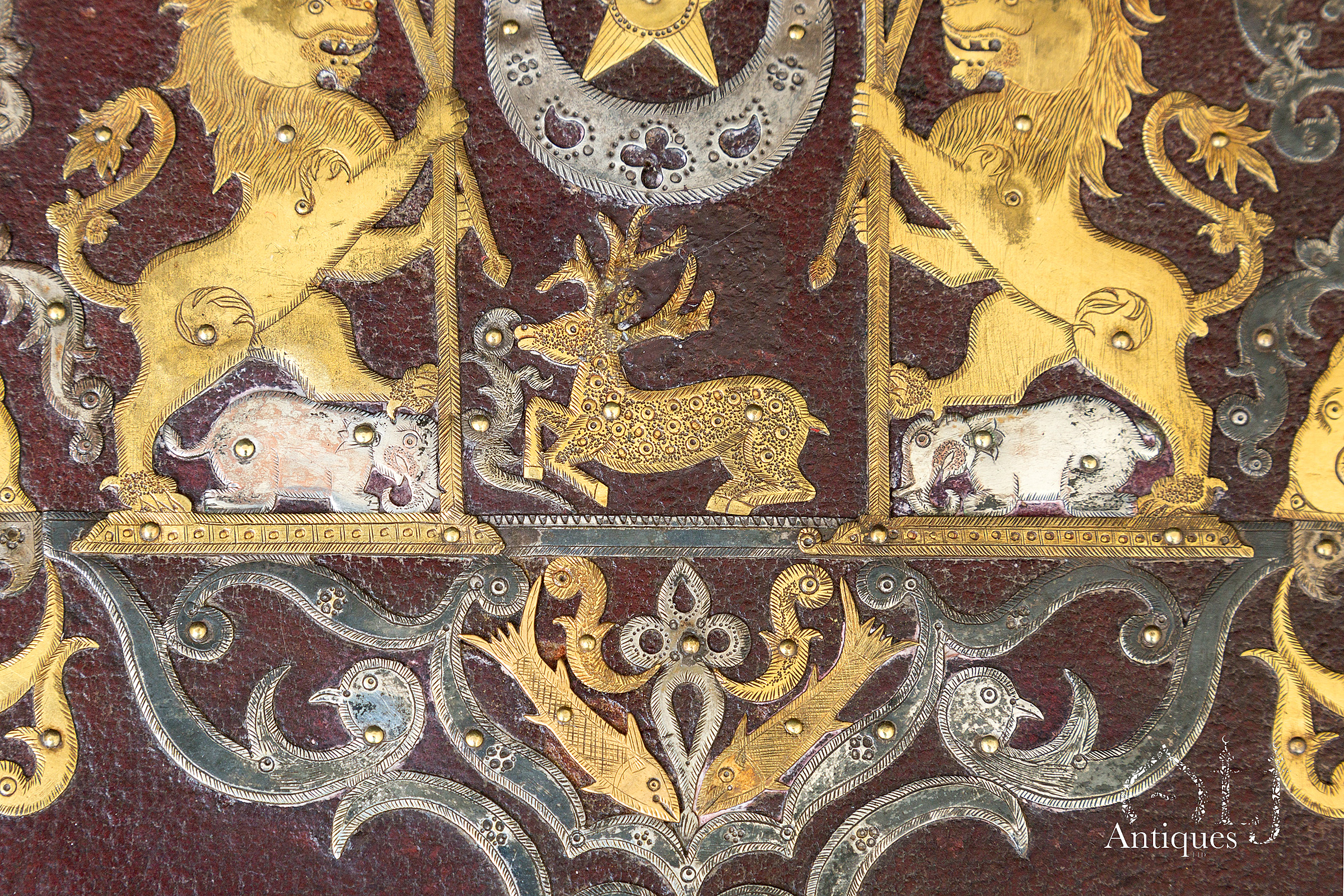
At the centre is a five-pointed gold star within a large silver crescent, the latter pierced and enriched with ring-and-dot ornament.
Immediately below is an exceptionally finely modelled recumbent or kneeling gold stag, distinguished by its large branching antlers.
Flanking this central composition are two powerful rampant gold lions. Our subsequent comparison with Indian princely heraldry makes their attributes clearer: each lion carries a flaming torch in one forepaw and a ceremonial flag or standard in the other.
Even more remarkably, each gold lion physically stands upon a separately fashioned kneeling silver elephant.
The combination of lion and elephant is therefore intentional and hierarchical rather than merely decorative.
Additional gold elephant heads appear laterally, their trunks transforming almost imperceptibly into scrolling vegetal arabesques—an accomplished example of the characteristically Indian transformation of animal anatomy into ornament.
The lower section develops into an elaborate heart-shaped pierced silver arabesque framework incorporating two confronted gold fish whose heads meet towards the centre, accompanied by two confronted silver birds and fantastic scrolling terminals, before terminating in a heart- or leaf-shaped lower element.
The Fish and the Māhī Marātib Tradition
Our subsequent research has made the paired fish considerably more important than they first appeared.
The confronted fish recall the prestigious Māhī Marātib, or “Fish of Dignity”, a courtly insignia of exalted rank with a much older Indo-Persian and Mughal history. It became particularly famous in Awadh/Lucknow, where paired fish developed into a dynastic emblem; LACMA, for example, preserves a Lucknow bidri plate of circa 1880 decorated with paired mahi-ye maratib fish arranged head-to-head, the LACMA Collection.
Their appearance on the present casket should not, however, be taken as evidence for Lucknow manufacture.
The fish insignia had a much wider courtly life, and importantly it was known in Hyderabad itself. Yale’s MAVCOR documentation of Hyderabad’s Bībī kā ʿAlam specifically records the ceremonial presence of the imperial fish ensign, the māhī marātib, within Hyderabad’s courtly and religious ceremonial culture.
The confronted gold fish on the casket may consequently represent an inherited Mughal/Deccani symbol of dignity, honour or rank incorporated into the owner’s more individual heraldic achievement. Until documentary evidence connects Nādī ʿAlī Beg Khān personally with the Māhī Marātib, however, this should remain an informed interpretation rather than a definitive identification.
Exterior Borders and Corner Devices
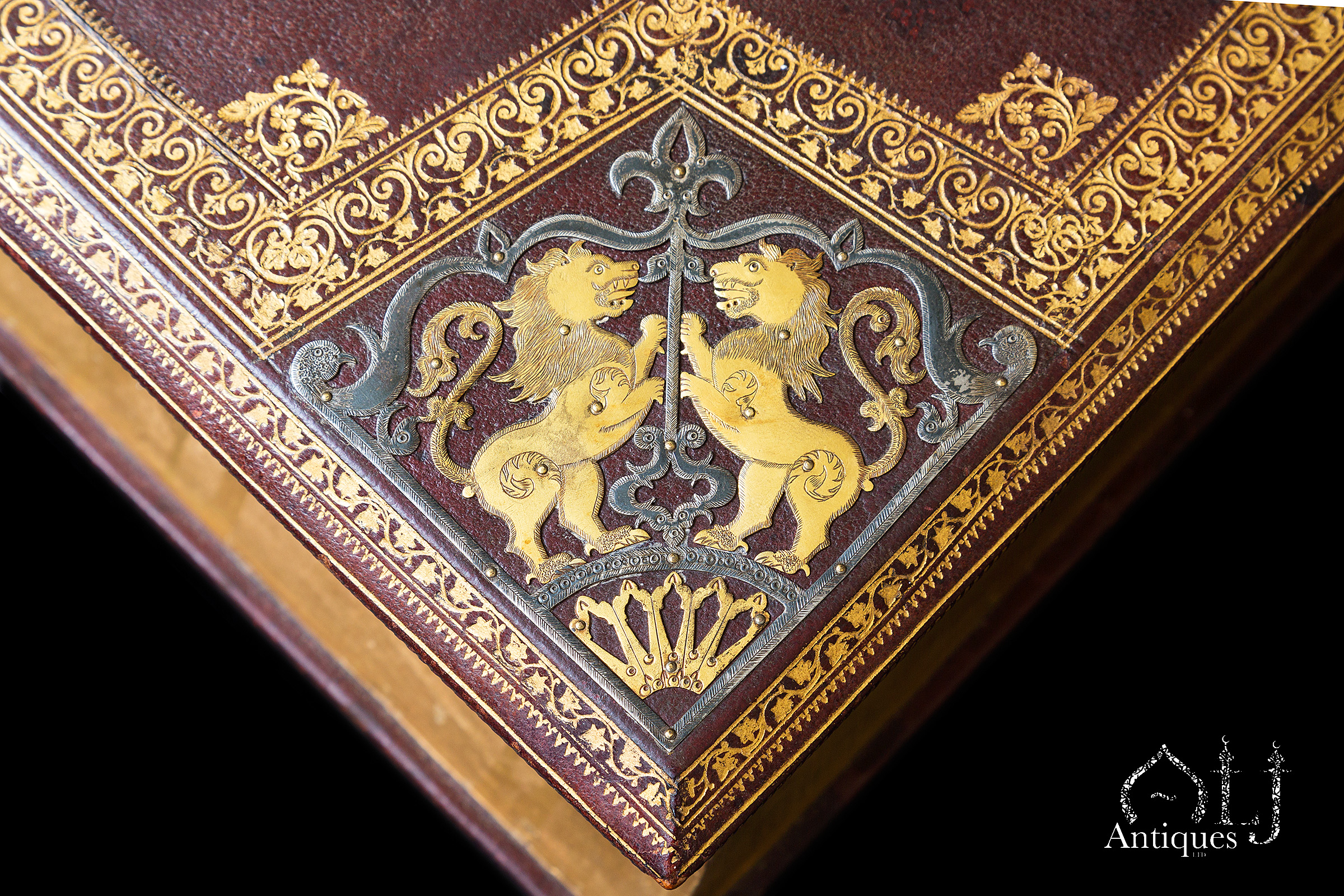
The principal achievement is enclosed within an exceptionally intricate pierced silver framework composed of repeating stylised tree-, palmette- or architectural forms alternating with arched elements and enriched with engraved feather-like borders and ring-and-dot ornament.
The elaborate corner devices incorporate pairs of confronted standing gold lions holding fleur-de-lis-headed ceremonial attributes, perhaps sceptres, maces or related insignia. These are accompanied by crown-like elements, pierced arabesques and confronted bird heads.
Smaller applied flower-head bosses flank the compositions.
The repeated appearance of the lion throughout the exterior and interior strongly suggests that it is not simply ornamental.
Interior Heraldic Achievement
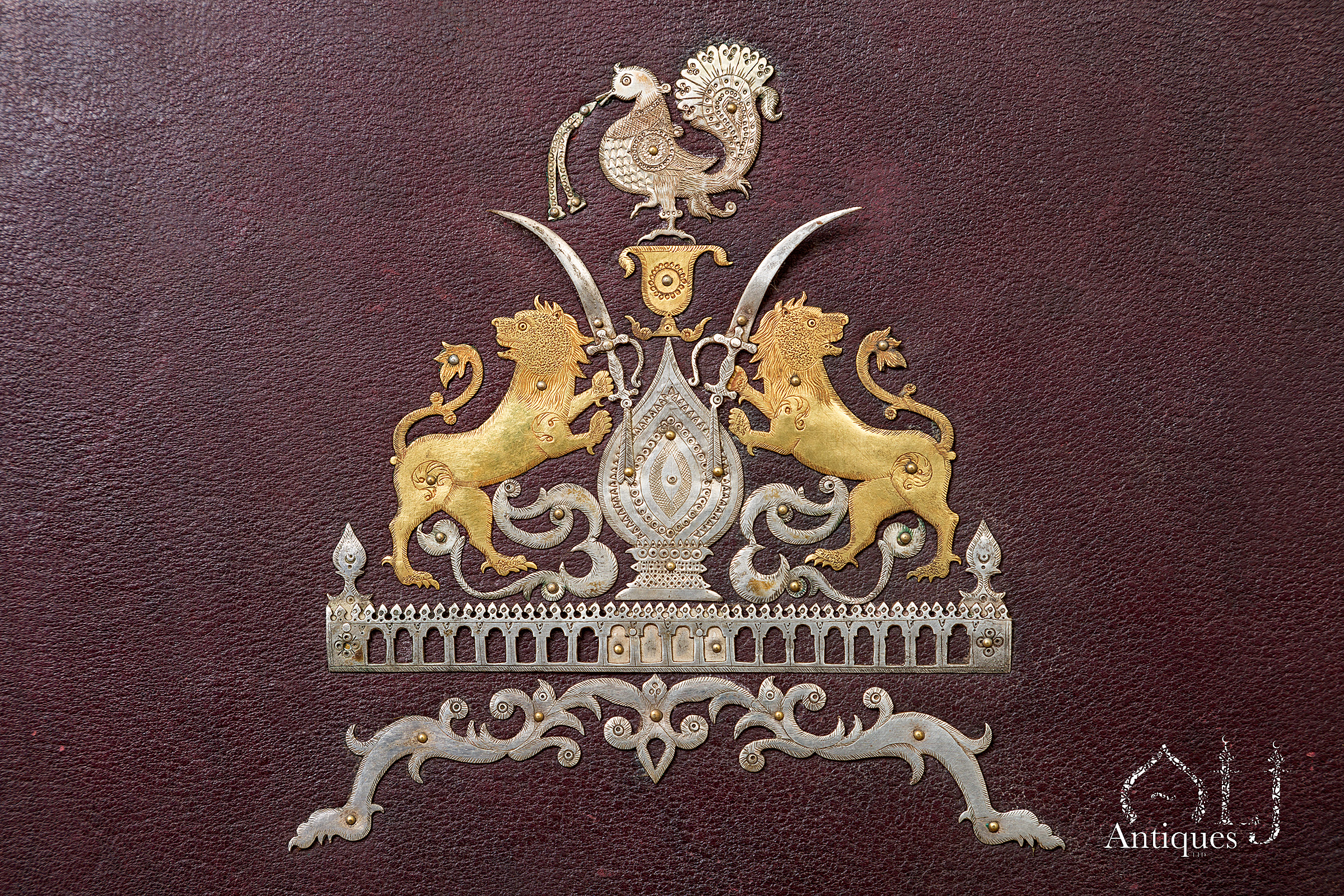
The interior face of the lid carries a second and deliberately different heraldic composition, applied directly to the burgundy leather.
At its summit stands an extraordinary silver fantastic bird, probably inspired by the Indian Hamsa or another courtly mythical bird, balanced on one leg upon a gold urn or vase. Its elaborate fan-like tail and stylised plumage are accompanied by two long ribbons descending from its beak.
Immediately below and behind the central composition are two enormous silver Indian talwars, one on either side, their strongly curved blades rising outward.
Two confronted gold lions flank the central device. Their heads turn outward while their bodies engage with a large central silver cypress-, flame-, leaf- or paisley-shaped cartouche, itself containing a smaller almond-shaped device and enriched with dense ring-and-dot punching.
The lions and central device stand upon an elaborate throne-like architectural platform, incorporating a balustrade or fence of repeated arches.
Below this is a large symmetrical pierced silver arabesque support or pair of “legs”, whose extremities develop into fantastic animal- or makara-like forms.
Of particular importance are two silver crescents, one incorporated into each lower side of this openwork composition.
Thus, while the interior achievement shares lions, symmetry, courtly imagery, precious-metal contrasts and related workmanship with the exterior, its iconography is deliberately distinct.
The Paired Talwars and the Hyderabad Court
The enormous paired talwars are especially significant because we have an unusually close contemporary Hyderabad comparison.
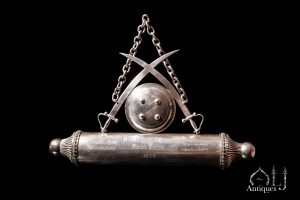
A silver scroll container in the collection of ALJ Antiques Ltd., inventory no. 282, inscribed “His Highness The Nizam’s Fortieth Birthday 1905,” incorporates a pair of monumental crossed Indian talwars.
The close similarity between their strongly curved blades and characteristic Indian hilts and those on the present casket is noteworthy. The two objects are separated by only approximately seven or eight years and belong to the same Hyderabad ceremonial environment.
This does not establish that paired talwars constituted an exclusive dynastic badge of the Nizam. It does, however, demonstrate that essentially the same martial imagery was employed on a ceremonial object explicitly associated with the Hyderabad court in the immediately succeeding years.
Interior Corner Devices
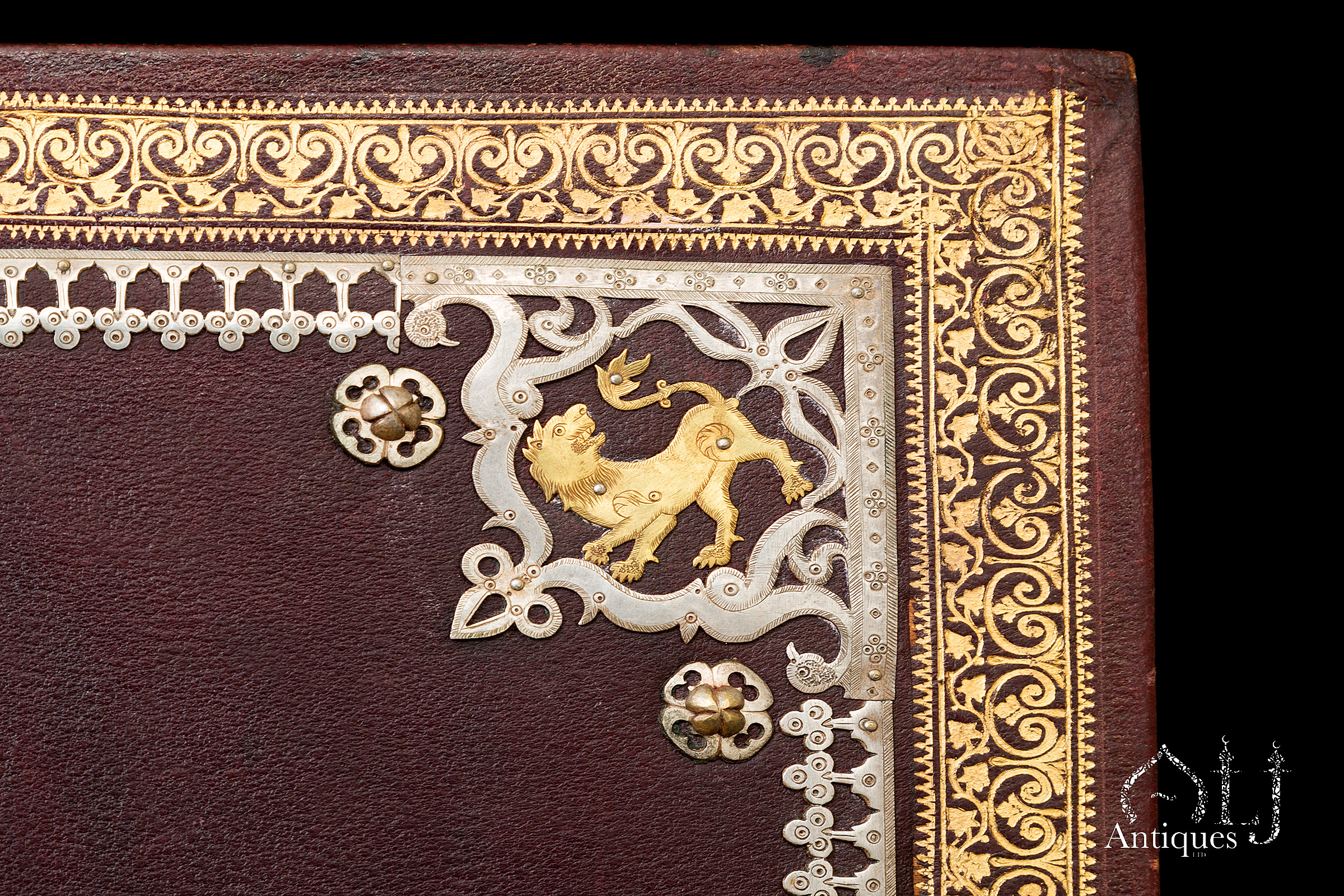
The four interior corners carry additional gold lions within elaborate pierced silver foliate and arabesque cartouches.
Each lion is shown striding, with its tail rising and terminating in a flower- or palmette-like form. Small gold birds and contrasting flower-head bosses accompany the lions, while adjoining silver borders repeat the architectural/palmette vocabulary employed elsewhere.
The repetition of the lion—in the exterior central achievement, exterior corner devices, interior central achievement and interior corners—is too systematic to dismiss as incidental ornament.
Heraldry and the Nizam of Hyderabad
Our broader comparison with late nineteenth-century Indian princely heraldry has clarified an important point.
The exterior composition should not presently be described as the official coat of arms of the Nizam.
Nevertheless, there is firm documentary evidence that formal armorial bearings were being developed for the Hyderabad court immediately before the period of this casket. The British Library preserves a Hyderabad Residency file entitled “Armorial Bearings of H.H. the Nizam,” dated 1876, shelfmark IOR/R/2/80/169, the British Library Archives.
Robert Taylor’s The Princely Armory, produced for the Imperial Assemblage of 1877, belongs to precisely this period in which European heraldic structures were being adapted to Indian princely identity; scholarly discussion of the Assemblage specifically identifies Taylor’s work as displaying the arms of India’s ruling chiefs after their banners, A course in Turkish Administrative History.
The paired rampant lions found in Hyderabad heraldic achievements therefore provide an important context for the repeated lions on the casket.
At the same time, our comparison with other Muslim-ruled princely states—including Surat, Junagadh, Jaora, Bhopal and others—shows that lions, crescents and stars, standards, swords, celestial symbols, fish and other ceremonial devices belonged to a broader vocabulary of nineteenth-century Indian princely heraldry.
No recognised state achievement located thus far, however, reproduces the extraordinary complete combination on this casket:
peacock and serpent + urn + standards + crescent and star + stag + paired lions carrying flaming torches and flags + kneeling elephants + elephant-head arabesques + confronted fish + birds.
This makes it increasingly unlikely that the exterior device is simply the standard arms of another Indian princely state.
A more compelling interpretation is that it represents a personal or noble-house heraldic achievement belonging to the Hyderabad courtly sphere, incorporating recognised symbols of rank, honour and political/courtly affiliation while adding devices particular to the individual or family concerned.
Its possible association with Nādī ʿAlī Beg Khān therefore deserves particular attention.
Nādī ʿAlī Beg Khān
The name is especially intriguing because a man named Nadi ʿAli Beg Khan is independently documented within the elite courtly world of Hyderabad considerably earlier in the nineteenth century.
The British Library’s Russell Collection preserves his portrait under shelfmark Add Or 1919, catalogued as Nadi ‘Ali Beg Khan. The portrait is dated 1808–1816, and the British Library records the contemporary inscription “Nadey Ally Beg Kha”, with his name repeated in Persian, the British Library Archives.
The portrait forms part of a remarkable group of portraits of Sikandar Jah and his courtiers, produced in Hyderabad circa 1808–1816. The British Library describes related works from this group as Deccani/Hyderabad/South Indian in style, the British Library Archives.
The chronological difference is crucial. The man represented circa 1808–1816 cannot simply be assumed to be the Nādī ʿAlī Beg Khān named on an object dated 1897–98.
Several possibilities therefore remain open.
The inscription may refer to a later descendant or namesake. Alternatively, if subsequent genealogical research establishes a direct family connection, the casket might have been commissioned as an ancestral or family repository, perhaps intended to preserve documents, correspondence, seals, insignia or personal possessions associated with an earlier member of the family.
A specifically commemorative or memorial purpose is also conceivable, but it should not presently be asserted because the inscription contains no identified funerary or memorial formula.
Cross-Cultural Character
The casket is particularly remarkable as an expression of the cross-cultural environment of late nineteenth-century Hyderabad.
Its fundamental conception—the illusion of an enormous gilt-edged, gilt-tooled European luxury book—belongs to European bookbinding and book-form box traditions.
That European-derived form has nevertheless been completely transformed through an Indian and Deccani decorative vocabulary: lions, elephants, peacock, serpent, stag, fish, birds, talwars, standards, flaming torches, crescents, celestial emblems, throne-like architecture and densely pierced arabesques.
Persianate and Indo-Islamic traditions are equally apparent in the symmetrical organisation, cypress/flame forms, arabesques, crescent imagery and inscription.
Perhaps most evocative of this cultural intersection is the inscription itself: an apparently South Indian craftsman, Venkatachari, associated with a Muslim courtly figure, Nādī ʿAlī Beg Khān, on an object explicitly identifying Hyderabad, Deccan, while the object itself adopts the physical appearance of a monumental European-style luxury book.
It is therefore not merely a European object decorated in India, nor simply an Indian box disguised as a book. It represents a sophisticated fusion of European form and bookbinding conventions with South Indian, Deccani, Indo-Persian and princely Indian courtly craftsmanship and symbolism.
Interpretation and Significance
Taken as a whole, the casket appears to have been an object of considerable prestige.
Its unusually large dimensions, complex fitted interior, extensive gilt tooling, sculpted simulated page block, individually fashioned gold and silver appliqués, repeated heraldic imagery, locking mechanism, named inscription and precise Hijri date all point towards an important private commission.