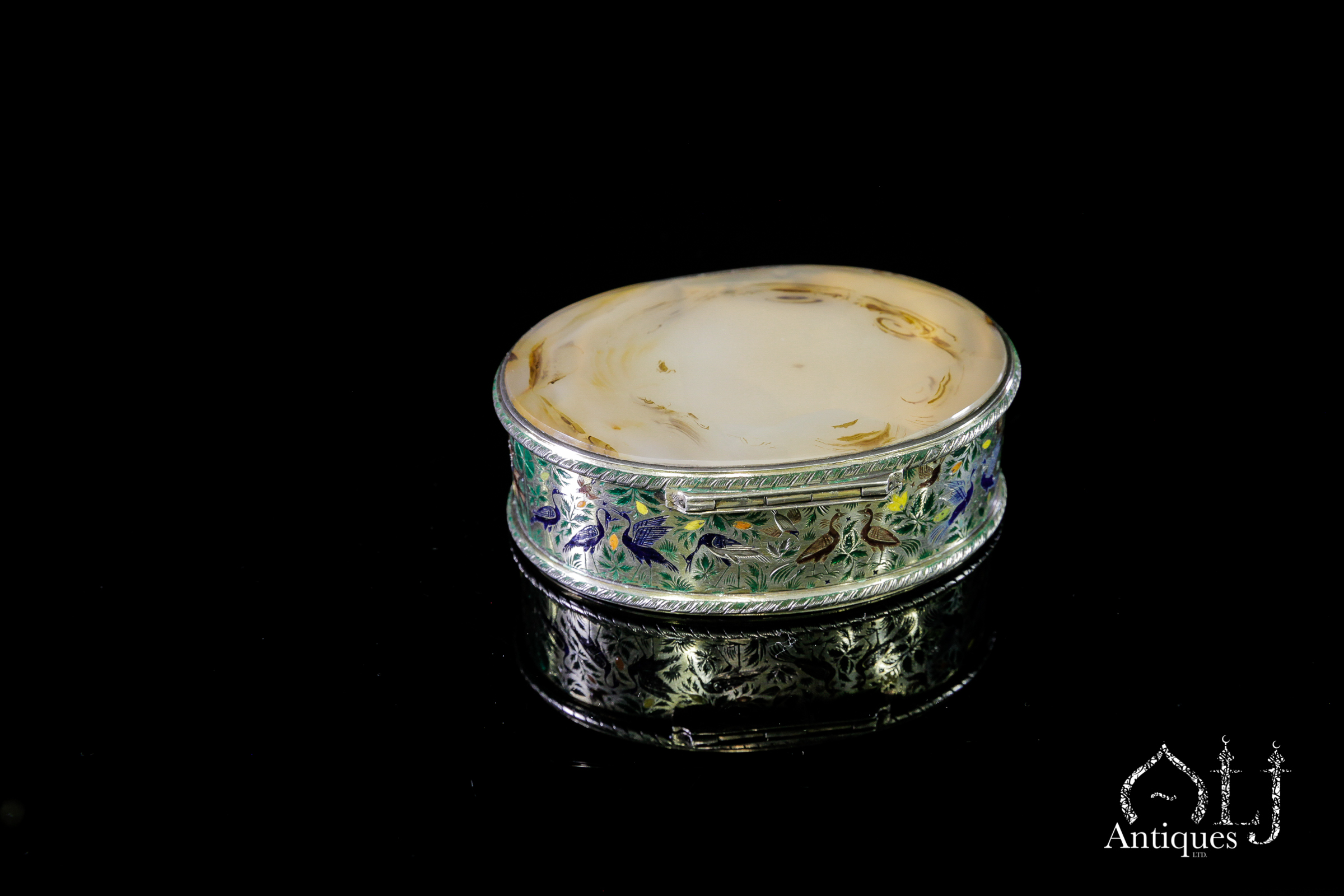
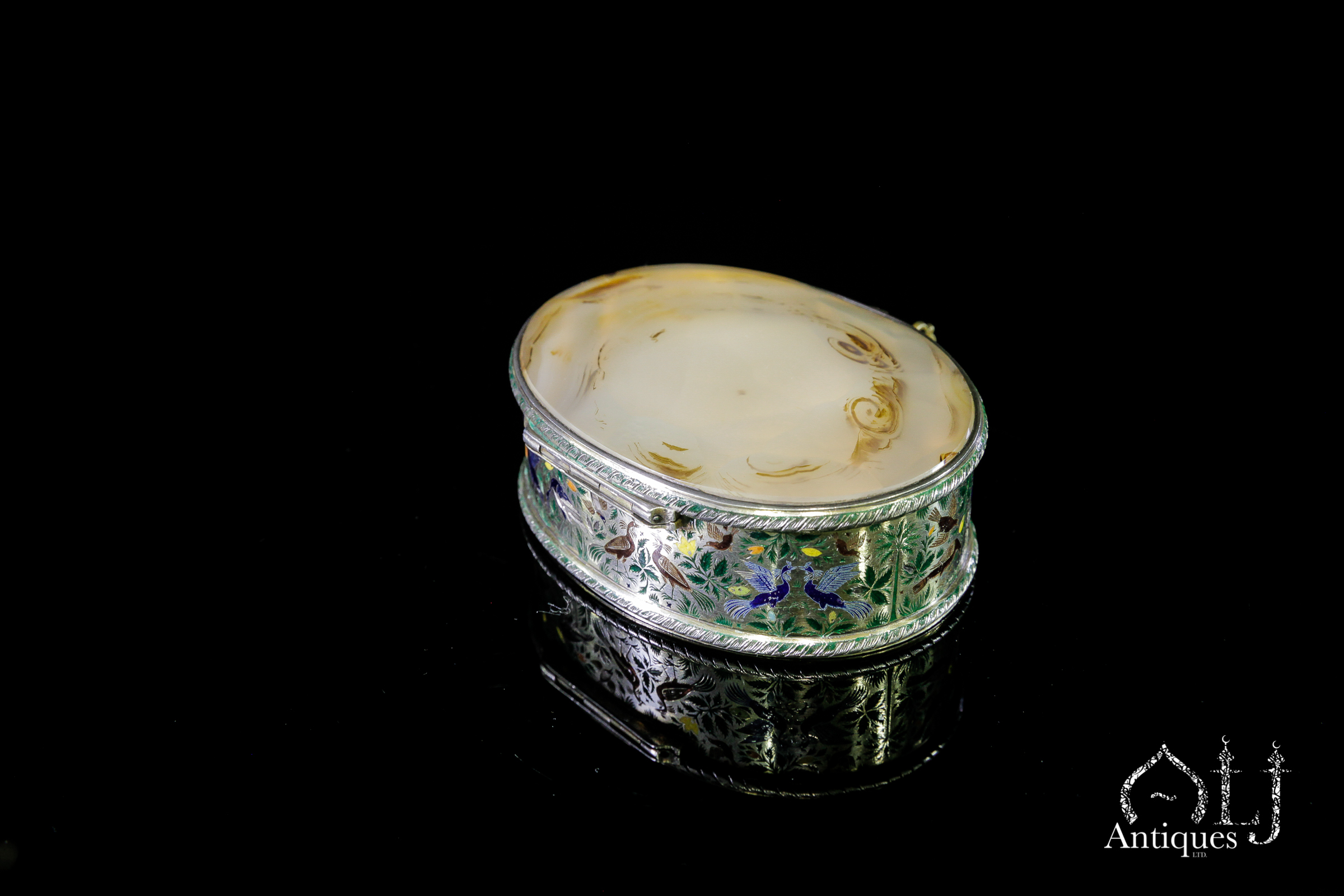
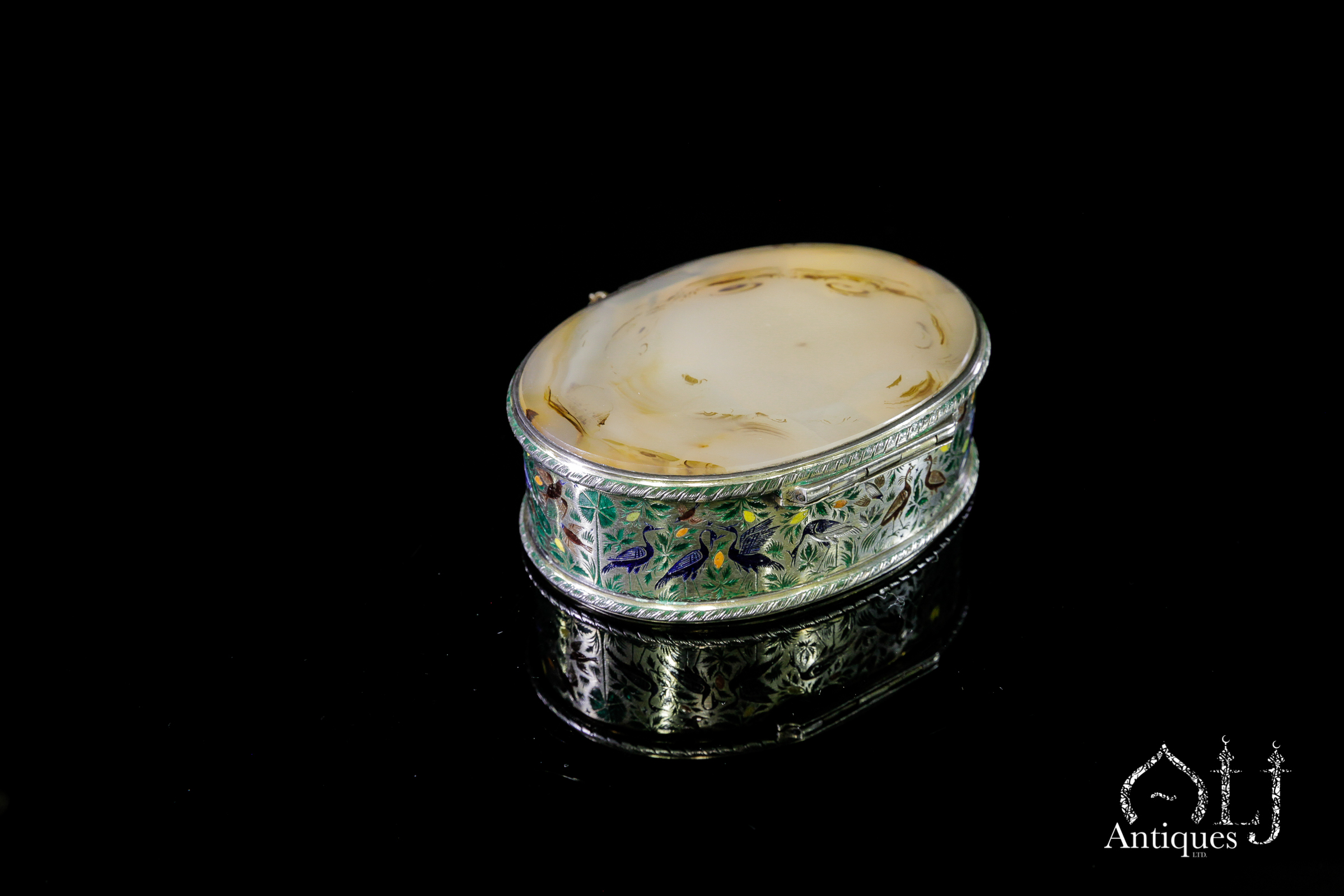
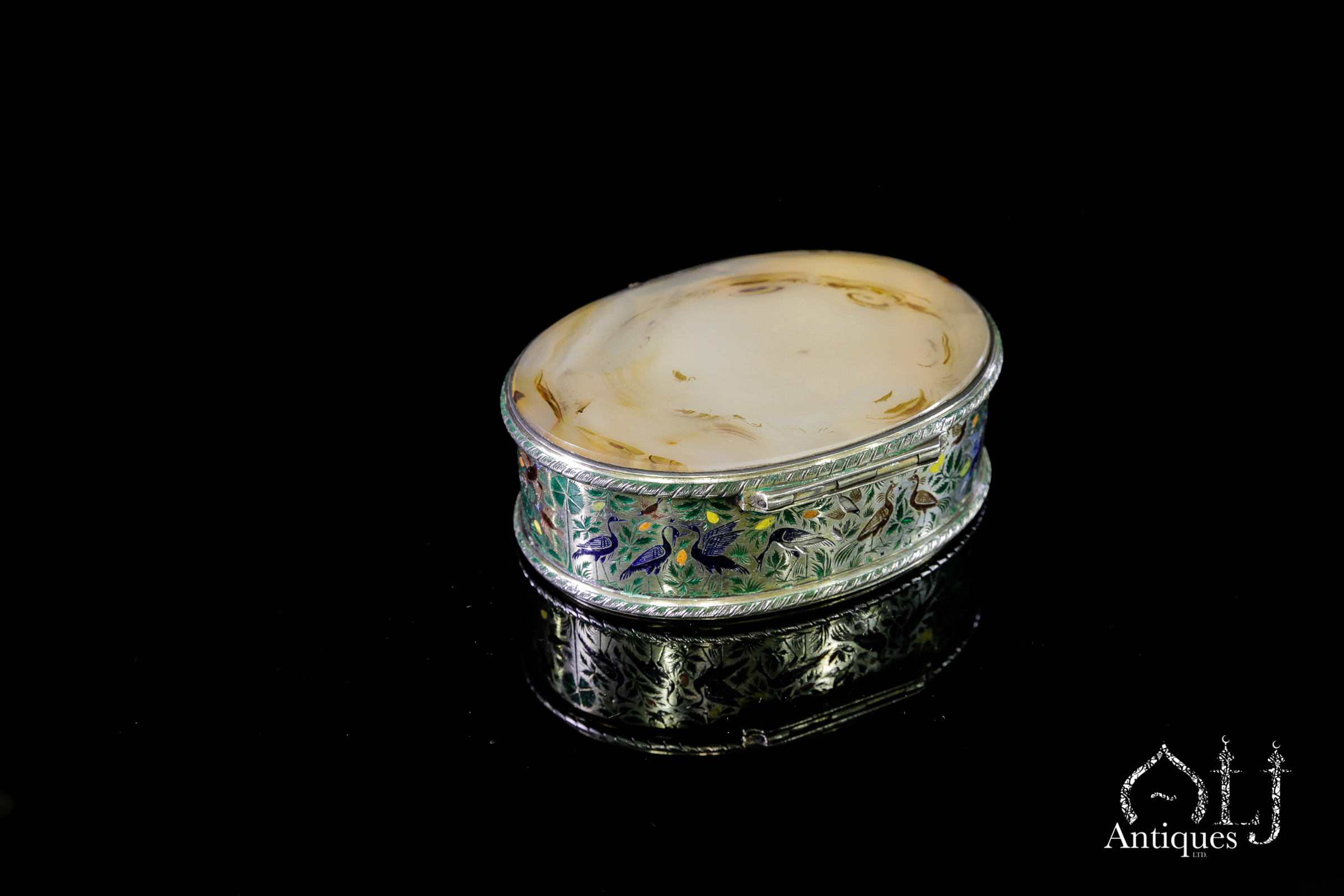
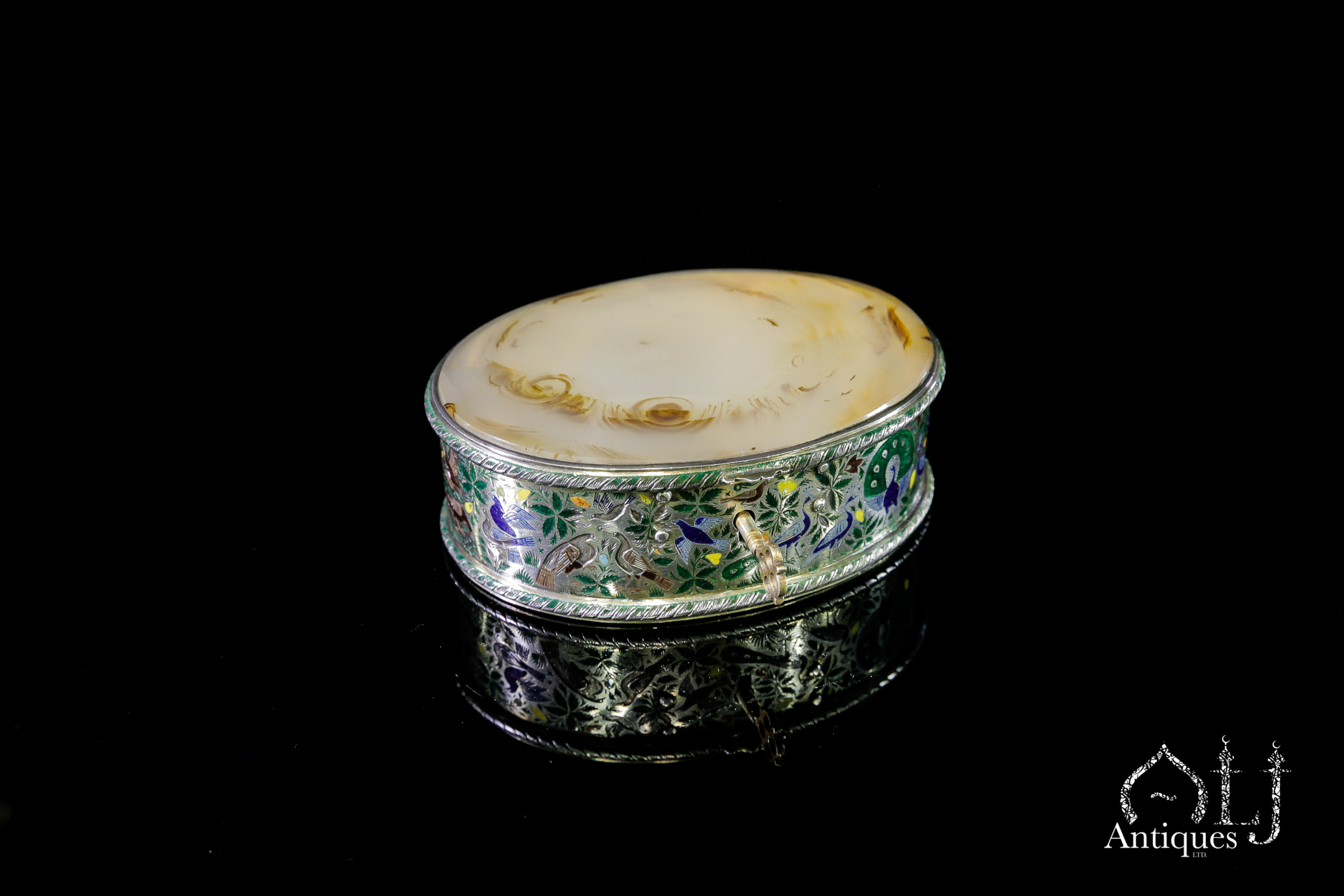
An Exceptionally Fine and Rare Lucknow Parcel-Gilt Silver Snuff Box, Richly Decorated in Translucent and Opaque Polychrome Enamels, Inset with Translucent Moss Agate Panels, Retaining its Original Silver Key, Nawab of Awadh, North India, Late 18th Century

Identification Number: 196
Available

Description

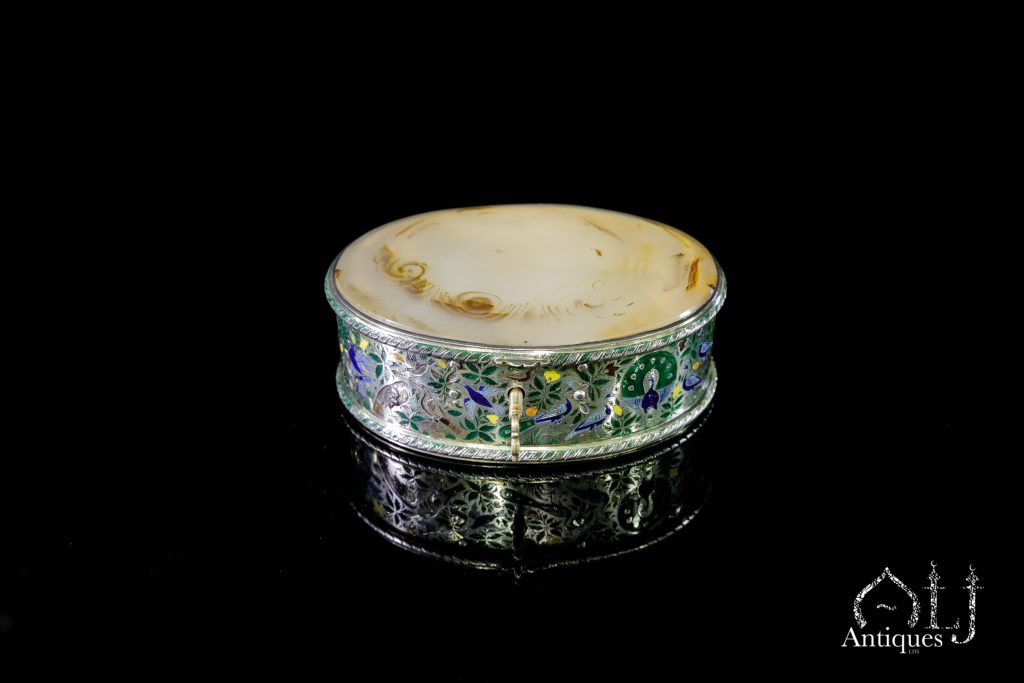
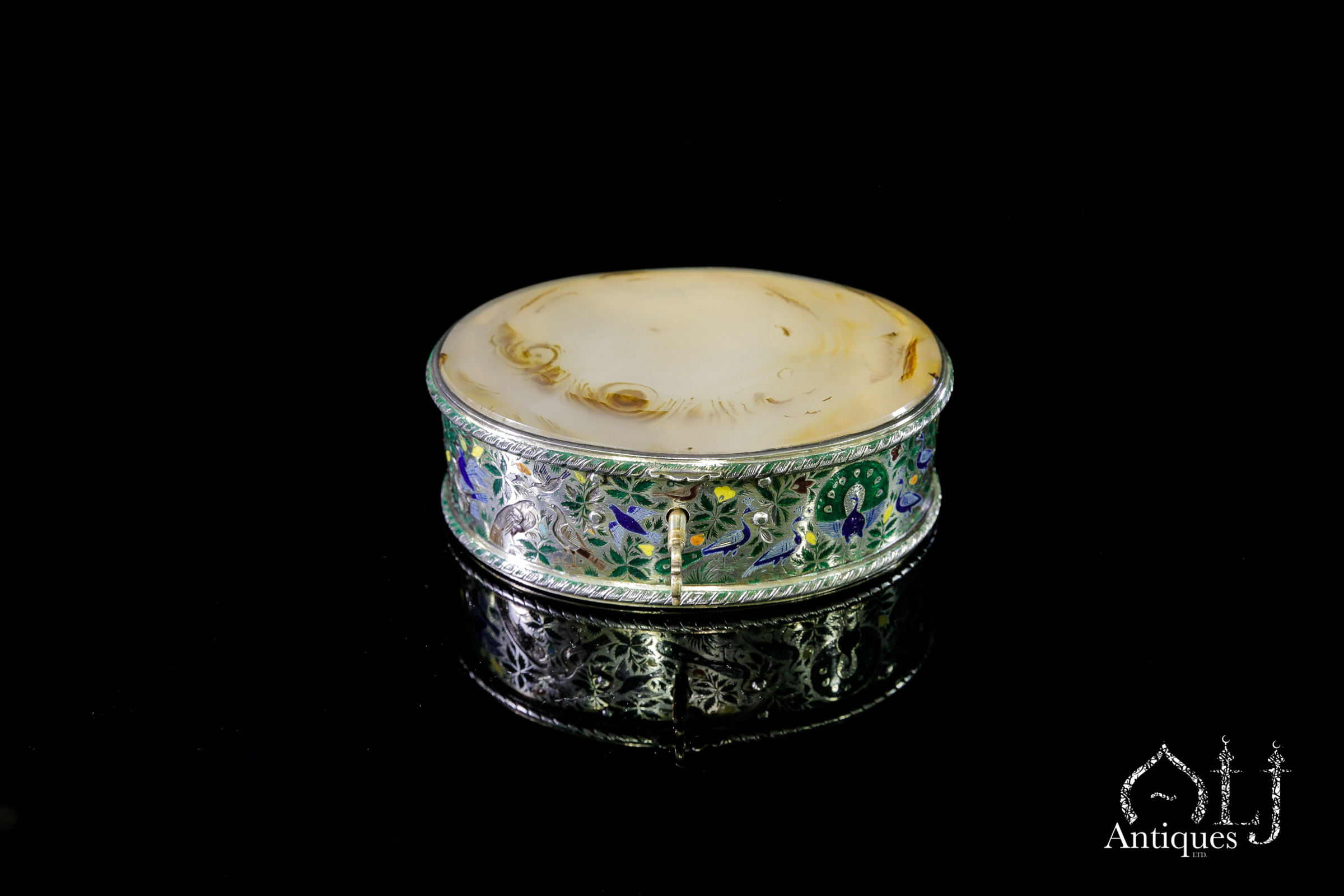
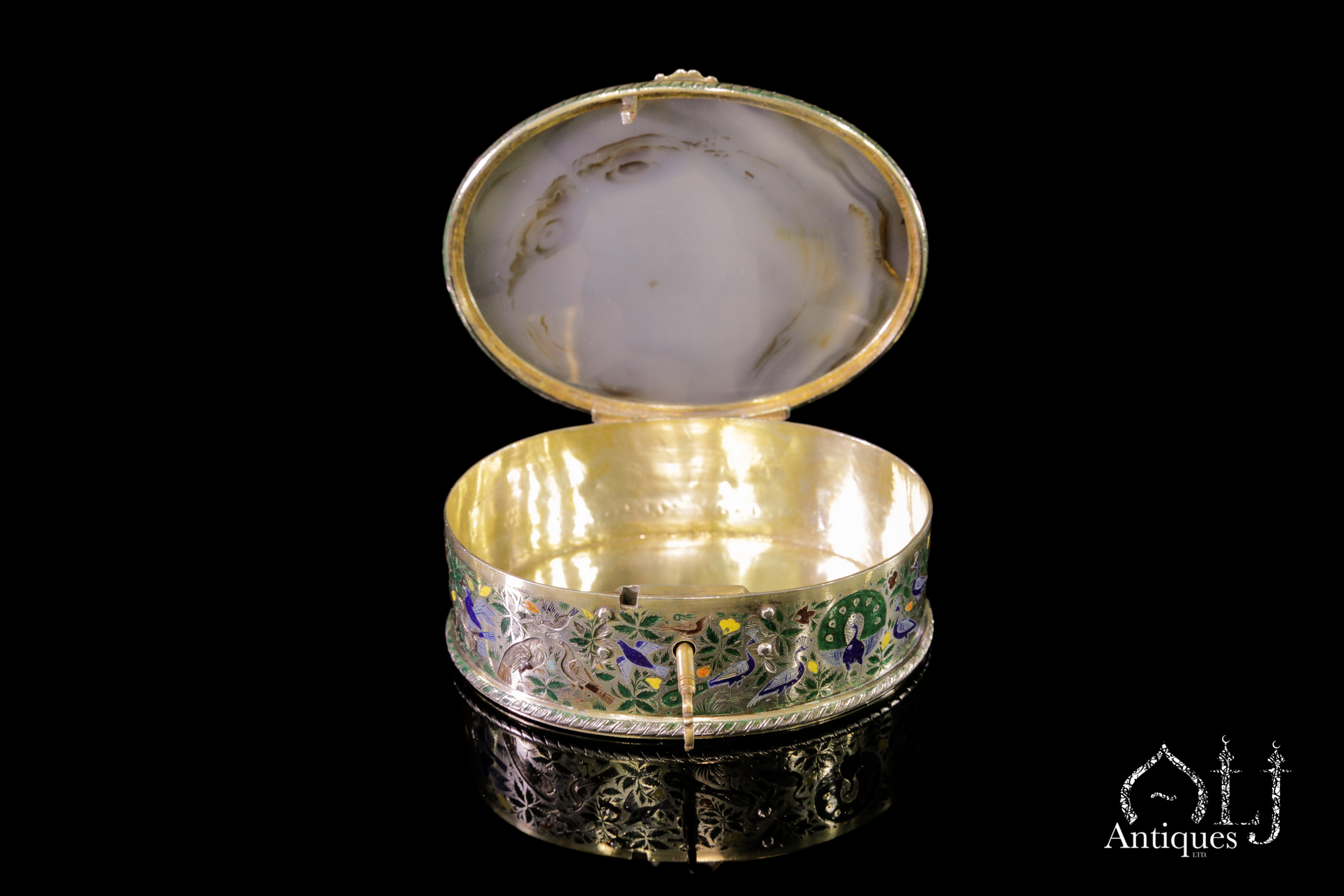
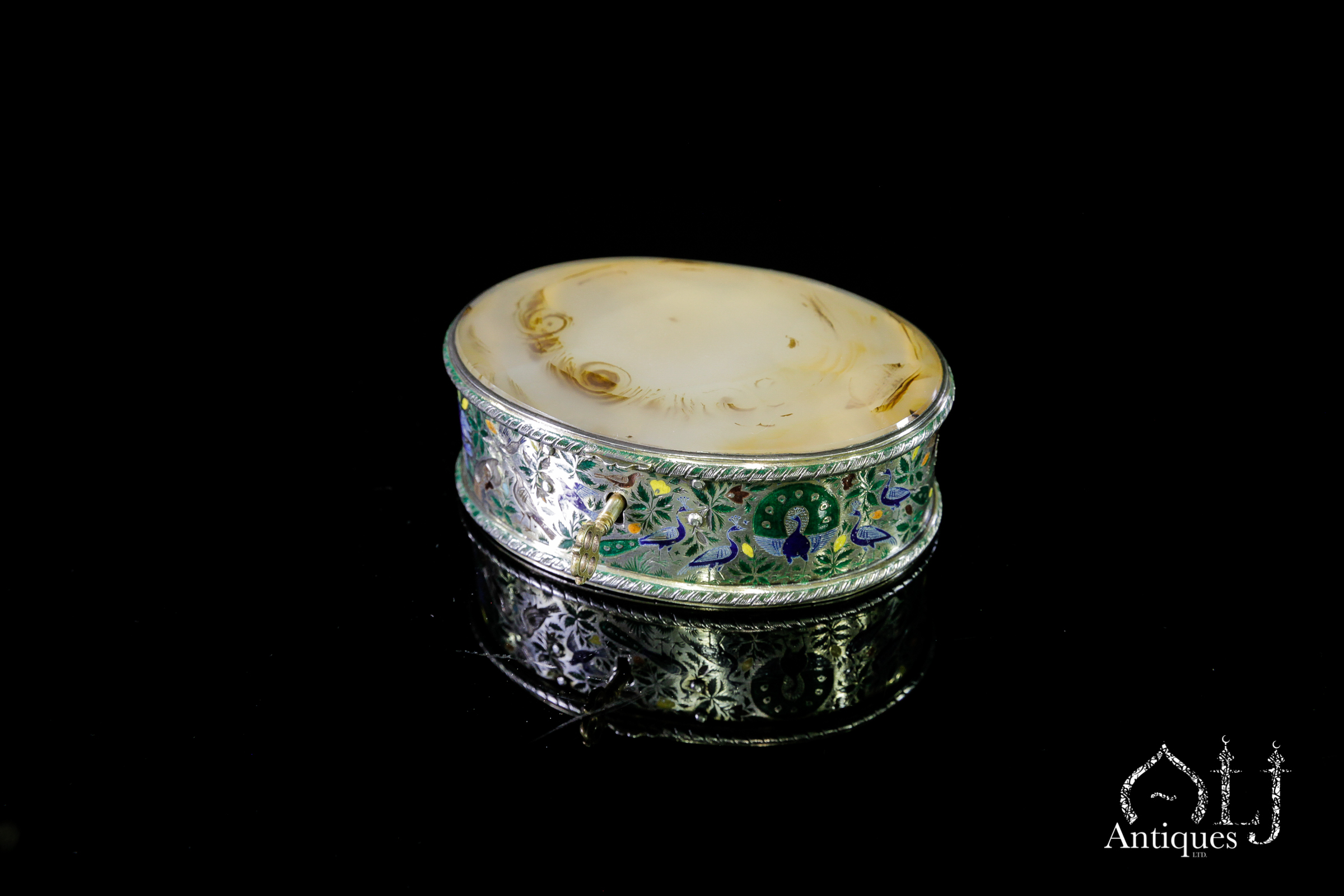
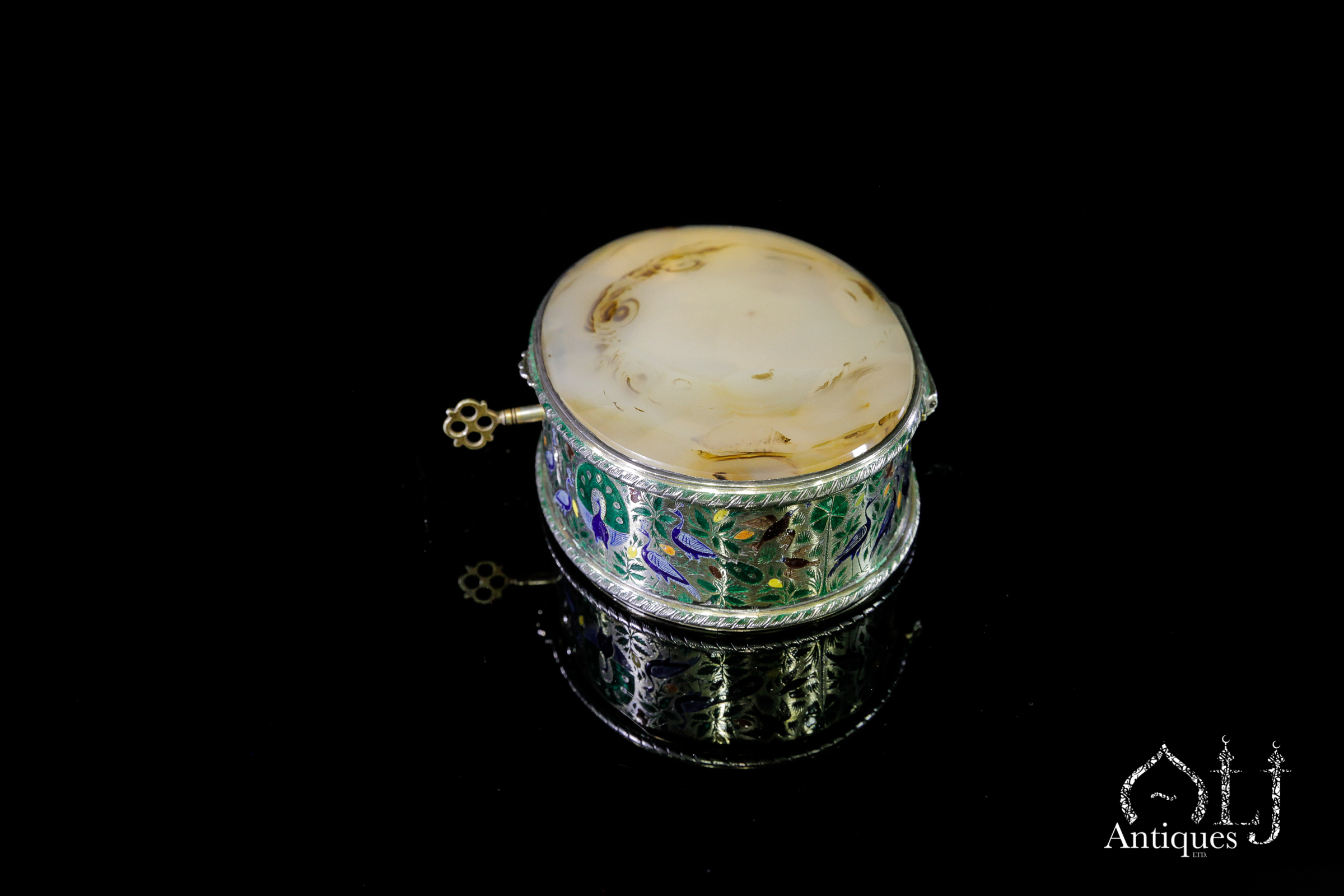
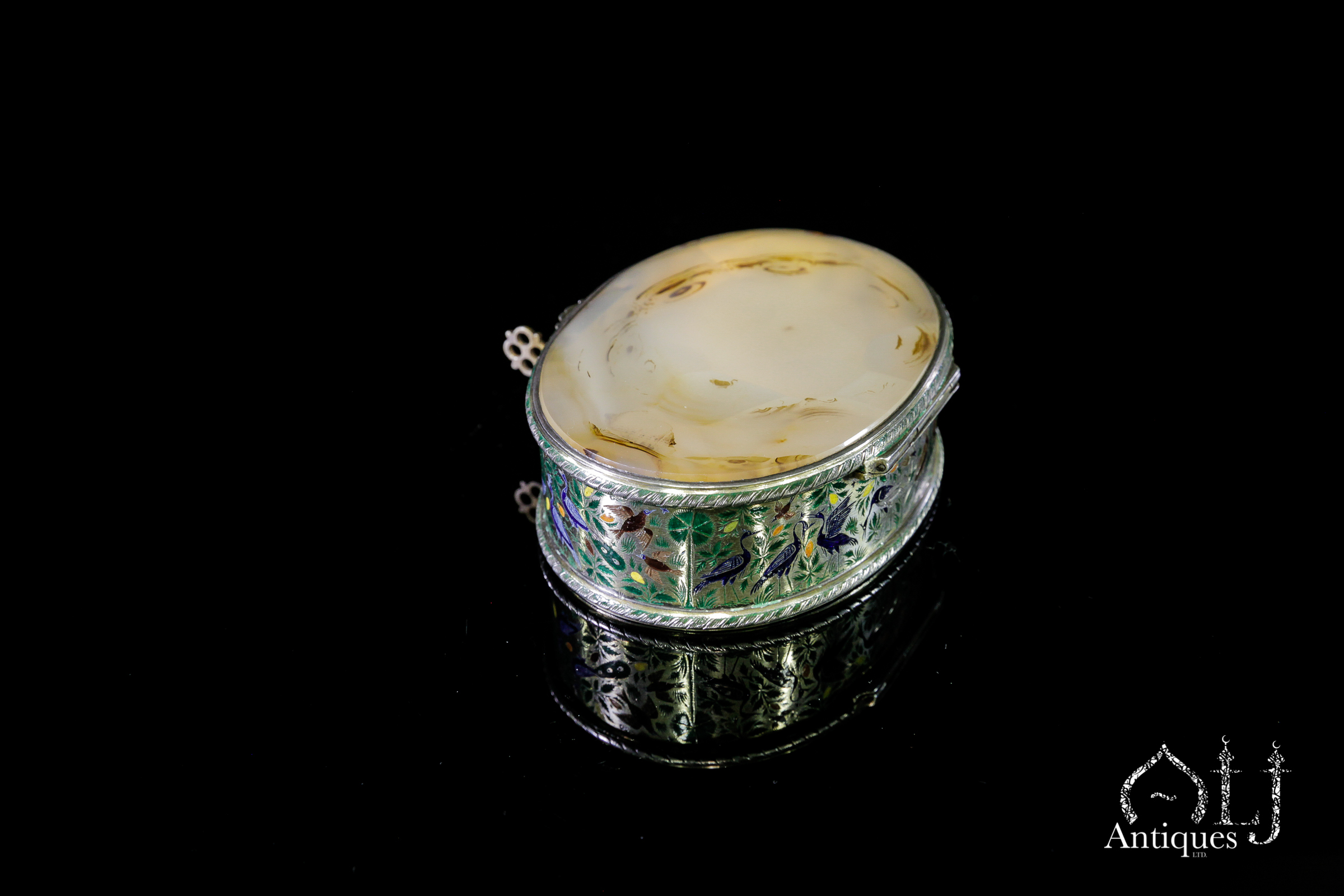
This exceptionally fine and rare parcel-gilt silver snuff box ranks amongst the finest surviving examples of the celebrated enamelling tradition that flourished in Lucknow, the capital of the Nawabs of Awadh, during the late eighteenth century. Richly decorated in brilliantly preserved polychrome enamels and inset with beautifully matched translucent moss agate panels, the box embodies the luxurious craftsmanship and refined artistic taste for which the court workshops of Lucknow became renowned.

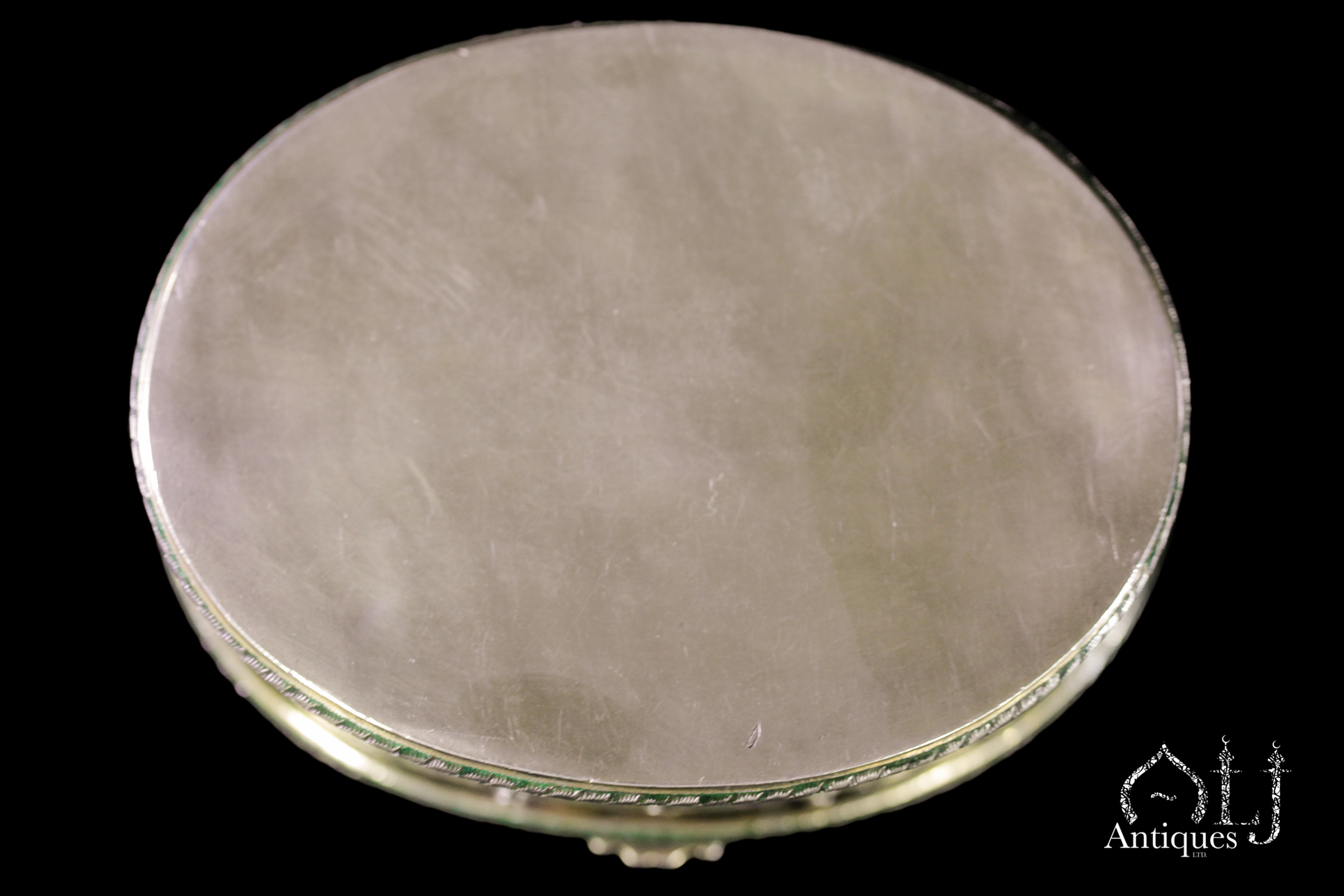
The elegant oval body is inset with finely polished oval panels of translucent moss agate to both the hinged lid and the underside, their attractive natural banding and moss-like inclusions beautifully complementing the richly parcel-gilt silver mounts. The silver mounts are finely engraved throughout and richly parcel-gilt, the gilding extending across the exterior, interior and underside, demonstrating the exceptional richness and luxury characteristic of the finest Lucknow court silver.

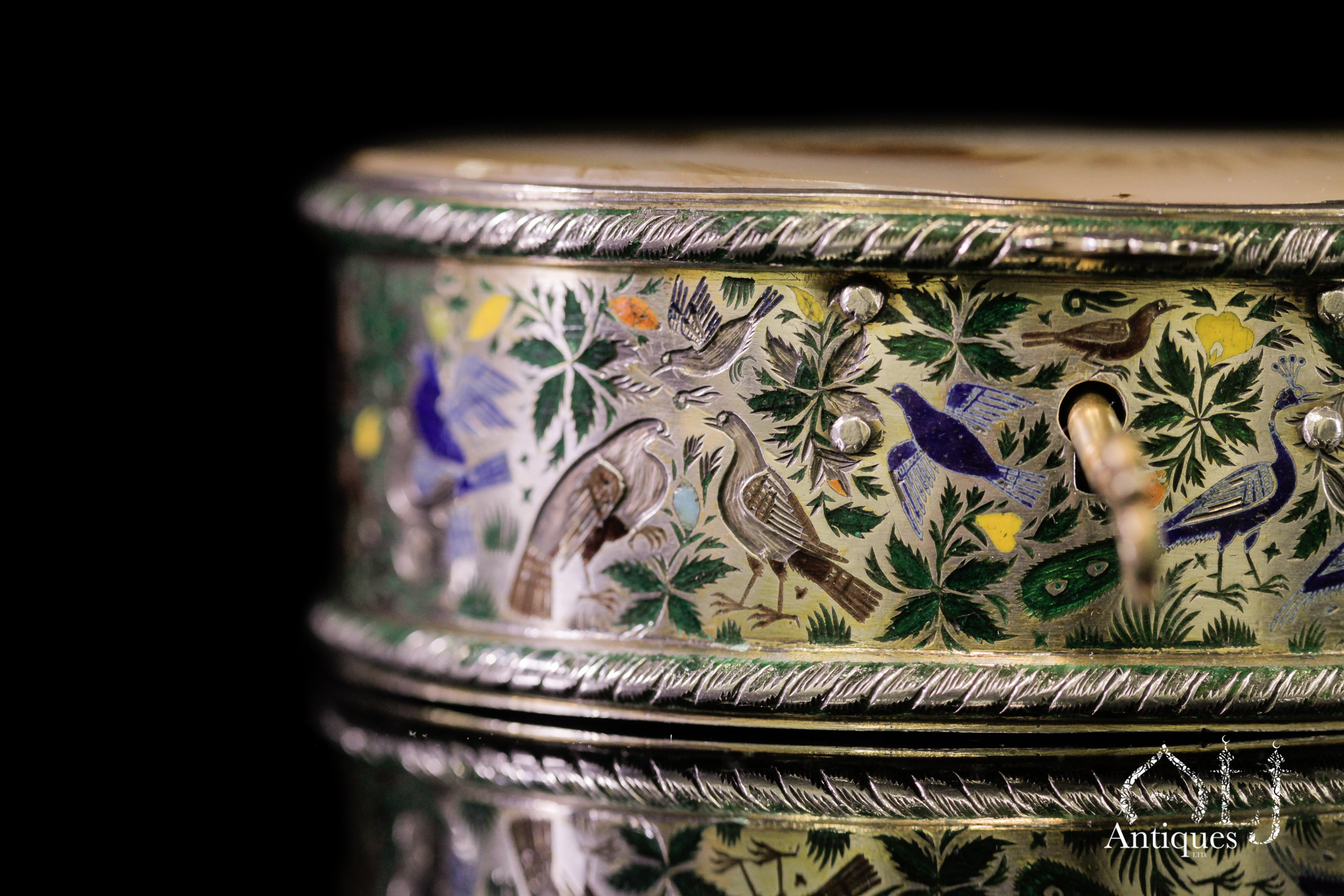
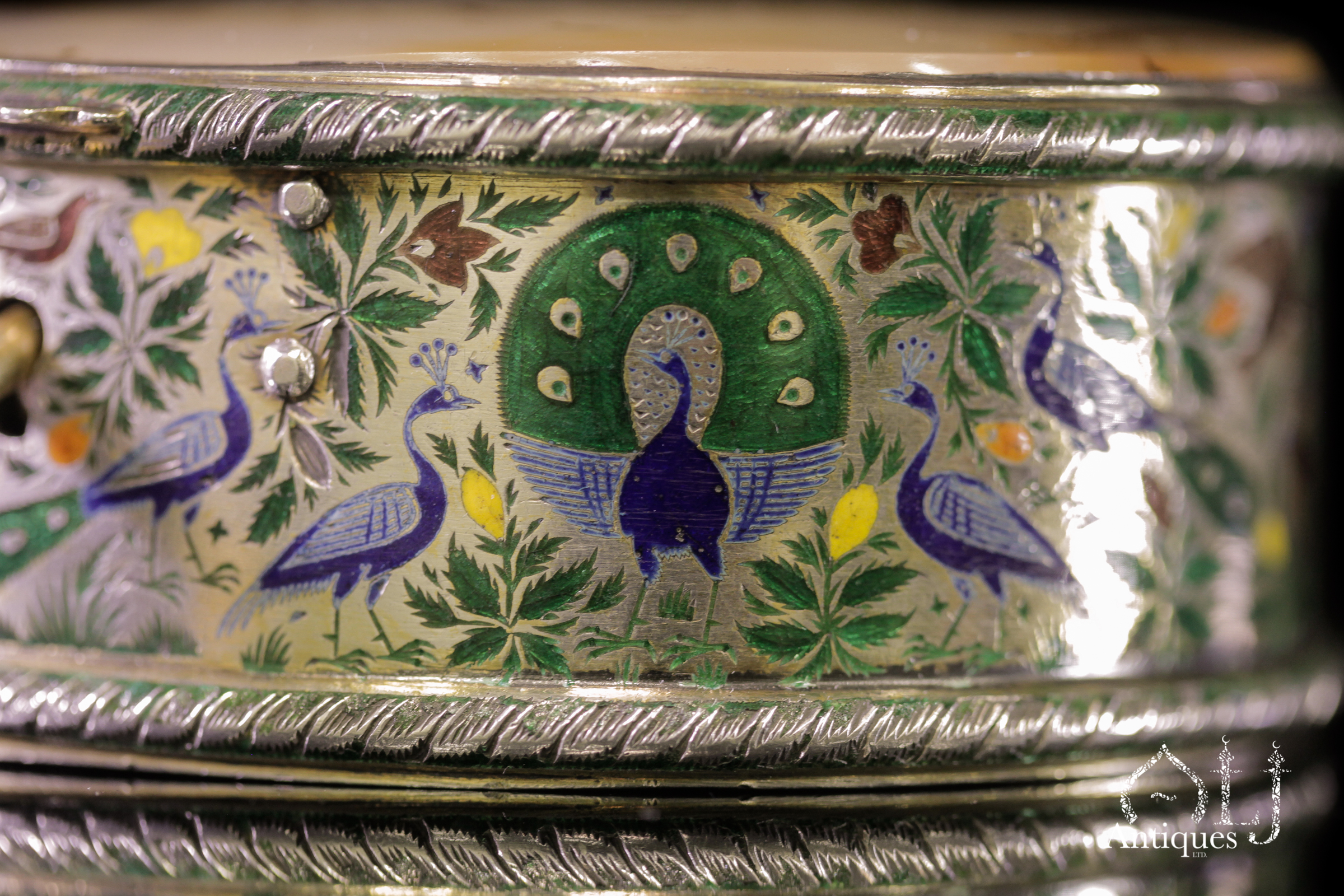
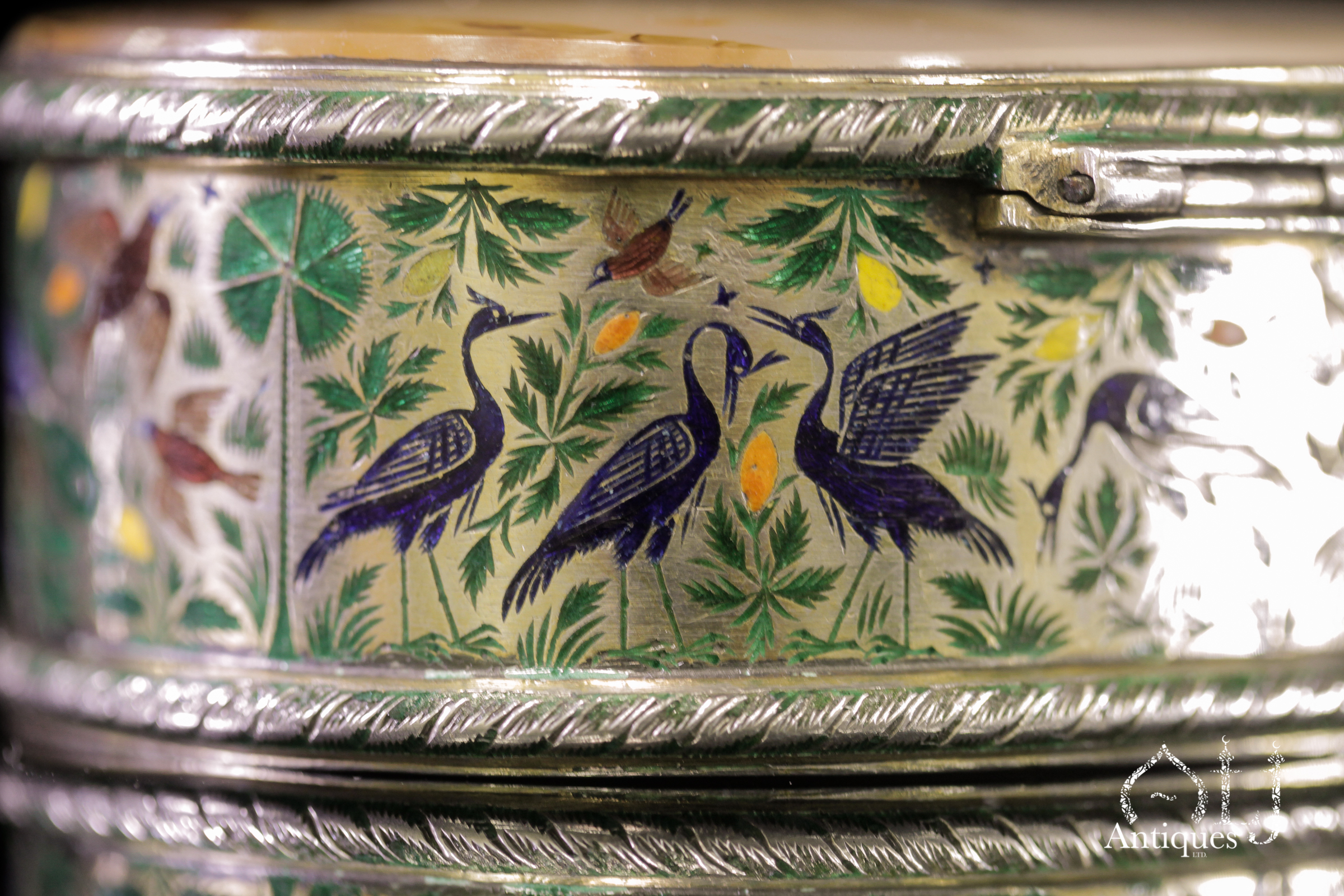
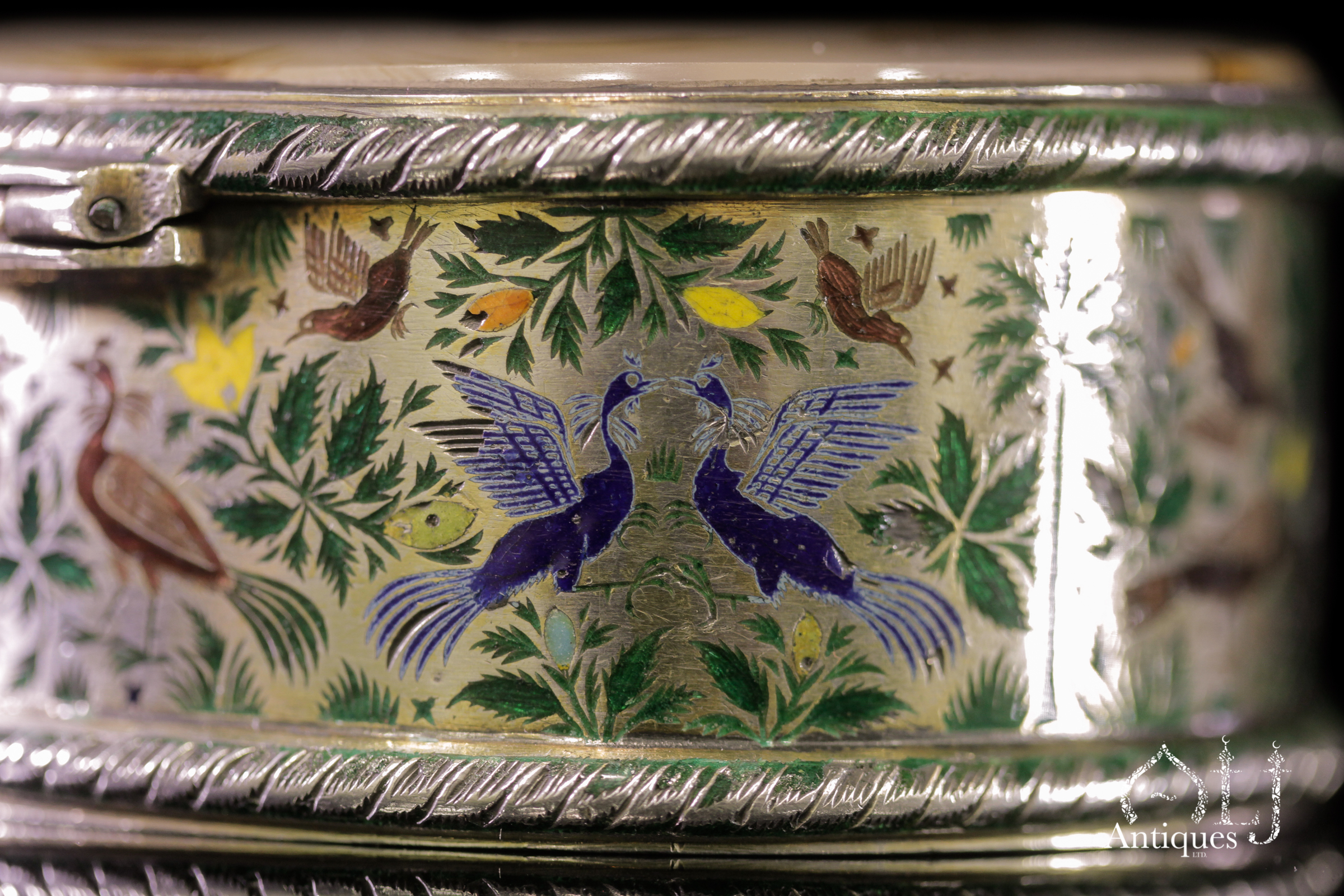
The sides are exquisitely decorated with individually composed enamelled panels depicting majestic peacocks, graceful cranes and other exotic birds amidst luxuriant flowering foliage. The decoration is executed using two distinct enamelling techniques. The foliage, particularly the emerald-green leaves, is rendered in translucent enamel, allowing the finely prepared silver ground beneath to shimmer through and creating remarkable depth, brilliance and jewel-like luminosity. In contrast, the birds and many of the floral details are painted in opaque enamels in vibrant shades of cobalt blue, turquoise, aubergine, yellow, white and russet, producing striking contrast, richness of colour and exceptional pictorial definition. The sophisticated combination of translucent and opaque enamels is characteristic of the most accomplished Lucknow enamellers and demonstrates an outstanding level of technical mastery.

Unlike many contemporary examples, each panel has been individually composed rather than repeated, reflecting the work of an accomplished court artist. Particularly striking is the panel depicting a magnificent peacock displaying its fanned tail, symbolising royalty, beauty and prosperity, while other panels portray elegant cranes and heraldic pairs of confronted birds amidst finely painted flowering plants inspired by the enduring naturalistic traditions of Mughal art. The refined draughtsmanship, harmonious compositions and remarkably well-preserved enamels create a decorative programme of exceptional elegance and sophistication.

During the eighteenth century, finely crafted snuff boxes such as the present example served not only as personal accessories but also as symbols of refinement and status amongst the aristocracy of the Nawabi court, where luxury objects fashioned from precious metals and adorned with exceptional enamelling reflected both wealth and cultivated taste.

Opening to reveal its beautifully preserved original parcel-gilt interior, the box retains its original silver key and lock mechanism, an uncommon survival that further enhances both its rarity and historical integrity.

With its exceptional quality of enamelling, richly parcel-gilt silver mounts, beautifully matched translucent moss agate panels and remarkable state of preservation, this snuff box ranks amongst the finest surviving examples of late eighteenth-century Lucknow luxury silver produced for the Nawabi court.
Dimensions

11 cm long *8 cm.
4 cm Height

Condition

Overall in very good condition, with only very minor enamel loss. The translucent moss agate panels to both the lid and underside are in excellent condition, displaying attractive natural banding and moss-like inclusions. The box retains its original silver key and lock mechanism; however, the lock is no longer functional. The original parcel-gilt interior and exterior are beautifully preserved, showing only light surface wear consistent with age and careful use.

Provenance

The USA Art Market.

References

Mark Zebrowski, Gold, Silver & Bronze from Mughal India, London: Alexandria Press in association with Laurence King Publishing, 1997. See cat. no. 79, p. 90, illustrating the celebrated parcel-gilt and enamelled silver pandan in the collection of the Victoria and Albert Museum, London (Accession No. IM.30-1912). This represents one of the closest published comparisons in terms of workmanship, enamelling technique, artistic quality and overall refinement.
Stephen Markel and Tushara Bindu Gude, India's Fabled City: The Art of Courtly Lucknow, Los Angeles County Museum of Art, DelMonico Books / Prestel, 2010. See pp. 198–212 for a comprehensive discussion and illustrations of the finest surviving examples of Lucknow parcel-gilt and enamelled silver, demonstrating comparable techniques, colour palettes, decorative motifs and courtly patronage.
For the use of polished agate mounted in precious metal, compare the Indo-Portuguese or Batavian Filigree Silver-Mounted Polished Orange Agate Casket, probably Goa, India, or Batavia (Dutch East Indies), 17th century, formerly in the collection of ALJ Antiques Ltd. Although belonging to a different artistic tradition, it illustrates the continued appreciation of finely polished agate as a prestigious ornamental hardstone employed on luxury caskets and personal objects produced within the Indian world.

Related Antiques

  • A Small Portable Gilt & Enamelled Silver Water-Pipe (Huqqah) Base, Upper Pradesh, Lucknow-India, 18th. Century.

    A Small Portable Gilt & Enamelled Silver Water-Pipe (Huqqah) Base, Upper Pradesh, Lucknow-India, 18th. Century.

    Sold
  • Lucknow Silver Parcel-Gilt and Enamelled Gulabdan (Rosewater Sprinkler) in the Form of a Mango Lucknow, Kingdom of Awadh (Oudh), North India, Circa 1780–1800

    Lucknow Silver Parcel-Gilt and Enamelled Gulabdan (Rosewater Sprinkler) in the Form of a Mango Lucknow, Kingdom of Awadh (Oudh), North India, Circa 1780–1800

  • Lucknow Enamelled Silver, An Exceptionally Rare Champleve Enamelled And Gilt Silver Betel Nut Box Or Pandan, Beautifully Decorated With Mughal Style Flowers, The Nawab of Awadh, Uttar Pradesh, Lucknow, North India, Late 18th. Early 19th. Century

    Lucknow Enamelled Silver, An Exceptionally Rare Champleve Enamelled And Gilt Silver Betel Nut Box Or Pandan, Beautifully Decorated With Mughal Style Flowers, The Nawab of Awadh, Uttar Pradesh, Lucknow, North India, Late 18th. Early 19th. Century

    Enamelled And Gilt Silver Betel Nut Box Or Pandan, The Nawab of Awadh, Uttar Pradesh, Lucknow, North India, Late 18th. Early 19th. Century.

    Sold
  • A Silver Gilt And Enamelled Water-Pipe Base (Huqqa),The Nawab Of Awadh, Uttar Pradesh, Lucknow, North India, Circa 1775.

    A Silver Gilt And Enamelled Water-Pipe Base (Huqqa),The Nawab Of Awadh, Uttar Pradesh, Lucknow, North India, Circa 1775.

    Sold