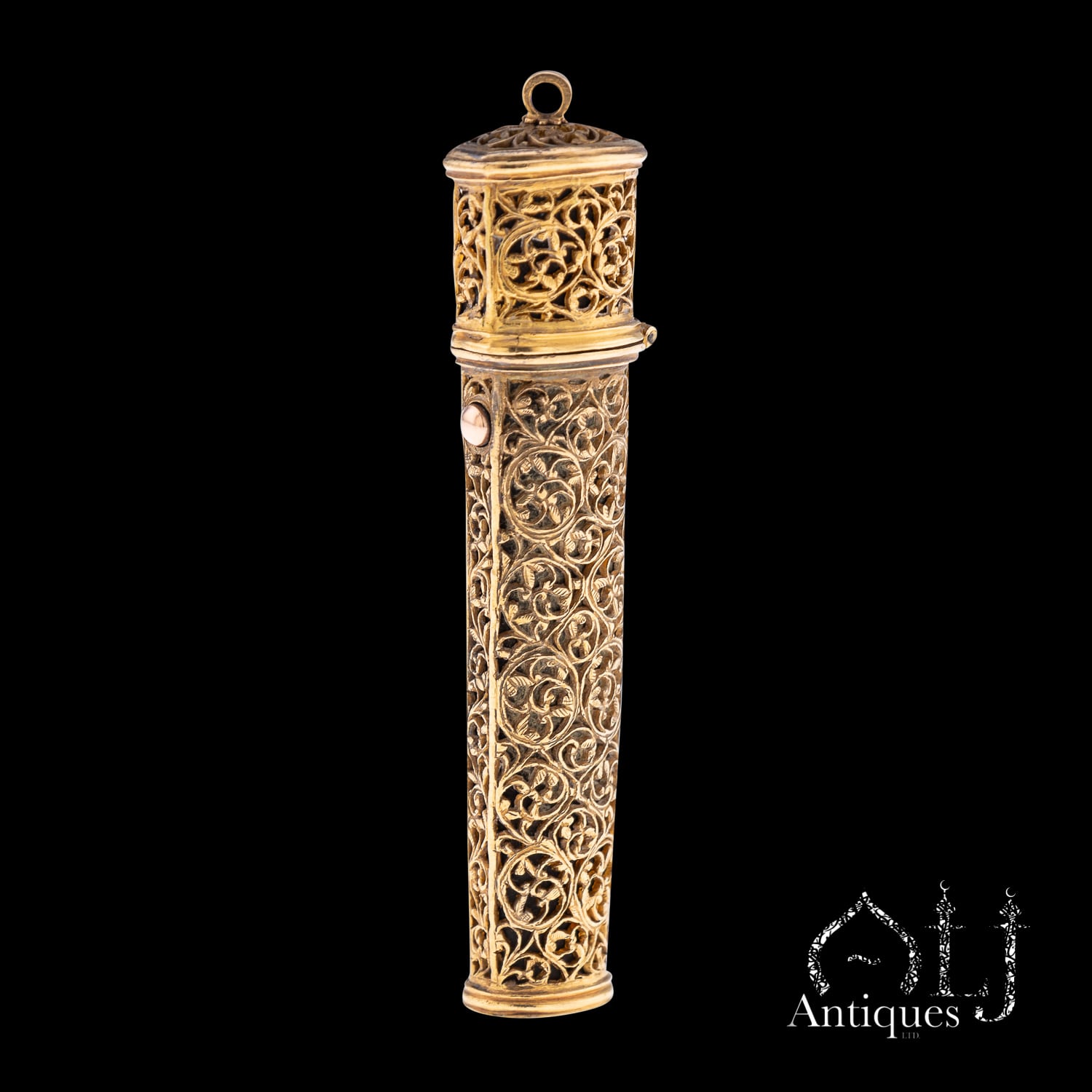
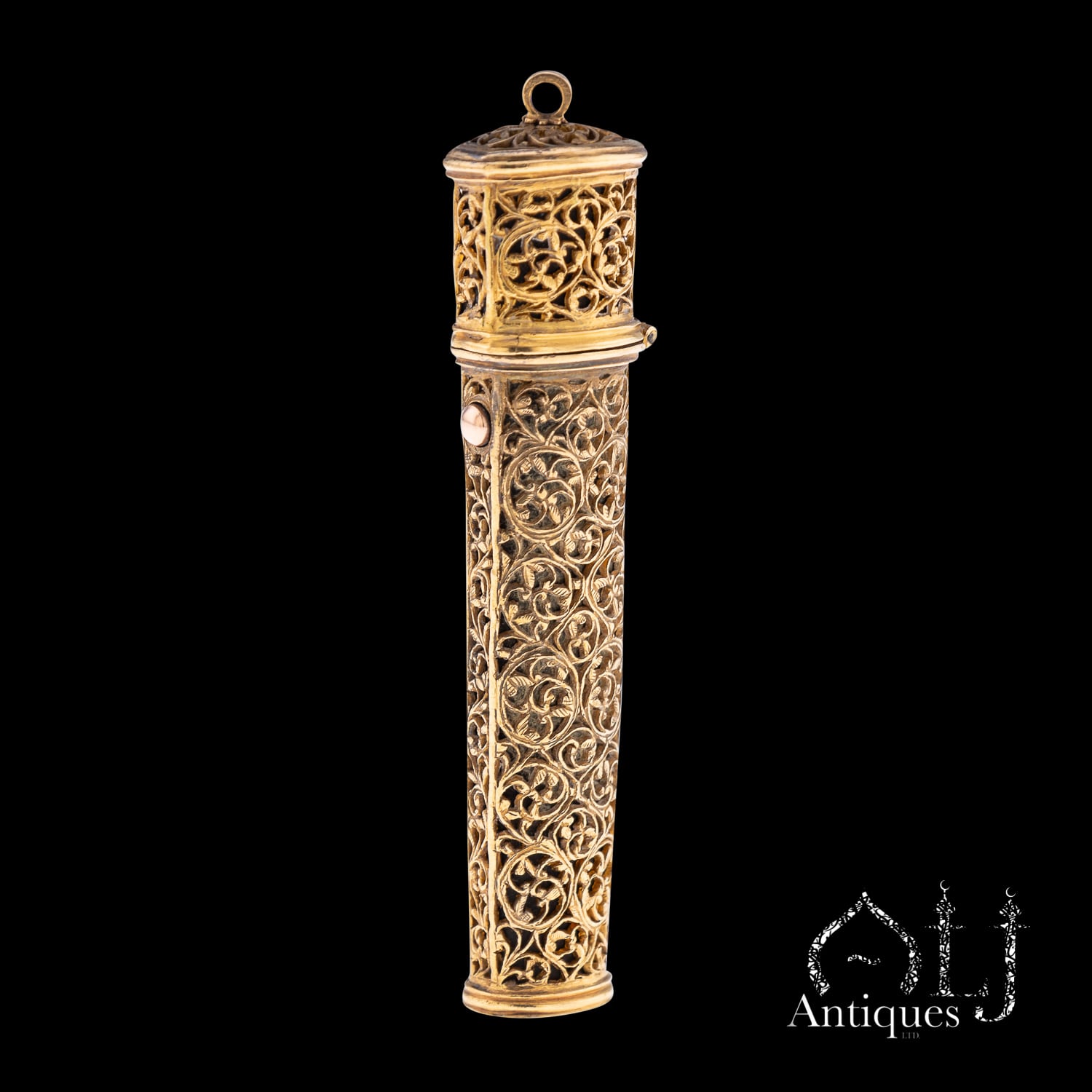
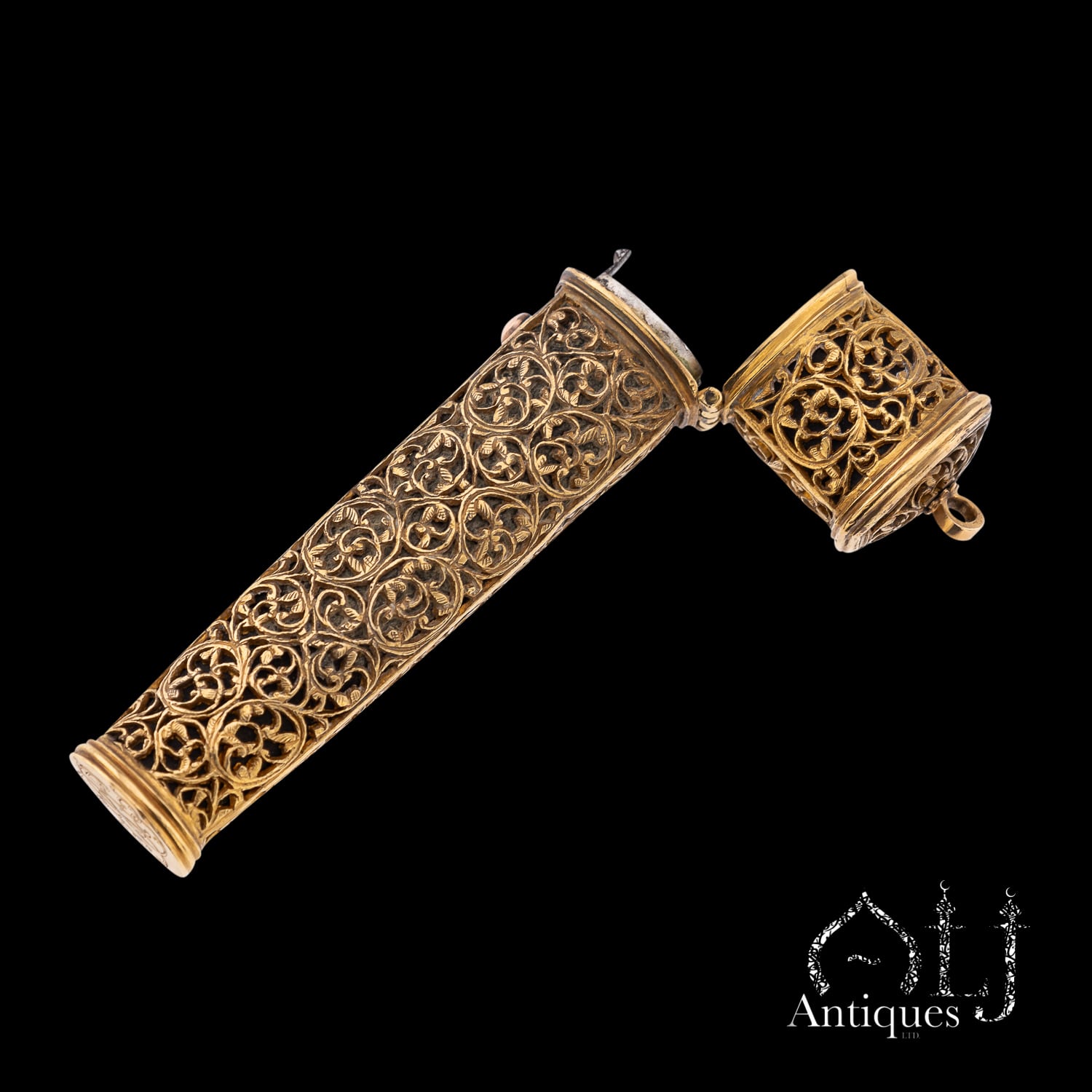
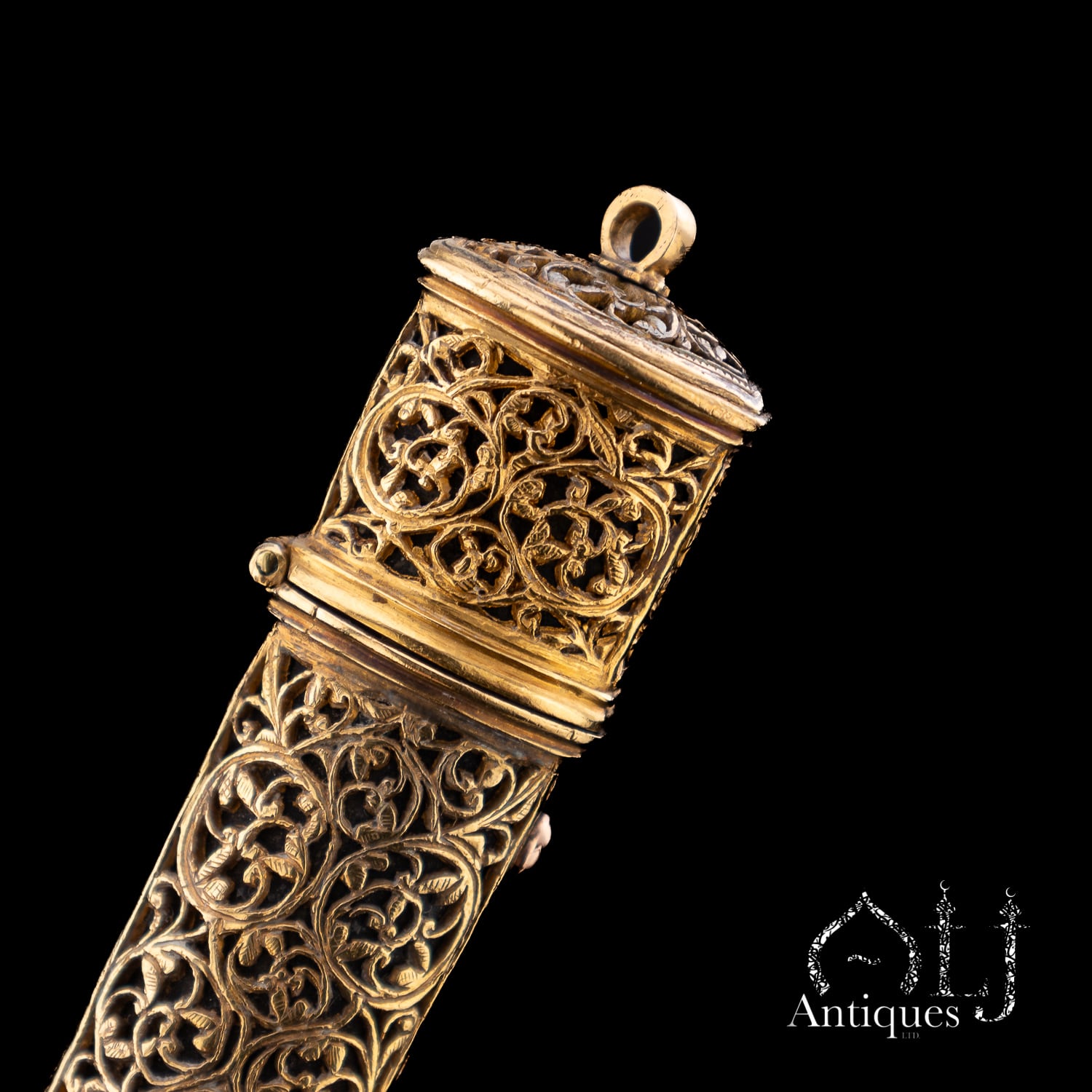
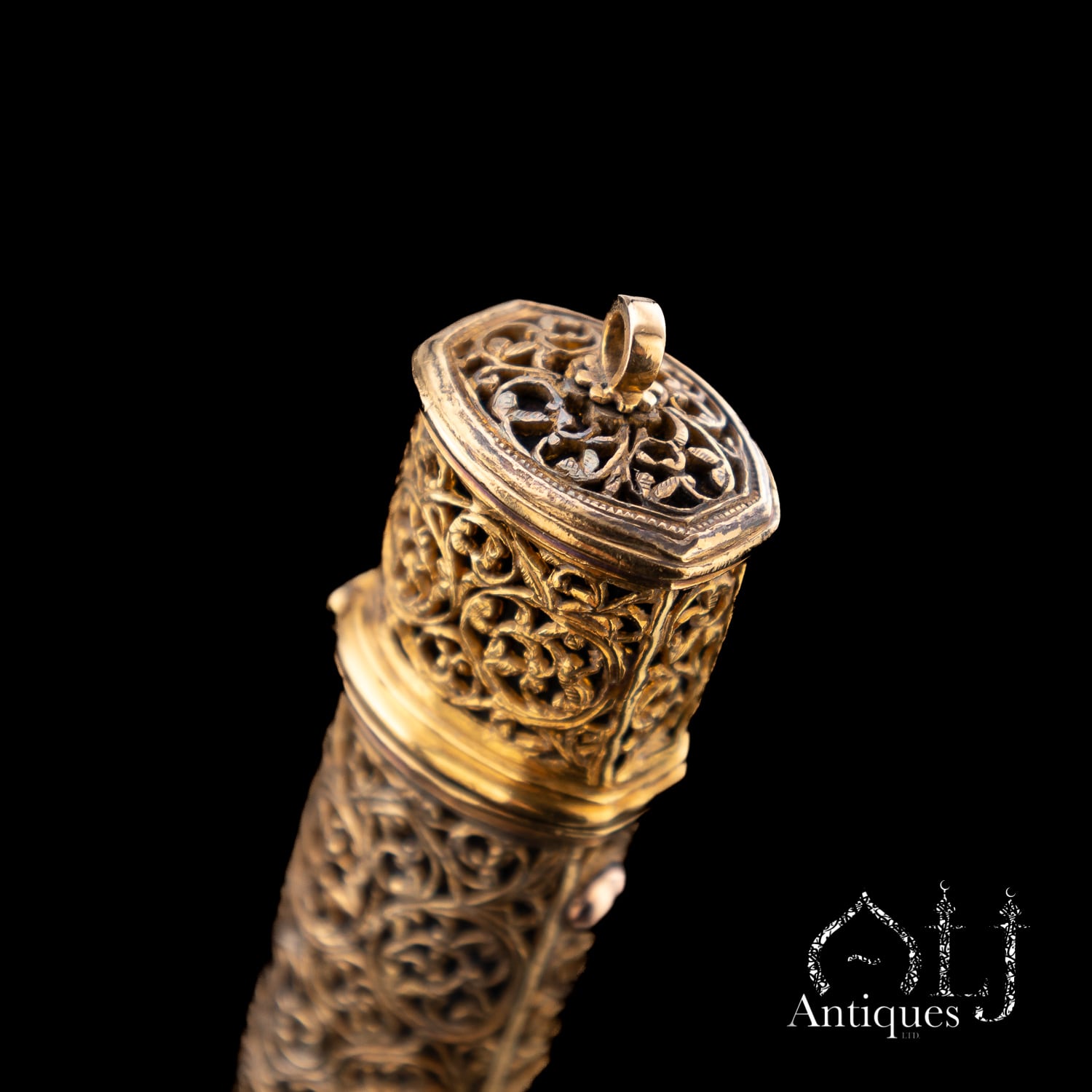
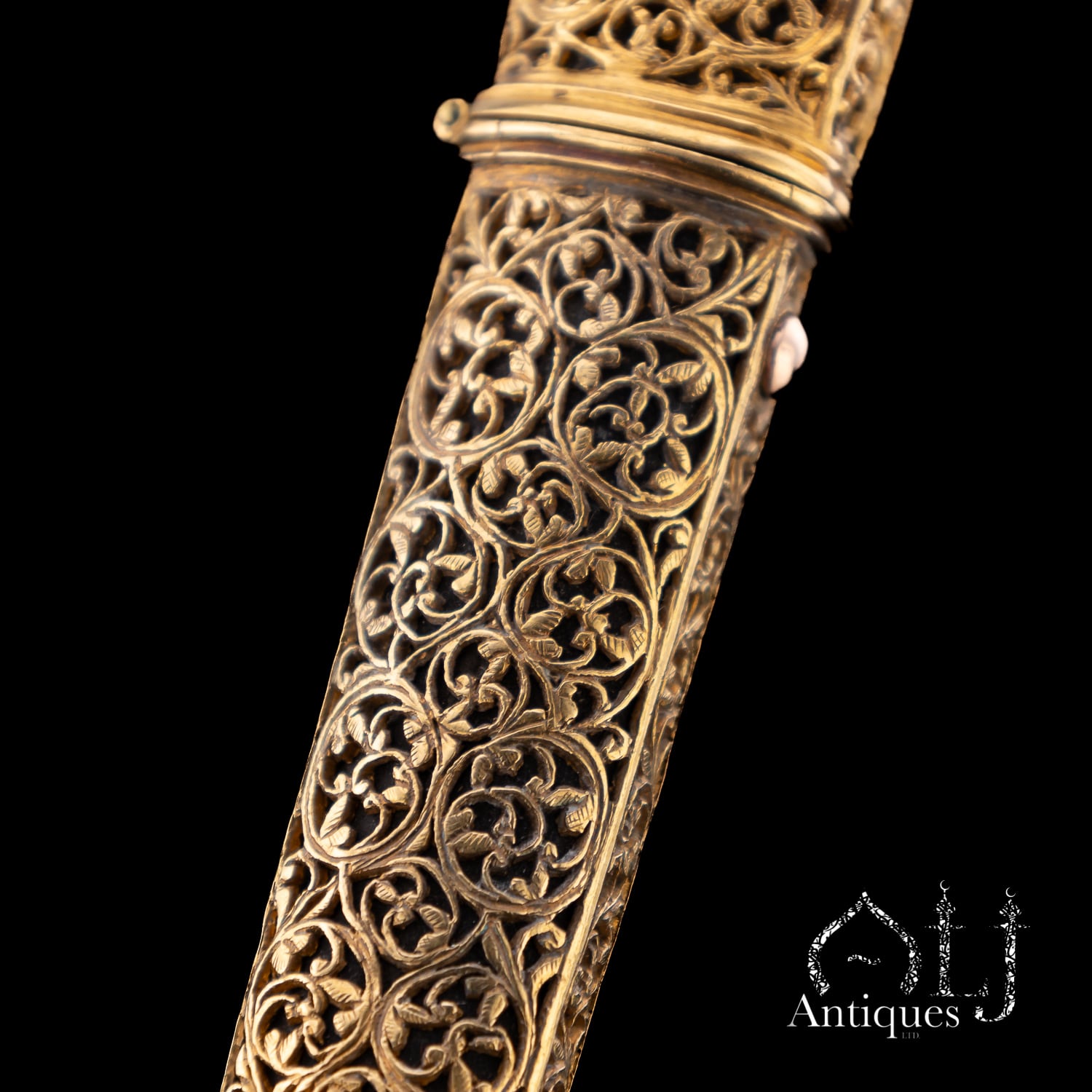
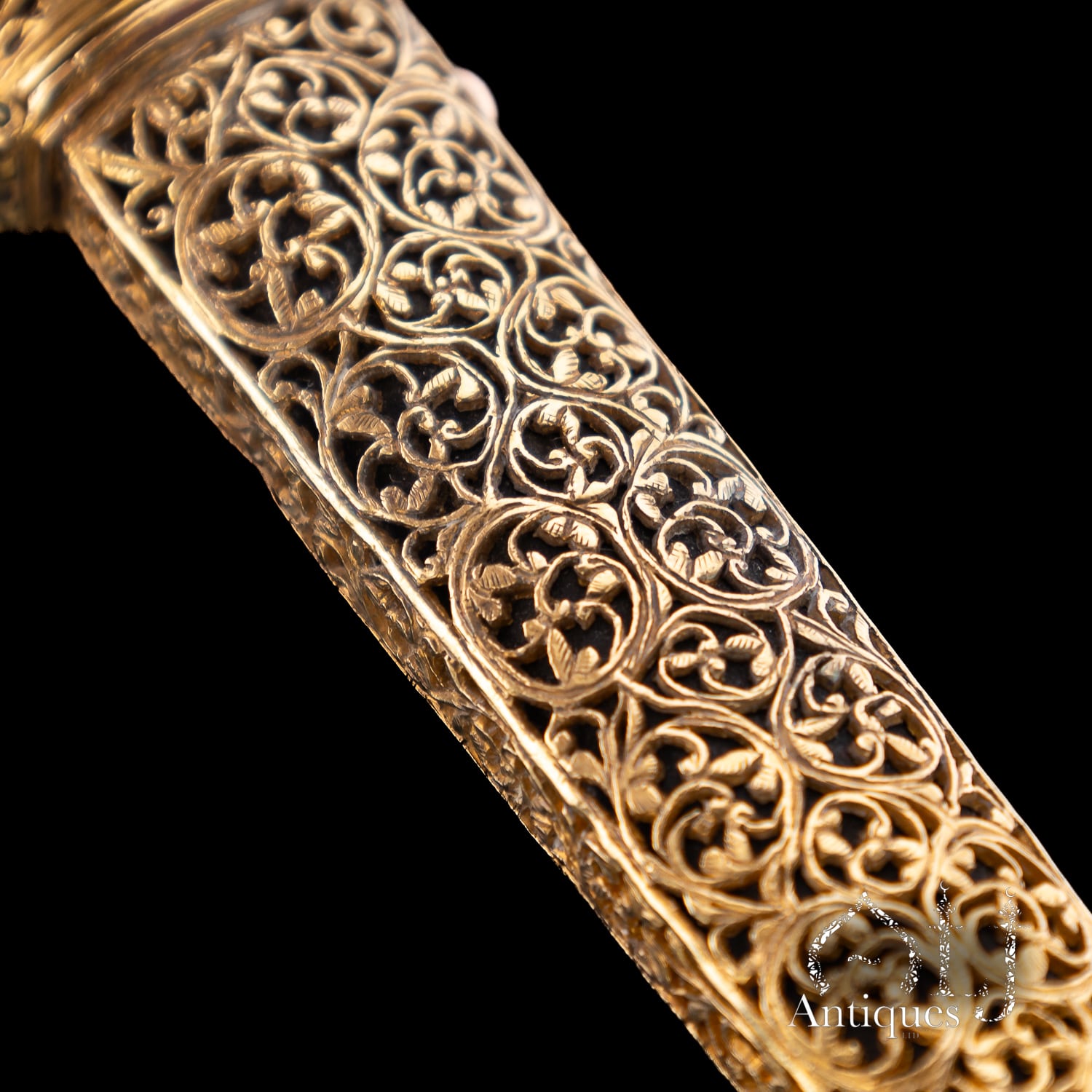
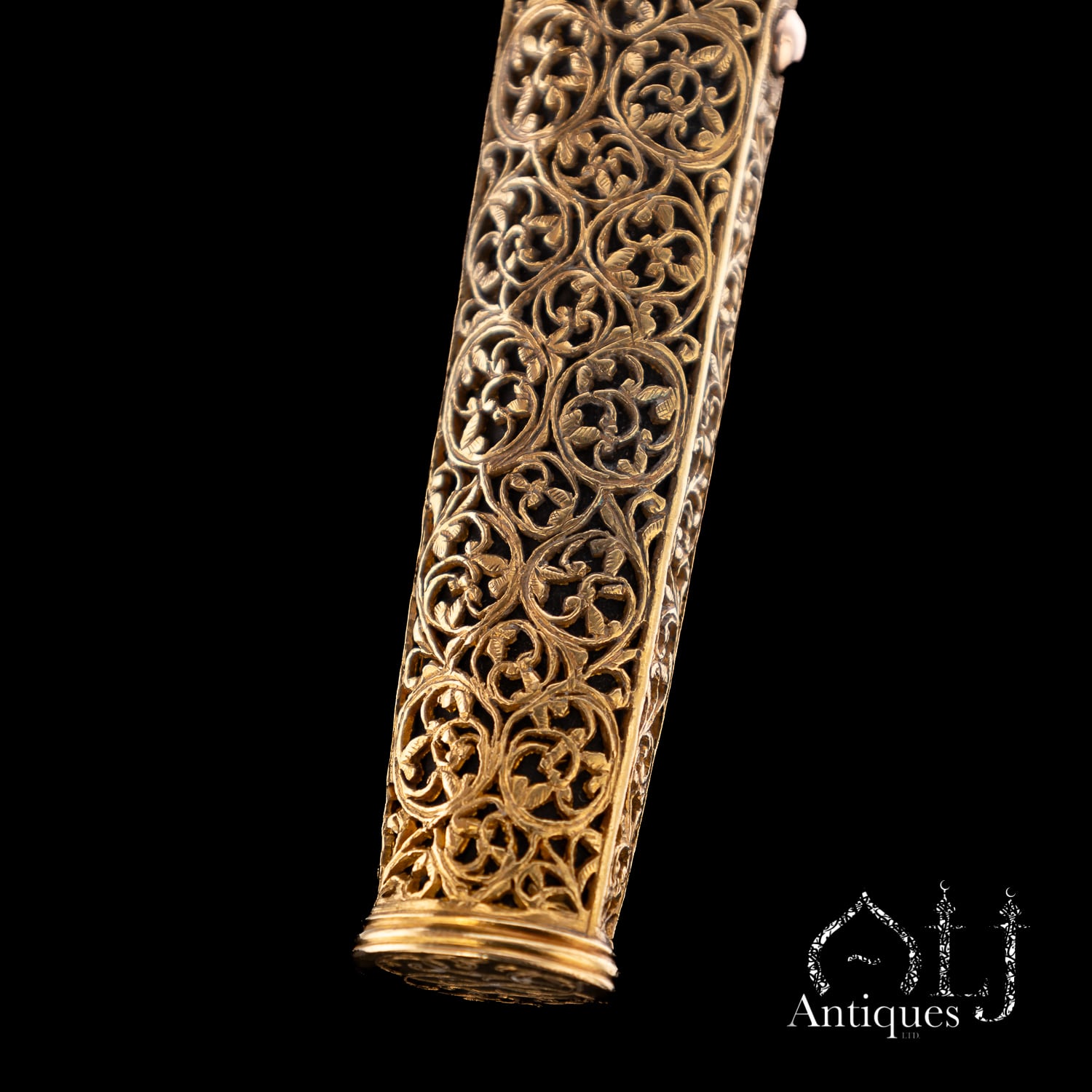
A Fine Indo-Portuguese Parcel-Gilt Silver Needle Case (Étui),West India, possibly Goa or Gujarat, ca. 1700 CE

Identification Number: 663
Available

Description

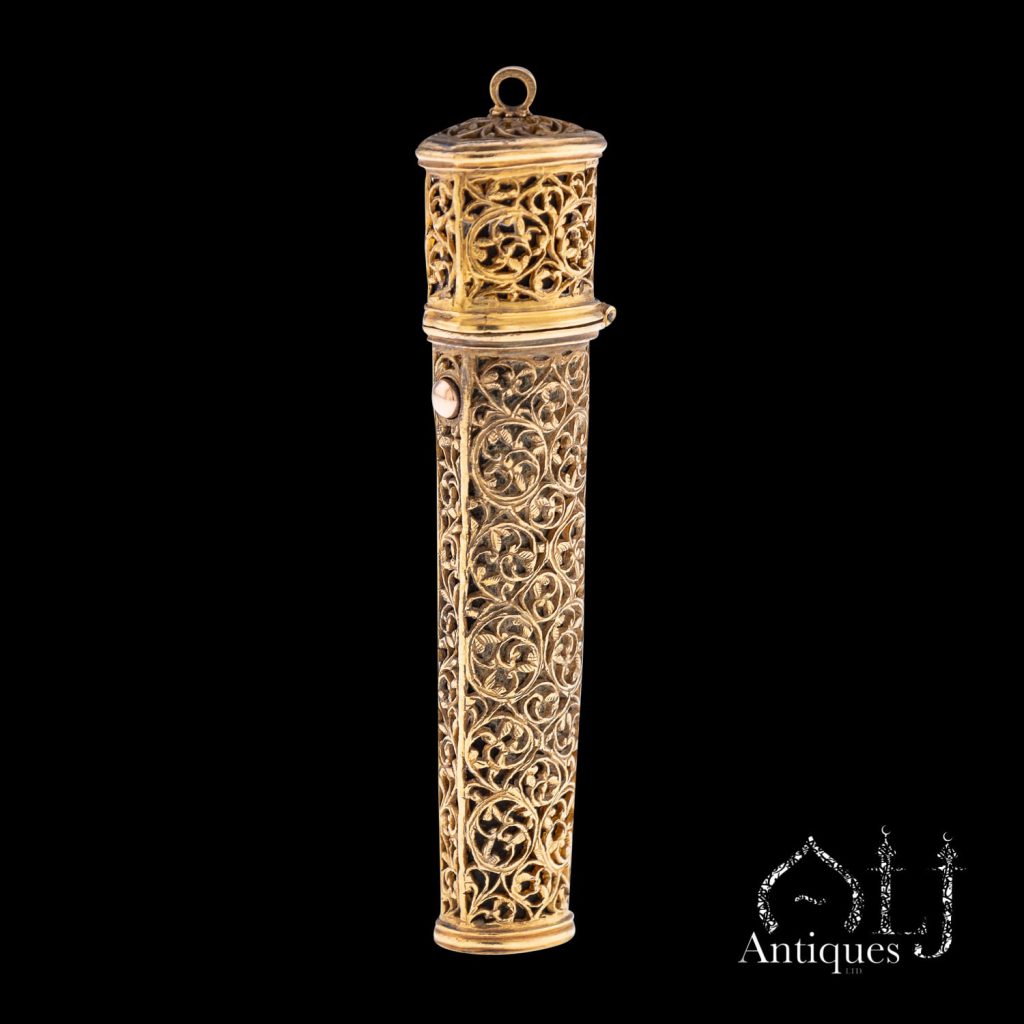
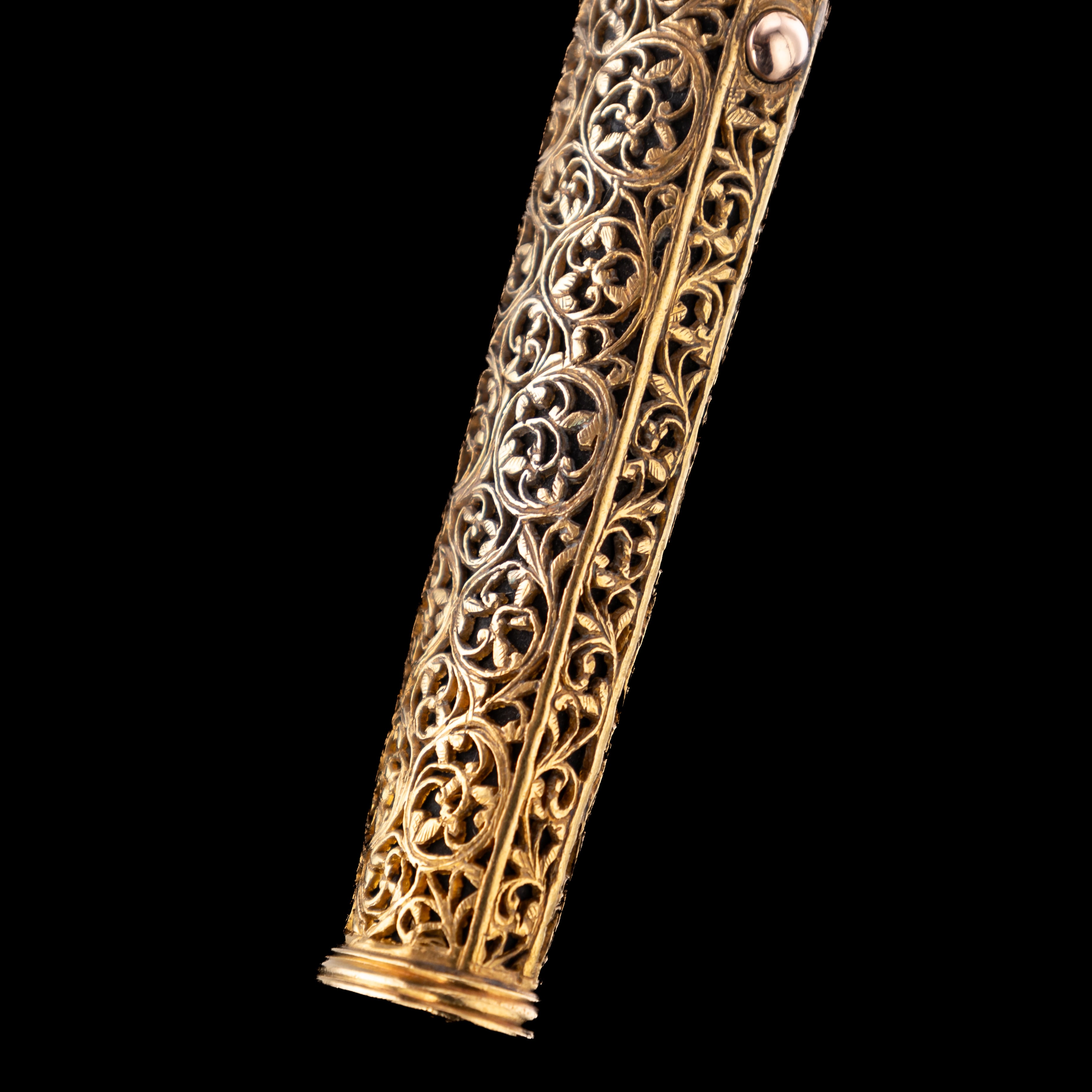
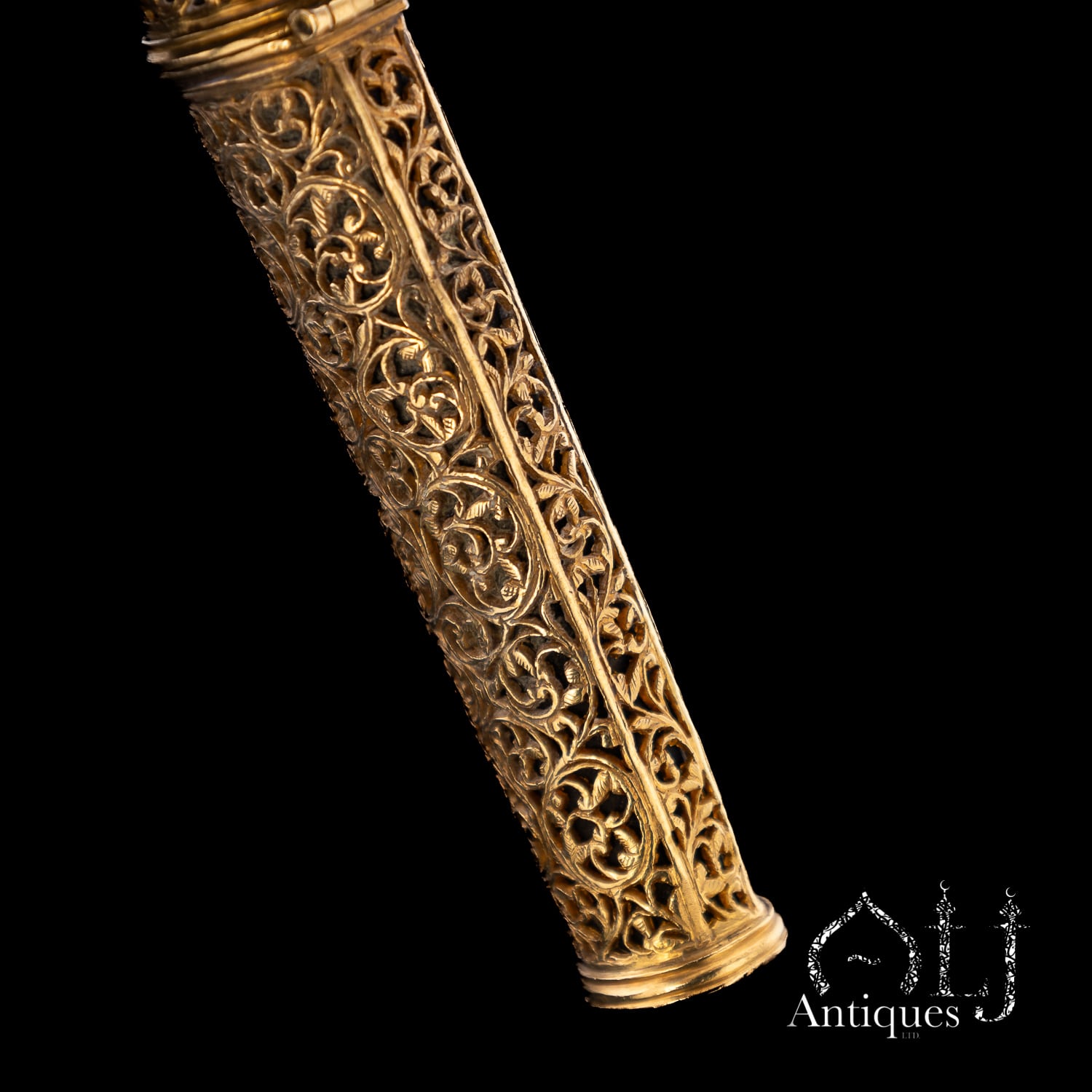
This exceptionally rare—and perhaps the only recorded—piece of its type commissioned in India for a Portuguese patron is finely pierced and chased with scrolling vegetal meanders. This luxurious Indo-Portuguese gilded silver needle case, or étui, exemplifies the refined craftsmanship of late 17th- to early 18th-century Indian silversmiths working for the Portuguese colonial elite. Probably produced in Goa or Gujarat—two of the most important centres of Indo-Portuguese exotica and openwork silver production—it reflects the cross-cultural aesthetics that flourished under European patronage in India.

The green velvet-lined, two-part pierced silver case comprises a nearly cylindrical lower body with an oval profile and a fitted domed lid with a small suspension loop, suggesting that the étui was designed to be worn or suspended from a chain as part of an aristocratic sewing kit. Its primary purpose—to store delicate embroidery needles—connects it directly to the production of fine Indo-Portuguese embroidered silks and cottons, highly prized by European elites. An example of such sought-after 18th-century colonial textiles, whose ground is entirely decorated with a vegetal arabesque motif analogous to the present case, is published in the exhibition catalogue Portugal and the East through Embroidery: 16th to 18th Century Coverlets from the Museu Nacional de Arte Antiga, Lisbon, International Exhibitions Foundation, 1981, p. 23, fig. 9. The lavish materials and technical sophistication of this étui underline the cultural and social value attributed to the art of embroidery in the early modern Lusophone world.

Heavily gilded throughout, the exterior displays a dense lattice of scrolling foliage and intertwined leafy tendrils, forming a rhythmic arabesque pattern characteristic not only of Indo-Portuguese filigree design but also of other Portuguese colonial exports, such as marquetry furniture, lacquered cabinets, and engraved coco de mer cups typical of South and Southeast Asian territories. For instance, the same dense foliage scrollwork pattern can be admired on the front drawers of a gold-leaf and red lacquered (talha baixa lacada e dourada) 16th-century cabinet, published in the exhibition catalogue Na Rota do Oriente, organised by the Association “Amigos do Oriente”, 23 November–2 December 1999, p. 56, cat. no. 26. The cabinet was most probably produced in Southeast Asia, either Myanmar or Thailand, and reached Portugal via maritime routes from trading ports such as Martaban (Mottama) or Pegu (Bago) in Myanmar (Burma).

Similar interlocking foliate arabesque patterns dress the exterior of a silver-mounted Sinhalese coco de mer cup dating to the second half of the 16th century (Nuno Vassallo e Silva, in Masterpieces: Pegadas dos Portugueses no Mundo, 2010, pp. 40–43), as well as the gilt silver filigree mount of a pair of coco de mer cups attributed to 17th-century Goa (exhibition catalogue, Manuel Castilho, Oriente e Ocidente, Bienal de Antiguidades, Lisbon, 2006, pp. 14–17, cat. no. 5).

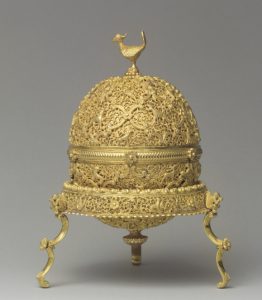
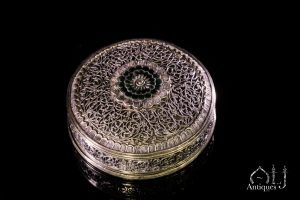
Lastly, such scrolling vegetal motifs were also favoured on another renowned Indo-Portuguese—specifically Goanese—production: bezoar and Goa stone cases. Once believed to possess curative properties and to prolong life expectancy, these stones were often encased in ornate circular containers thought to enhance their medicinal effects. Among other related works of art, The Metropolitan Museum of Art preserves a remarkable example of a Goa stone case made of pierced, chased, and mercury-gilded silver (acc. no. 1980.228.1, .2a, b, .3), closely comparable to the present étui. These works testify not only to the vast trading network of exotica established by the Portuguese in the 16th and 17th centuries but also to the sophisticated taste and artistic vocabulary prevalent in Portugal and the wider Lusophone world.

Please note the identical foliage openwork seen on a Goanese stone-and-gold case dating to the late 17th–early 18th century in The Metropolitan Museum of Art, New York (acc. no. 2004.244a–b).

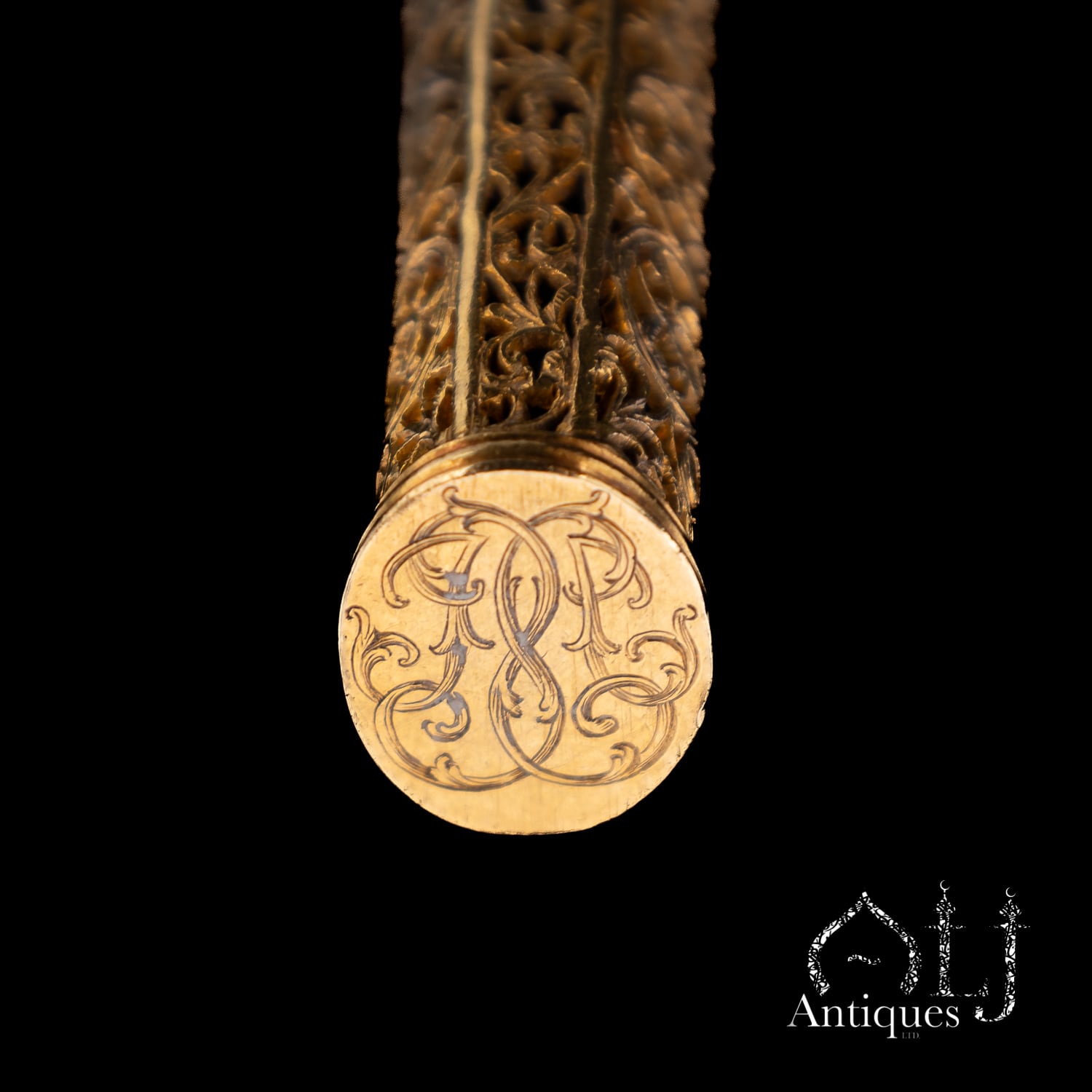
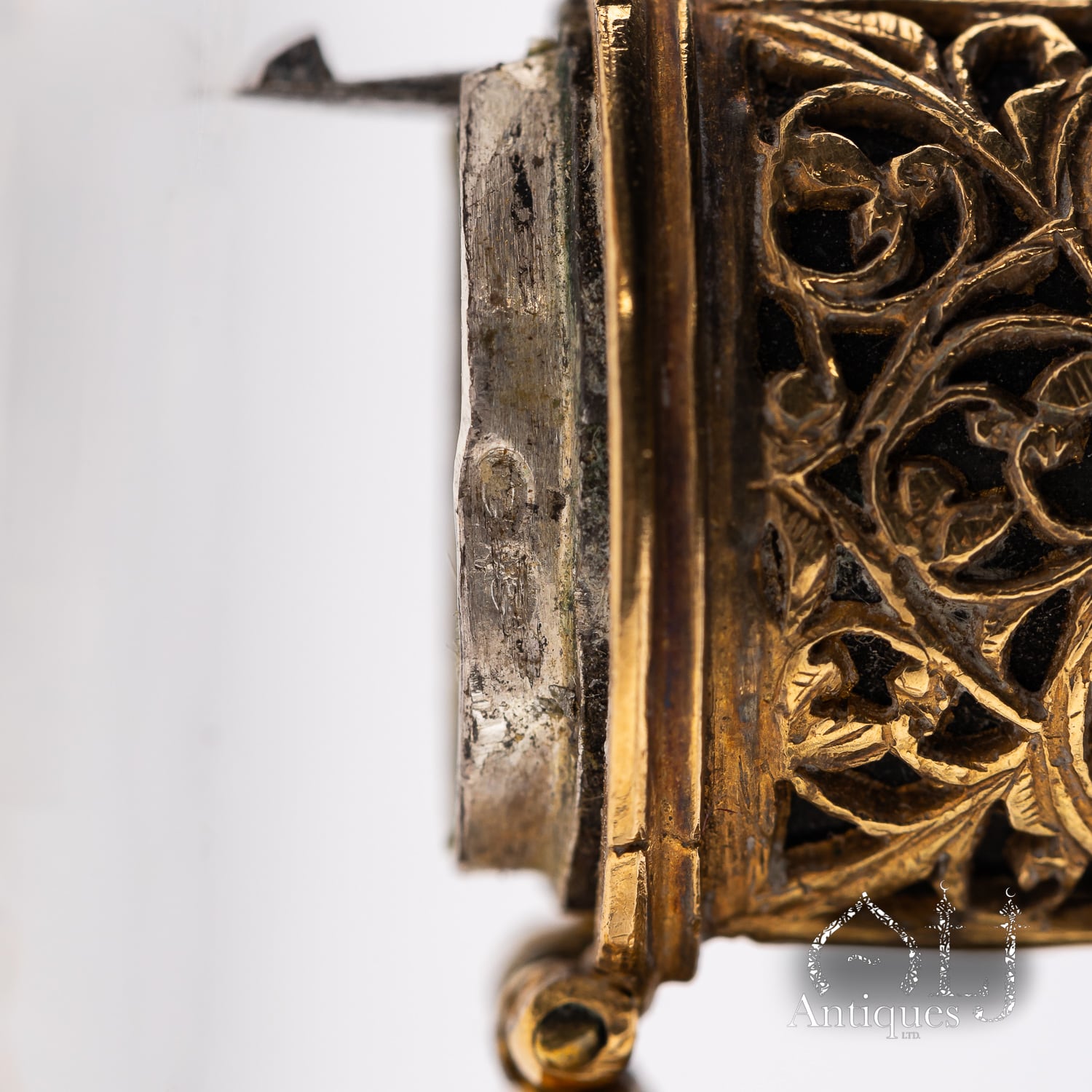
The base of this needle case is engraved with the mirrored initials “JS”, likely the owner’s monogram. Two oval assay or import marks on the upper rim may indicate European testing or circulation. These marks, together with the European monogram and the refined workmanship, suggest that the piece was exported or gifted within aristocratic transoceanic trade networks linking Goa to Lisbon and other Portuguese territories.

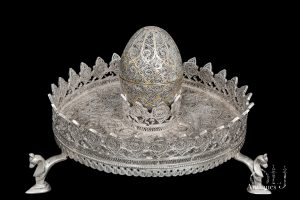
Further comparable Indo-Portuguese silver openwork decoration with similar floral arabesques and pierced latticework can be found on the celebrated Reliquary Casket of St Francis Xavier, Goa, c. 1686–1690 (Museu de São Roque, Lisbon, inv. Or.392), regarded as a masterpiece of Goanese 17th-century silverwork. A close stylistic parallel also appears in a pair of parcel-gilt silver covered bowls with associated tazzas, attributed to West India, probably Gujarat, late 17th century (Christie’s London, Islamic Art and Manuscripts, 12 October 2004, lot 200), where similar openwork vegetal motifs frame birds, animals, and arabesques in intricate interlaced bands. Together, these comparables highlight a shared aesthetic language of luxurious pierced silverwork, blending Mughal ornamental conventions with Baroque European influences.

This rare and refined object stands as a testament to cross-cultural artistic exchange from the late 17th century onwards and would make an exceptional addition to any collection of artefacts related to the European colonial era, including Indo-Portuguese, Dutch-colonial, Anglo-Indian, and Mughal art.

Acknowledgment

The above text and literature were produced with the valued collaboration of Ms. B. C. (with thanks).

Dimensions

Height: 8.6 cm
Width: 2 cm
Depth: 1.5 cm

Condition

Overall, in excellent condition, with minor superficial marks and gentle wear to the original silk velvet lining, consistent with age and use.

Provence

The EU Art Market.

References

Christie’s London, Islamic Art and Manuscripts, 12 October 2004, lot 200.

Manuel Castilho, Na Rota do Oriente, exhibition catalogue for “The Legacy of Macao”, organised by the Association “Amigos do Oriente”, Lisbon, 1999, p. 56, cat. no. 26.

Manuel Castilho, Oriente e Ocidente, exhibition catalogue for the Bienal de Antiguidades, FIL – Feira Internacional de Lisboa, Lisbon, 2006, pp. 14–17, cat. no. 5.

Arte Oriental nas Colecções do Museu de São Roque, Museu de São Roque, Lisbon, 2010, pp. 30–31, fig. 1 (Reliquary of St Francis Xavier, Goa, c. 1686–1690, the full description on gages 104-105), also please see figure nos. 18 & 19 catalogued on page 48.

Nuno Vassallo e Silva, in Exotica: The Portuguese Discoveries and the Renaissance Kunstkammer, exhibition catalogue edited by Helmut Trnek and Nuno Vassallo e Silva, Museu Calouste Gulbenkian, Lisbon, 2001, p. 152, no. 48.

Nuno Vassallo e Silva, in Masterpieces: Pegadas dos Portugueses no Mundo, exhibition catalogue edited by Pedro Aguiar Branco and Álvaro Roquette, Lisbon, 2010, pp. 40–43.

Portugal and the East through Embroidery: 16th to 18th Century Coverlets from the Museu Nacional de Arte Antiga, International Exhibitions Foundation, Washington DC, 1981, p. 23, fig. 9.

Related Antiques