
Description
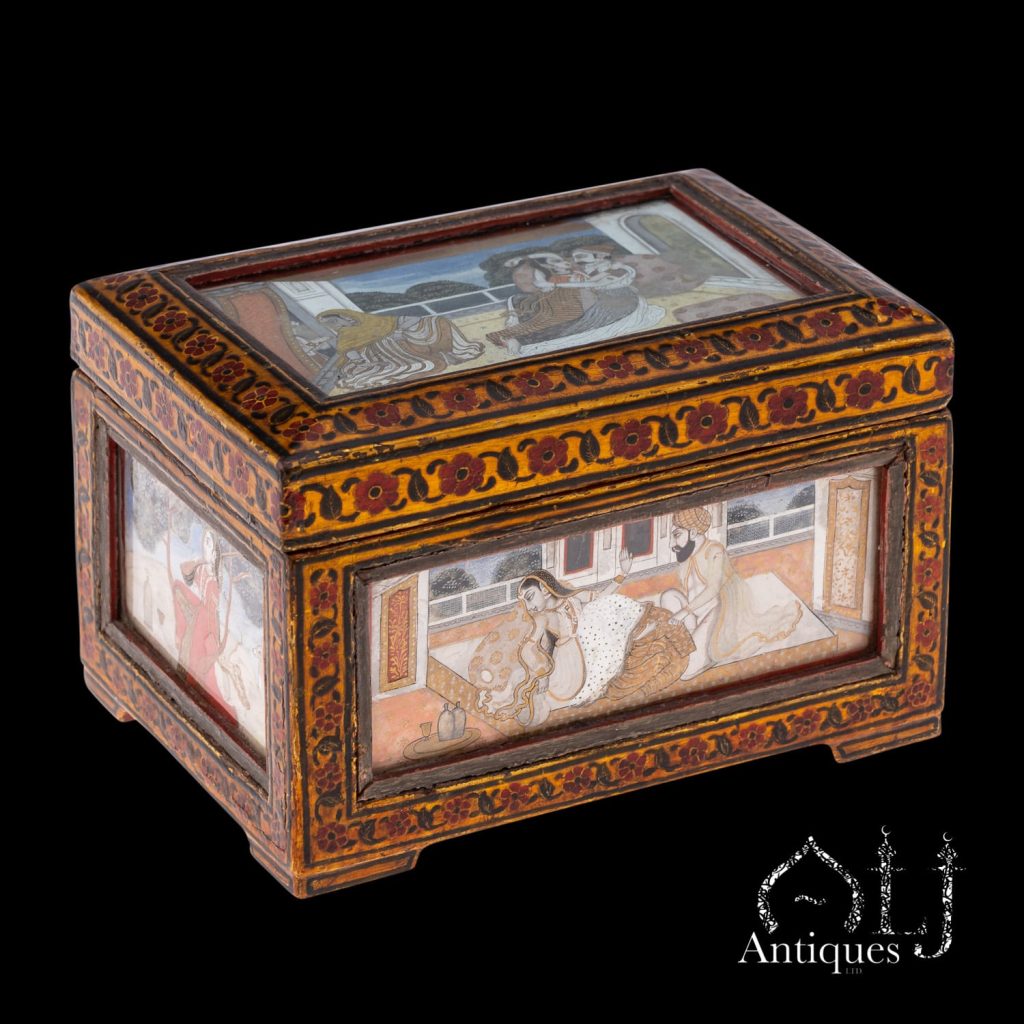
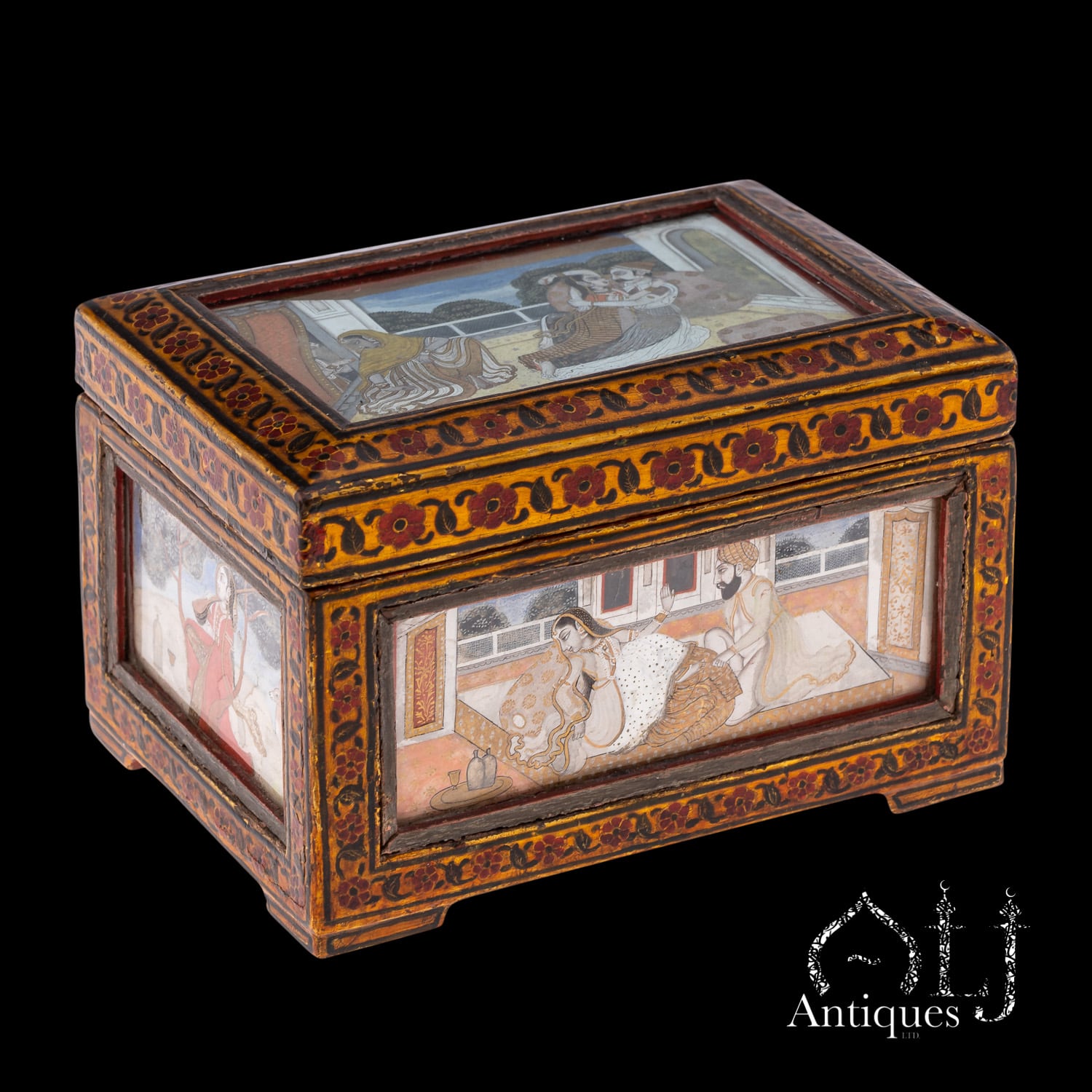
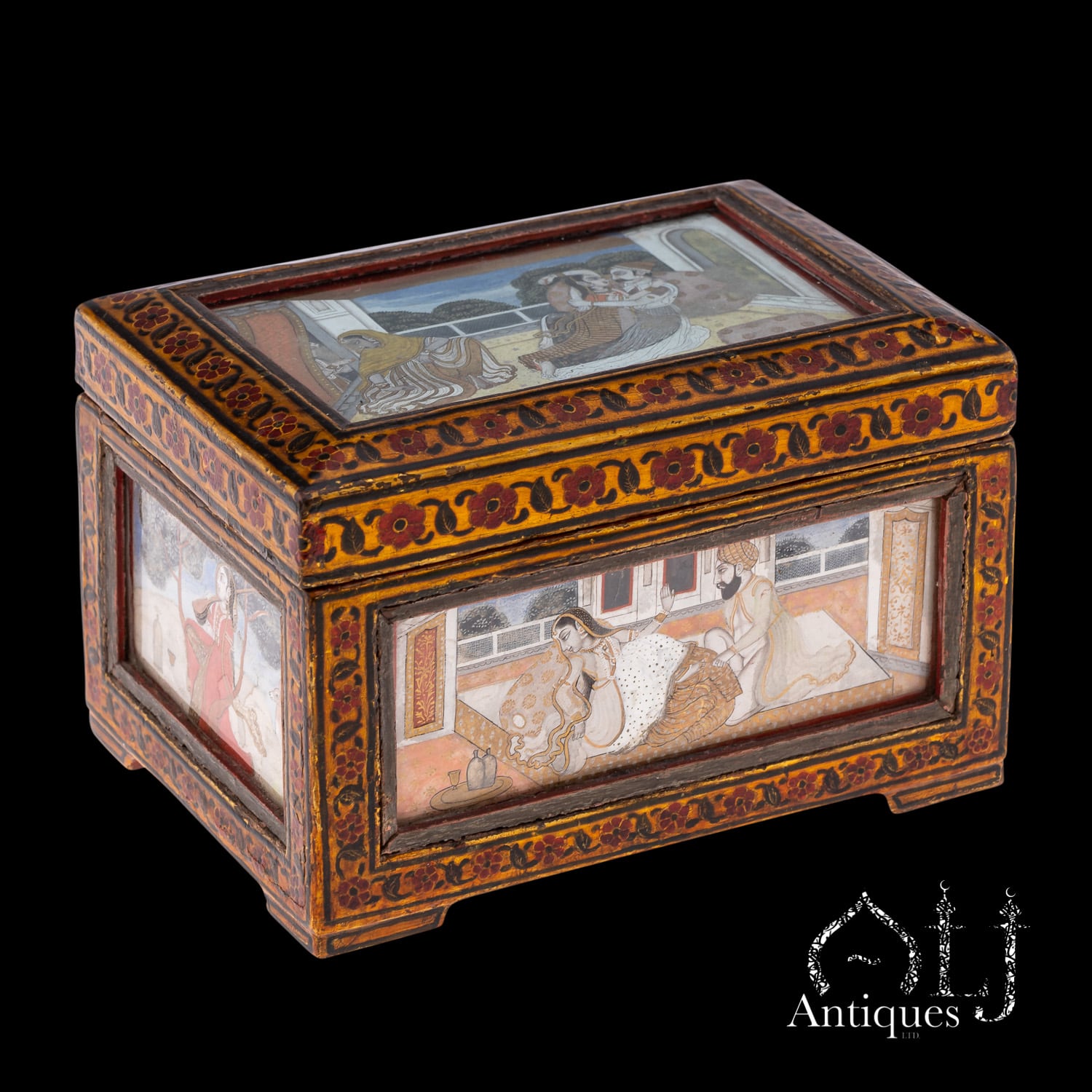
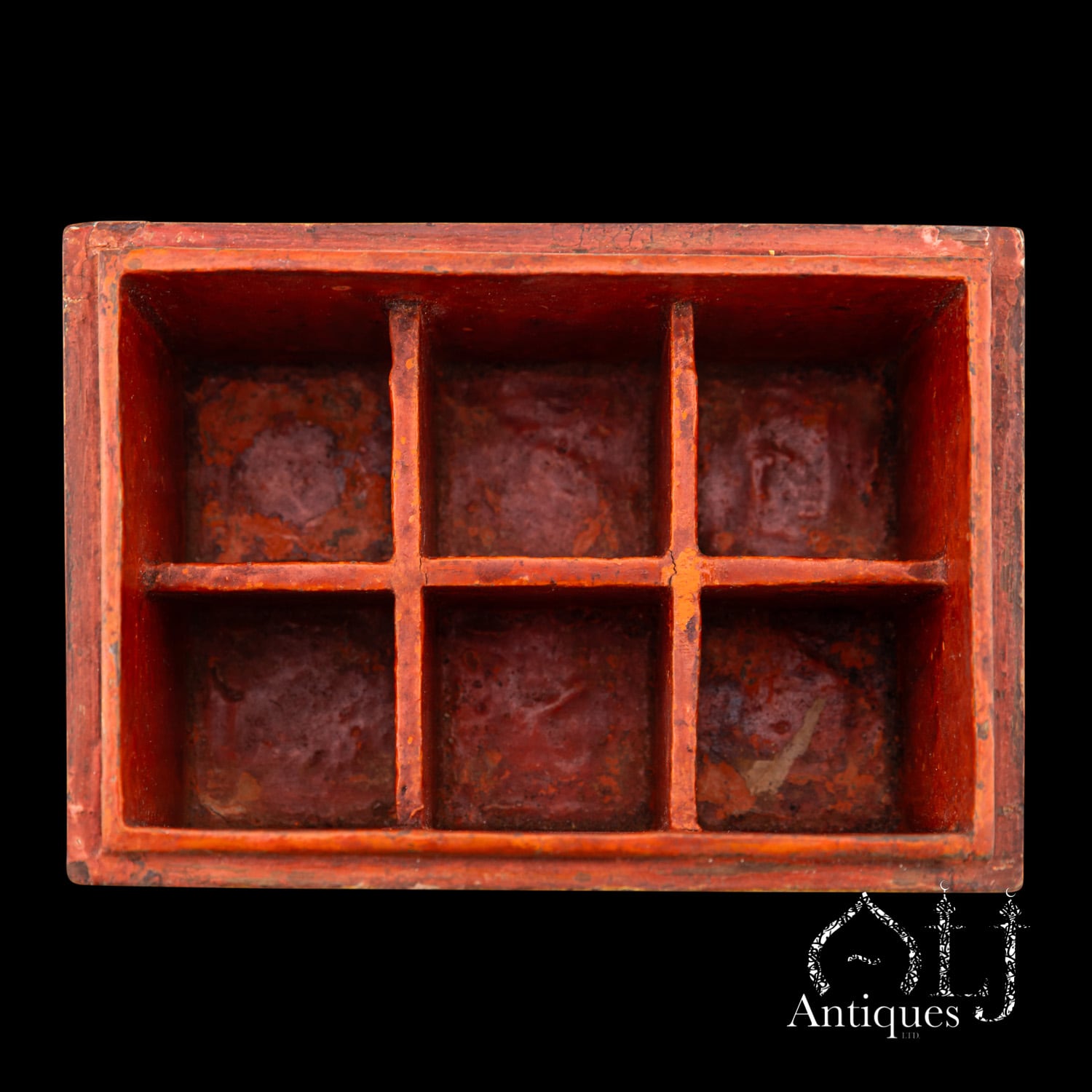
An exceptional, extremely rare and apparently unique Deccani courtly painted and lacquered wooden perfume, scent or cosmetic casket, probably made at Hyderabad in the Deccan during the late eighteenth century, lavishly decorated with gold and a remarkable series of purpose-made courtly miniature paintings, and containing a fitted group of six rectangular gilt-decorated glass scent or perfume bottles.
The exceptional quality of the miniature paintings, the lavish employment of gold throughout both the lacquered decoration and the painted compositions, the sophistication of its construction and the provision of a purpose-made fitted group of six decorated glass bottles strongly suggest that this was conceived as a courtly luxury object for an elite aristocratic patron, rather than as an ordinary utilitarian perfume casket.
While no documentary evidence presently permits an association with a particular member of the Hyderabad court or the household of the Nizam, its materials, workmanship and imagery are entirely consistent with an object intended for a highly privileged Deccani courtly environment.
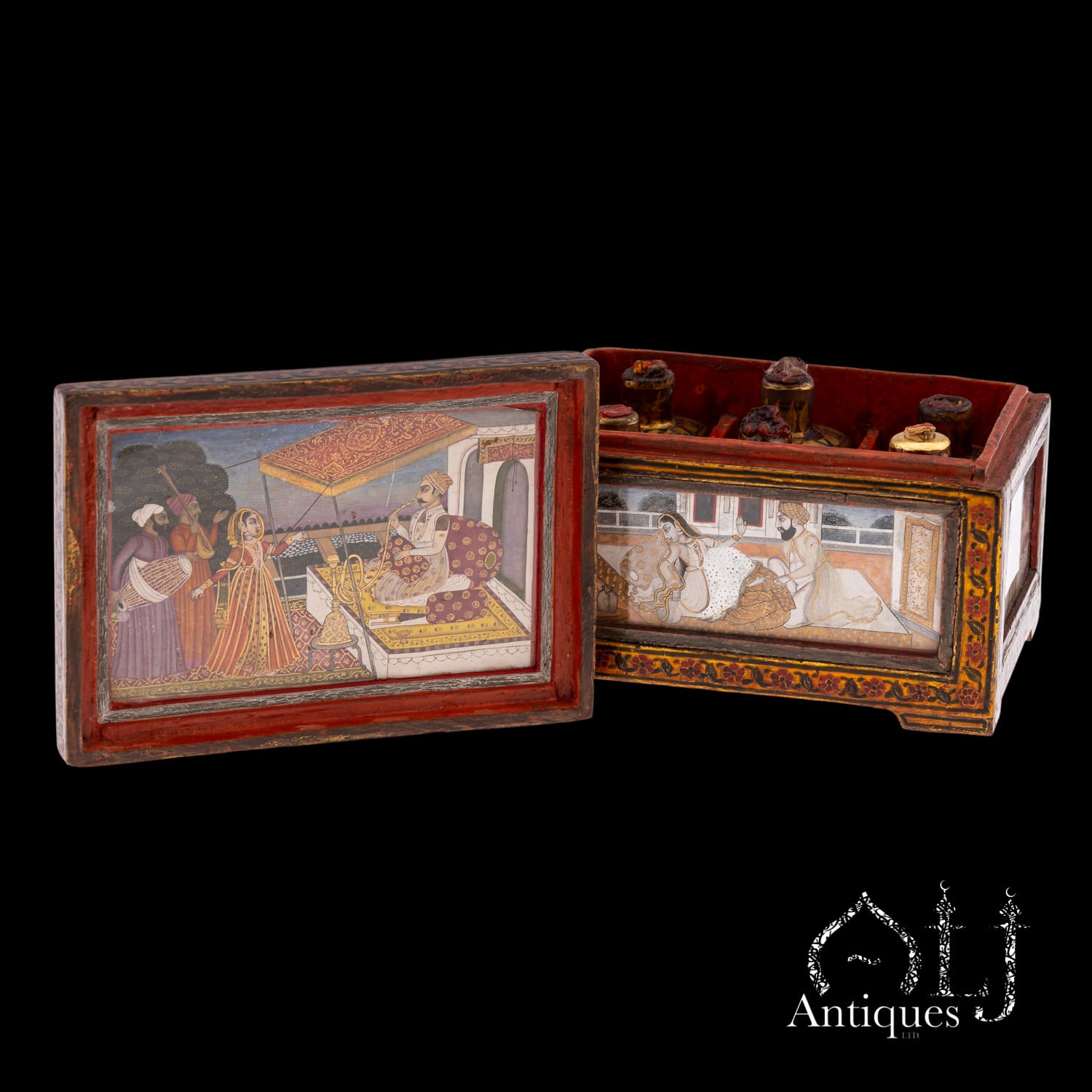
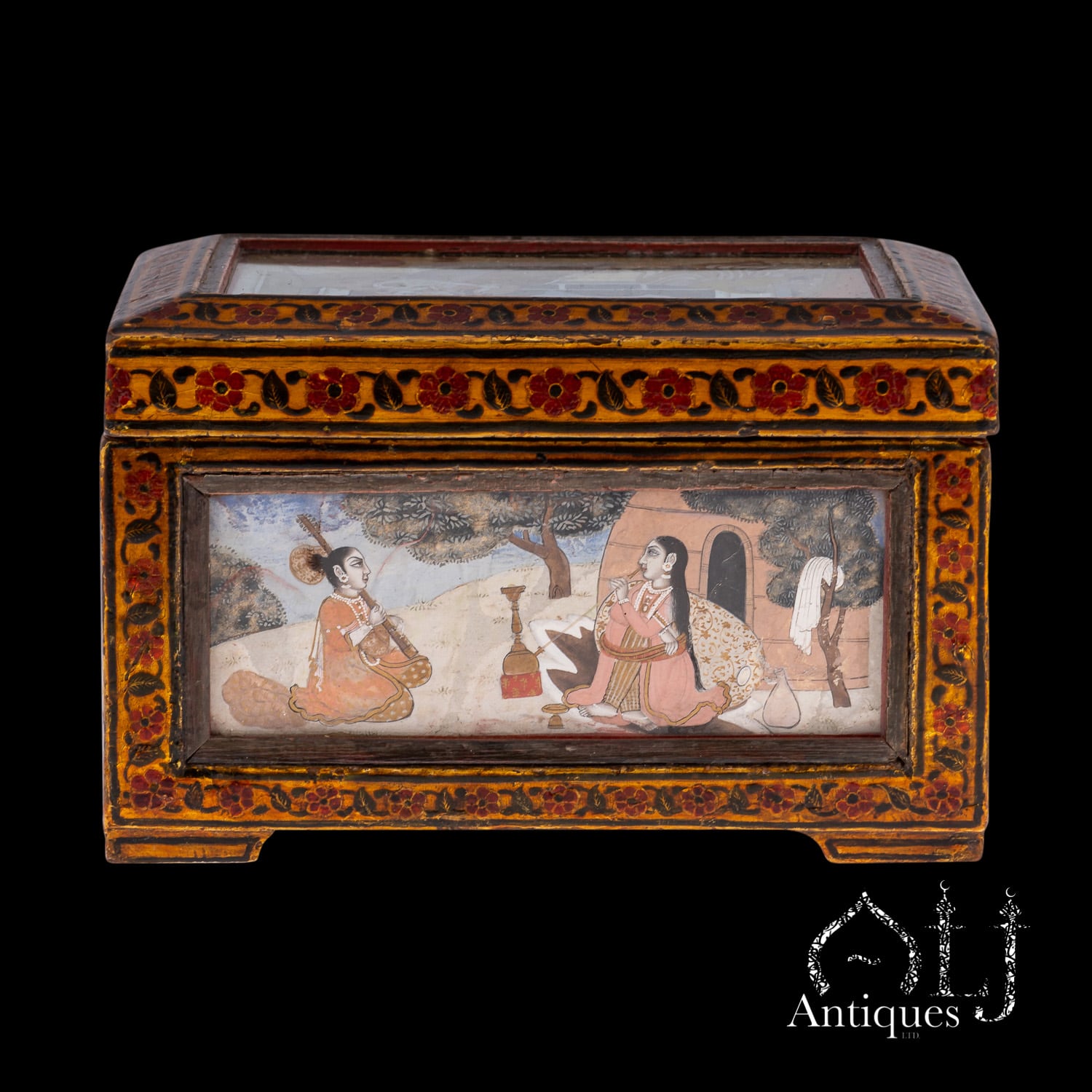
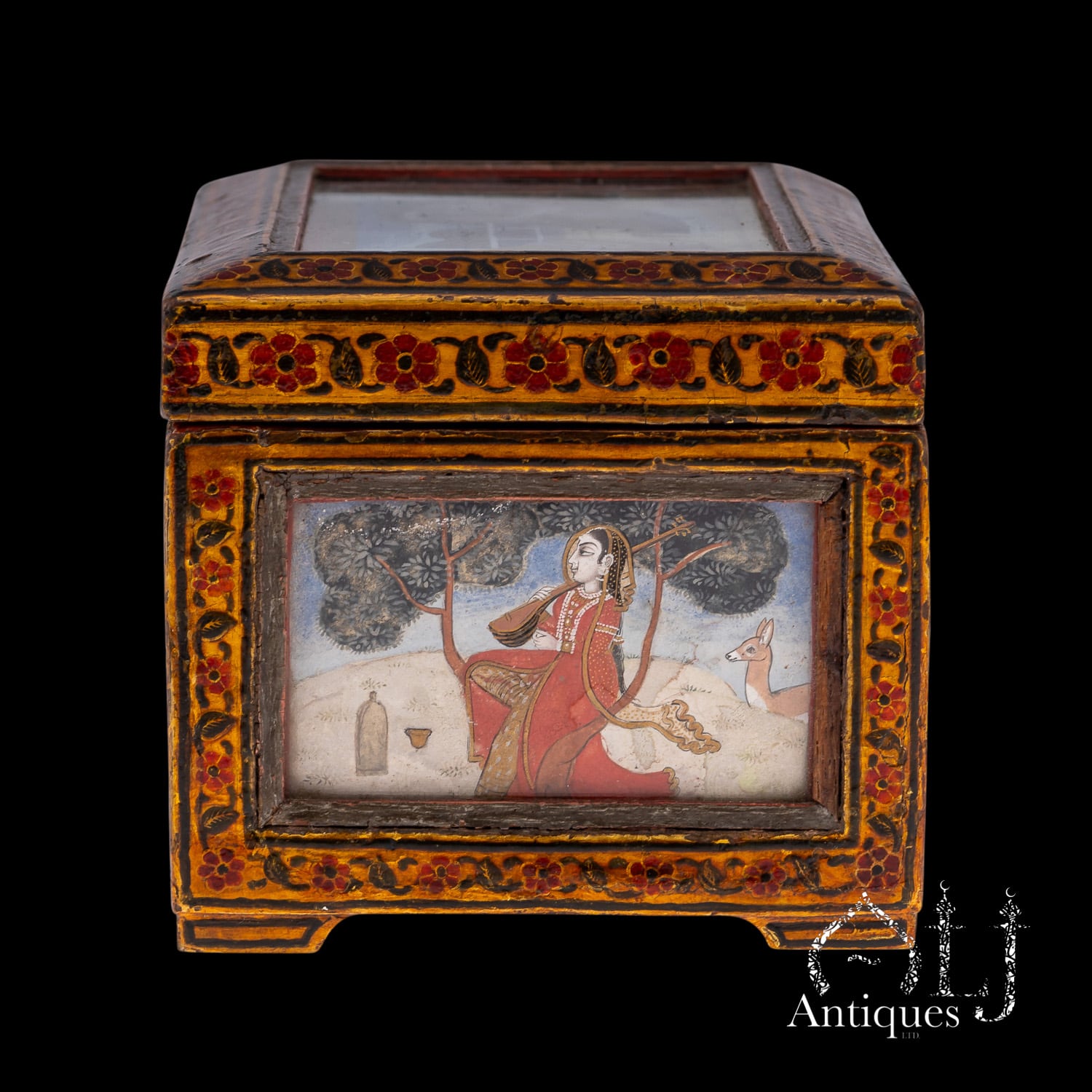
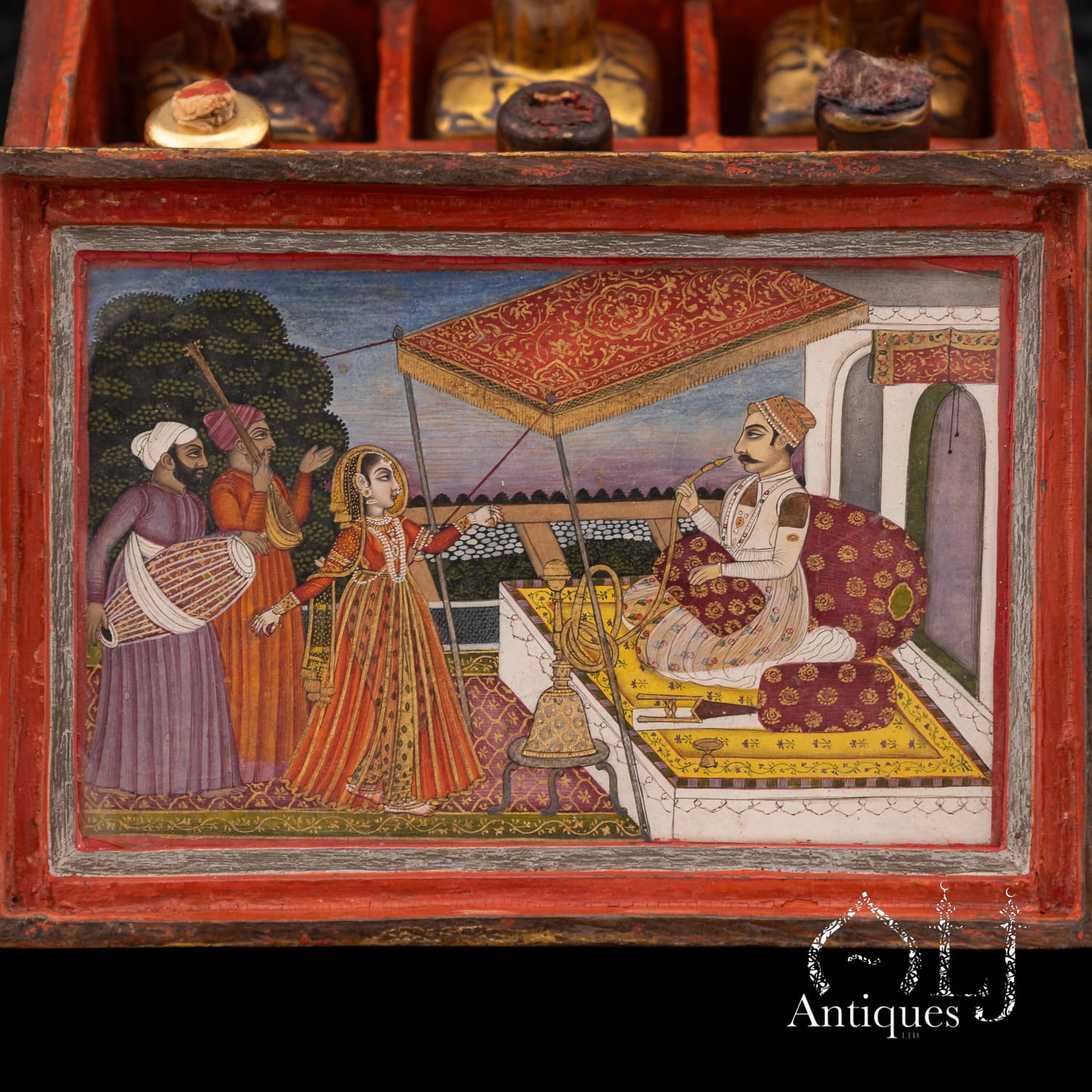
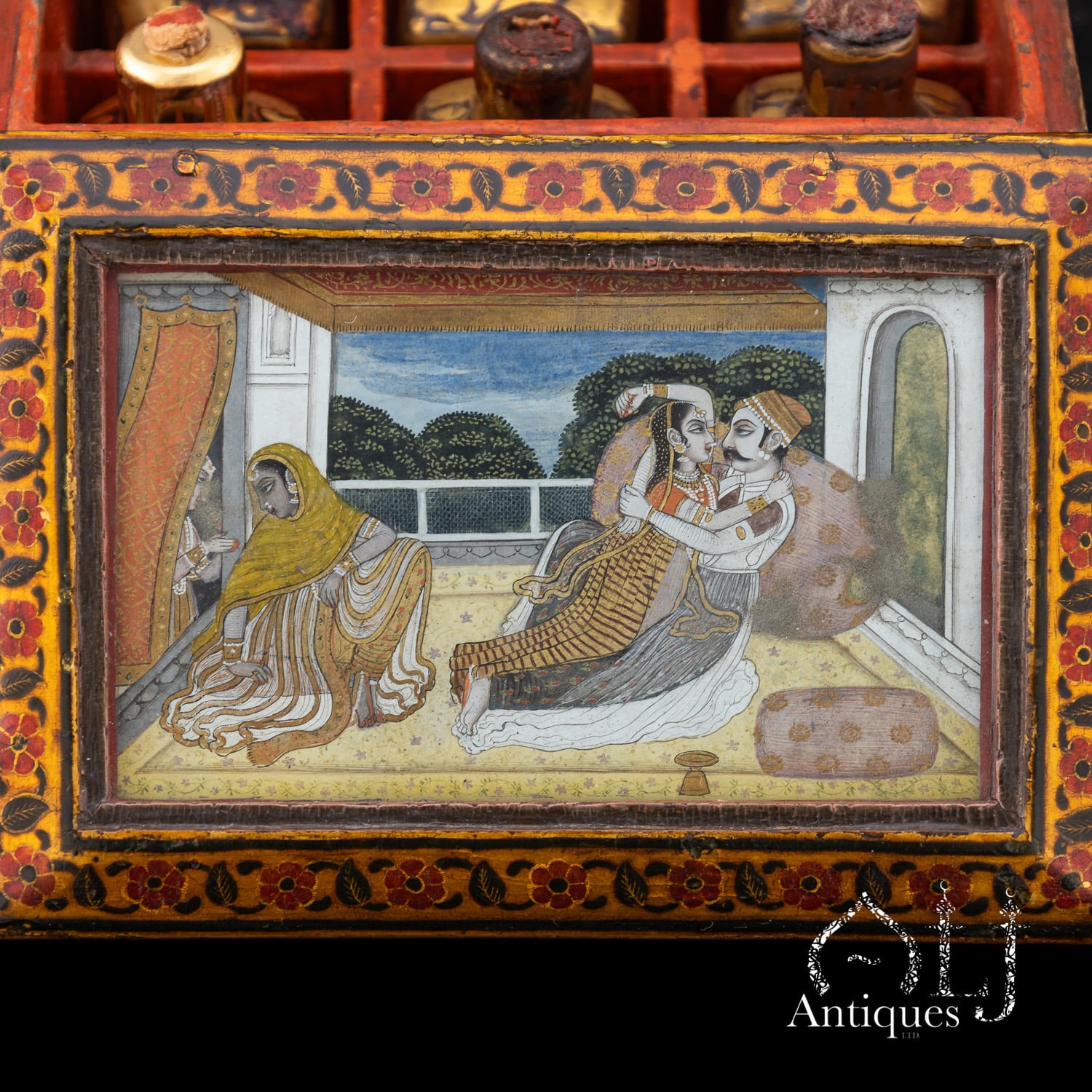
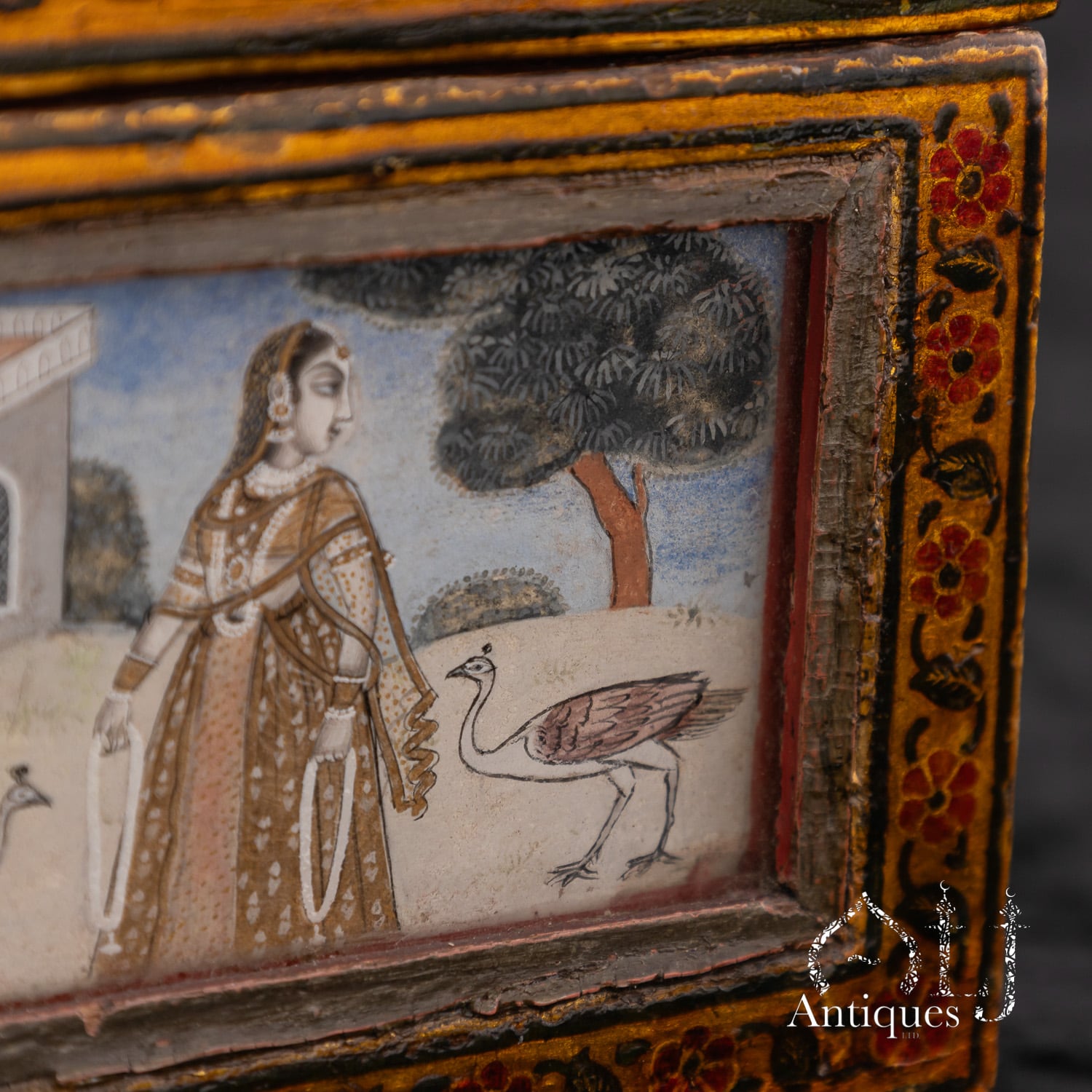
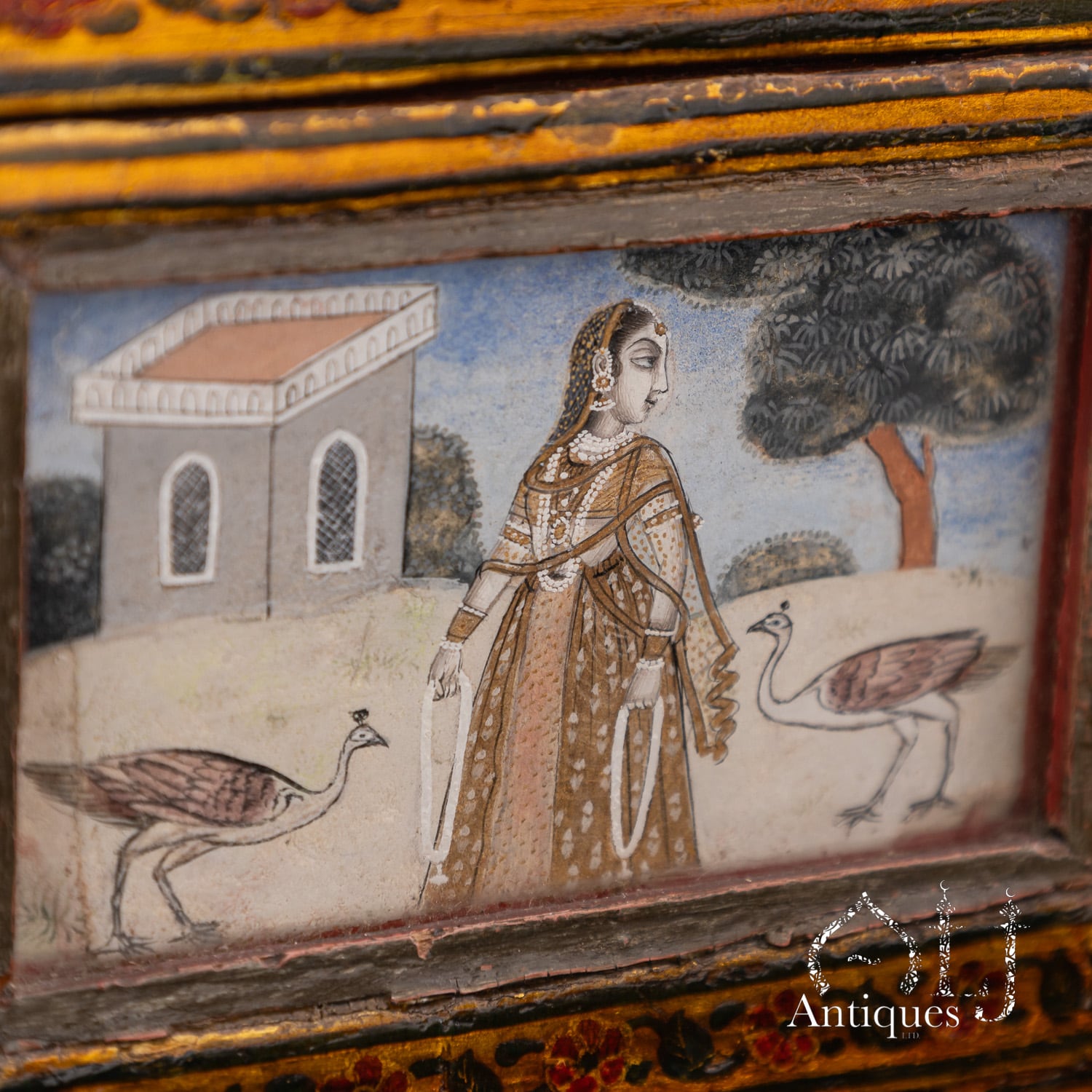
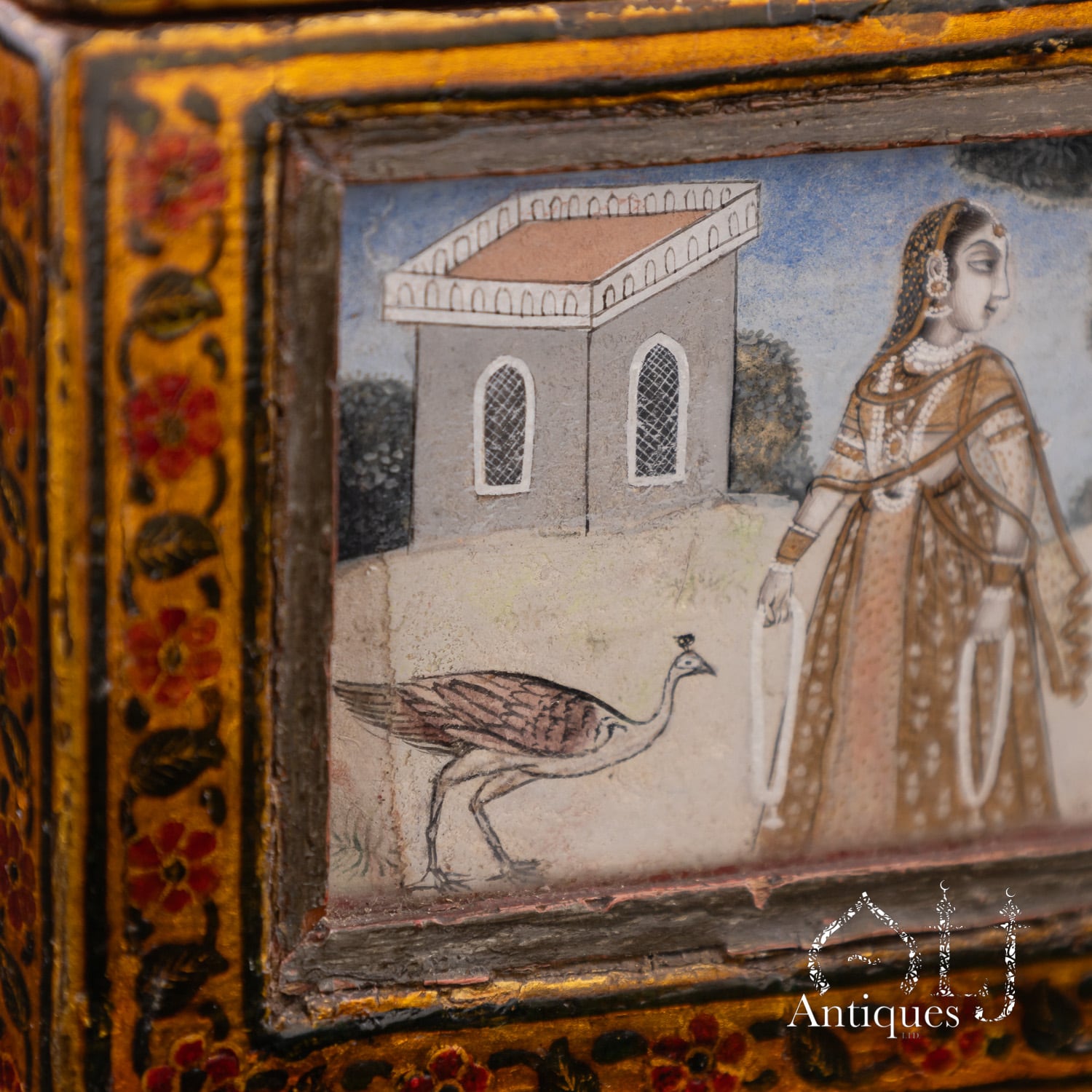
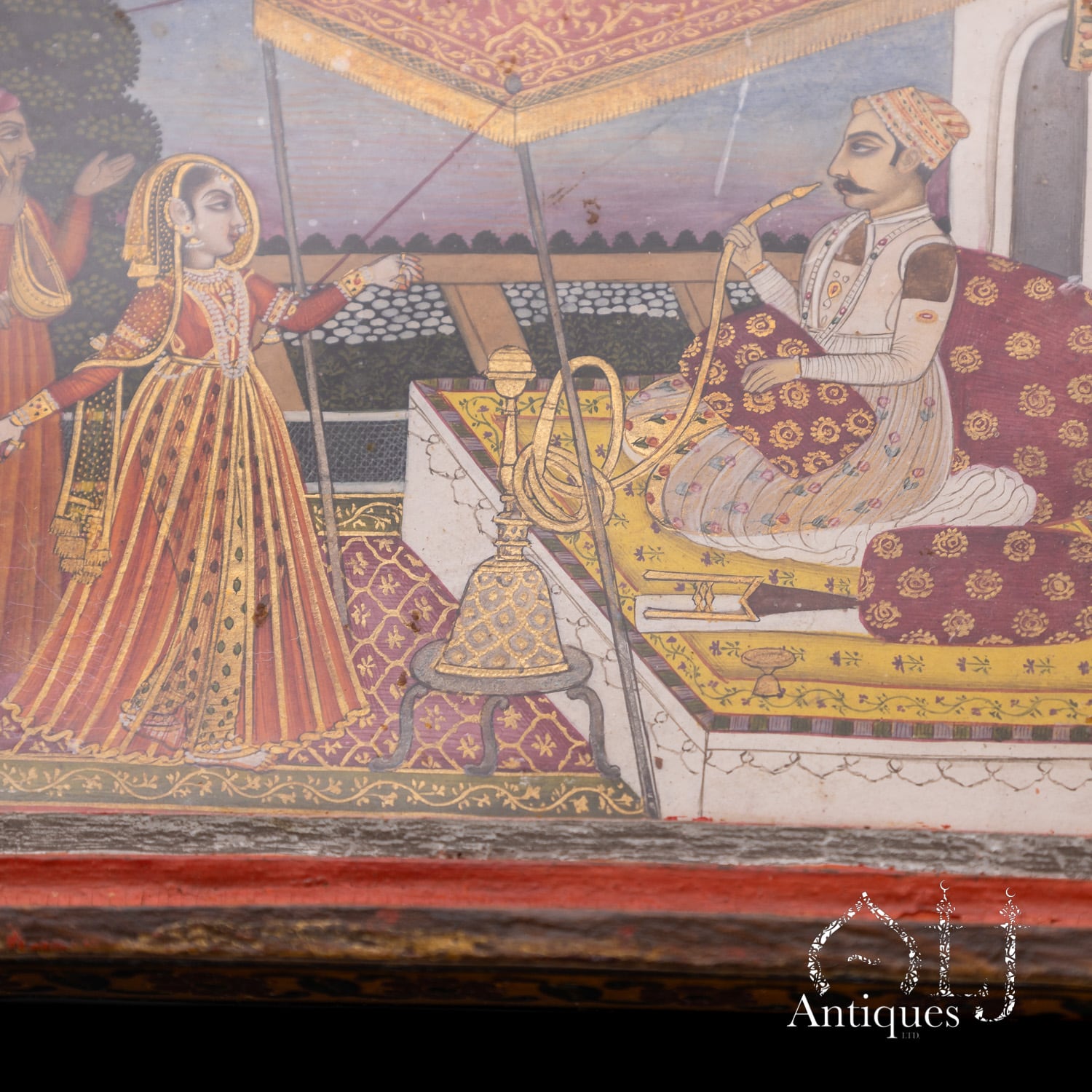
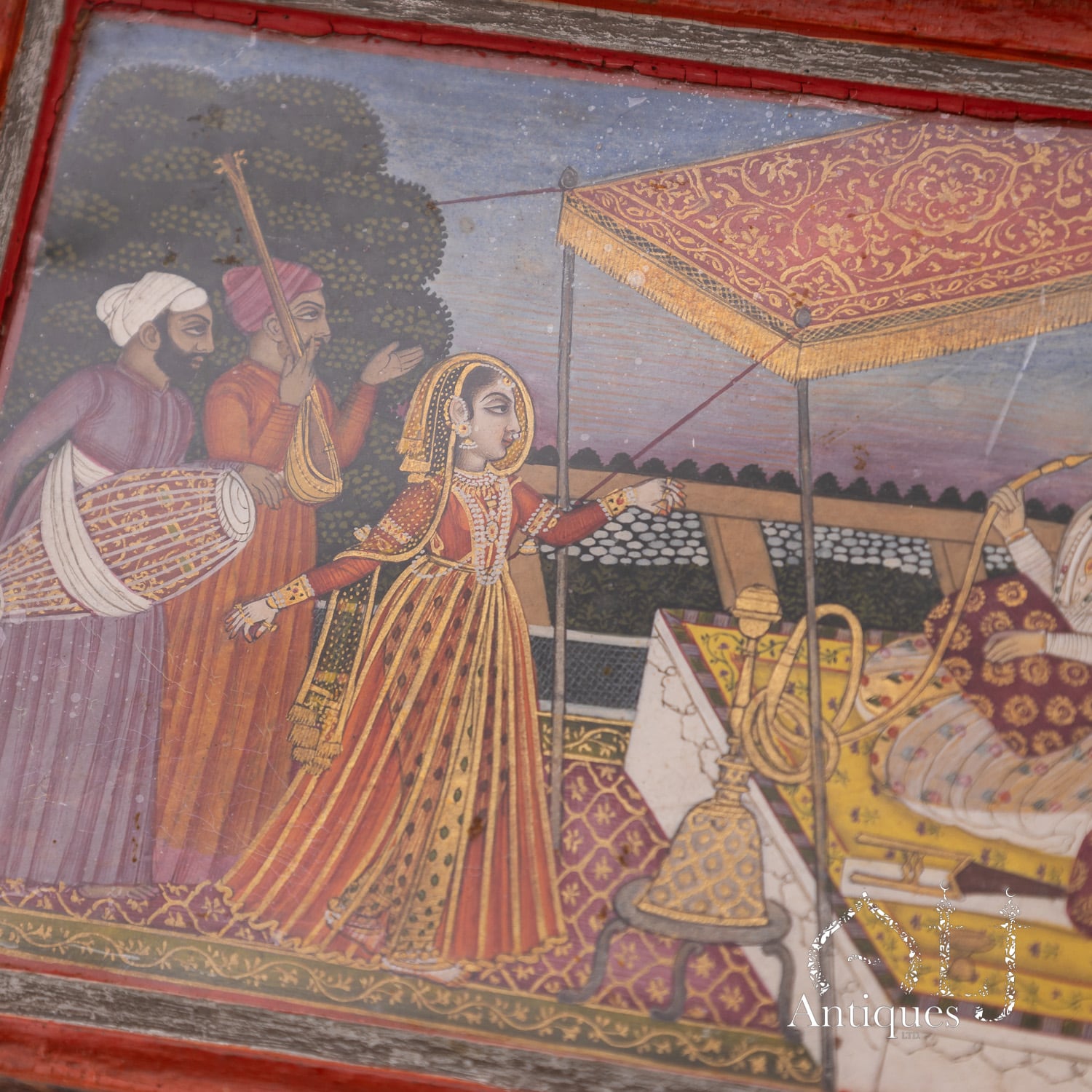
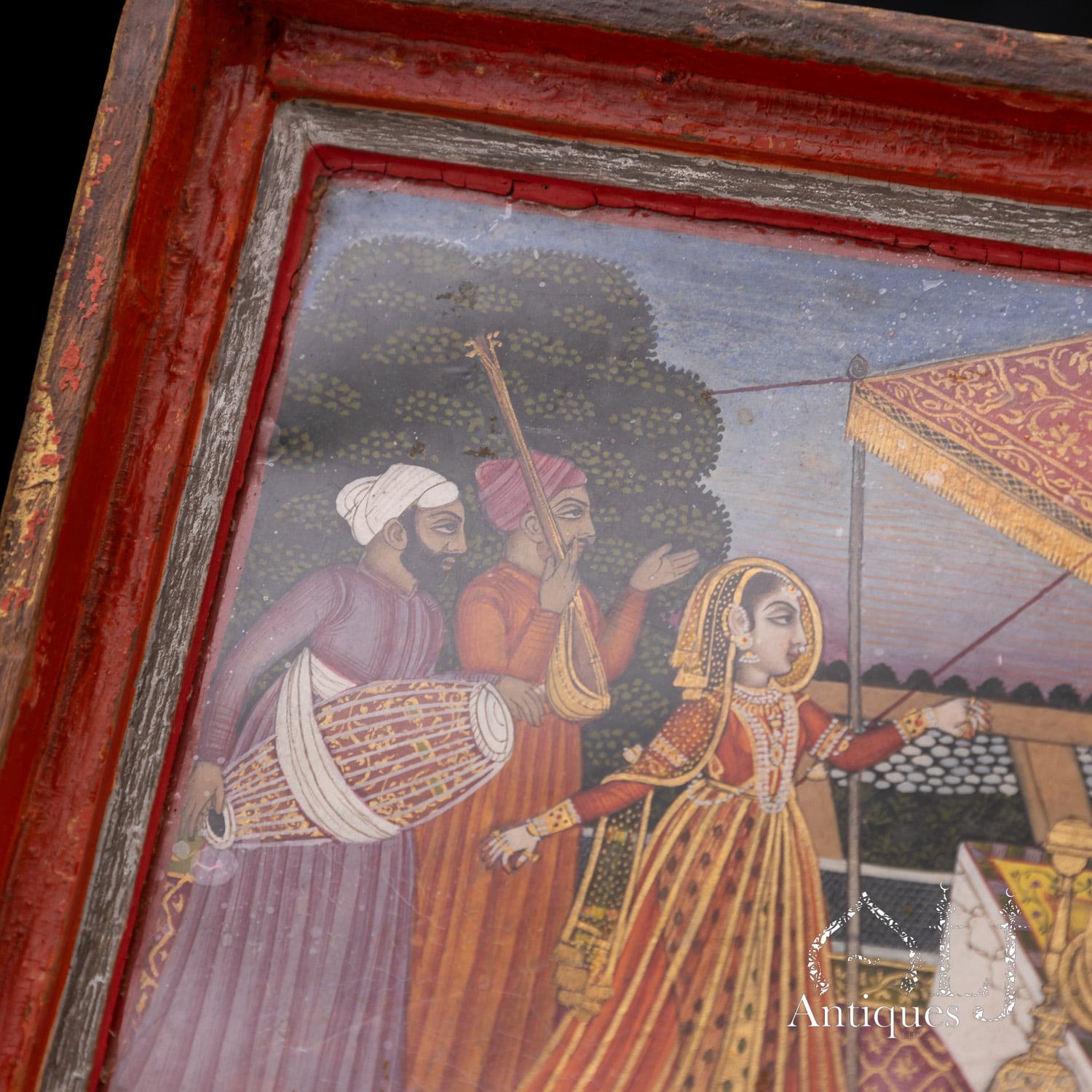
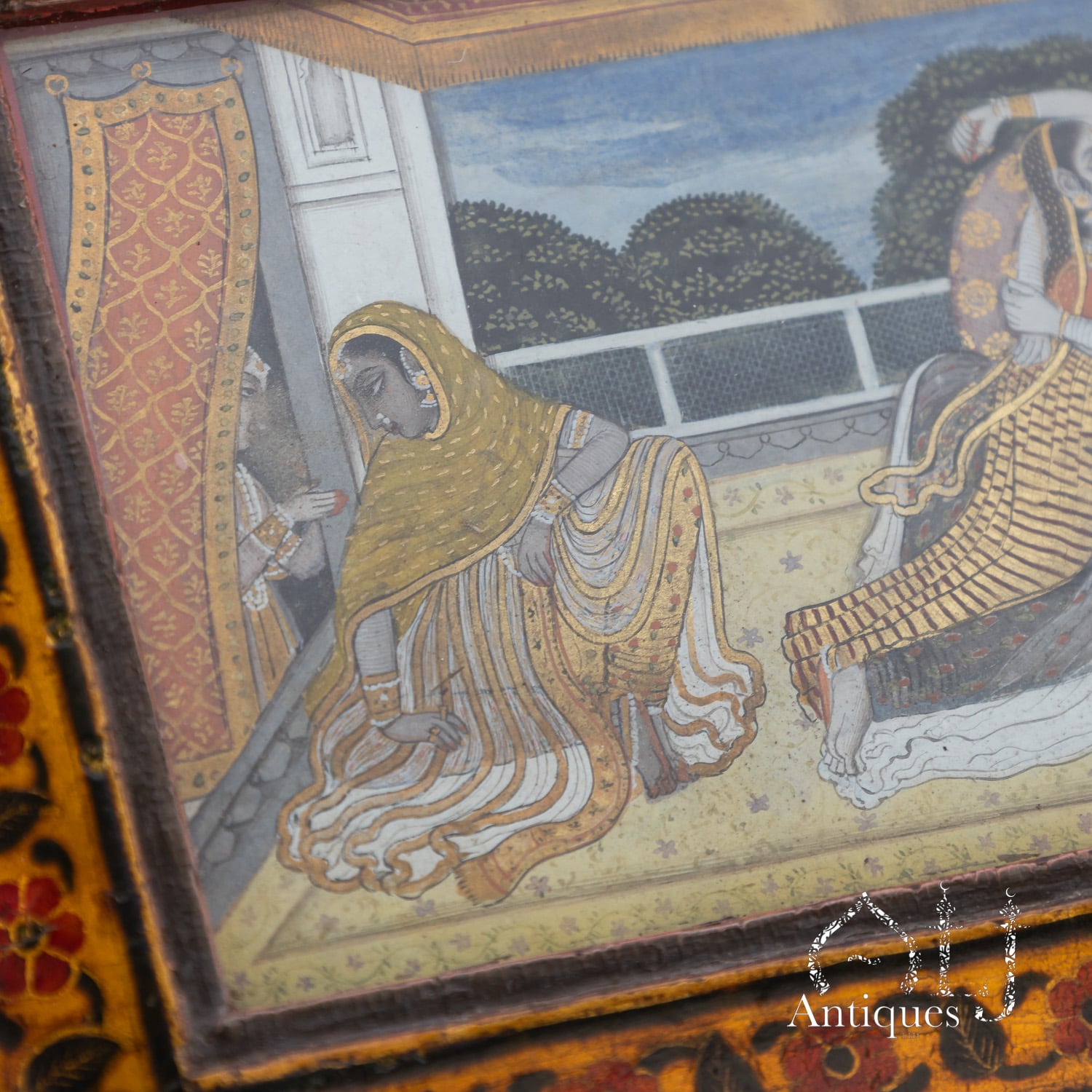
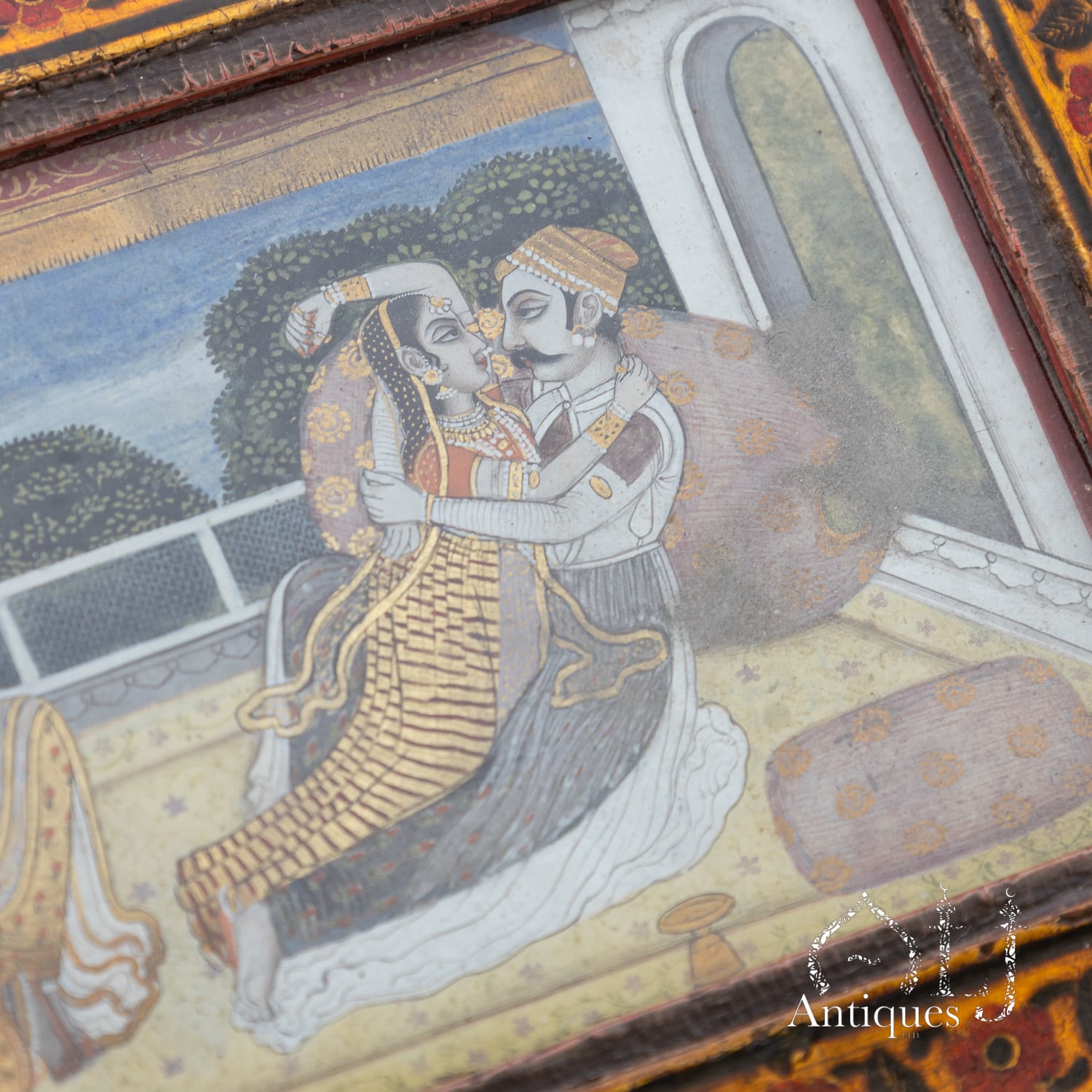
The rectangular wooden casket is richly decorated internally and externally with a predominantly red lacquered ground, extensively embellished with gilt floral and ornamental borders. Its principal surfaces are inset with finely executed miniature paintings forming an unusually coherent pictorial programme around the entire object.
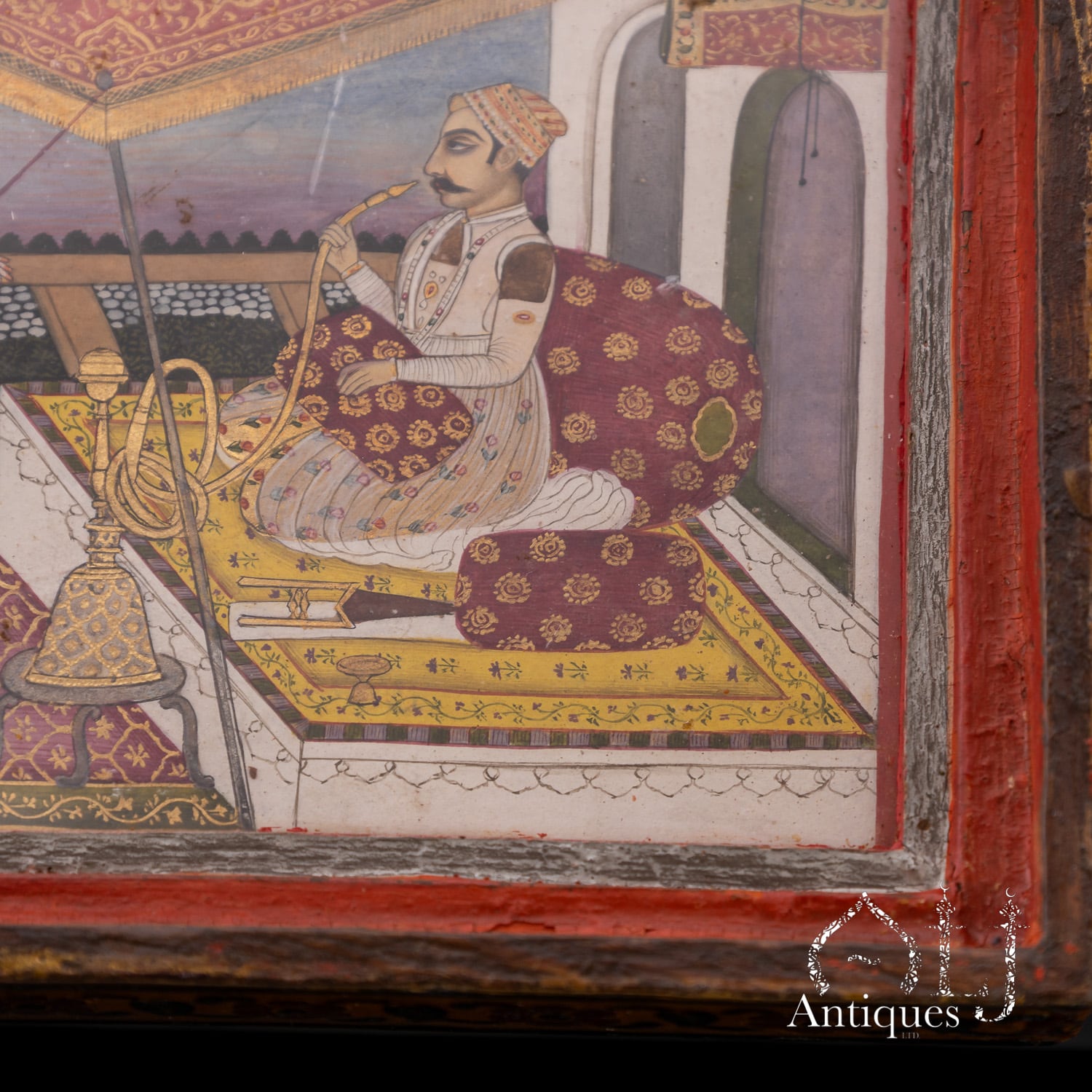
The exterior paintings are protected beneath thin flat glass, while the miniature within the interior of the lid is protected beneath mica.
Significantly, the miniature paintings appear to have been conceived and painted specifically for their individual positions within the casket rather than representing unrelated paintings subsequently cut down and inserted. Their proportions, compositions and architectural framing correspond closely to the panels they occupy, indicating that painting, lacquer decoration and cabinet-making formed part of a unified conception.
The Courtly Miniature Paintings
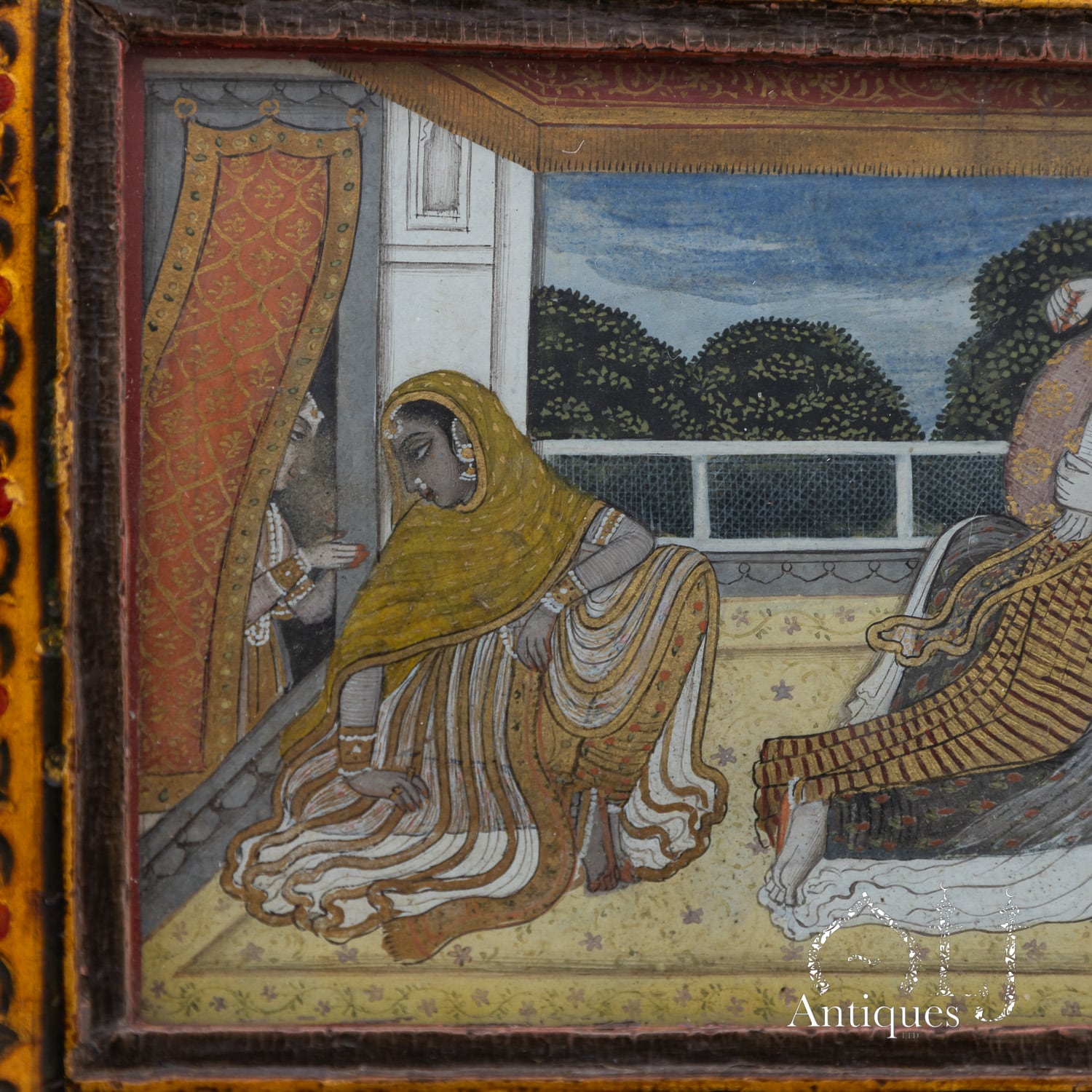
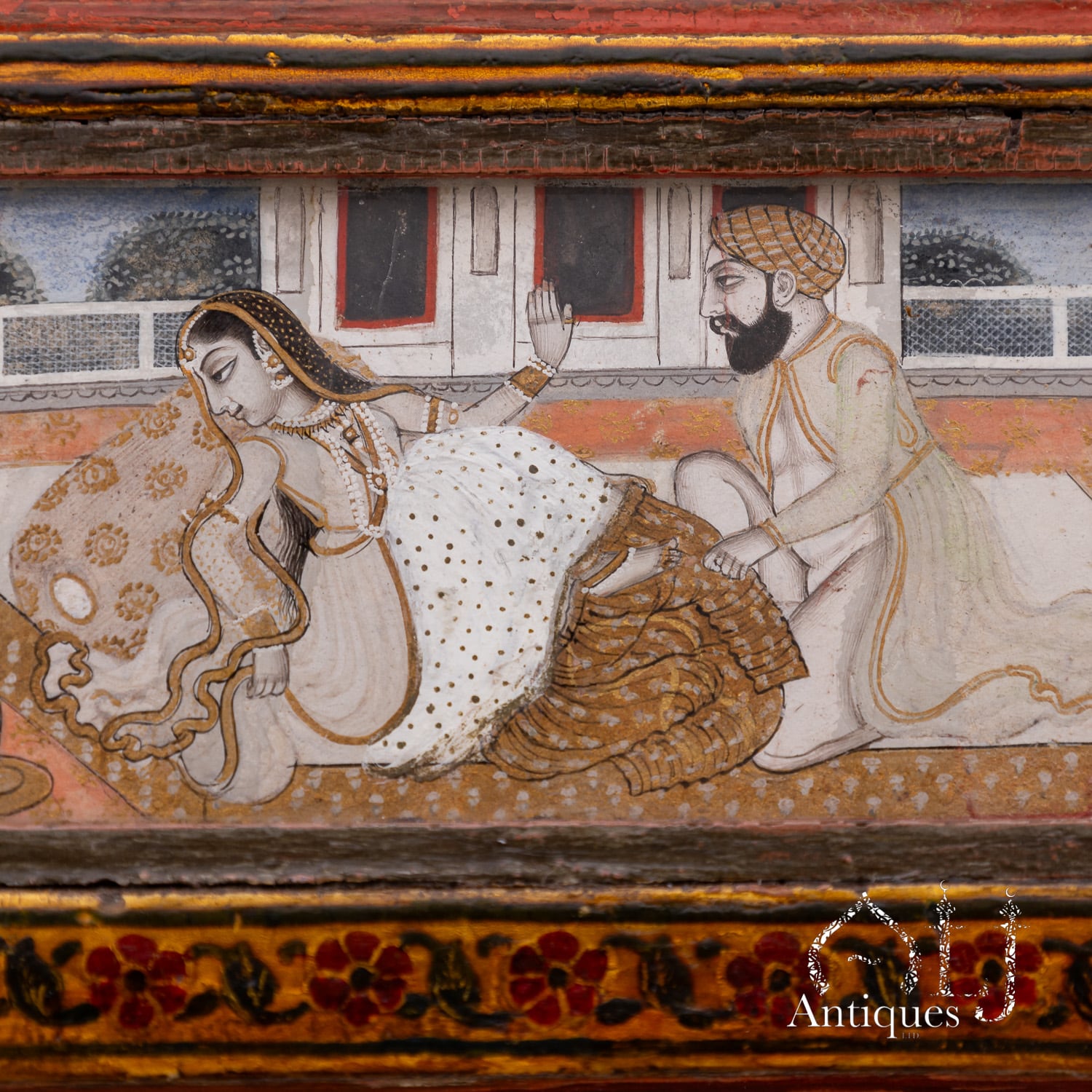
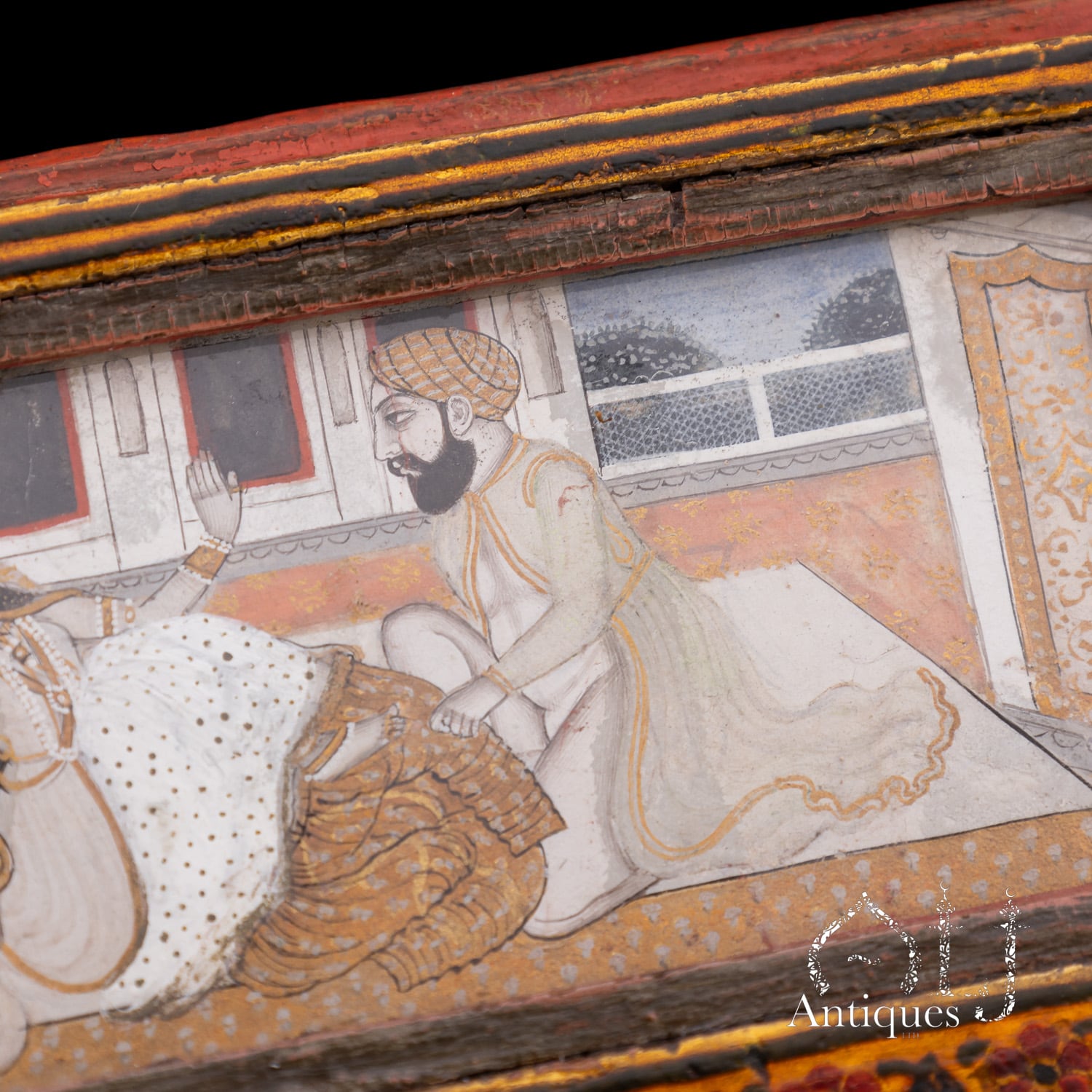
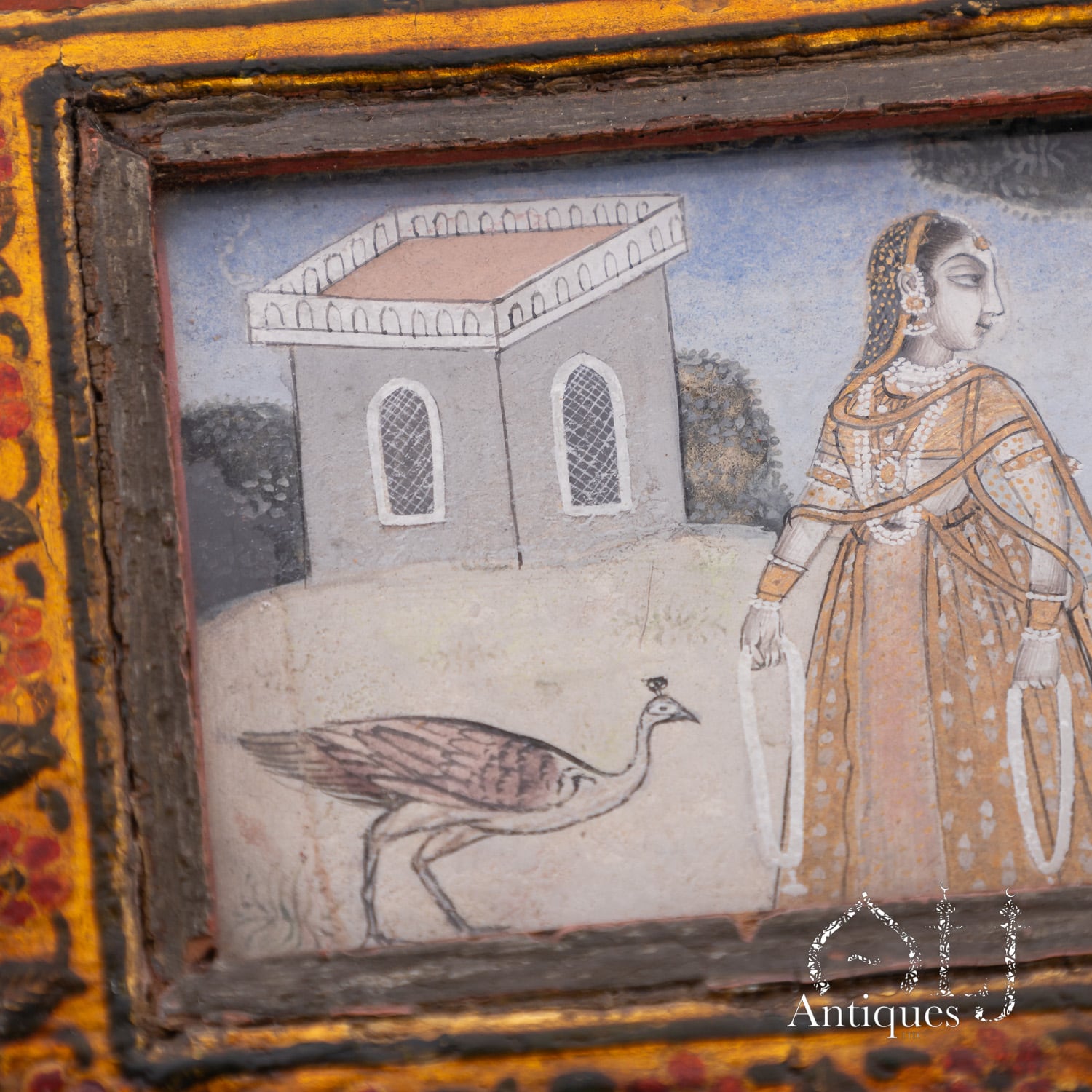
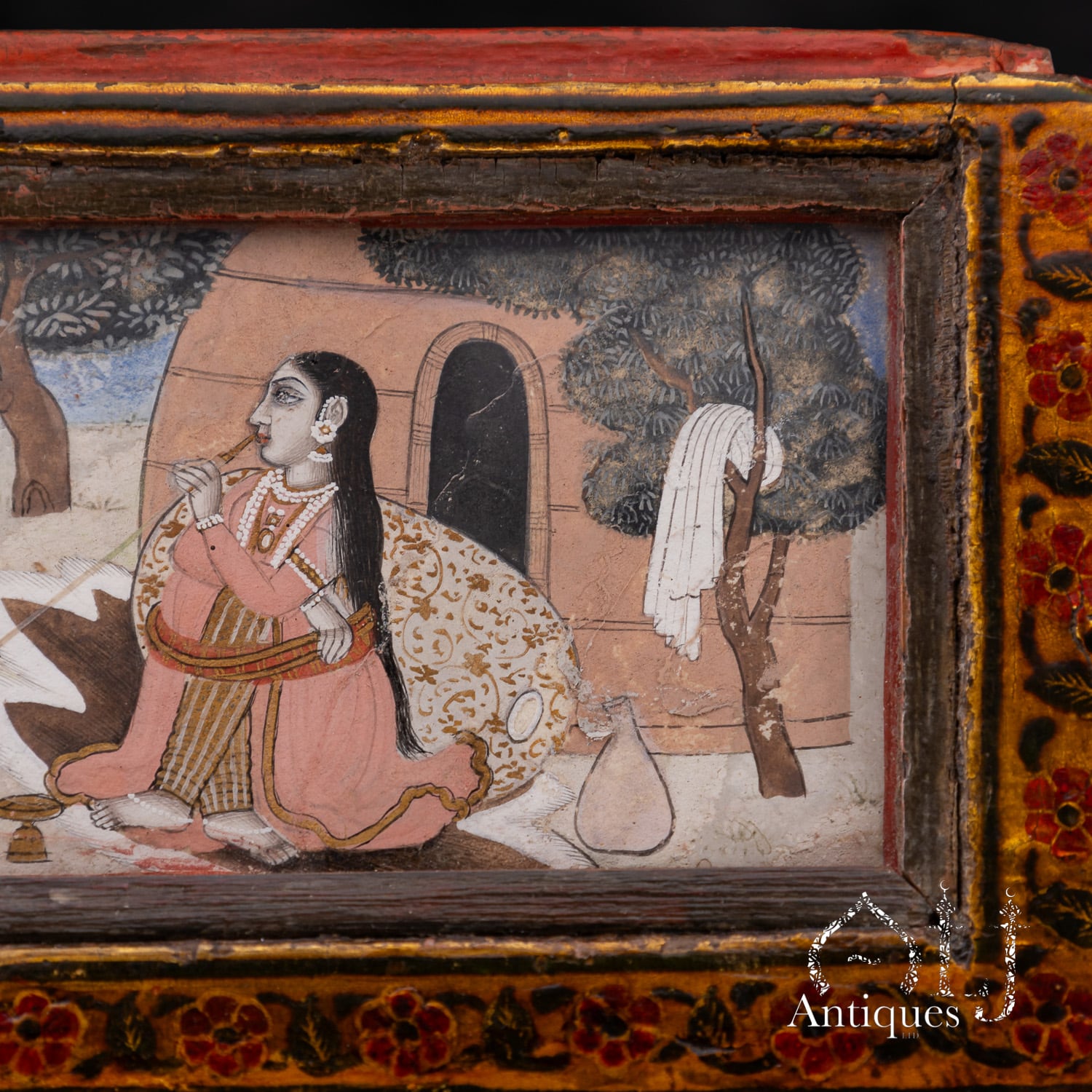
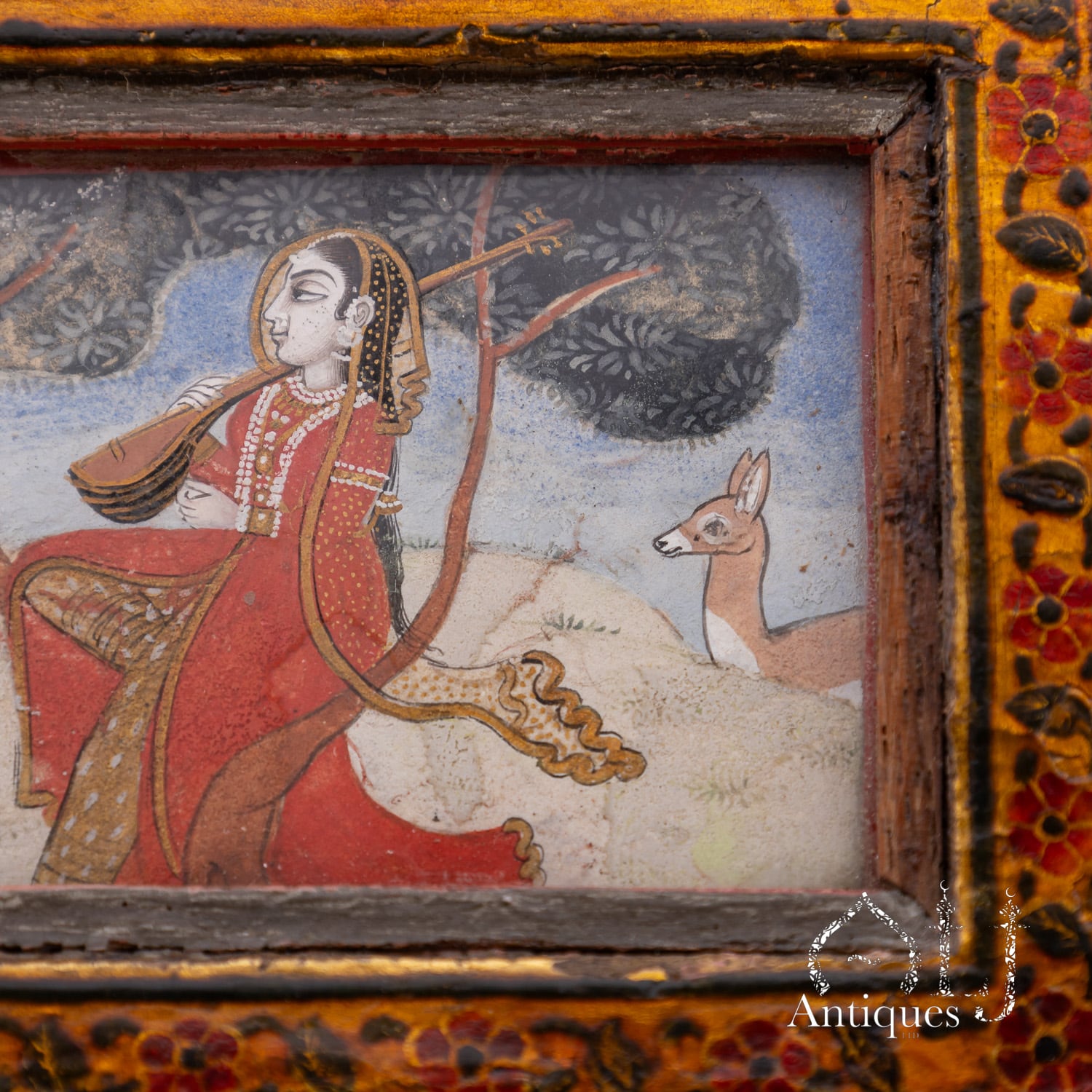
The paintings constitute an intimate visual sequence of aristocratic, romantic and courtly life, populated by elegantly dressed noblewomen, male companions, lovers, musicians and attendants.
Among the most striking compositions is a reclining or sleeping lady accompanied by a male figure dressed in an exceptionally fine, almost transparent garment. Other scenes include female musicians and companions, a lady associated with a hookah, and elegant women accompanied by peacocks and other birds.
Throughout the compositions appear numerous objects associated with elite Indian court culture, including hookahs, spittoons, a katar dagger, bazubands and other jewellery, luxurious textiles, patterned yellow and green carpets, marble or stone terraces, jali-like screens, flowering plants, birds, canopies and tented or palatial architectural settings.
The paintings are notable not merely for their subject matter but for the quality and richness of their execution. Gold is employed extensively, both within the ornamental framework of the casket and throughout the miniature paintings themselves. It is therefore not simply an incidental embellishment but an important component of the object’s overall visual conception.
The cumulative effect is deliberately sumptuous. The precious appearance of the lacquered surfaces, the abundance of gold, the sophisticated paintings and the fitted gilt-decorated bottles would have proclaimed the refinement and status of the casket’s original owner.
Stylistically, the elongated and elegant figures, languid poses, refined costumes, luxuriant interiors and gardens, and the combination of Mughal-derived naturalism with the more poetic and sometimes fantastical character of Deccani painting point strongly towards the Deccan, most probably Hyderabad.
The Earlier Deccani Tradition: The V&A Painted Casket
An exceptionally important antecedent for the present object is the celebrated late seventeenth-century painted Deccani casket in the Victoria and Albert Museum, London, associated with Rahim Deccani and the Golconda tradition.
The importance of the V&A casket lies in demonstrating that the practice of transforming a precious portable casket into a vehicle for a coherent sequence of specially conceived Deccani courtly miniature paintings was already established by the late seventeenth century.
Its compositions similarly explore intimate aristocratic subjects, including lovers, elegantly dressed women, musicians and figures inhabiting luxurious garden and palace environments.
The comparison does not require the present casket to be of the same period. Rather, the V&A example establishes a significant earlier Deccani precedent for the artistic concept embodied by the present piece.
The present casket appears to belong to a later continuation and development of this sophisticated Deccani tradition under the Nizams of Hyderabad.
The survival of earlier Deccani pictorial conventions into the later eighteenth century can be observed in Hyderabad paintings associated with artists such as Rai Venkatchellam, where elongated and languid figures, luxurious textiles, elaborate carpets, palace interiors, gardens, birds and scenes of aristocratic refinement continued to form an important part of the courtly visual vocabulary.
These comparisons support a probable dating of the present casket to approximately 1780–1795.
The Later Tradition: Lala Fakir Chand
The concept of incorporating miniature painting into precious Indian caskets did not disappear with the eighteenth century.
An important later development is represented by the distinguished Delhi ivory-carving tradition associated with Lala Fakir Chand, particularly the remarkable casket in the Victoria and Albert Museum, London, circa 1880, constructed from elaborately carved and pierced ivory and incorporating miniature paintings.
The Lala Fakir Chand casket belongs to a substantially later period and a different regional environment and should therefore not be regarded as a direct prototype for the present object.
Its significance lies instead in demonstrating the remarkable longevity of the Indian tradition of combining fine miniature painting with exceptionally elaborate luxury casket-making.
The three groups of material consequently form an illuminating chronological sequence: the late seventeenth-century Deccani V&A casket provides an important earlier precedent; the present casket represents what appears to be an exceptionally sophisticated late-eighteenth-century Hyderabad manifestation of that tradition; and the later work associated with Lala Fakir Chand in nineteenth-century Delhi demonstrates its subsequent survival and transformation.
The Six Fitted Glass Scent Bottles
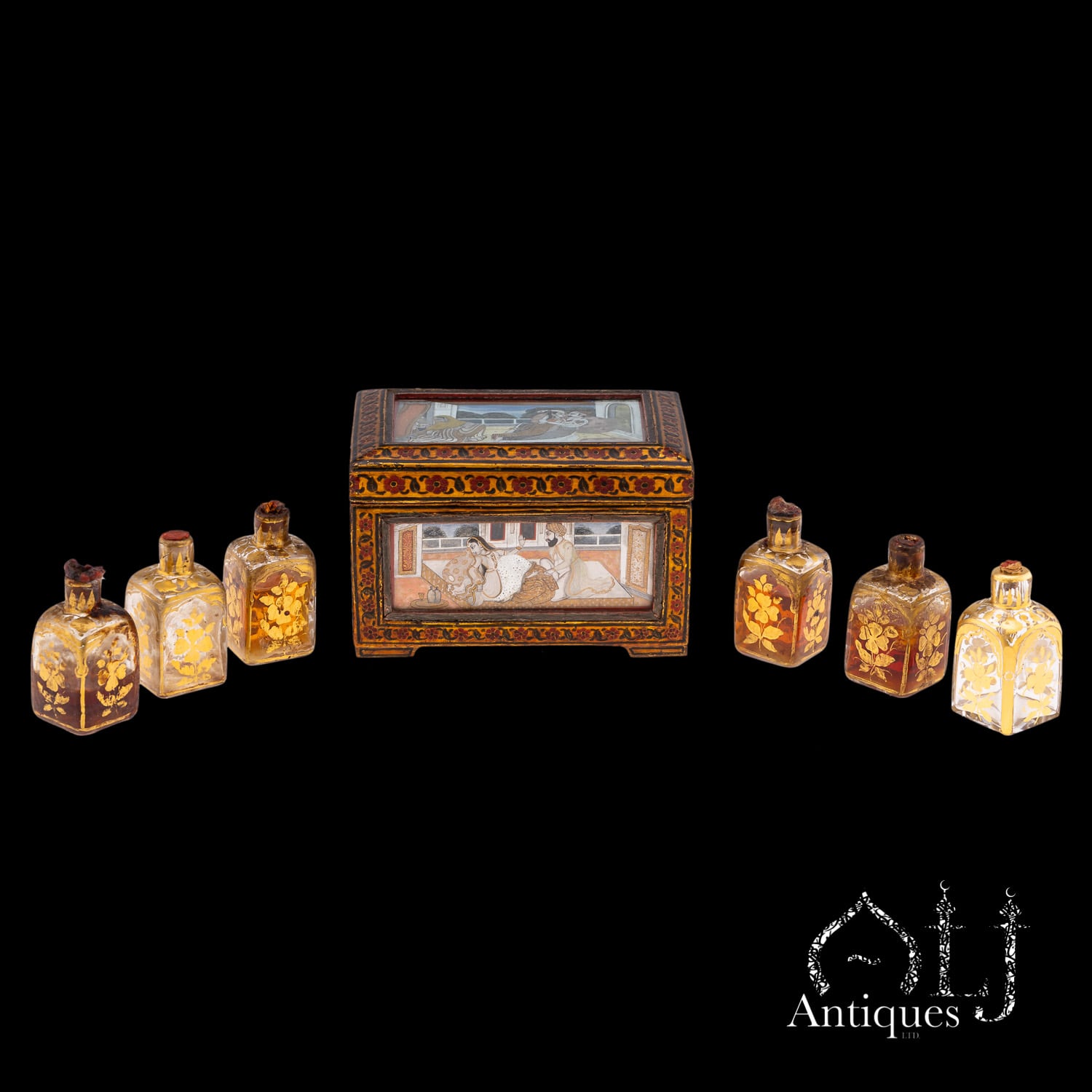
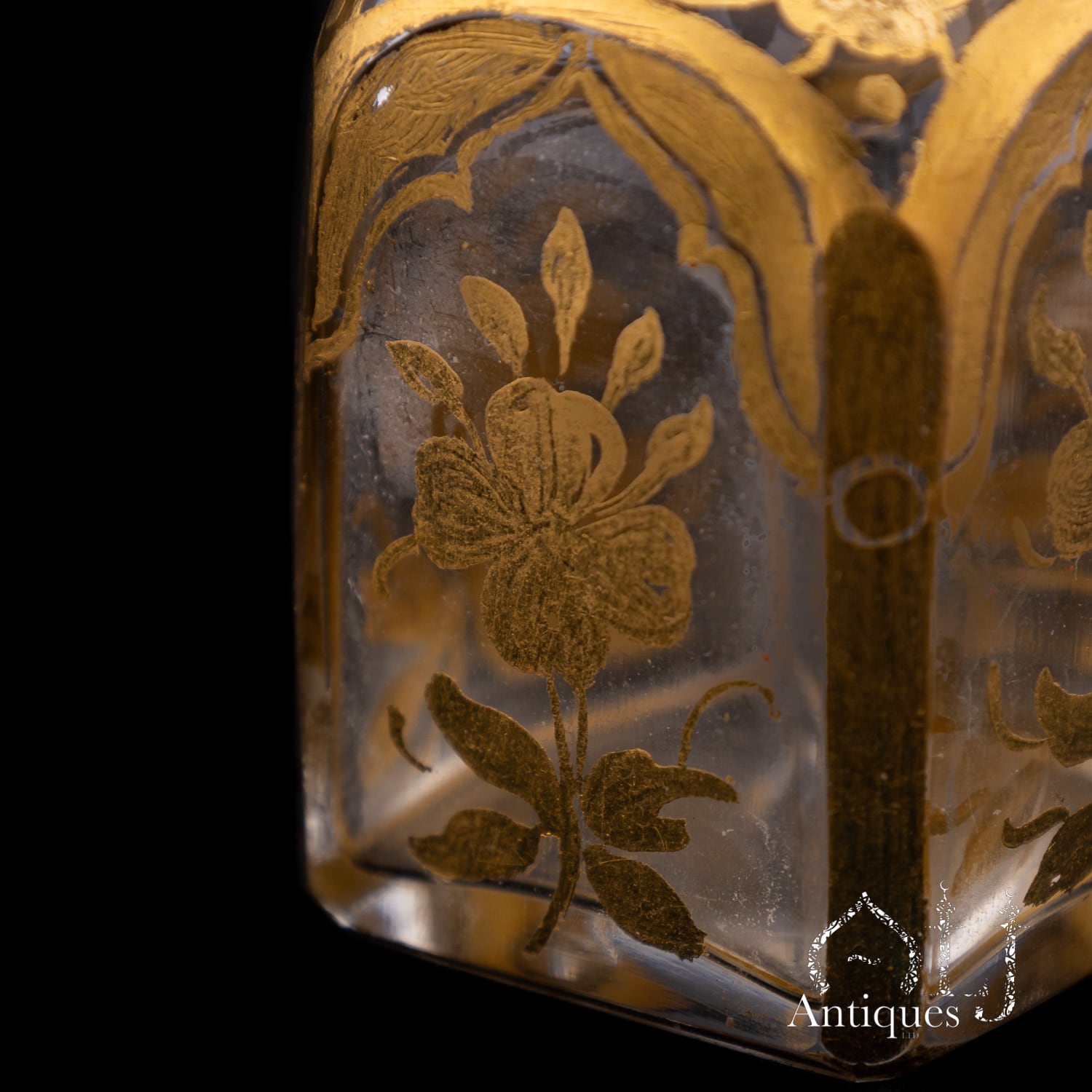
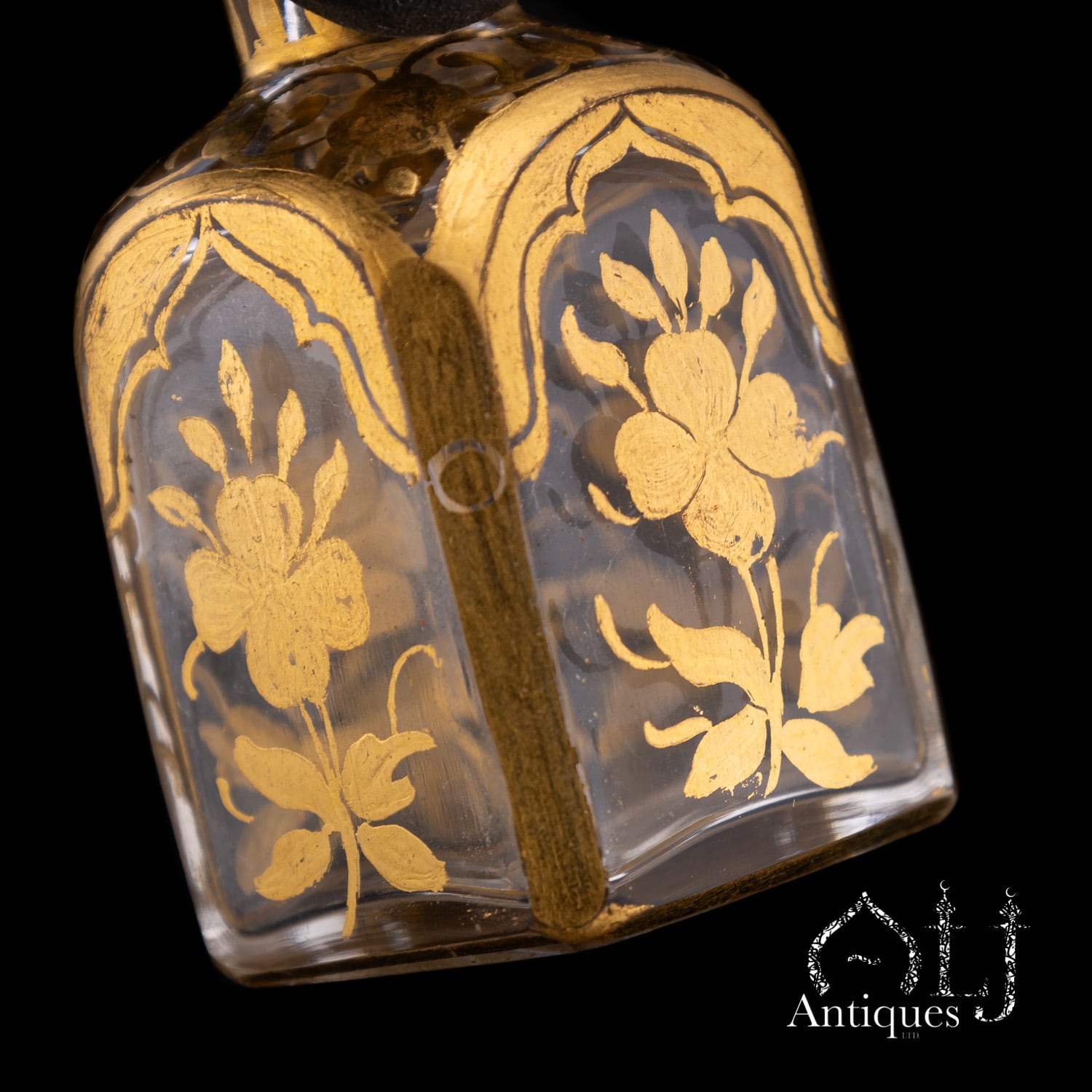
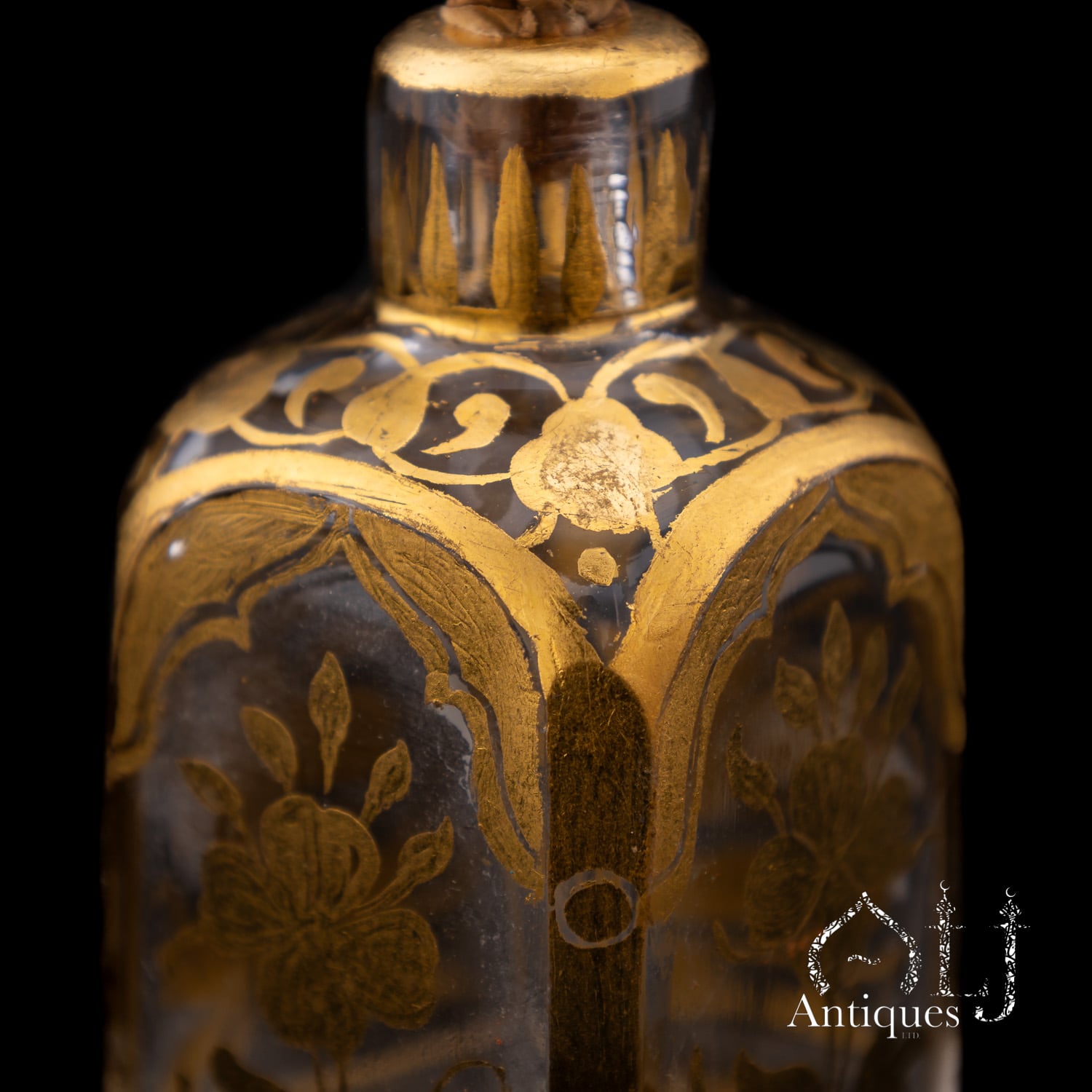
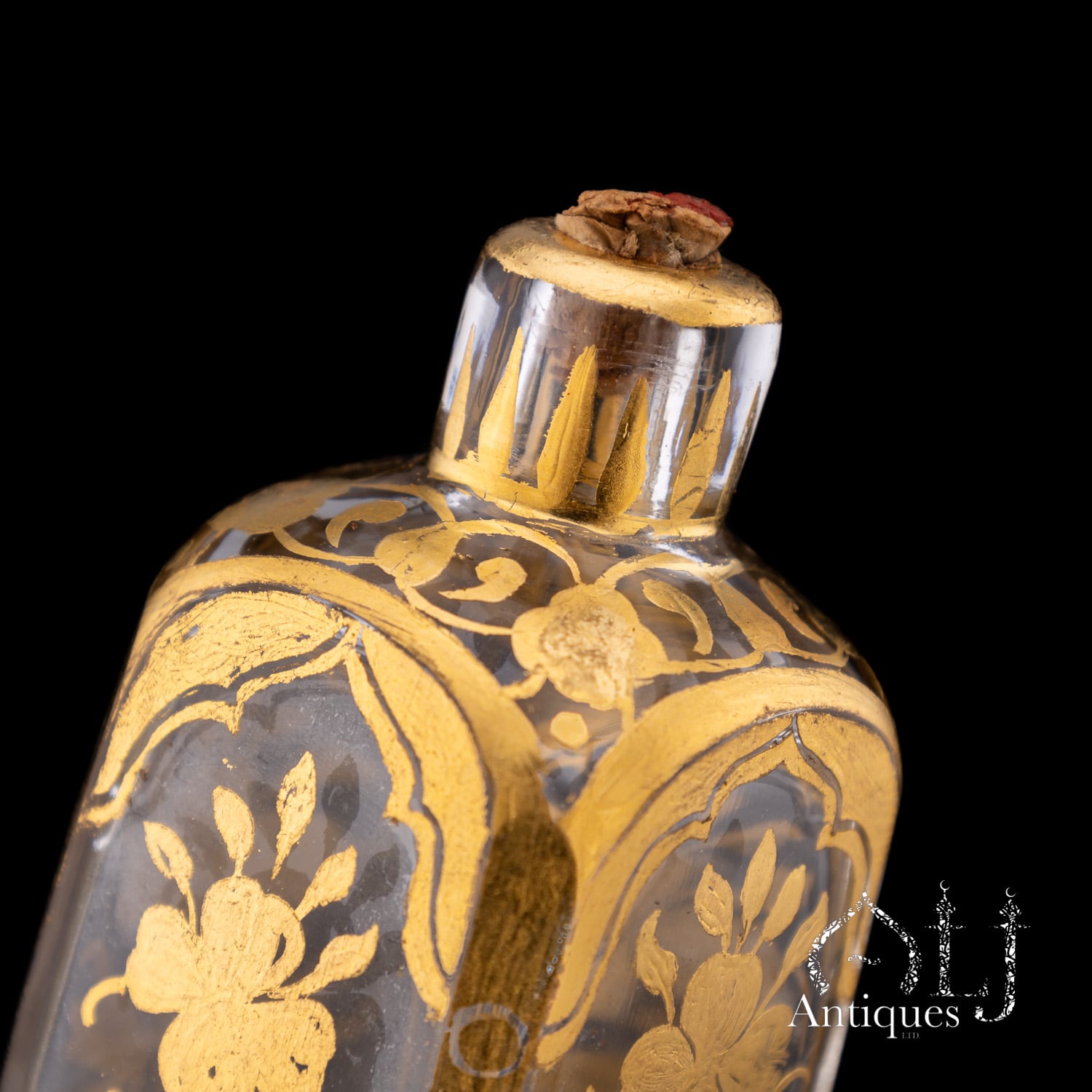
Of equal importance is the survival of the casket’s purpose-made fitted group of six rectangular glass scent or perfume bottles, individually decorated with elaborate gilt floral, vegetal and arabesque ornament.
The bottles belong to the broader eighteenth-century Indian tradition of rectangular vessels frequently described as “case bottles”, so called because examples were assembled and transported within specially fitted cases.
A particularly important published comparison is the “Decanter case with bottles,” Batavia and India, Gujarat, 18th century, preserved in the Asian Civilisations Museum, Singapore (inv. 2013-00749) and published in Port Cities: Multicultural Emporiums of Asia, 1500–1900, p. 145, cat. 69.
That ensemble comprises a wooden case with silver mounts and velvet lining containing six matching rectangular decorated glass bottles.
Its importance for the present casket is considerable because it demonstrates that groups of six luxury glass bottles were deliberately assembled and preserved within purpose-made fitted cases during the eighteenth century.
The extensive corpus published by Tara Desjardins in Mughal Glass: A History of Glassmaking in India further demonstrates the sophistication and geographical breadth of Indian free-blown, tooled, painted and gilded glass production during the eighteenth and early nineteenth centuries, with related examples associated with Gujarat, Delhi, Lucknow, Awadh and other centres.
Evidence from surviving museum examples also demonstrates that some Indian-decorated case bottles utilised glass manufactured in Europe and subsequently decorated in India, while other vessels appear to have been locally manufactured. It is therefore prudent to distinguish between the manufacture of the glass itself and the location in which its painted or gilt decoration was applied.
The present bottles are consequently most appropriately described as:
Indian gilt-decorated glass case bottles, probably Gujarat, 18th century.
They were presumably intended for precious aromatic liquids such as perfume, rosewater, scented oils or related preparations.
Their probable Gujarati association presents no difficulty in relation to the attribution of the painted casket to Hyderabad. On the contrary, the ensemble illustrates the movement of specialised luxury goods between different artistic and commercial centres within eighteenth-century India.
The Original Wax Seals and Surviving Contents
A particularly remarkable aspect of the ensemble is the survival of the bottles’ ancient wax closures.
Of the six bottles presently contained within the casket, five are original period examples and remain completely sealed with their ancient wax closures.
Even more remarkably, some of these bottles continue to contain quantities of their original liquid contents, still trapped inside as a consequence of the surviving seals.
The liquid has not been disturbed or scientifically analysed, and its precise composition therefore remains unknown. It would be inappropriate to identify it specifically as perfume, rosewater or scented oil without analysis.
Nevertheless, the survival of sealed period bottles retaining their historic liquid contents is an exceptionally evocative and unusual feature, preserving an element of the casket’s original function that is normally lost.
Courtly Character and Rarity
Taken as a whole, the casket should be understood not merely as a container but as an exceptionally luxurious courtly object.
The elaborate painted programme, extensive use of gold, sophisticated lacquer decoration, intimate depictions of elite court life and provision of six fitted gilt-decorated bottles indicate an object conceived at an unusually high level of artistic and material refinement.
Its precise original patron remains unknown, and in the absence of documentary evidence it would be inappropriate to describe it specifically as a royal commission or associate it directly with the Nizam.
Nevertheless, its quality and iconography strongly suggest production for an elite aristocratic or courtly patron within the Hyderabad cultural sphere.
Furthermore, while absolute claims of uniqueness are difficult to establish, no closely comparable surviving casket combining this particular arrangement of Deccani miniature paintings, lacquer and gilding with a fitted group of six decorated glass scent bottles has presently been identified in the course of this research.
It may therefore reasonably be described as an apparently unique or exceptionally rare surviving example of its type.
Dating and Attribution
On the basis of the miniature paintings, costume, courtly imagery, decorative vocabulary, extensive gilding, relationship with earlier Deccani painted caskets and comparison with later eighteenth-century Hyderabad painting, the most convincing attribution is:
Probably Hyderabad, Deccan, India, circa 1780–1795.
The fitted glass bottles:
Indian, probably Gujarat, 18th century.
Materials
Painted and lacquered wood; polychrome and gilt decoration; miniature paintings; thin protective glass; mica; gilt-decorated glass bottles; ancient wax seals and closures; metal fittings; and surviving historic liquid contents.
The internal framing appears originally to have possessed a silver-coloured or silvered surface, much of which has oxidised or tarnished to a predominantly dark grey tone.
Final Catalogue Attribution
An exceptional, extremely rare and apparently unique Deccani courtly painted and lacquered perfume, scent or cosmetic casket, lavishly decorated in gold with purpose-made miniature paintings beneath glass and mica, probably Hyderabad, Deccan, India, circa 1780–1795; containing a fitted group of six eighteenth-century Indian gilt-decorated glass scent or perfume bottles, probably Gujarat, five being original period bottles retaining their ancient wax seals and some preserving their original liquid contents, with one later specially made and hand-painted replacement for a broken original.Top of Form