



Description
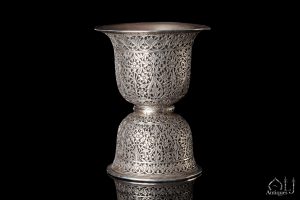
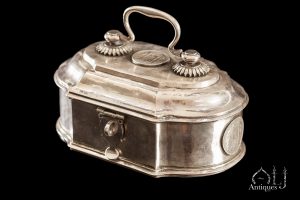
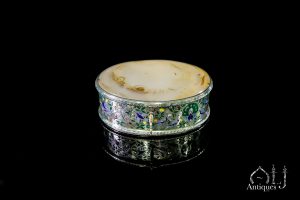
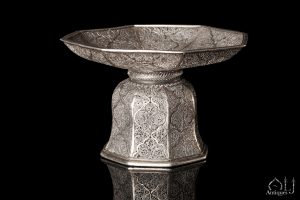
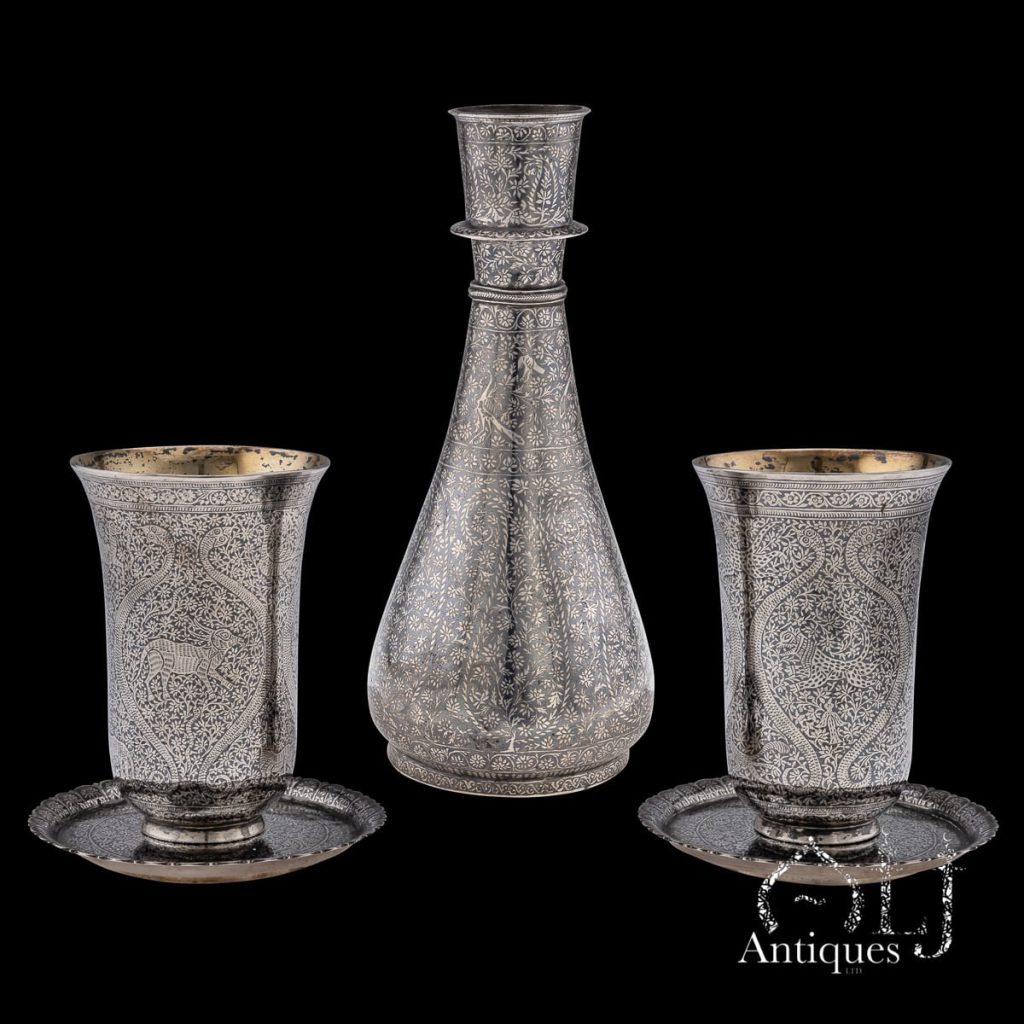
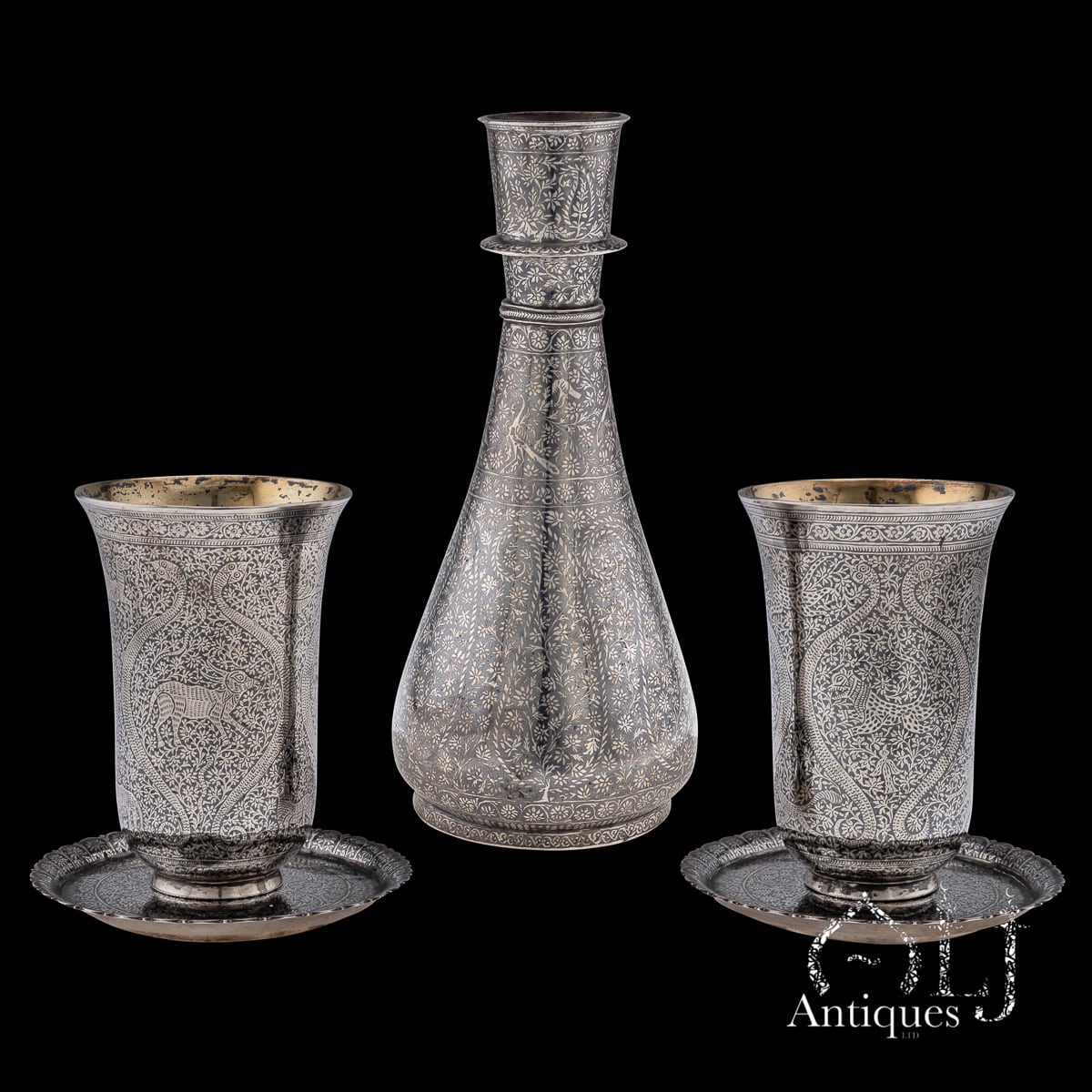
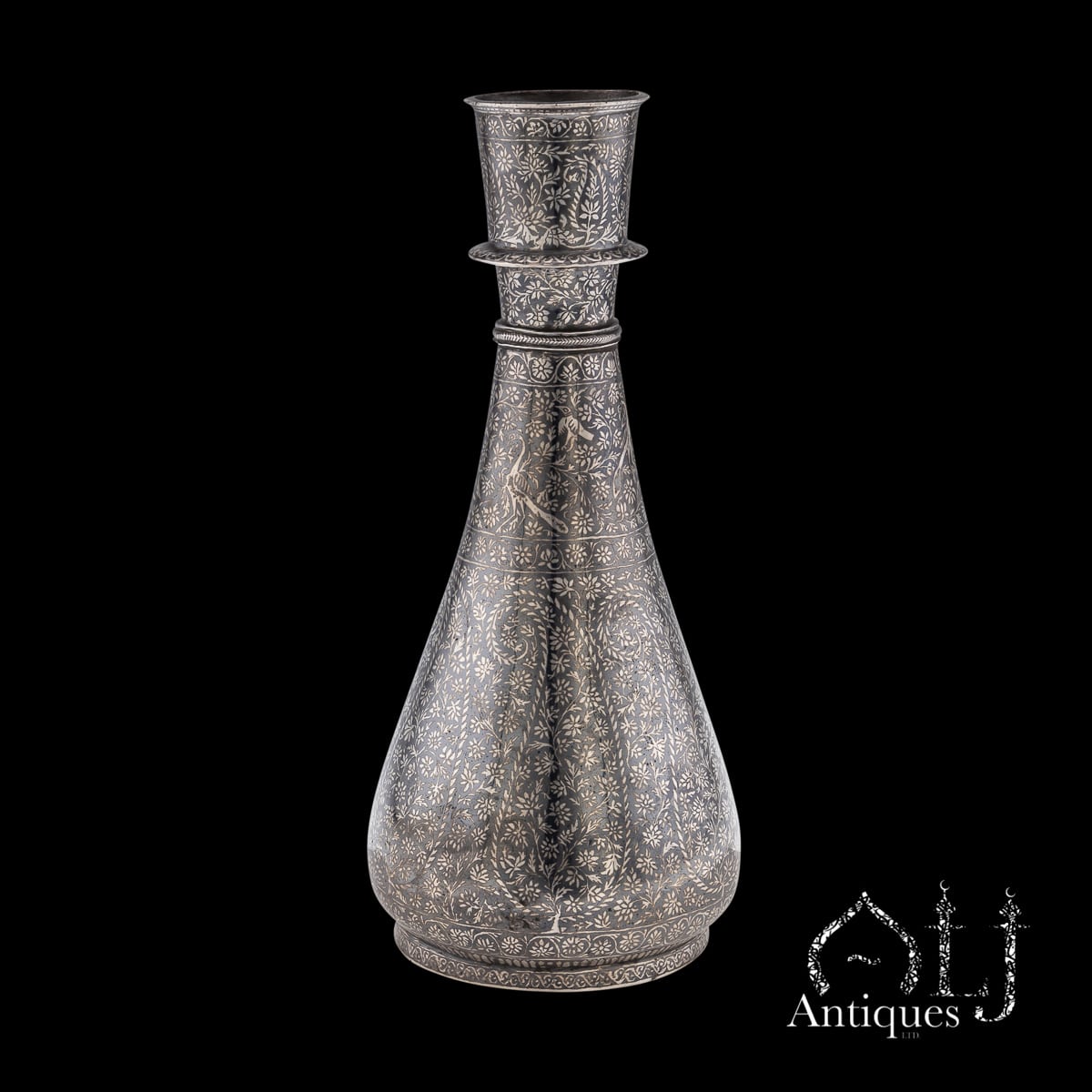
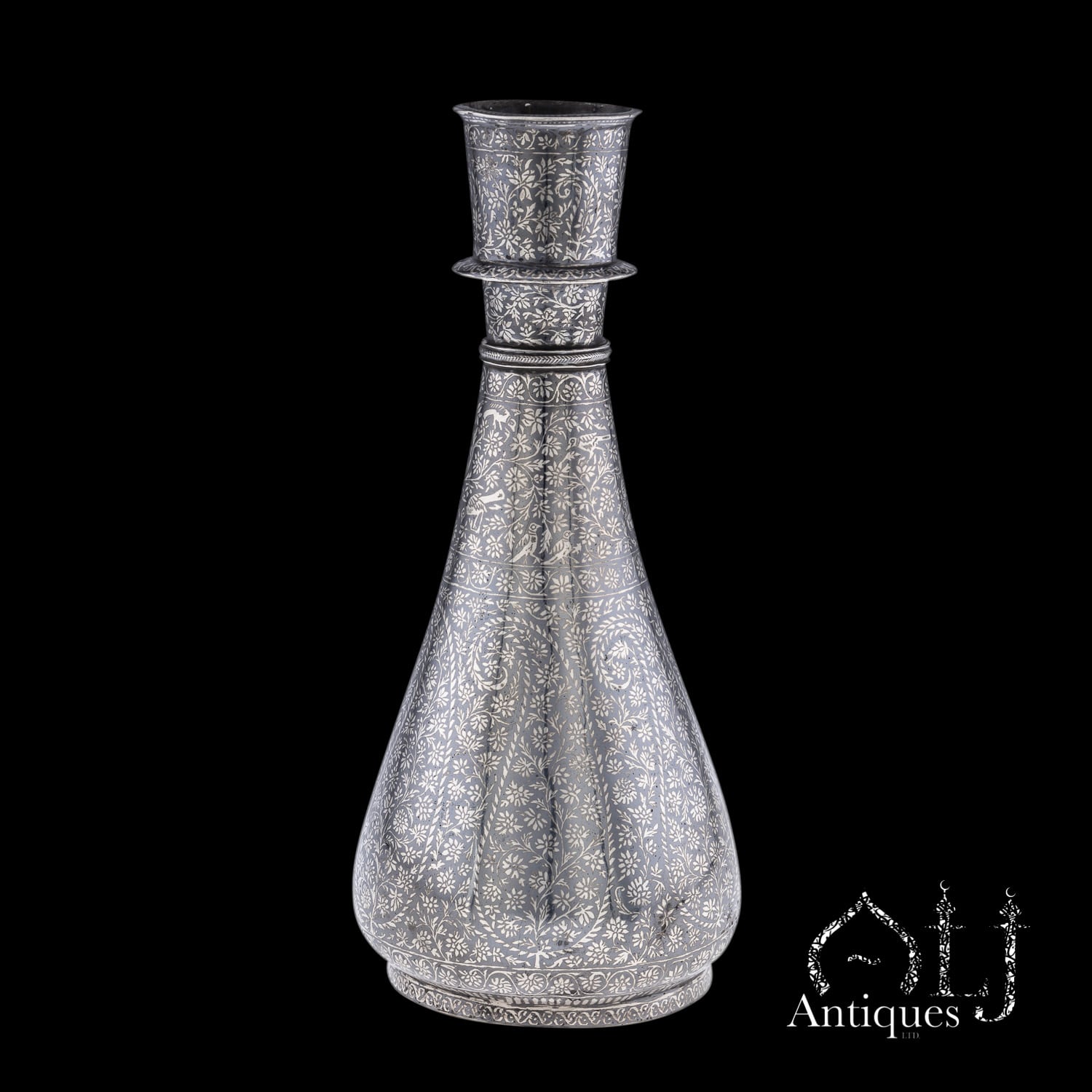
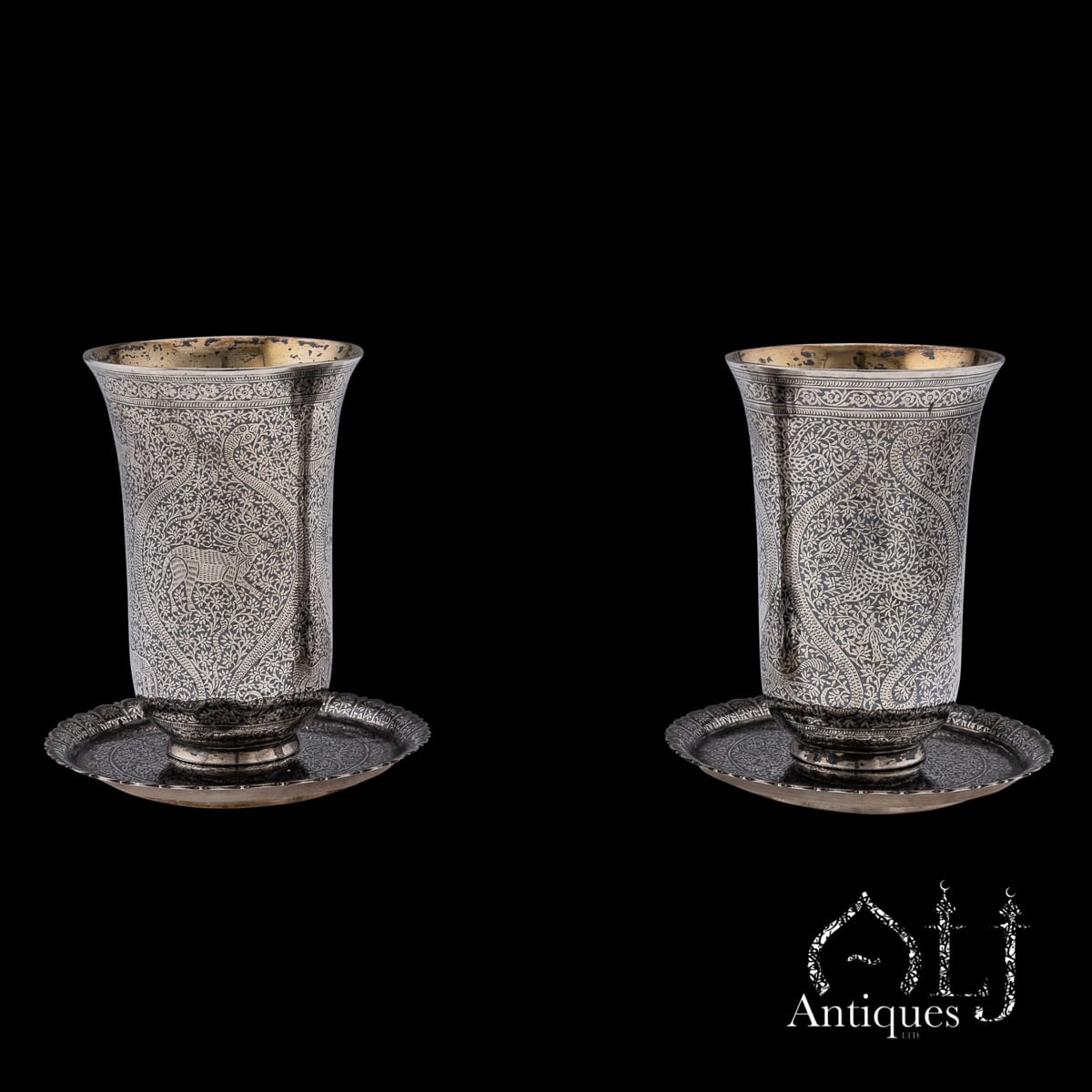
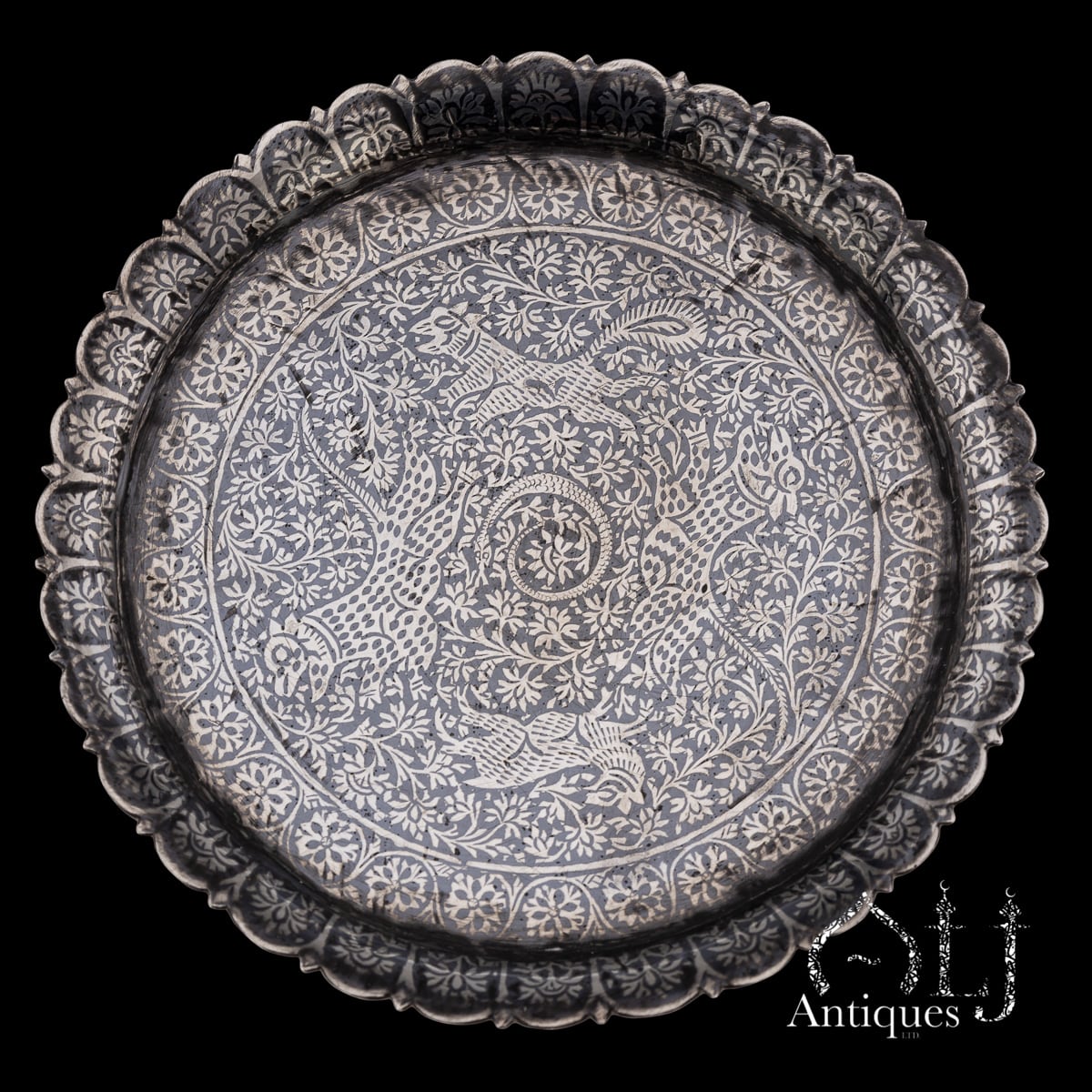
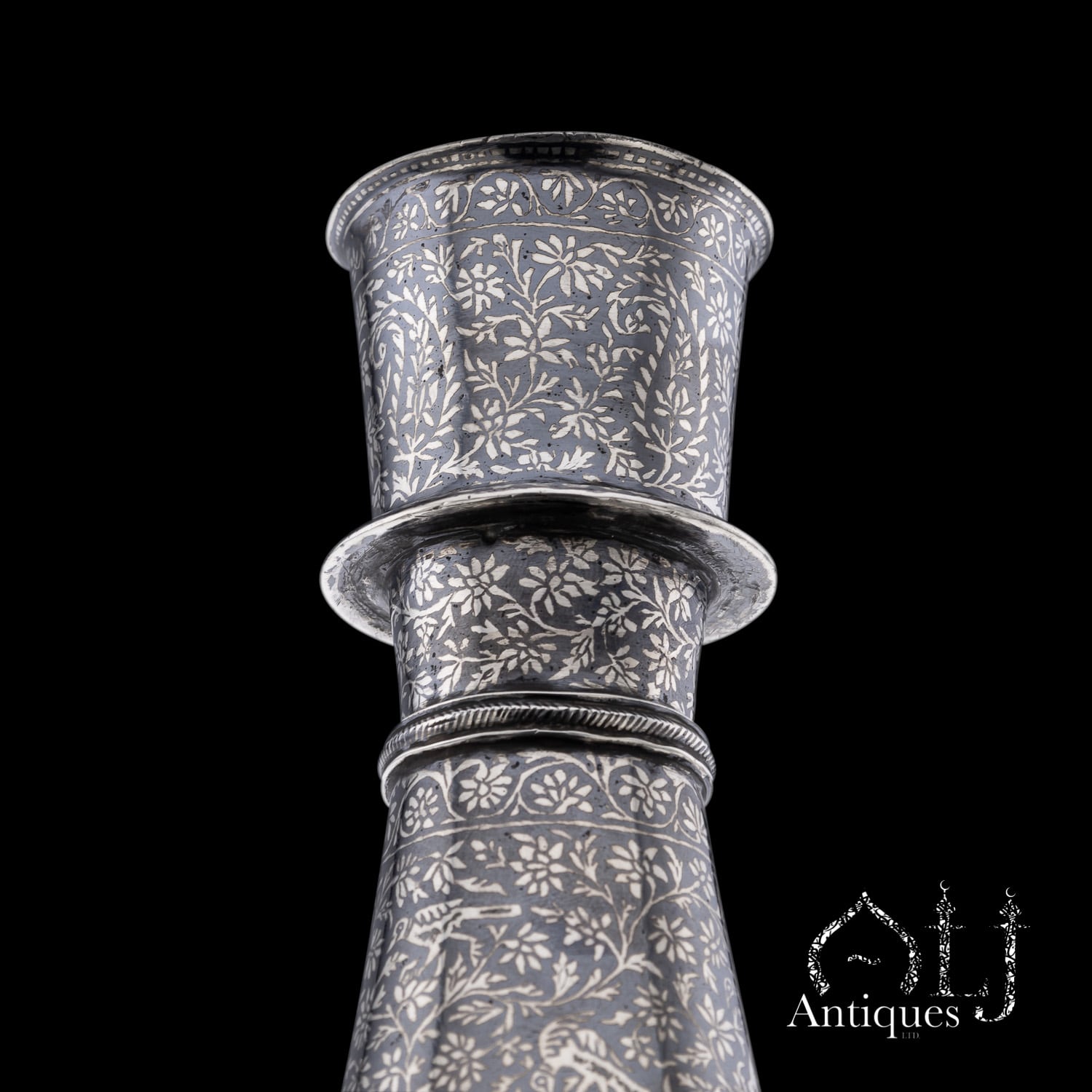
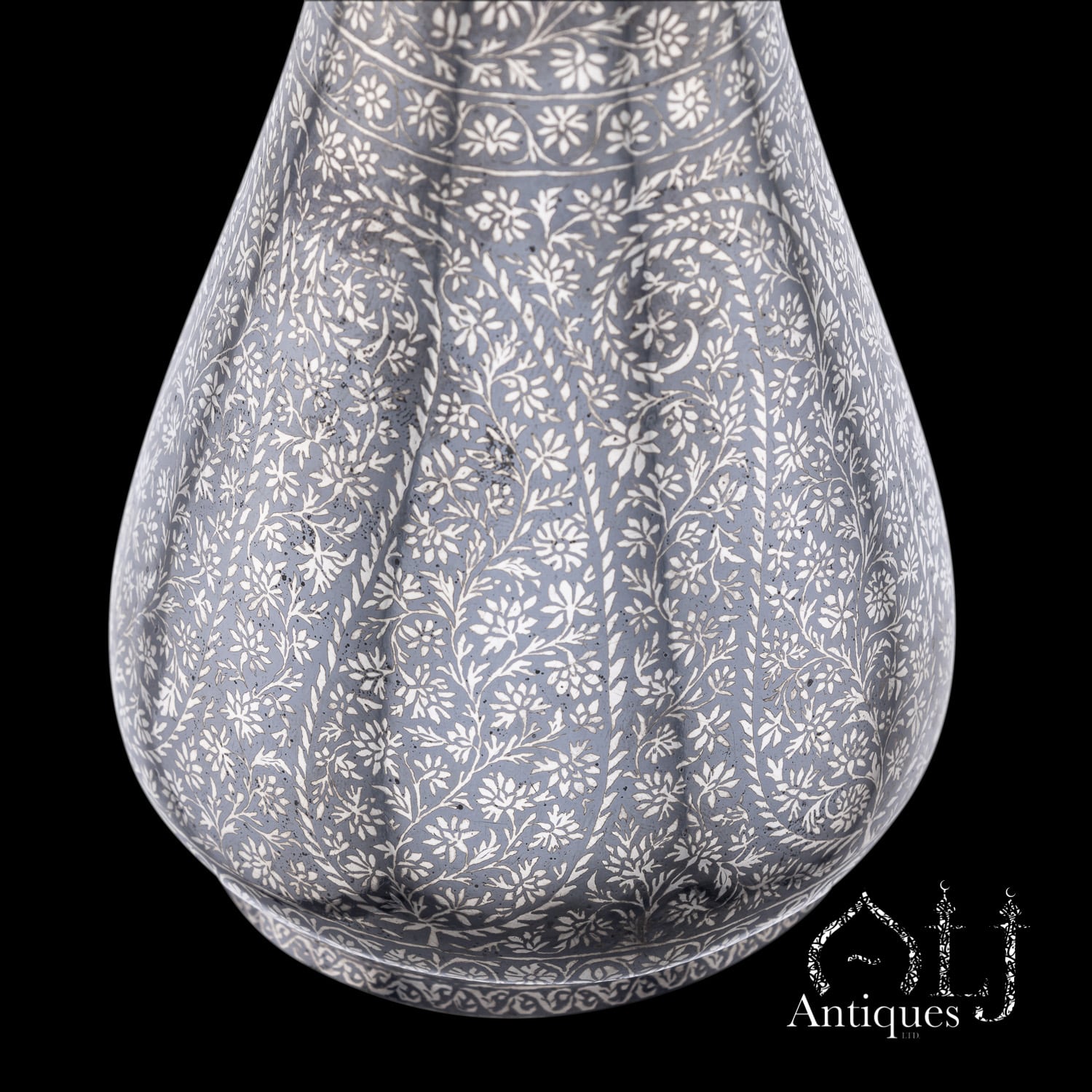
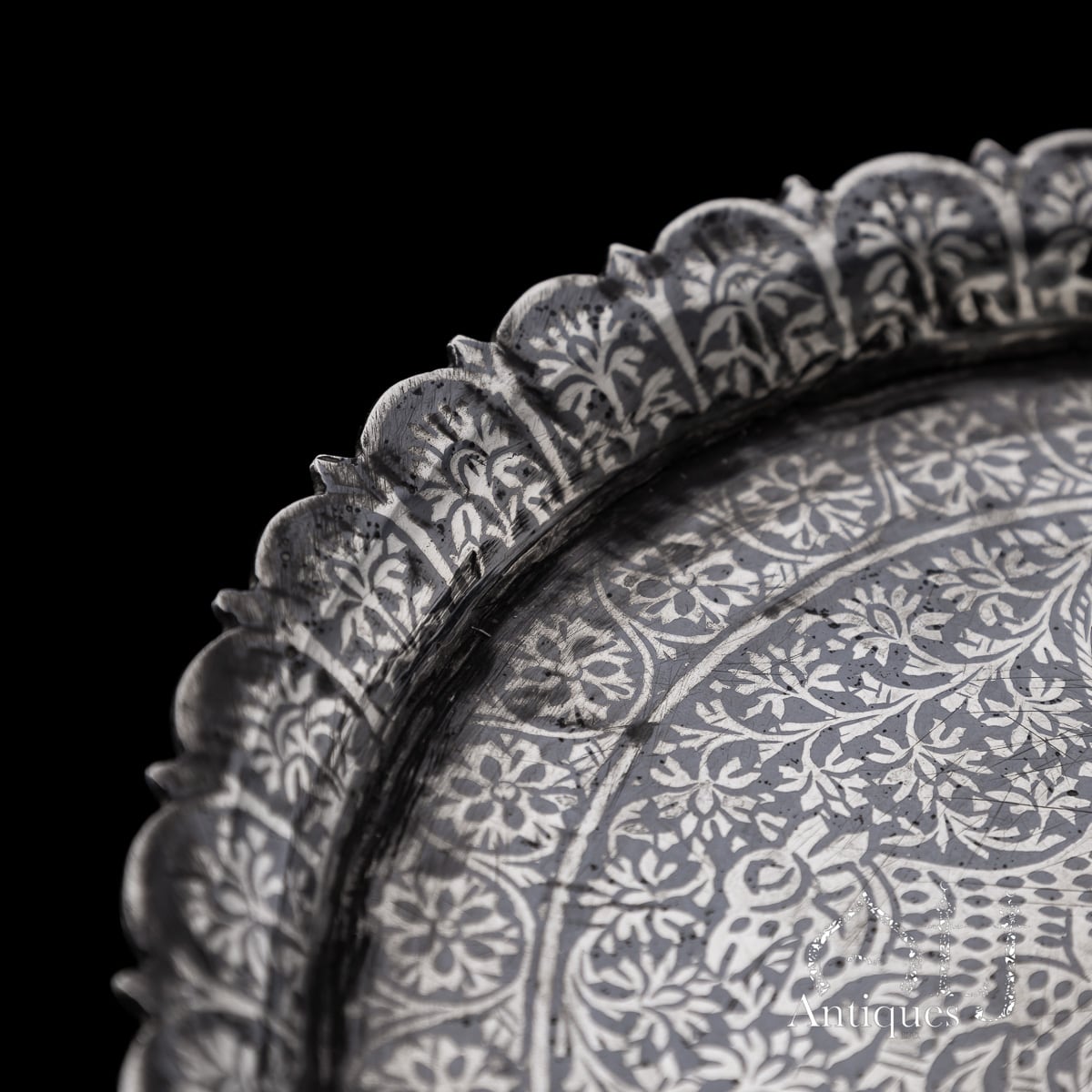
Comprising a tall, tapering pyriform hookah or huqqa base, a pair of beakers with everted lips, and matching scalloped offering bases or trays (thali), this finely worked silver ensemble is intricately and densely decorated with vegetal, animal, and scrolling motifs characteristic of late 18th- and early 19th-century Indian metalwork.
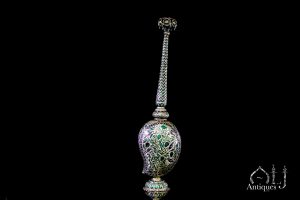
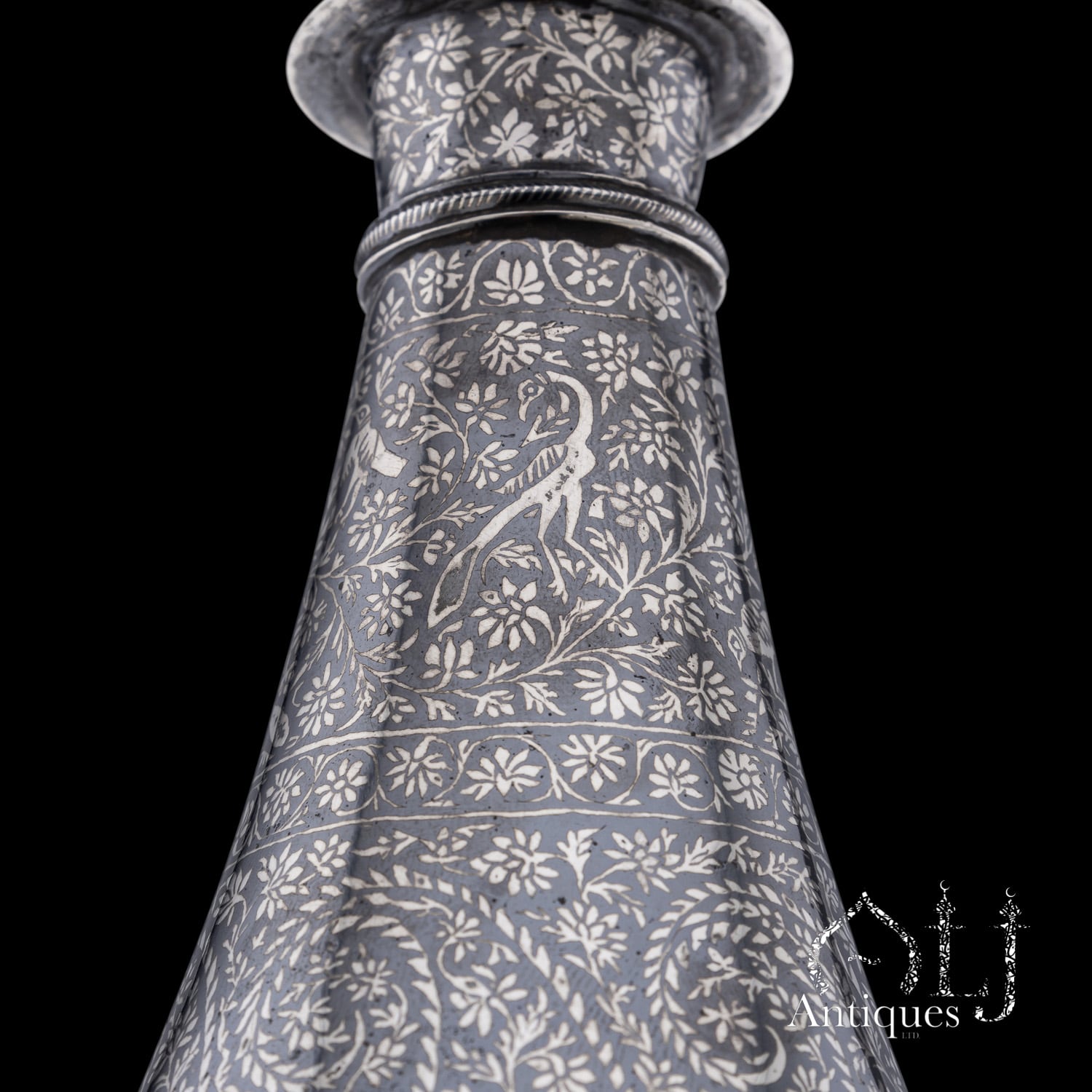
The huqqa base displays an elegant, tapering silhouette rising to a double-ringed neck and flaring mouth. Remarkably, its entire surface—including the upper rim of the mouth, the neck rings, the joints, and the rounded base—is densely engraved and worked with vegetal and animal motifs set against a deep black niello ground. The lower frieze features a continuous band of paisley (boteh) leaves, a motif commonly associated with Kashmiri artworks, infilled with delicate floral sprays, meandering tendrils, and interlacing palmettes.
The central frieze is animated by lively depictions of long-tailed birds, including peacocks and doves, as well as a bird of prey—possibly a hawk—attacking a vulnerable bird lying on the ground. These scenes are woven into dense foliage and recall the refined courtly taste of Deccani workshops in Golconda and Hyderabad. A closely related comparison can be drawn with a chased and niello-inlaid silver box decorated with animals in a scrolling vine, formerly exhibited at The Metropolitan Museum of Art, New York, Sultans of Deccan India, 1500–1700: Opulence and Fantasy (20 April – 26 July 2015).
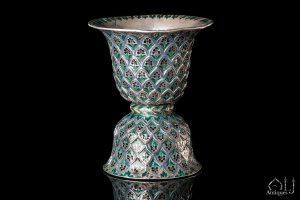
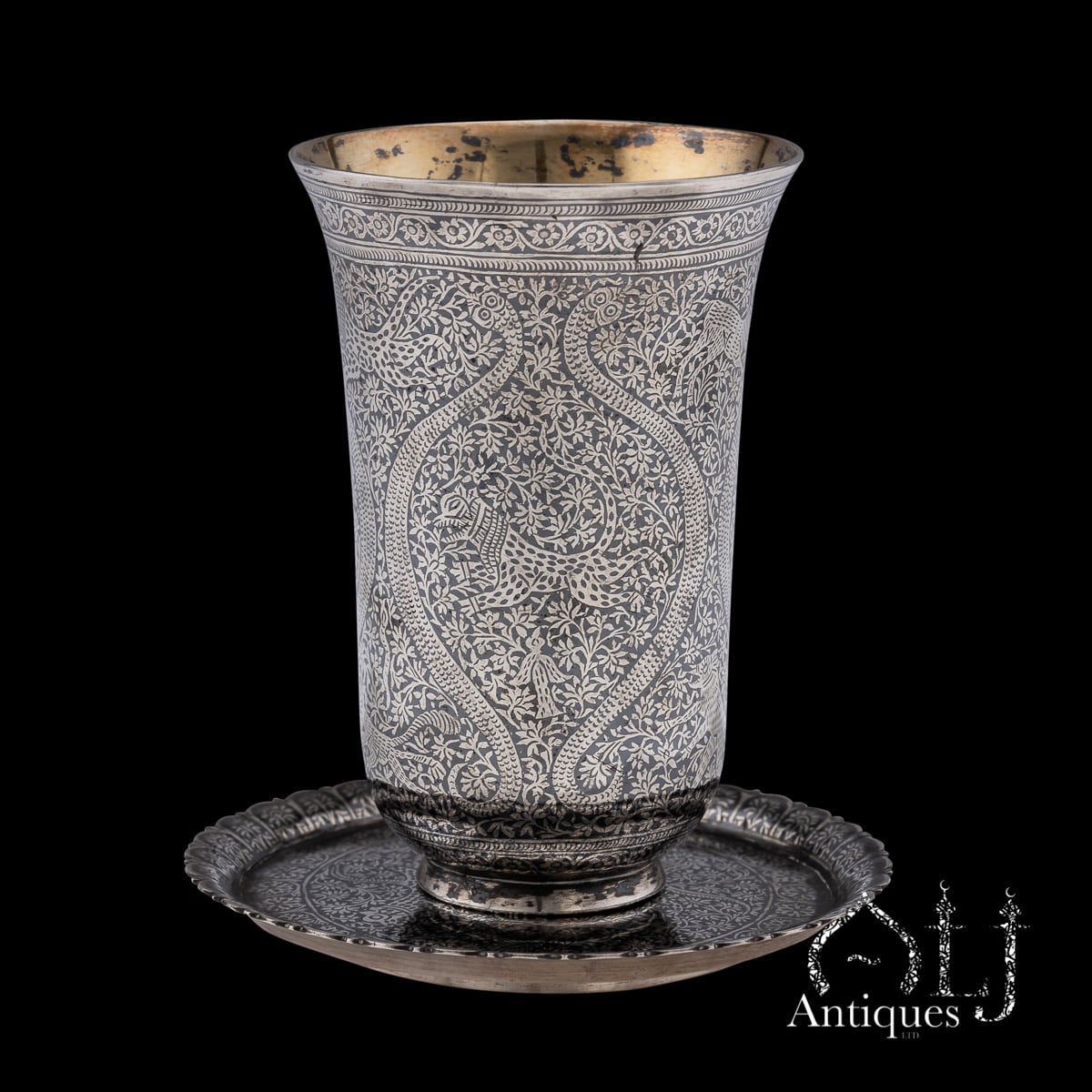
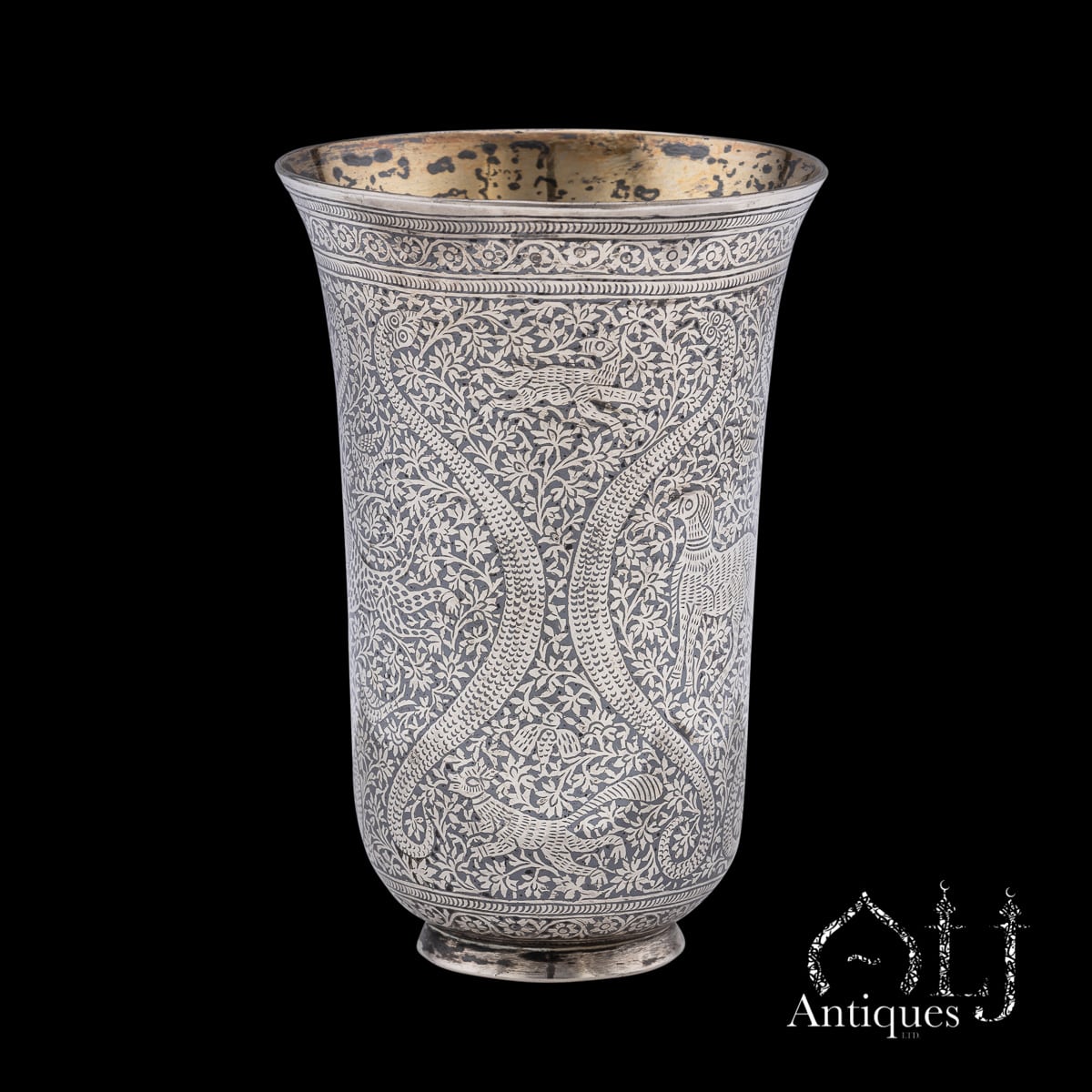
The two cylindrical beakers, each with an everted rim and parcel-gilt interior, are decorated using the same niello technique. The principal exterior frieze is composed of almond-shaped medallions outlined by entwined snakes and infilled with a remarkable range of wild animals, including elephants, peacocks, gazelles, buffaloes, smaller snakes, bears, dogs, birds, foxes, wolves, and running tigers and leopards shown in hunting mode. These scenes unfold against miniature flowering plants and scrolling vines.
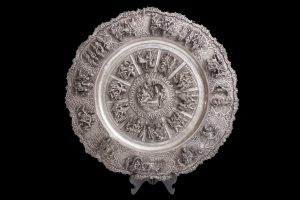
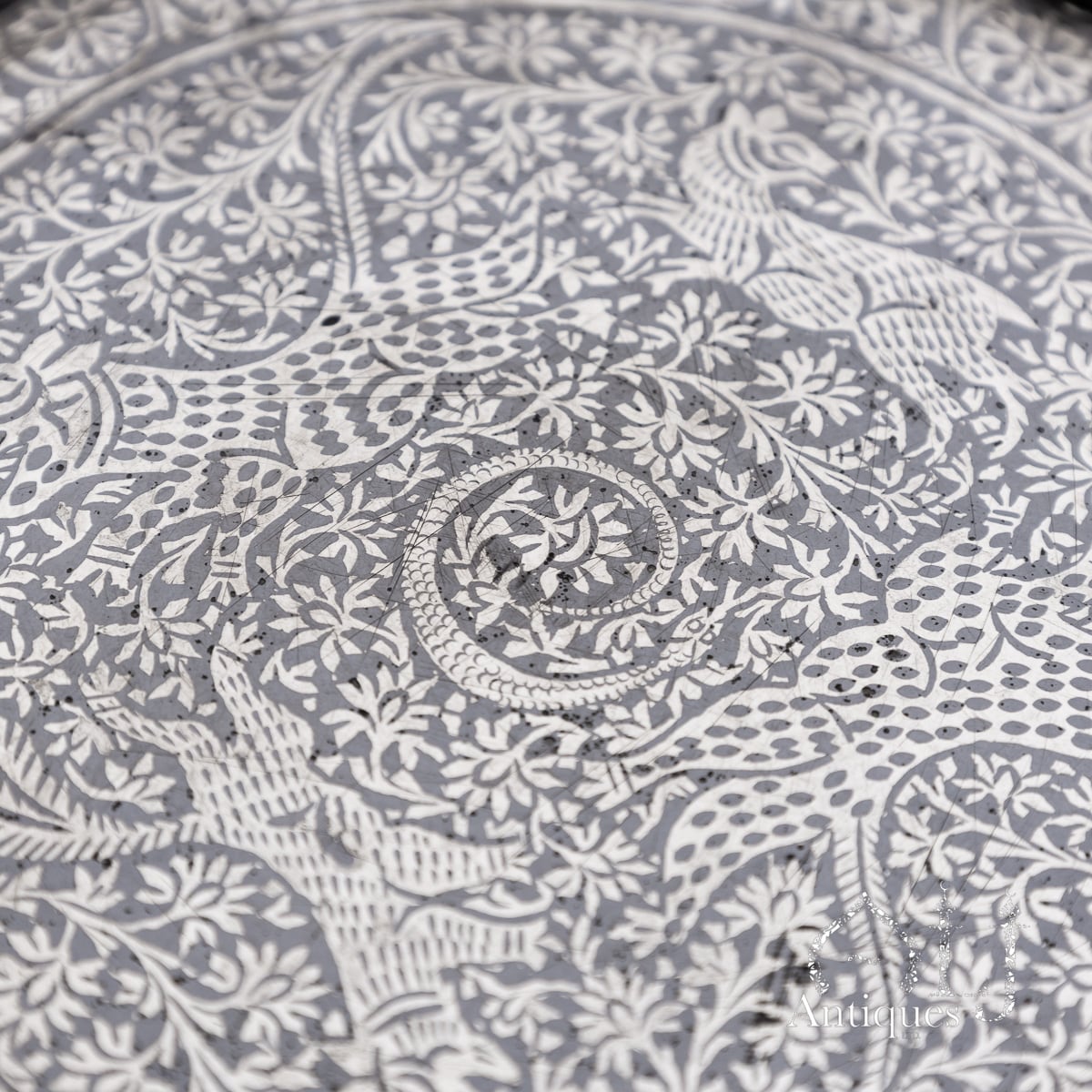
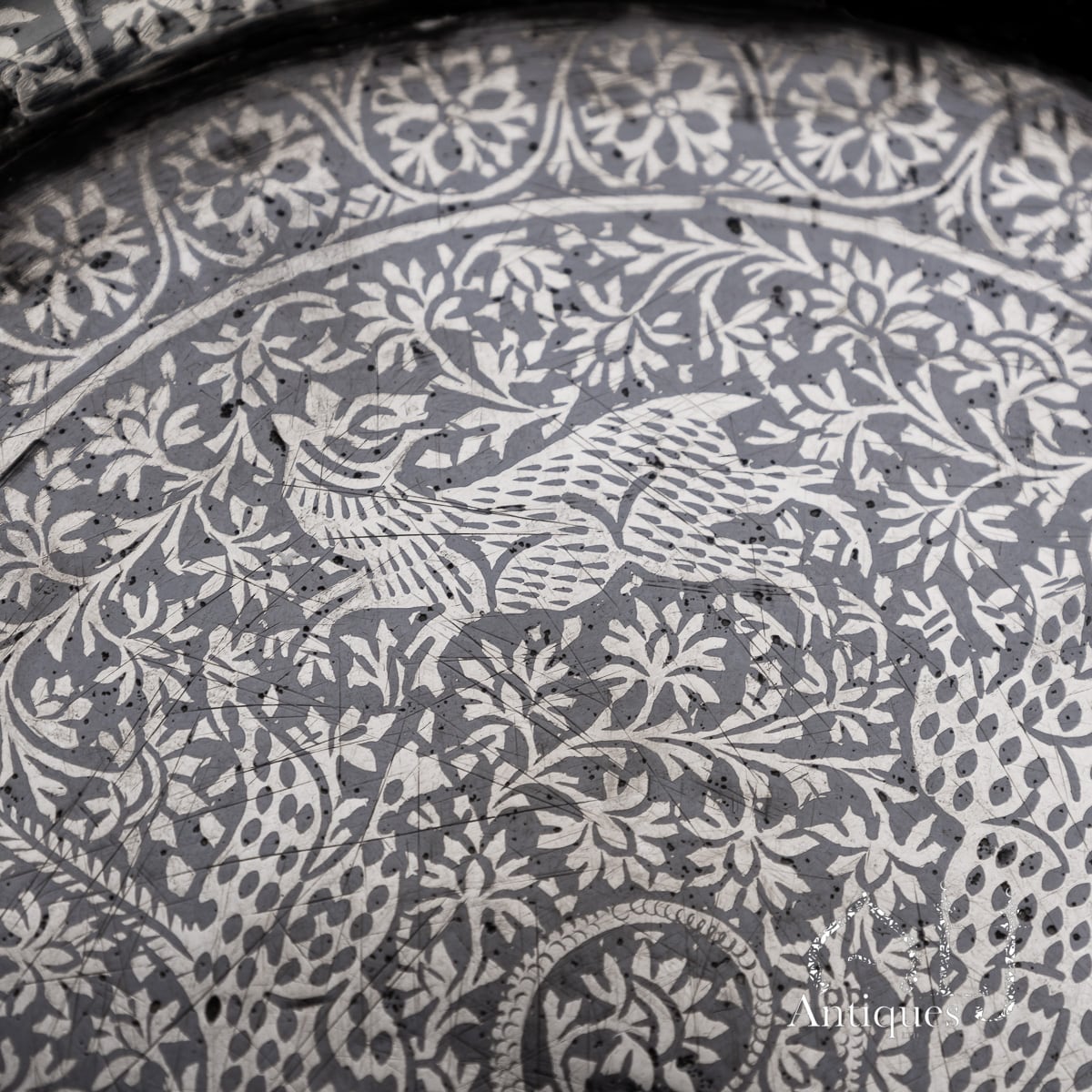
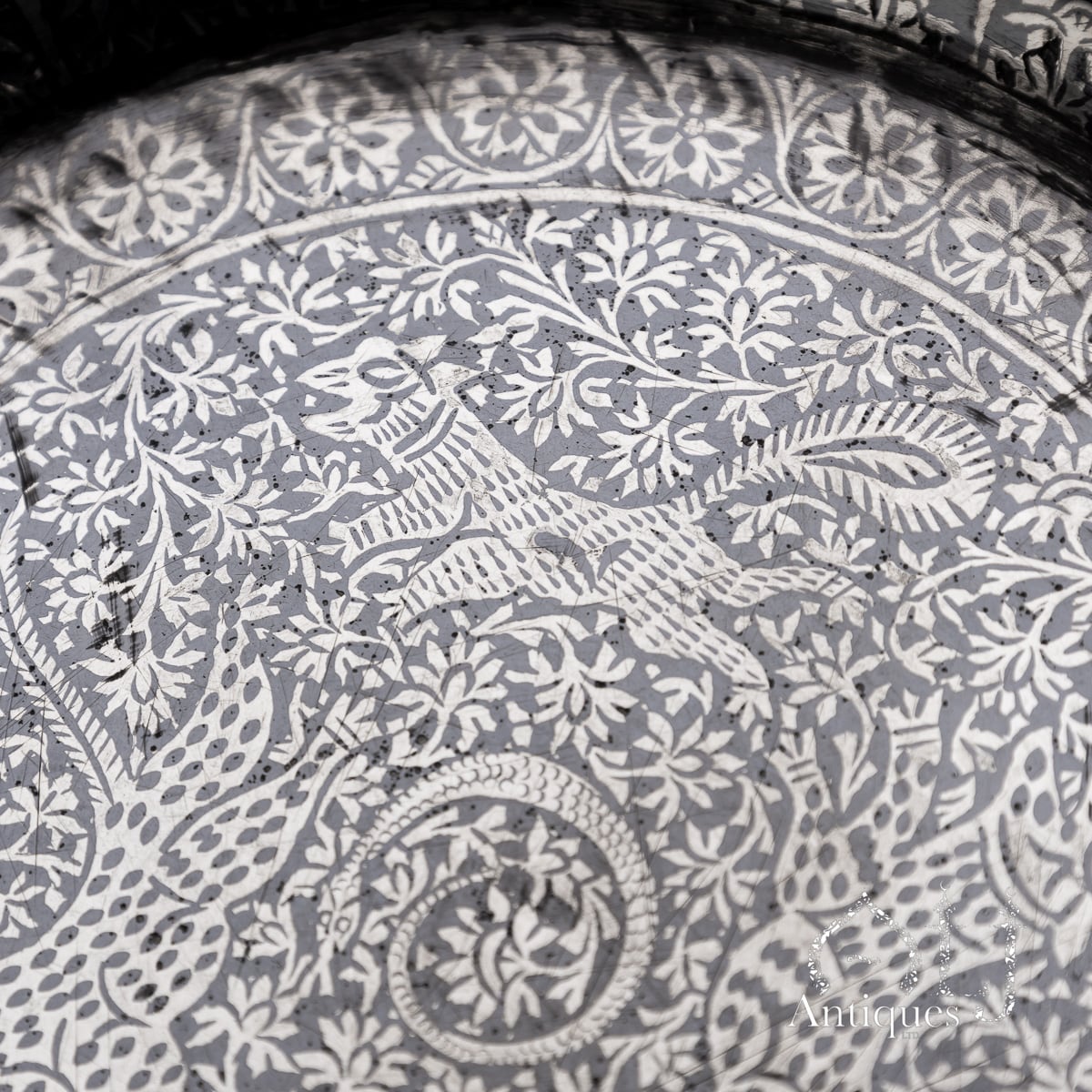
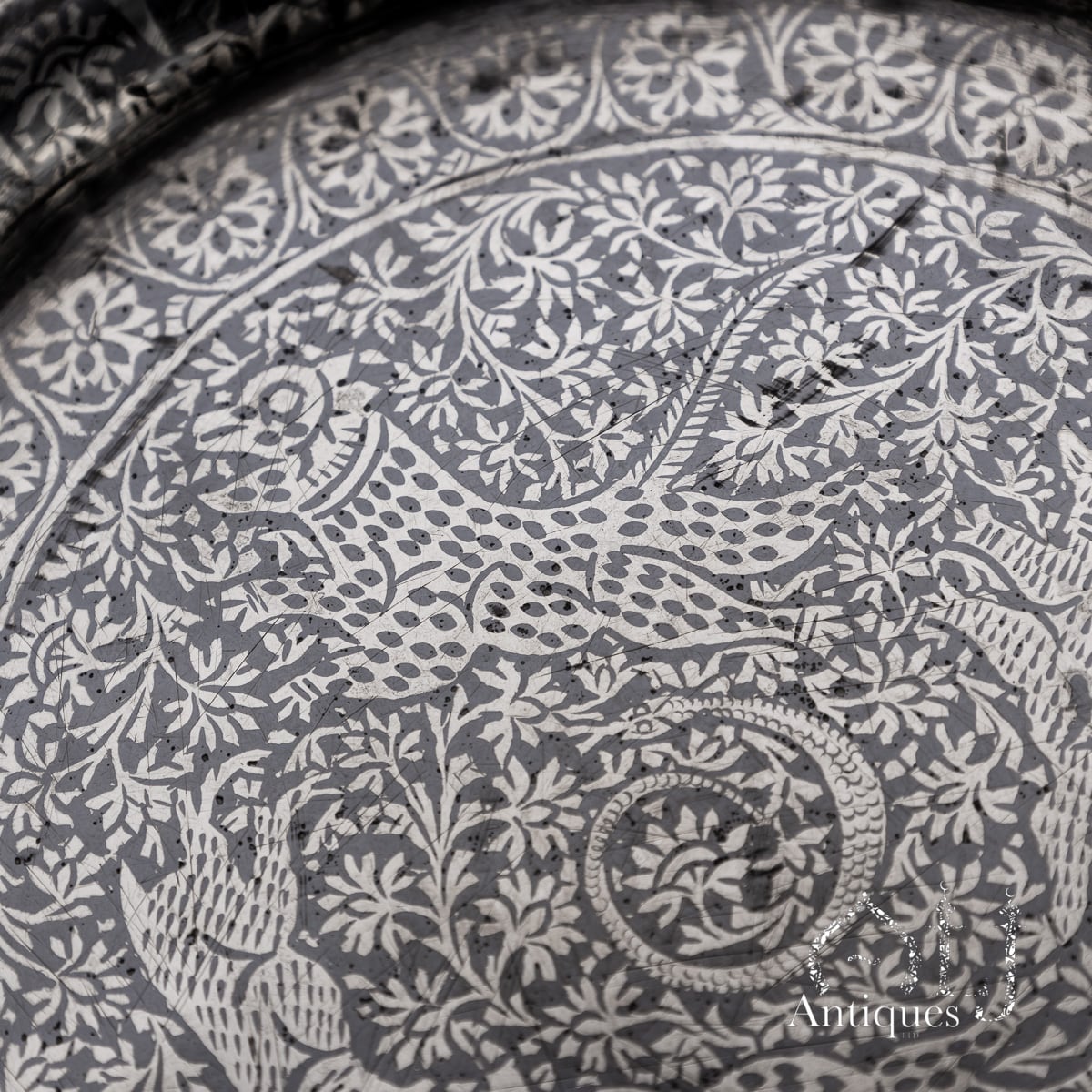
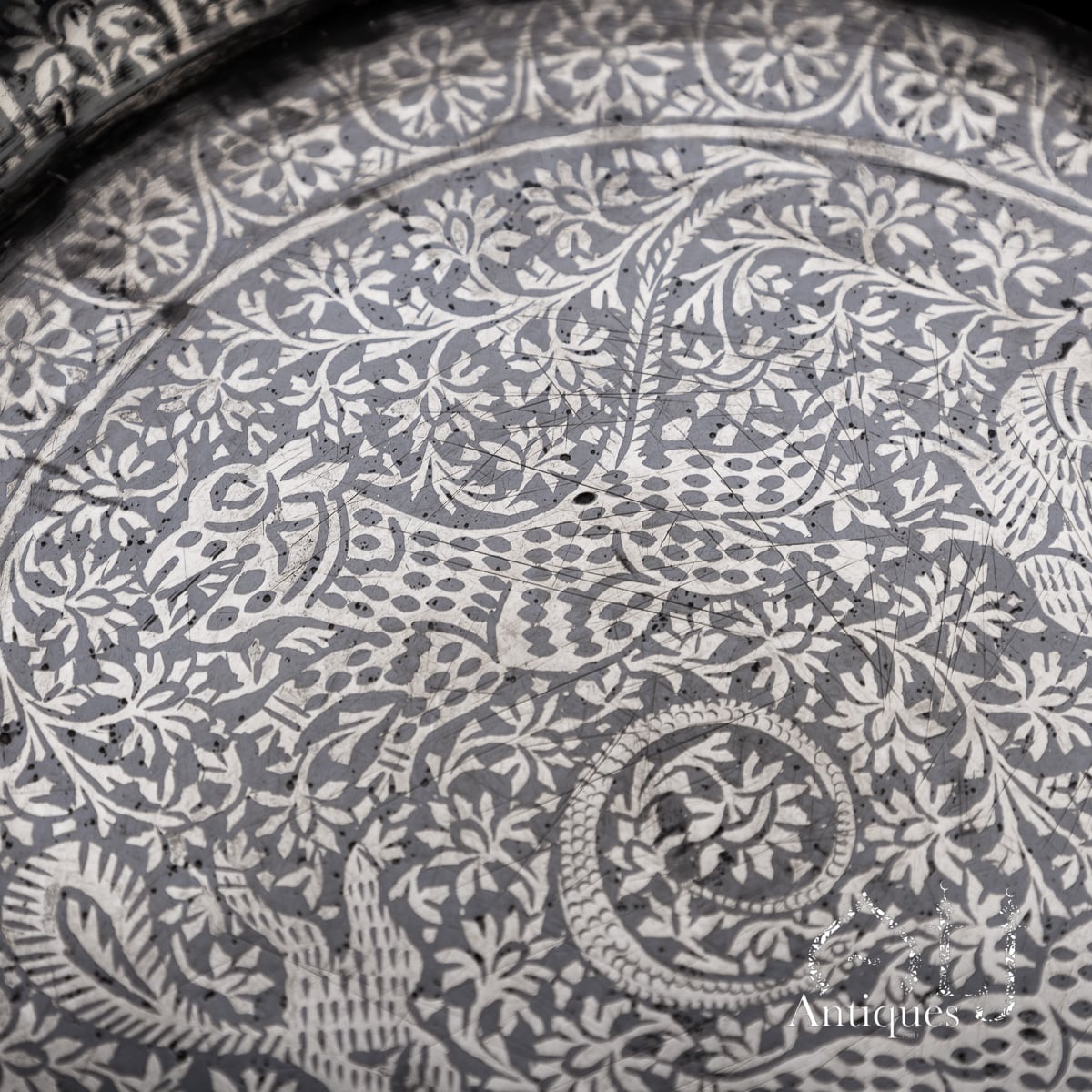
The accompanying circular trays feature scalloped rims and radiating registers of floral motifs arranged around central animal medallions, again depicting hunting scenes with tigers and possibly hyenas pursuing a deer. These compositions recall Bidri trays (thali) produced in Bidar, Deccan, during the 17th century (see Mark Zebrowski, Gold, Silver & Bronze from Mughal India, 1997, cat. nos. 422, 428, and 441). The striking contrast between the shimmering silver surface and the dark niello ground strongly aligns this group with Bidriware aesthetics, though here executed entirely in silver, creating a luxurious reinterpretation of a celebrated Deccani decorative idiom.
Antique Indian nielloed silverware is exceptionally rare, with only a small number of surviving examples. For this reason, the technique is often described as a “lost” art of Indian silver nielloware. Production ceased at an unknown date, and the precise locations of manufacture remain uncertain, especially when compared with other inlaid metal techniques such as durable champlevé and opaque enamelling, or more fragile decorative materials like lac. As a result, the present ensemble raises important questions regarding its precise origin.
The beakers shape and certain decorative features bear resemblance to Kashmiri metalwork, which typically emphasises floral and geometric ornamentation. At the same time, the vitality of the animal scenes and the intricacy of the vegetal scrollwork are also reminiscent of Lucknow or Awadhi works in precious and semi-precious metals. Nevertheless, the overall stylistic coherence and vessel forms strongly echo Bidri silver-inlaid zinc wares. The affinity with Bidri production, combined with the unconventional use of pure silver niello, supports an attribution to the Deccan Sultanates—specifically Hyderabad or Golconda—where craftsmen were known to adapt Bidri idioms into luxurious forms intended for elite patrons.
Simultaneously, the dynamic hunting imagery—leopards, deer, birds, and predators in pursuit—reflects the naturalistic aesthetic favoured at the Mughal court from the late 17th century onward. Regardless of the precise silversmithing centre, this ensemble exemplifies the sophisticated metalworking traditions that flourished across Mughal and Deccani territories during the 18th century. This period was characterised by strong regional mobility of artisans and the circulation of shared artistic vocabularies (see C. Terlinden, Mughal Silver Magnificence, XVI–XIX Centuries, 1987, pp. 21–24). The present set speaks to a cosmopolitan metalworking culture in which Deccani technical virtuosity, Mughal iconography, and local adaptation converged to produce hybrid works of exceptional aesthetic harmony.
Acknowledgment
The above text and literature were produced with the valued collaboration of Ms. B. C. (with thanks).